Facts about Kosovo
Explore Kosovo from Pristina and Prizren to the Rugova gorge, medieval monasteries and the Sharr Mountains. Learn seven statistical regions, place sixteen cities and towns, follow rivers and find a lake, discover sixteen sights, read ten illustrated topics and begin Albanian or Serbian.
- Capital
- Pristina / Prishtina / Priština
- Area
- About 10,900 km²
- Official languages
- Albanian and Serbian
- Currency
- Euro (€)
- Independence declared
- 17 February 2008
- Geographic setting
- Landlocked Balkans
Kosovo · 0 of 20 rounds passed
Two timed rounds per topic, 20 seconds a question
Kosovo lies in the Balkan interior between mountain rims and two broad basins. Pristina anchors the east-central plain, Prizren opens onto the southern Sharr landscape, and Peja/Peć is the gateway to Rugova in the west. Gjakova, Ferizaj, Gjilan and Mitrovica introduce different urban histories. Albanian and Serbian names often identify the same place.
This guide follows Kosovo’s geographic outline for learning. Its 2008 declaration of independence is recognised by many states but remains disputed by Serbia and others. Seven statistical regions, sixteen settlement pins and selected waters connect the landscape with history, institutions and everyday life alongside sixteen sights and ten illustrated topics. Albanian and Serbian lessons offer two ways into its multilingual setting.
Plains and mountain rims in the Balkans
Kosovo is landlocked in southeastern Europe, bordered by Albania, Montenegro, Serbia and North Macedonia. The Kosovo Plain lies in the east, while a broad western basin is often called Dukagjin in Albanian and Metohija in Serbian. These names carry different historical and cultural associations. Pristina, also written Prishtina or Priština, is the capital; Prizren sits below the southern mountains, and Peja, also called Peć, stands at the mouth of Rugova gorge.
- Does Kosovo have a coastline?
- No. Kosovo is landlocked in the interior of the Balkans.
- Which places border Kosovo?
- Albania, Montenegro, Serbia and North Macedonia.
- Where do Kosovo’s rivers drain?
- The White Drin leads towards the Adriatic, the Ibar system towards the Black Sea, and the Lepenac towards the Aegean.
More about Kosovo: geography
Kosovo is landlocked in southeastern Europe, bordered by Albania, Montenegro, Serbia and North Macedonia. The Kosovo Plain lies in the east, while a broad western basin is often called Dukagjin in Albanian and Metohija in Serbian. These names carry different historical and cultural associations. Pristina, also written Prishtina or Priština, is the capital; Prizren sits below the southern mountains, and Peja, also called Peć, stands at the mouth of Rugova gorge.
The Sharr Mountains form much of the southern mountain rim, while the Accursed Mountains rise in the west. The White Drin drains much of the western basin towards the Adriatic through Albania. The Sitnica joins the Ibar, whose waters reach the Danube and Black Sea; the Lepenac drains south towards the Vardar and Aegean. Mountain divides therefore connect a compact territory with three different seas. The city game marks settlement centres, rather than municipal areas or administrative seats of equal rank.
Medieval heritage, Yugoslavia and the 2008 declaration
The ancient region of Dardania became part of the Roman world; Ulpiana preserves an important archaeological site near modern Pristina. Medieval Serbian rulers founded monasteries whose architecture and frescoes remain central to Serbian Orthodox heritage. The Battle of Kosovo in 1389 holds a major place in Serbian historical memory. Ottoman rule developed over the following decades and lasted until the Balkan Wars of 1912–13. Prizren’s 1878 League of Prizren became an important organisation in the Albanian national movement.
- When did Kosovo declare independence?
- On 17 February 2008. The declaration did not produce universal international recognition.
- What happened in Kosovo in 1999?
- NATO intervened during the 1998–99 war, and Resolution 1244 established an international civil and security presence.
- What was the League of Prizren?
- An organisation founded in 1878 that became important in the Albanian national movement.
More about Kosovo: history
The ancient region of Dardania became part of the Roman world; Ulpiana preserves an important archaeological site near modern Pristina. Medieval Serbian rulers founded monasteries whose architecture and frescoes remain central to Serbian Orthodox heritage. The Battle of Kosovo in 1389 holds a major place in Serbian historical memory. Ottoman rule developed over the following decades and lasted until the Balkan Wars of 1912–13. Prizren’s 1878 League of Prizren became an important organisation in the Albanian national movement.
Kosovo became an autonomous province within Serbia in socialist Yugoslavia. The curtailment of autonomy in 1989 was followed by repression, parallel Albanian institutions and a period of nonviolent resistance. The 1998–99 war brought killings and mass displacement. NATO intervened in 1999, and UN Security Council Resolution 1244 established an international civil and security presence. Kosovo declared independence on 17 February 2008. Many states recognise it, while Serbia and others do not; the declaration and its international recognition are distinct questions.
Albanian and Serbian, with several local languages
Albanian and Serbian are official languages under Kosovo’s constitutional framework. Turkish, Bosnian and Romani have official status at municipal level or official use as provided by law. Albanian belongs to its own branch of the Indo-European language family, while Serbian is South Slavic. Gheg varieties predominate in spoken Albanian in Kosovo; standard written Albanian draws mainly on Tosk. Everyday speech and the language of a textbook can therefore sound different.
- What are Kosovo’s official languages?
- Albanian and Serbian. Other languages have municipal-level status or official use under the law.
- Are Albanian and Serbian related closely enough to be mutually intelligible?
- No. Albanian forms its own Indo-European branch, while Serbian is South Slavic.
- Why does Peja also appear as Peć?
- Peja is the Albanian name and Peć the Serbian name of the same city. Multiple name forms are common across Kosovo.
More about Kosovo: language
Albanian and Serbian are official languages under Kosovo’s constitutional framework. Turkish, Bosnian and Romani have official status at municipal level or official use as provided by law. Albanian belongs to its own branch of the Indo-European language family, while Serbian is South Slavic. Gheg varieties predominate in spoken Albanian in Kosovo; standard written Albanian draws mainly on Tosk. Everyday speech and the language of a textbook can therefore sound different.
Albanian uses a Latin alphabet; Serbian uses both Cyrillic and Latin. Përshëndetje and dobar dan offer greetings in Albanian and Serbian, while faleminderit and hvala mean thank you. Place names often have several forms: Peja/Peć, Ferizaj/Uroševac and Gjilan/Gnjilane are examples. Worldly links to separate Albanian and Serbian lessons. Roma, Ashkali and Egyptian communities have distinct identities and language practices; they should not be assigned a single mother tongue as a group.
Prizren’s cinema, craft workshops and living traditions
Prizren’s DokuFest brings documentary and short films into cinemas and outdoor venues, including spaces beside the river. Filigree workshops work fine silver wire into intricate jewellery, while the white felt cap known as a plis and the two-stringed çifteli connect with Albanian traditions. Traditions differ by community and generation: a costume or instrument is an introduction to one practice, rather than a description of everyone’s life.
- What is DokuFest?
- An international documentary and short film festival held in Prizren.
- What is a plis?
- A traditional white felt cap associated with Albanian dress.
- What is Prizren filigree?
- Intricate ornamental work made by shaping fine metal wire, especially silver, into jewellery and other objects.
More about Kosovo: culture
Prizren’s DokuFest brings documentary and short films into cinemas and outdoor venues, including spaces beside the river. Filigree workshops work fine silver wire into intricate jewellery, while the white felt cap known as a plis and the two-stringed çifteli connect with Albanian traditions. Traditions differ by community and generation: a costume or instrument is an introduction to one practice, rather than a description of everyone’s life.
Serbian Orthodox monasteries, Ottoman mosques, Catholic churches and local neighbourhoods preserve overlapping layers of cultural history. Pristina adds theatre, galleries, contemporary music and a strong café culture. The Neolithic figurine known as the Goddess on the Throne has become a symbol of the city. The League of Prizren complex introduces the Albanian national movement; monastery frescoes introduce a different strand of heritage. These places can be studied together without treating their histories or religious meanings as interchangeable.
Services, diaspora links and an adopted euro
Services, trade, construction and agriculture all contribute to Kosovo’s economy. Pristina concentrates public administration, higher education and many service businesses, while small enterprises and food production connect towns with the countryside. Vineyards around Rahovec/Orahovac are one regional specialism. Remittances from a large diaspora support household incomes and spending; migration also affects the supply of skills and the lives of families at home.
- Does using the euro make Kosovo an EU member?
- No. Kosovo uses the euro without a formal monetary agreement and is not an EU or euro-area member.
- Why are diaspora connections important to Kosovo’s economy?
- Remittances and family networks link household incomes, investment and migration with communities abroad.
- What is Trepča known for?
- Mining and metallurgy, historically centred on lead, zinc and associated metals in the Mitrovica area.
More about Kosovo: economy
Services, trade, construction and agriculture all contribute to Kosovo’s economy. Pristina concentrates public administration, higher education and many service businesses, while small enterprises and food production connect towns with the countryside. Vineyards around Rahovec/Orahovac are one regional specialism. Remittances from a large diaspora support household incomes and spending; migration also affects the supply of skills and the lives of families at home.
Kosovo uses the euro without a formal monetary agreement with the European Union. Euro use does not make it a member of the EU or the euro area. Lignite-fired generation around Obiliq/Obilić has supplied much of its electricity, creating difficult questions about air pollution, reliability and the energy transition. The Trepča mining and metallurgy complex is associated with the Mitrovica area. Jobs, investment and economic opportunity vary by location, so an old national estimate should not be substituted for a current labour-market measure.
Parliamentary institutions and disputed recognition
Kosovo’s institutions operate as a parliamentary republic under the 2008 constitution. The Assembly has 120 seats, including twenty guaranteed for non-majority communities: ten for the Kosovo Serb community and ten for other communities. The president is head of state, while the prime minister leads the government. Constitutional arrangements for representation are separate from the population shares recorded by a census.
- Is Kosovo universally recognised as independent?
- No. Many states recognise Kosovo, while Serbia and others do not; Kosovo is not a United Nations member.
- How many seats does Kosovo’s Assembly have?
- 120, including twenty constitutionally guaranteed for non-majority communities.
- Did the ICJ require states to recognise Kosovo?
- No. Its 2010 advisory opinion addressed whether the declaration violated international law, not an obligation on other states to recognise it.
More about Kosovo: politics
Kosovo’s institutions operate as a parliamentary republic under the 2008 constitution. The Assembly has 120 seats, including twenty guaranteed for non-majority communities: ten for the Kosovo Serb community and ten for other communities. The president is head of state, while the prime minister leads the government. Constitutional arrangements for representation are separate from the population shares recorded by a census.
Kosovo’s international status remains disputed. Many states recognise its independence; Serbia and others do not, and Kosovo is not a United Nations member. UNMIK was established under Security Council Resolution 1244 in 1999; NATO’s KFOR and the EU’s EULEX have different mandates. The EU facilitates a Belgrade–Pristina dialogue on normalisation. In 2010 the International Court of Justice concluded that the 2008 declaration did not violate international law; its advisory opinion did not require other states to recognise Kosovo.
Rugova’s gorge, Sharr pastures and river cascades
Bjeshkët e Nemuna, part of the Accursed Mountains in the west, contains steep valleys, forests and high pastures. Rugova gorge cuts into the mountains west of Peja/Peć. The Sharr Mountains in the south extend across modern borders, with alpine habitats above wooded slopes. Brown bears and other large mammals inhabit suitable forest areas. Seeing a species on a habitat list does not imply it can reliably be observed from a particular trail.
- Where is Rugova gorge?
- In western Kosovo, immediately west of Peja/Peć, in the Accursed Mountains landscape.
- What are the Mirusha Waterfalls?
- A series of river cascades and pools in a limestone gorge.
- Is Bear Sanctuary Prishtina a wild bear habitat?
- It is a sanctuary caring for rescued bears, distinct from an unmanaged wild habitat.
More about Kosovo: nature & wildlife
Bjeshkët e Nemuna, part of the Accursed Mountains in the west, contains steep valleys, forests and high pastures. Rugova gorge cuts into the mountains west of Peja/Peć. The Sharr Mountains in the south extend across modern borders, with alpine habitats above wooded slopes. Brown bears and other large mammals inhabit suitable forest areas. Seeing a species on a habitat list does not imply it can reliably be observed from a particular trail.
The Mirusha river forms cascades and linked pools in a limestone gorge. The White Drin spring and nearby waterfall offer another introduction to western waters, while Gadime Cave reveals formations below ground. Near Pristina, Gërmia is an accessible wooded landscape and Bear Sanctuary Prishtina cares for rescued bears. A sanctuary is distinct from a wild habitat. Landscape pins are reference locations; weather, visitor rules and seasonal access determine how a place can actually be explored.
Flija, filled pastries and shared Balkan tables
Flija, also written flia, is made by gradually cooking layers of batter, traditionally under a heated metal lid called a saç. It takes time and is often associated with shared meals. Pite and byrek include filled pastries with ingredients such as cheese, greens or meat. Qebapa are small grilled minced-meat rolls; peppers, bread, dairy products and seasonal vegetables accompany many meals. Local recipes form part of a culinary world shared across the Balkans.
- What is flija?
- A dish built gradually from layers of batter, traditionally cooked under a heated metal lid called a saç.
- What are qebapa?
- Small grilled minced-meat rolls, often served with bread and accompaniments.
- Are Kosovo’s familiar dishes found elsewhere?
- Yes. Filled pastries, grilled meats, baklava and other dishes connect Kosovo with wider Balkan and Ottoman culinary traditions.
More about Kosovo: food & cuisine
Flija, also written flia, is made by gradually cooking layers of batter, traditionally under a heated metal lid called a saç. It takes time and is often associated with shared meals. Pite and byrek include filled pastries with ingredients such as cheese, greens or meat. Qebapa are small grilled minced-meat rolls; peppers, bread, dairy products and seasonal vegetables accompany many meals. Local recipes form part of a culinary world shared across the Balkans.
Baklava and other syrup-soaked sweets reflect Ottoman connections. Black tea is commonly served in small glasses, and coffee, including macchiato, is part of urban café life. Ayran is a salted yoghurt drink, while ajvar is a pepper-based relish. Food habits vary with household, faith, region and personal preference. A dish can be strongly associated with Kosovo while also belonging to neighbouring cuisines; cultural connections do not require assigning an exclusive national origin.
Monasteries, Ottoman streets and modern architecture
UNESCO’s Medieval Monuments in Kosovo property comprises four Serbian Orthodox sites: Visoki Dečani, the Patriarchate of Peć, Gračanica and the Church of the Virgin of Ljeviša in Prizren. Their churches and frescoes preserve major achievements of medieval religious art. The property is listed by UNESCO under Serbia, reflecting UNESCO’s institutional framework; that listing is distinct from a resolution of Kosovo’s political status. These remain sacred places with their own visiting arrangements.
- Which sites make up UNESCO’s Medieval Monuments in Kosovo?
- Visoki Dečani, the Patriarchate of Peć, Gračanica and the Church of the Virgin of Ljeviša.
- What is NEWBORN in Pristina?
- A public artwork unveiled on the day of Kosovo’s 2008 declaration of independence, with changing visual designs.
- What is Ulpiana?
- An ancient Roman and late antique urban site near Gračanica, southeast of Pristina.
More about Kosovo: landmarks
UNESCO’s Medieval Monuments in Kosovo property comprises four Serbian Orthodox sites: Visoki Dečani, the Patriarchate of Peć, Gračanica and the Church of the Virgin of Ljeviša in Prizren. Their churches and frescoes preserve major achievements of medieval religious art. The property is listed by UNESCO under Serbia, reflecting UNESCO’s institutional framework; that listing is distinct from a resolution of Kosovo’s political status. These remain sacred places with their own visiting arrangements.
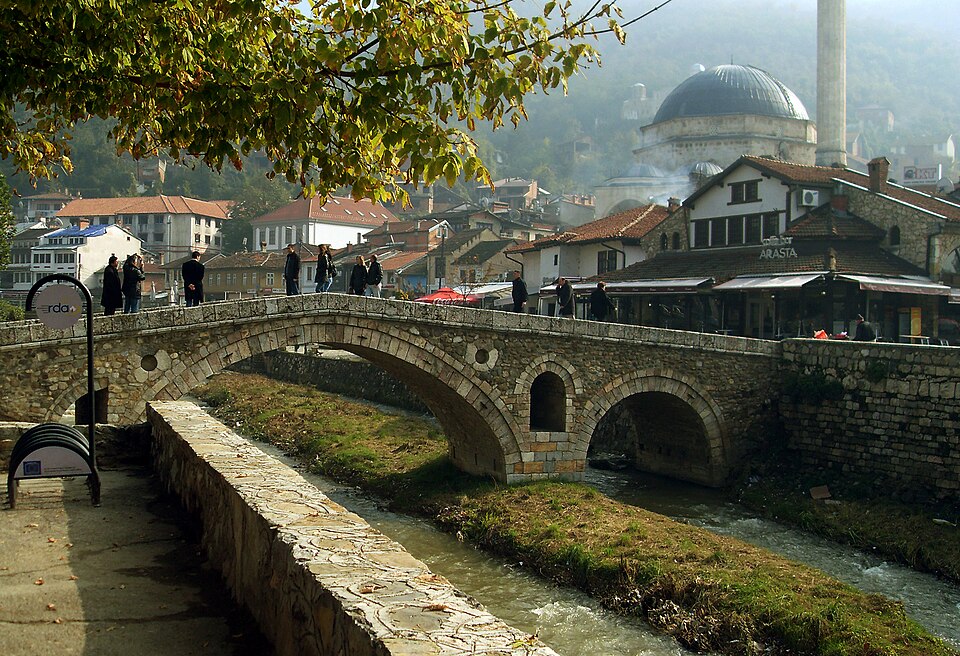
Prizren’s fortress overlooks the old town, the stone bridge and Sinan Pasha Mosque. In Gjakova/Đakovica, the Grand Bazaar connects craft and trade with a history of destruction and rebuilding. Ulpiana preserves ancient urban remains near Gračanica. Pristina’s National Library, designed by Andrija Mutnjaković, brings a striking twentieth-century architectural language to the guide; NEWBORN marks the 2008 independence declaration through public art. Ancient ruins, active religious sites and modern monuments ask different questions of a visitor.
Many communities and connections across borders
Albanians form the majority population. Serb, Bosniak, Turkish, Roma, Ashkali, Egyptian, Gorani and other communities also belong to Kosovo’s social landscape. Ethnicity, language, religious practice and citizenship are different aspects of identity. Muslim, Orthodox Christian and Catholic traditions are present, alongside other beliefs and secular lives. Census participation and coverage matter, particularly in Serb-majority areas; a single undated population percentage can conceal those limits.
- Which communities live in Kosovo?
- Albanians are the majority; Serb, Bosniak, Turkish, Roma, Ashkali, Egyptian, Gorani and other communities also live there.
- Who won Kosovo’s first Olympic gold medal?
- Majlinda Kelmendi, in women’s judo at Rio 2016.
- Was Dua Lipa born in Kosovo?
- No. She was born in London to Kosovo Albanian parents; Rita Ora was born in Pristina.
More about Kosovo: people & society
Albanians form the majority population. Serb, Bosniak, Turkish, Roma, Ashkali, Egyptian, Gorani and other communities also belong to Kosovo’s social landscape. Ethnicity, language, religious practice and citizenship are different aspects of identity. Muslim, Orthodox Christian and Catholic traditions are present, alongside other beliefs and secular lives. Census participation and coverage matter, particularly in Serb-majority areas; a single undated population percentage can conceal those limits.
Diaspora families maintain strong connections with Germany, Switzerland and other destinations. Music and sport bring some of those connections into public view: Rita Ora was born in Pristina, while Dua Lipa was born in London to Kosovo Albanian parents. Judoka Majlinda Kelmendi won Kosovo’s first Olympic gold medal at Rio 2016. Everyday life extends well beyond famous names, through neighbourhoods, schools, farming, businesses and family networks in both towns and rural communities.