Facts about Andorra
Andorra’s seven parishes follow Pyrenean valleys between France and Spain. Romanesque churches stand beside ski routes, shopping streets and high mountain pastures. Locate the seven parish centres, discover twelve sights, explore ten illustrated topics and begin Catalan.
- Capital
- Andorra la Vella
- Area
- 468 km²
- Parishes
- 7
- Official language
- Catalan
- Currency
- Euro (€)
- Highest summit
- Comapedrosa · 2,942 m
Andorra · 0 of 20 rounds passed
Two timed rounds per topic, 20 seconds a question
Andorra la Vella and neighbouring Escaldes-Engordany form the main urban area in the south-central valley. Upstream, the eastern branch of the Valira leads through Encamp and Canillo towards the French frontier. The northern branch connects La Massana with Ordino. Sant Julià de Lòria lies downstream towards Spain. These seven names identify both parishes and their main settlements; a parish includes surrounding villages and mountains as well as its centre.
Comapedrosa, in the northwest, is the highest summit at 2,942 metres. The Madriu-Perafita-Claror Valley preserves a working mountain landscape southeast of the capital. Winter sports, summer walking and Romanesque architecture offer different ways into the country. The map round marks parish centres rather than parish boundaries, and the dated national outline is a geographic reference. Andorra la Vella and Escaldes-Engordany are close together: zoom in to separate their pins.
Geography of Andorra
Seven parishes and two branches of the Valira connect a country of mountain valleys.
- Which countries border Andorra?
- France and Spain. Andorra is landlocked in the eastern Pyrenees.
- How many parishes does Andorra have?
- Seven. The map round marks their main settlements rather than their boundaries.
- What is Andorra’s highest mountain?
- Comapedrosa, at 2,942 metres, in the northwest near Arinsal.
More about Andorra: geography
Andorra is landlocked in the eastern Pyrenees, with France to the north and Spain to the south. Its 468 square kilometres contain steep ridges, glacial basins and narrow valley floors. The Valira del Nord and Valira d’Orient meet at Escaldes-Engordany; the combined Gran Valira flows past Andorra la Vella and Sant Julià de Lòria towards Spain. Comapedrosa reaches 2,942 metres in the northwest.
The seven parishes are Canillo, Encamp, Ordino, La Massana, Andorra la Vella, Sant Julià de Lòria and Escaldes-Engordany. Settlement concentrates in the valleys, leaving high slopes for forests, pasture and recreation. Pas de la Casa belongs to Encamp parish near the French border. Port d’Envalira is the high road pass; the Envalira tunnel offers a separate route beneath it. Andorra has no railway or commercial airport within its borders.
History of Andorra
Medieval shared lordship developed into a constitutional parliamentary co-principality.
- What happened in 1278?
- The paréage established shared authority between the bishop of Urgell and the count of Foix, the medieval foundation of the co-principality.
- When did Andorra adopt its modern constitution?
- Voters approved it on 14 March 1993. Andorra joined the United Nations in July that year.
- Was Andorra at war with Germany until 1958?
- The often-repeated story lacks reliable documentary support and should not be presented as established history.
More about Andorra: history
The paréage of 1278 settled shared authority between the bishop of Urgell and the count of Foix. It is the medieval foundation of the co-principality, rather than a modern democratic constitution. The French side of that inheritance eventually passed to the president of France. The Consell de la Terra, established in 1419, was an important predecessor of the present parliament. Casa de la Vall became its meeting place in 1702.
Andorra’s modern constitution was approved by referendum on 14 March 1993, establishing the present framework of rights, institutions and parliamentary government. The country joined the United Nations later that year and the Council of Europe in 1994. Roads, migration and tourism transformed the twentieth-century economy. Escaldes-Engordany became the seventh parish in 1978. Stories about Andorra remaining at war with Germany until 1958 lack reliable documentary support and should not be taught as settled history.
Language of Andorra
Catalan is official in a multilingual society with Spanish, Portuguese and French speakers.
- What is Andorra’s official language?
- Catalan is the sole official language. Spanish, Portuguese and French are also used in daily life.
- Is Catalan a dialect of Spanish?
- No. Catalan is a distinct Romance language with its own grammar and literary tradition.
- What do bon dia and gràcies mean?
- Bon dia means good morning or good day; gràcies means thank you. The lessons introduce general Catalan.
More about Andorra: language
Catalan is Andorra’s sole official language under the constitution. It is a Romance language with its own grammar and literary tradition, not a dialect of Spanish. Andorran speech belongs broadly to the northwestern Catalan area, while formal writing uses standard Catalan. Public signs, government documents and local place names make the language visible even where several languages are heard in the same street.
Spanish, Portuguese and French are important in everyday life, reflecting migration, neighbouring countries and tourism. Language use does not identify a person’s nationality or place of birth. The linked Catalan lessons introduce useful forms such as bon dia for good morning, gràcies for thank you and si us plau for please. They teach general Catalan rather than claiming to reproduce every local pronunciation or expression.
Culture of Andorra
Meritxell celebrations, parish festivals and summer fire traditions give the calendar its rhythm.
- When is Andorra’s National Day?
- 8 September, the feast of Our Lady of Meritxell, the country’s patroness.
- Are the Pyrenean fire festivals a World Heritage site?
- They are UNESCO intangible cultural heritage, a separate category from World Heritage sites such as the Madriu valley.
- What is on Andorra’s coat of arms?
- A bishop’s mitre and crozier, the bars associated with Foix and Catalonia, and two cows representing Béarn. It does not depict a chamois.
More about Andorra: culture
National Day falls on 8 September, the feast of Our Lady of Meritxell, Andorra’s patroness. The sanctuary in Canillo parish combines the old chapel with Ricardo Bofill’s modern complex, built after a fire in 1972. Parish festivals, music and traditional dances such as the contrapàs connect public squares with local community life. Romanesque churches are small in scale but central to the country’s architectural heritage.
Summer solstice fire festivals in the Pyrenees are recognised by UNESCO as intangible cultural heritage shared by communities in Andorra, France and Spain. That recognition is separate from the World Heritage listing of the Madriu valley. Museums explore rural households, ironworking, transport and art, while winter skiing and cycling events bring an international sporting audience. Andorra’s flag has vertical blue, yellow and red bands with the national coat of arms.
Economy of Andorra
Tourism, shops and financial services support an economy connected to its neighbours.
- Does Andorra have income tax?
- Yes. Personal income tax and the general indirect tax, IGI, are part of its tax system. “Tax-free country” is misleading.
- Does using the euro make Andorra an EU member?
- No. It uses the euro under a monetary agreement with the EU but remains outside the union.
- What supports Andorra’s economy?
- Tourism, retail, banking and other services are important. Winter skiing and summer mountain activities bring different visitor seasons.
More about Andorra: economy
Tourism, retail and financial services are major parts of Andorra’s service economy. Skiing brings winter visitors, while walking, cycling and mountain scenery support summer travel. Shopping is prominent in Andorra la Vella, Escaldes-Engordany and Pas de la Casa. Farming and livestock helped shape the historic landscape, although the modern economy is much broader than mountain agriculture.
Andorra uses the euro under a monetary agreement with the European Union but is not an EU member. Its customs union with the EU covers industrial products; agricultural products have different arrangements. The country has personal income tax and a general indirect tax called IGI. Describing everything as tax-free is inaccurate, and purchases remain subject to travellers’ customs allowances when carried across a border. Visitor totals also distinguish overnight tourists from same-day visitors.
Politics of Andorra
Two constitutional heads of state coexist with an elected parliament and head of government.
- Who are Andorra’s two co-princes?
- The president of France and the bishop of Urgell. They are constitutional heads of state, while a separate head of government leads the executive.
- How many members sit in the Consell General?
- Twenty-eight: fourteen elected nationally and fourteen through the seven parishes.
- Is Andorra in Schengen?
- No. Entry normally takes place through France or Spain, so travellers must also consider the conditions for returning to the Schengen area.
More about Andorra: politics
Andorra is a parliamentary co-principality. The president of France and the bishop of Urgell hold the two co-prince offices; the bishop’s see is in La Seu d’Urgell in Spain. These are constitutional heads of state. The Consell General is a unicameral parliament with twenty-eight members, fourteen elected nationally and fourteen through the seven parishes. Parliament elects the cap de Govern, or head of government.
Each parish has a local administration called a comú. The national government conducts foreign policy, and Andorra is a sovereign member of the UN and Council of Europe. Neither the co-princes nor close relations with France and Spain make it part of either neighbour. Euro use does not imply EU membership, and Andorra is not a Schengen member. Entry normally takes place through France or Spain, so travellers must consider the rules for returning to those countries.
Nature & Wildlife of Andorra
Glacial lakes, mountain pine forests and high pastures show the effects of altitude and land use.
- Why is the Madriu valley UNESCO-listed?
- It is a cultural landscape showing how people used the mountains through grazing, paths, stone buildings and ironworking. It was inscribed in 2004.
- What is an isard?
- The Catalan name used locally for the Pyrenean chamois, an animal associated with high mountain habitats.
- Are Sorteny, Comapedrosa and Ordino the same protected area?
- No. Sorteny and Comapedrosa are separate natural parks; Ordino parish has UNESCO biosphere reserve status.
More about Andorra: nature & wildlife
Andorra’s habitats change sharply with elevation. Lower valleys support settlements and broadleaf woods; higher slopes have mountain pine forests, meadows, scree and rocky summits. Chamois, locally called isards, are associated with the high mountains, alongside marmots and birds of prey. Winter snow and summer storms can change mountain conditions quickly. A summit pin marks a geographic feature rather than a suggested route.
UNESCO inscribed the Madriu-Perafita-Claror Valley in 2004 as a cultural landscape, recognising the relationship between people and the mountains. Paths, dry-stone huts, grazing land and ironworking remains are part of that heritage. Comapedrosa and Sorteny have distinct natural parks, while the Ordino parish is a UNESCO biosphere reserve. These designations serve different purposes and should not be treated as interchangeable World Heritage sites.
Food & Cuisine of Andorra
Escudella, trinxat and converted stone bordes connect food with mountain life.
- What is escudella?
- A substantial soup or stew with meat, vegetables and other ingredients that vary by recipe, shared with neighbouring Catalan food traditions.
- What is trinxat?
- A dish combining cabbage and potatoes, commonly with pork or bacon.
- What is a borda?
- A traditional rural building used for agricultural storage or livestock. Many have been converted into restaurants.
More about Andorra: food & cuisine
Escudella is a substantial soup or stew made with meat, vegetables and other ingredients that vary by recipe. Trinxat combines cabbage and potatoes, commonly with pork or bacon. Grilled meats, mushrooms, trout and cured sausages also appear in mountain cooking. These dishes connect Andorra with Catalan and neighbouring Pyrenean traditions rather than forming a cuisine isolated by the border.
A borda was a rural building used for agricultural storage or livestock; many have been converted into restaurants. Coca refers to a family of sweet or savoury flatbreads and pastries, and ratafia is a liqueur associated with herbs, fruit or nuts. The topic photograph shows escudella in Barcelona, illustrating a shared dish rather than an Andorran restaurant. Food traditions vary between households, seasons and modern menus.
Landmarks of Andorra
A former parliament house, Romanesque churches and modern thermal architecture.
- Is Casa de la Vall still the ordinary seat of parliament?
- It is the historic parliamentary house. Ordinary parliamentary work moved to a new building in 2011.
- Are Andorra’s Romanesque churches UNESCO World Heritage sites?
- They are important monuments but are not individually inscribed. Andorra’s inscribed World Heritage property is the Madriu-Perafita-Claror Valley.
- What is Caldea?
- A modern thermal spa complex in Escaldes-Engordany, beside Andorra la Vella.
More about Andorra: landmarks
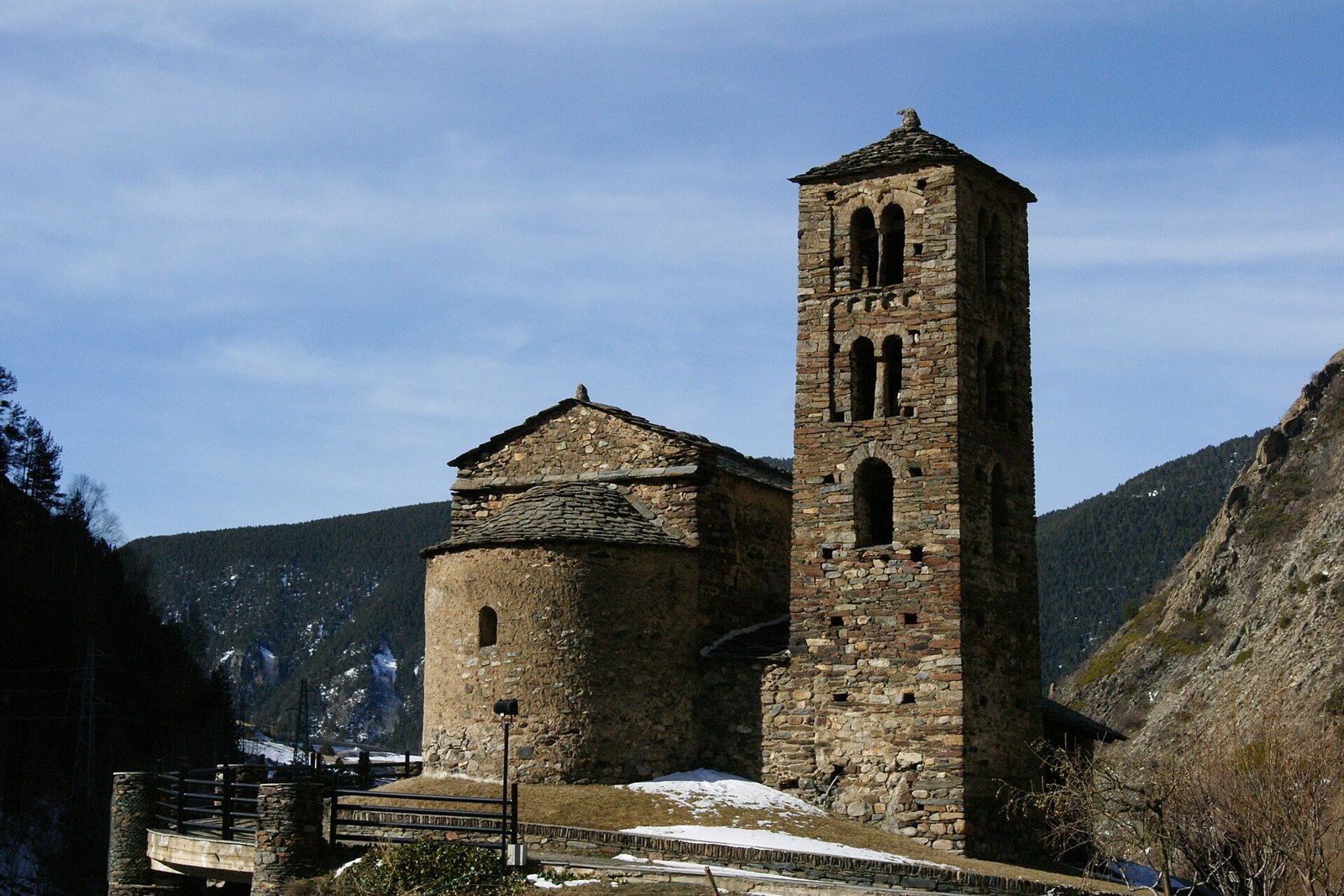
Casa de la Vall stands in Andorra la Vella’s old quarter. Built as a family house in 1580, it became the parliamentary seat in 1702; ordinary parliamentary work moved to a new building in 2011. Sant Joan de Caselles near Canillo has a distinctive detached bell tower, while Santa Coloma near the capital is known for its round tower. These churches are important monuments, but they are not individually inscribed UNESCO World Heritage sites.
The Meritxell sanctuary, the medieval Pont de la Margineda and Ordino’s historic centre tell other parts of the country’s story. Caldea in Escaldes-Engordany is a modern thermal spa, not a medieval church or a natural lake. Lake Engolasters has been modified for hydroelectric use. The twelve sight pins are learning locations: large valleys and peaks use representative points, and venue access and mountain conditions need separate planning.
People & Society of Andorra
Valley communities bring together Andorran citizens and residents from many countries.
- Are Andorran residents all Andorran citizens?
- No. Residence, nationality, birthplace and language are different categories. The country includes substantial Spanish, Portuguese, French and other communities.
- When did Andorra first compete at the Olympics?
- In 1976, in both the Summer and Winter Games.
- Is Escaldes-Engordany part of Andorra la Vella parish?
- It is a separate parish, created in 1978. Their main settlements form a continuous urban area.
More about Andorra: people & society
Andorra’s population includes Andorran citizens and substantial communities with roots in Spain, Portugal, France and elsewhere. Nationality, birthplace, home language and permission to reside are different categories. They should not be collapsed into a percentage of “native Andorrans”. The main urban area spans Andorra la Vella and Escaldes-Engordany, while parish identity remains important in smaller settlements.
Andorran writer Albert Salvadó worked in Catalan, and diplomat and writer Antoni Morell was closely associated with the country’s cultural life. Canoeist Mònica Doria has represented Andorra at the Olympics; the country first competed in the Summer and Winter Games in 1976. Skiing and football also have strong club and national-team identities. Famous foreign athletes who live in Andorra are residents, which does not automatically make them Andorran citizens.