Facts about Czech Republic
Capital Prague · Europe
10 topics · 20 lessons · about 20 minutes
Czechia is a landlocked country in central Europe made up of the historic lands of Bohemia, Moravia and Czech Silesia, ringed by low mountains that give it unusually clean natural borders. It emerged from the peaceful split of Czechoslovakia in 1993 and has since become one of the most industrialised economies in the European Union, with Prague among the most visited cities on the continent.
Bohemia in the west is a basin enclosed by ranges on almost every side, the Krušné hory toward Germany, the Šumava along the Bavarian and Austrian border, and the Krkonoše in the northeast where Sněžka reaches 1,603 meters. Moravia in the east is lower and opens toward the Danube basin, which is why the Moravian Gate has served as a trade route since prehistory. The Elbe and Vltava drain north to the North Sea, the Morava south to the Danube.
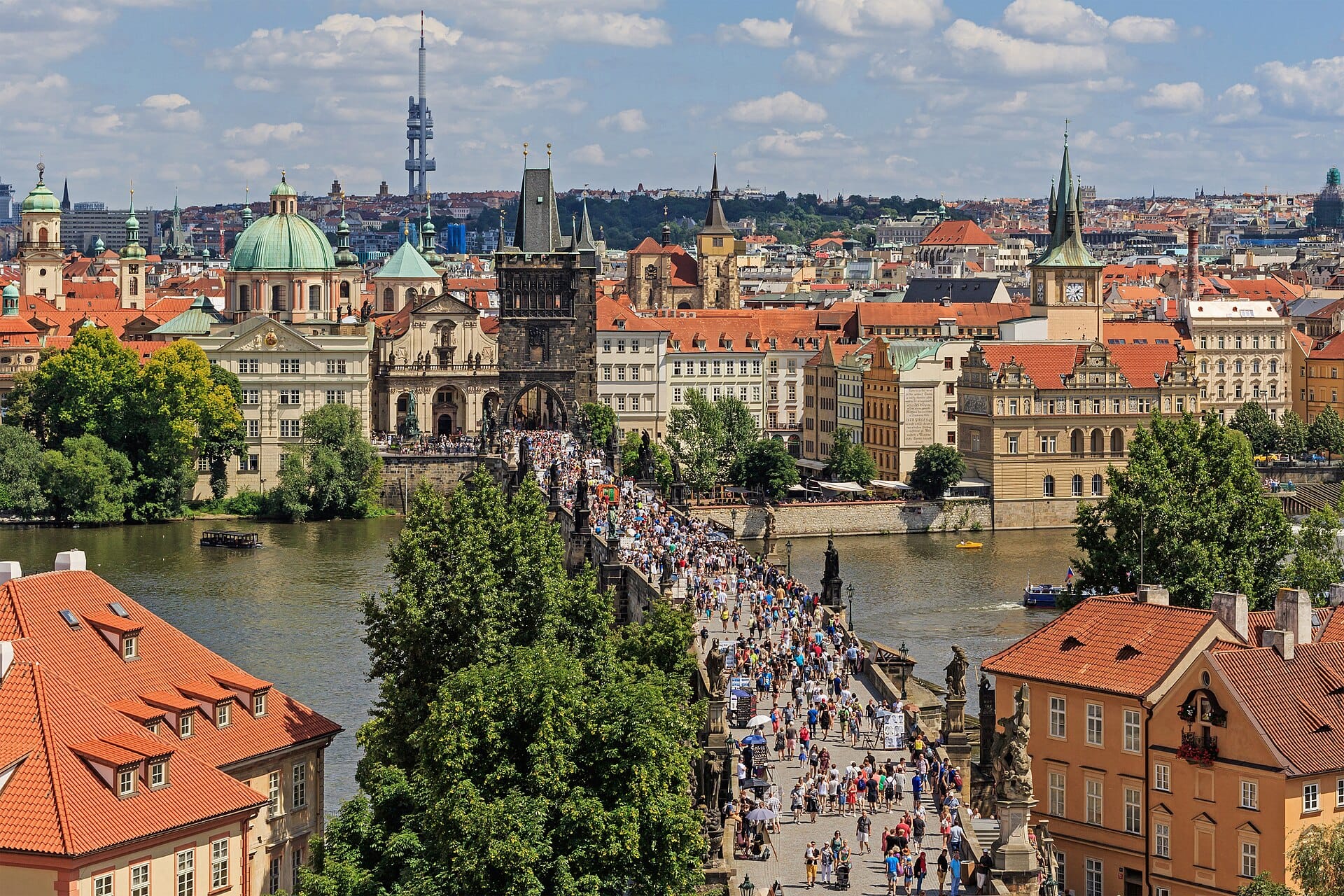
Prague sits on the Vltava and holds the castle complex, the Charles Bridge and an old town that survived the war largely intact. Brno is the Moravian capital and second city, home to the constitutional court and a strong university and technology sector, Ostrava is the old coal and steel center, and Plzeň gave its name to pilsner. Český Krumlov, Karlovy Vary and the Bohemian Switzerland sandstone country draw most of the remaining visitors.
- Population
- 10.9 million
- Area
- 78,871 km²
- Capital
- Prague
- Currency
- Czech koruna (CZK)
- Official language
- Czech
- Highest point
- Sněžka, 1,603 m
The Czech Republic course
Geography of Czech Republic2 lessons
A basin walled in by mountains, with rivers running to three different seas.
History of Czech Republic2 lessons
A Holy Roman capital, a defenestration that started a war, and two velvet events in four years.
Language of Czech Republic2 lessons
Seven cases, free word order, and a sentence with no vowels that Czechs enjoy testing on visitors.
Culture of Czech Republic2 lessons
Kafka and Kundera, marionette theater, and the highest beer consumption per person in the world.
Economy of Czech Republic2 lessons
Cars above all, with Škoda and a supplier network that reaches across the country.
Politics of Czech Republic2 lessons
A parliamentary republic whose president has been directly elected since 2013.
Nature & Wildlife of Czech Republic2 lessons
Sandstone towers and gorges in the north, and forests recovering from acid rain.
Food & Cuisine of Czech Republic2 lessons
Roast pork, sliced dumplings and sauerkraut, washed down with the beer that named a style.
Landmarks of Czech Republic2 lessons
A fourteenth-century bridge lined with saints, and the largest ancient castle complex anywhere.
People & Society of Czech Republic2 lessons
Eleven million people, among the least religious anywhere, in a country that grows by migration.
Geography of Czech Republic
Czechia is landlocked between Germany, Poland, Austria and Slovakia, and covers 78,871 square kilometers. Bohemia forms a plateau enclosed by low mountain ranges, while Moravia to the east is lower and more open, and the Moravian Gate between the two has carried traffic between the Baltic and the Danube since the Bronze Age.
Sněžka in the Krkonoše is the highest point at 1,603 meters. Water leaves the country in three directions: the Elbe and Vltava north to the North Sea, the Oder to the Baltic and the Morava south into the Danube and eventually the Black Sea. Sandstone erosion in Bohemian Switzerland and the Adršpach rocks has produced towers and gorges that are the country’s signature landscape.

History of Czech Republic
The Přemyslid dukes established the Bohemian state around Prague in the ninth century, and under Charles IV in the fourteenth Prague became the capital of the Holy Roman Empire and gained the first university in central Europe. Jan Hus was burned as a heretic in 1415, setting off the Hussite wars, and the defenestration of Prague in 1618 helped trigger the Thirty Years’ War.
Three centuries of Habsburg rule ended with the creation of Czechoslovakia in 1918. The Munich Agreement of 1938 handed the borderlands to Germany, occupation followed, and after the war the communist takeover of 1948 lasted until the Velvet Revolution of 1989 brought Václav Havel to the castle. The Prague Spring of 1968 had been crushed by a Warsaw Pact invasion. Czechoslovakia divided peacefully on 1 January 1993.

Language of Czech Republic
Czech is a West Slavic language very close to Slovak, with which it is mutually intelligible, and more distantly related to Polish. It has seven cases, three genders, and a distinction between hard and soft consonants, and word order is free enough that emphasis rather than grammar decides it.
The letter ř denotes a raised alveolar trill found in almost no other language and is the sound learners struggle with longest. Syllabic consonants allow whole words and even sentences without vowels, of which strč prst skrz krk, put your finger through your throat, is the standard demonstration. The written standard and the everyday spoken variety differ noticeably, so learners meet two registers at once.

Culture of Czech Republic
Prague produced Franz Kafka, who wrote in German, and the country later gave the world Milan Kundera, Bohumil Hrabal and the playwright turned president Václav Havel. Antonín Dvořák and Bedřich Smetana anchor the musical tradition, and the Prague Spring festival opens each year with Smetana’s Má vlast.
Marionette theater is an old and living tradition recognized by UNESCO, and Czech animation, from Jiří Trnka to Jan Švankmajer, has a distinct and often unsettling style. Czechs drink more beer per person than any other nation, and the pub is a social institution rather than a night out. Religious practice is among the lowest in the world, with most people declaring no affiliation.

Economy of Czech Republic
Czechia has one of the most industry-heavy economies in the European Union, with vehicle manufacturing at its center. Škoda Auto, now part of Volkswagen, along with Hyundai and Toyota plants and a deep supplier network, makes cars and components the single largest export category, followed by machinery and electronics.
The country kept the koruna rather than adopting the euro and runs consistently low unemployment, often the lowest in the bloc. Glass and crystal from Bohemia, brewing, and a growing IT and cybersecurity sector round out the picture. Heavy exposure to German demand means Czech output tracks the German business cycle closely, and energy has shifted since the country stopped taking Russian oil and gas by pipeline.

Politics of Czech Republic
Czechia is a parliamentary republic with a 200-seat Chamber of Deputies elected proportionally and an 81-seat Senate elected in single-member districts on staggered six-year terms. The president, head of state for a five-year term, has been chosen by direct popular vote since 2013 rather than by parliament, which has raised the political weight of the office.
The country joined NATO in 1999 and the European Union in 2004, and it is part of the Schengen area and the Visegrád group with Poland, Hungary and Slovakia, though its positions within that group vary considerably by government. Governments are usually multi-party coalitions, and turnout in parliamentary elections is high by regional standards.

Nature & Wildlife of Czech Republic
Bohemian Switzerland National Park on the German border is a landscape of sandstone towers, ravines and the Pravčická brána, the largest natural sandstone arch in Europe. Šumava along the Bavarian border is one of the largest continuous forests in central Europe and is managed partly as wilderness where bark beetle outbreaks are left to run.
Lynx, otters and increasing numbers of wolves live in the border ranges, and beavers have spread widely along the rivers. The spruce plantations of the northern mountains were badly damaged by acid rain from lignite burning in the late twentieth century, and the slow conversion of those monocultures to mixed forest is the main conservation project of the present.

Food & Cuisine of Czech Republic
The core of Czech cooking is meat with sauce and bread or potato dumplings to soak it up. Vepřo knedlo zelo, roast pork with sliced dumplings and cabbage, is the standard example, and svíčková, beef sirloin in a strained root vegetable cream sauce with cranberries and whipped cream, is the dish served at celebrations.
Pilsner Urquell, brewed in Plzeň from 1842, was the first pale lager and gave the world the pilsner style that now dominates global brewing; Budweiser Budvar from České Budějovice is at the center of a long trademark dispute with the American brand. Fried cheese, potato pancakes, open sandwiches called chlebíčky and fruit-filled dumplings fill the rest of the menu.

Landmarks of Czech Republic
The Charles Bridge, begun in 1357 under Charles IV, crosses the Vltava on sixteen arches and carries thirty baroque statues added from the late seventeenth century, most of them now copies with the originals in museums. Prague Castle above it is recorded as the largest ancient castle complex in the world and contains St Vitus Cathedral and the seat of the president.
The astronomical clock on the Old Town Hall has been running since 1410 and still draws crowds on the hour. Outside Prague, Český Krumlov’s old town wraps inside a bend of the Vltava beneath its castle, Kutná Hora holds the Gothic St Barbara’s Church and the Sedlec ossuary decorated with human bones, and Karlštejn guards the ridge southwest of the capital.

People & Society of Czech Republic
Czechia has around 10.9 million residents. The German-speaking population of the borderlands, close to three million people, was expelled after 1945, which reshaped the demography of whole regions and left some areas thinly settled for a generation.
Surveys consistently place the country among the least religious in the world, with a large majority reporting no denomination. Population growth now depends entirely on migration, chiefly from Ukraine, Slovakia and Vietnam, the last a community dating to labour exchanges under communism and highly visible in retail and food. Living standards have converged steadily on the western European average since 1993.

Reading is one thing, recall is another. Play the Czech Republic challenge to test what stuck. The lessons on all ten topics are open too, and a free account is what keeps your progress across them.