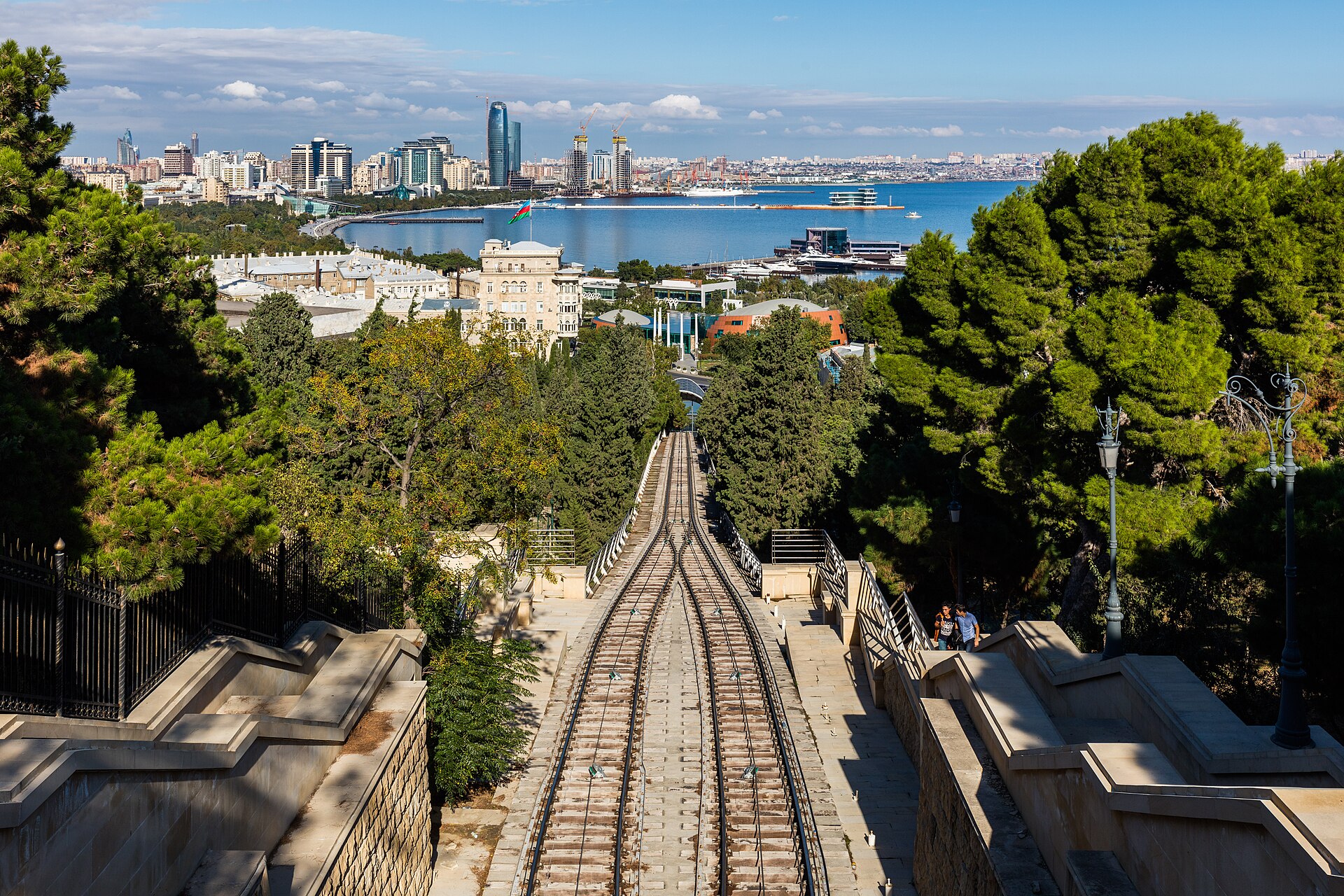
Facts about Azerbaijan
Explore Azerbaijan from Baku’s walled old city and the Caspian coast to Sheki’s silk heritage, the Caucasus and the forests of the south. Learn fourteen economic regions, place twenty cities and sixteen sights, discover ten illustrated topics and begin Azerbaijani.
- Capital
- Baku
- Population
- About 10.27 million, July 2026
- Currency
- Azerbaijani manat (AZN)
- State language
- Azerbaijani
- Economic regions
- 14, including Baku and Nakhchivan
- UNESCO World Heritage
- 5 properties
Azerbaijan · 0 of 20 rounds passed
Two timed rounds per topic, 20 seconds a question
Baku faces the Caspian on the Absheron Peninsula. Follow the northern foothills west through Gabala, Sheki and Zagatala; look northeast to Guba and the high Caucasus, west to Ganja and Lake Goygol, or south to Lankaran and the Talysh forests. Nakhchivan is a separate exclave with its own capital and mountain landscapes.
The maps use internationally recognised Azerbaijani territory and fourteen economic regions. They do not draw current lines of security control or establish safe routes. Karabakh and border areas have mine risks and access restrictions. The sights priorities describe places to learn about; check current official advice and local permissions before planning visits.
Geography of Azerbaijan
Caspian shores, Caucasus mountains and an exclave beside the Aras.
- Does Azerbaijan have an ocean coast?
- No. Its coast faces the Caspian Sea, an inland body of water with no natural outlet to the ocean.
- Why does Nakhchivan appear separately?
- It is an Azerbaijani exclave and autonomous republic, separated from the main territory by Armenia. It also borders Iran and Türkiye.
- What do the fourteen regional targets represent?
- Economic regions established in 2021. They group administrative districts and cities; they are not a system of fourteen provinces.
More about Azerbaijan: geography
Azerbaijan lies in the South Caucasus on the western shore of the Caspian Sea. Russia and Georgia lie to the north, Armenia to the west and Iran to the south. The Greater Caucasus rises in the north, the Lesser Caucasus shapes the west and the Talysh Mountains border the humid southeast. The Kura–Aras lowlands form a broad central plain.
Baku occupies the Absheron Peninsula. The Kura, called Kur in Azerbaijani, arrives from Georgia and crosses the country towards the Caspian. The Aras, or Araz, follows long stretches of the Iranian border before joining it. Mingachevir Reservoir is an artificial lake on the Kura. The Caspian has no natural outlet to an ocean, despite its familiar name.
Nakhchivan is an autonomous republic and an exclave separated from the main territory by Armenia. It borders Iran, Armenia and a short stretch of Türkiye. The regional game uses fourteen economic regions established in 2021, grouping districts and cities for planning. These are not fourteen provinces. Baku has its own economic region, separate from Absheron–Khizi.
History of Azerbaijan
Trading towns, the oil boom, two republics and the human cost of conflict.
- When was the first modern republic proclaimed?
- On 28 May 1918. It lasted until Soviet rule began in 1920; independence was restored in 1991.
- Did the 2020 war put all of Nagorno-Karabakh under Azerbaijani control?
- No. Azerbaijan regained surrounding districts and part of Nagorno-Karabakh in 2020. It took control of the remaining Armenian-controlled territory in September 2023.
- What happened to the Armenian population in September 2023?
- More than 100,000 ethnic Armenians fled to Armenia. UNHCR coordinated refugee support; displacement is central to the region’s recent history.
More about Azerbaijan: history
The territory of present-day Azerbaijan has belonged to different kingdoms and empires, including Caucasian Albania, Persian states and regional khanates. Caucasian Albania was a kingdom in the Caucasus, geographically distinct from modern Albania in the Balkans. Shirvan’s rulers left a major architectural legacy in Baku, while Sheki grew through trade and silk production.
Russian imperial expansion in the nineteenth century reshaped the region. Oil development transformed Baku into an industrial city connected with international markets. The Azerbaijan Democratic Republic was proclaimed on 28 May 1918. Soviet rule began in 1920; Azerbaijan restored independence in 1991 as the Soviet Union broke up.
The conflict over Nagorno-Karabakh brought war, loss and displacement to Azerbaijani and Armenian communities. Armenian forces controlled the region and surrounding Azerbaijani districts after the early-1990s war. Azerbaijan regained surrounding districts and part of Nagorno-Karabakh in 2020, then took control of the remaining Armenian-controlled territory in September 2023. More than 100,000 ethnic Armenians fled to Armenia. These changes must not erase earlier Azerbaijani displacement or be mistaken for proof of present visitor access.
Azerbaijani language
An Oghuz Turkic language written in a Latin alphabet in the republic.
- Is Azerbaijani related to Turkish?
- Yes. Both belong to the Oghuz branch of the Turkic family, although they are distinct languages.
- What alphabet does Azerbaijan use for Azerbaijani?
- A Latin alphabet with 32 letters. Azerbaijani in Iran is generally written with an Arabic-based script.
- How do you say hello and thank you?
- Salam means hello. Təşəkkür edirəm is a polite way to say thank you; the lessons include pronunciation guidance.
More about Azerbaijan: language
Azerbaijani belongs to the Oghuz branch of the Turkic language family, alongside Turkish and Turkmen. Similarities with Turkish can help a learner, but pronunciation, vocabulary and usage differ. Azerbaijani is the state language of the republic. Azerbaijani-speaking communities also live beyond its borders, notably in Iran.
The modern alphabet used in Azerbaijan has 32 letters, including ə, ı, ö and ü. The republic adopted a Latin alphabet after independence, following a Soviet-era Cyrillic period and an earlier Latin reform. Azerbaijani in Iran is generally written with an Arabic-based script. A language’s writing system and its family are different questions.
Start with Salam for hello, Zəhmət olmasa for please and Təşəkkür edirəm for thank you. The linked lessons introduce everyday Azerbaijani as used in the republic. Lezgin, Talysh, Avar, Russian and other languages also belong to community life. Khinalig’s community has its own language, which should not be described as a dialect of Azerbaijani.
Culture of Azerbaijan
Mugham, carpets, silk scarves and the welcome of a shared tea table.
- What is mugham?
- A musical tradition combining modal structures, poetry and improvisation, performed by singers and instrumentalists.
- What is a kelaghayi?
- A traditional silk headscarf made using dyeing and decorative techniques, associated especially with Sheki and Basgal.
- Is Novruz celebrated only in Azerbaijan?
- No. It is a spring celebration shared across several countries and communities, including Iran and parts of Central Asia.
More about Azerbaijan: culture
Mugham is a musical tradition in which performers work with modal structures, poetry and improvisation. Singers and instrumentalists develop a shared musical conversation rather than repeating a single fixed tune. Ashiq performance brings together sung poetry and the long-necked saz. These traditions connect Azerbaijan with a wider region while retaining local forms.
Carpet weaving carries regional patterns and skills passed between generations. Kelaghayi silk scarves involve dyeing and woodblock decoration, with important centres in Sheki and Basgal. The intricate wooden lattice and coloured glass known as shebeke are especially associated with Sheki’s architecture. A craft is both a finished object and the knowledge needed to make it.
Novruz marks the arrival of spring and is celebrated in several countries and communities. Sprouted wheat, sweets and family gatherings are familiar parts of celebrations in Azerbaijan. Tea, often served in pear-shaped armudu glasses with sweets or preserves alongside, is another important social practice. Customs vary between households; a national tradition does not prescribe every person’s habits.
Economy of Azerbaijan
Caspian oil and gas, regional farming, crafts and transport routes.
- What currency does Azerbaijan use?
- The Azerbaijani manat, abbreviated AZN. One manat is divided into 100 qapik.
- Where does the Baku–Tbilisi–Ceyhan pipeline end?
- At Ceyhan on Türkiye’s Mediterranean coast, after crossing Georgia.
- Why does economic diversification matter?
- Oil and gas are central to exports and public finances, leaving the economy exposed to energy-price changes and the long-term transition away from fossil fuels.
More about Azerbaijan: economy
Oil and natural gas have a central role in Azerbaijan’s exports and public finances. Baku’s nineteenth-century oil boom and later offshore production changed both the economy and the cityscape. Reliance on hydrocarbons also leaves the country exposed to energy prices and makes diversification an important economic challenge.
The Baku–Tbilisi–Ceyhan pipeline carries oil through Georgia to Türkiye’s Mediterranean coast. The Southern Gas Corridor connects Azerbaijani gas production with markets through Georgia and Türkiye into Europe. Caspian shipping, railways and roads also support east–west trade. These networks cross borders; they do not give Azerbaijan a direct ocean coastline.
Farming and food production vary by region: tea and rice are associated with the humid south, hazelnuts with northern foothills, and pomegranates with areas including Goychay. Services, tourism, manufacturing and craft production support other livelihoods. The national currency is the Azerbaijani manat, abbreviated AZN, with 100 qapik to one manat.
Politics of Azerbaijan
Presidential institutions, a national parliament and restricted political competition.
- What is the Milli Majlis?
- Azerbaijan’s national parliament. The president holds executive power under the constitution.
- Does the constitutional label describe the quality of elections?
- No. OSCE/ODIHR observers found that the 2024 elections took place in a restrictive environment without genuine political alternatives.
- Is Azerbaijan an OIC observer?
- No. It is a member of the Organisation of Islamic Cooperation.
More about Azerbaijan: politics
Azerbaijan is a presidential republic. Under the constitution the president holds executive power, while the Milli Majlis is the national legislature. The constitution describes a secular state and identifies Azerbaijani as the state language. Nakhchivan has autonomous status within the republic. Constitutional arrangements describe institutions; they do not by themselves measure political freedom.
Ilham Aliyev has been president since 2003, following his father Heydar Aliyev, who became president in 1993. OSCE/ODIHR observers reported that the 2024 presidential and parliamentary elections took place in a restrictive environment without genuine political alternatives. Their findings also describe limits on independent media, civil society and fundamental freedoms.
Relations with Armenia, Türkiye, Russia, Iran, Georgia and European partners all shape foreign policy. Azerbaijan is a member of the United Nations, the Council of Europe and the Organisation of Islamic Cooperation. Its OIC status is membership, not observer status. Economic-region boundaries in this guide are a planning framework and should not be read as a settlement of border-demarcation questions.
Nature of Azerbaijan
High Caucasus peaks, semi-desert mud volcanoes and ancient southern forests.
- Do mud volcanoes erupt molten lava?
- No. They release gas, water and sediment. Azerbaijan’s mud volcanoes are different from conventional lava volcanoes.
- Where are Azerbaijan’s Hyrcanian forests?
- In the humid southeast near the Talysh Mountains. Selected forest components joined the transboundary UNESCO property shared with Iran in 2023.
- What is Yanar Dag?
- A burning natural-gas seep on the Absheron Peninsula, rather than a lava volcano.
More about Azerbaijan: nature & wildlife
High mountains, central lowlands and a humid southern coast support very different habitats. Bazarduzu rises on the Russian border in the Greater Caucasus. Forests and alpine meadows contrast with the drier Absheron Peninsula and Kura–Aras plain. Elevation, rainfall and distance from the coast explain the variety more usefully than an unsupported count of climate zones.
Mud volcanoes release gas, water and fine sediment rather than streams of molten lava. They occur around Gobustan, Absheron and offshore in the Caspian basin. Yanar Dag is a different phenomenon: burning natural gas escaping through the ground. Neither a mud volcano nor a gas flame should be confused with a conventional lava volcano.
Hirkan National Park in the Talysh region protects parts of the Hyrcanian forest ecosystem, shared with Iran. Azerbaijan’s forest components joined the transboundary World Heritage property in 2023; the inscription does not cover every part of the park. Shirvan’s semi-desert protects goitered gazelle, while Lake Goygol occupies a mountain basin near Ganja. Park boundaries, seasonal conditions and authorised routes need separate checks.
Food of Azerbaijan
Plov, dolma, herb-filled qutab and Sheki’s distinctive sweets.
- What is plov?
- A rice-based dish with many versions, often accompanied by meat, dried fruit, herbs or chestnuts. Shah plov is baked inside a lavash shell.
- What is the difference between dolma and qutab?
- Dolma uses leaves or vegetables around a filling. Qutab are thin folded flatbreads with fillings such as greens or meat.
- What makes Sheki halva distinctive?
- Its rice-flour lattice, nuts and syrup. It is different from sesame-based sweets also called halva elsewhere.
More about Azerbaijan: food & cuisine
Plov centres on rice and comes in many forms. Saffron, dried fruit, chestnuts, meat or herbs may accompany it, and in some versions rice and toppings are prepared separately. Shah plov is enclosed in a baked lavash shell. Regional and household methods matter more than a claim that one recipe represents every table.
Dolma can use vine leaves or vegetables to hold a filling, often with meat, rice and herbs. Qutab are thin folded flatbreads with fillings such as greens, meat or pumpkin. Dovga is a yoghurt-based soup with herbs; piti is a slow-cooked meat and chickpea dish associated with Sheki. Recipes and dietary suitability depend on the cook and ingredients.
Sheki halva uses a delicate rice-flour lattice with nuts and syrup. Pakhlava, shekerbura and other sweets are familiar at celebrations, especially Novruz. Tea often accompanies sweets and preserves. Culinary traditions cross modern borders, so recognising a dish in Azerbaijan does not establish exclusive ownership of a food shared with neighbouring cultures.
Landmarks of Azerbaijan
Baku’s old walls, Gobustan’s rock art and heritage beyond the capital.
- Are the Maiden Tower and Shirvanshahs’ Palace separate UNESCO properties?
- No. Both belong to the single Walled City of Baku World Heritage property.
- Is Ateshgah simply an ancient Zoroastrian temple?
- That is too narrow. The surviving complex has important Hindu and Sikh connections as well as associations with fire worship.
- What does Khinalig’s UNESCO landscape include?
- The mountain community’s cultural landscape and Köç Yolu, a seasonal livestock migration route linking summer and winter pastures.
More about Azerbaijan: landmarks
Baku’s walled old city, Icherisheher, includes the Maiden Tower and the Palace of the Shirvanshahs within a single UNESCO World Heritage property. The tower’s origins and function have prompted different interpretations. The modern Flame Towers and Heydar Aliyev Centre belong to a different architectural chapter and are not part of that inscription.
Gobustan’s rock art records thousands of images and a long history of human activity. UNESCO describes evidence spanning about 40,000 years; that does not mean every carving is that old. Sheki’s historic centre and Khan’s Palace form another World Heritage property. The Ateshgah at Surakhani has Hindu and Sikh connections as well as associations with fire worship, so calling it only a Zoroastrian temple oversimplifies its history.
Khinalig’s World Heritage cultural landscape includes the community’s seasonal livestock route, Köç Yolu, as well as its high mountain settlement. In Nakhchivan, the twelfth-century Momine Khatun Mausoleum shows a distinctive brick architectural tradition. Sights pins identify representative locations; they are not property boundaries, trail instructions or guarantees that a place is open.
People of Azerbaijan
Many communities, regional languages and connections across borders.
- What is Azerbaijan’s population?
- About 10.27 million, according to the State Statistical Committee’s estimate for 1 July 2026.
- Is Azerbaijani the only community language?
- No. Lezgin, Talysh, Avar, Russian, Udi and other languages are also spoken; Khinalig has its own language tradition.
- Are all Azerbaijani speakers citizens of Azerbaijan?
- No. Many live in Iran and elsewhere. A shared language does not imply the same citizenship or migration history.
More about Azerbaijan: people & society
The State Statistical Committee reported about 10.27 million residents on 1 July 2026. Baku is the largest urban centre, but its administrative population should not be confused with the wider metropolitan area. The country also includes small mountain settlements, agricultural towns and the cities of the Nakhchivan exclave.
Azerbaijanis form the majority population. Lezgins, Talysh, Avars, Russians, Mountain Jews, Udis and other communities contribute to the country’s life. Languages and religious traditions vary: many people have a Muslim cultural heritage, alongside Jewish, Christian and other traditions. Azerbaijan is constitutionally secular, and personal belief or practice cannot be inferred from nationality.
Family and migration networks connect people with neighbouring countries and communities farther abroad. Azerbaijani-speaking communities in Iran have their own histories and should not all be described as emigrants from the republic. War and displacement have profoundly changed Azerbaijani and Armenian lives. Language, citizenship, ethnicity and religion are different aspects of identity; let people describe their own.