Facts about Bosnia and Herzegovina
From Sarajevo’s bazaar and Mostar’s rebuilt bridge to the Una’s cascades and the Dinaric mountains, explore Bosnia and Herzegovina through its rivers, towns, languages and shared heritage.
- Population · 2013 census
- 3,531,159
- Area
- About 51,200 km²
- Capital
- Sarajevo
- Currency
- Convertible mark (BAM / KM)
- Languages in official use
- Bosnian, Croatian & Serbian
- Highest point
- Maglić · about 2,386 m
Bosnia and Herzegovina · 0 of 20 rounds passed
Two timed rounds per topic, 20 seconds a question
The country sits between Croatia, Serbia and Montenegro, with a short Adriatic coast at Neum. Sarajevo is the capital, Banja Luka anchors the northwest, and Mostar is a major centre of Herzegovina. Mountain valleys connect industrial towns, old trading routes and protected landscapes.
Learn the two entities and Brčko District, place twenty cities and sixteen sights, follow six selected rivers, and explore ten illustrated topics with thirty answered questions. Continue into eighty reviewed facts questions and the existing Bosnian, Croatian or Serbian lessons.
Mountains, river valleys and a small coast
The Dinaric Alps divide rivers flowing towards the Black Sea from those reaching the Adriatic.
- Which countries border Bosnia and Herzegovina?
- Croatia, Serbia and Montenegro. The country also has a short Adriatic coastline at Neum.
- Are Bosnia and Herzegovina the two entities?
- No. The two entities are the Federation of Bosnia and Herzegovina and Republika Srpska. Bosnia and Herzegovina are historical regions.
- Which river flows beneath Mostar’s Old Bridge?
- The Neretva. It continues into Croatia before reaching the Adriatic Sea.
More about Bosnia and Herzegovina: geography
Bosnia and Herzegovina lies in the western Balkans, bordered by Croatia, Serbia and Montenegro. Sarajevo occupies an inland valley, Banja Luka stands on the Vrbas, and Mostar follows the Neretva through Herzegovina. The Dinaric Alps dominate much of the interior; northern lowlands meet the Sava, while Neum gives the country a short Adriatic coastline.
Bosnia and Herzegovina are historical and geographical regions, not the names of the two present-day entities. The Federation of Bosnia and Herzegovina and Republika Srpska are the entities; Brčko District has a separate self-governing arrangement. Most northern rivers drain through the Sava and Danube towards the Black Sea. The Neretva flows south through Mostar and reaches the Adriatic in Croatia.
A medieval kingdom and layers of empire
Ottoman, Habsburg and Yugoslav periods left different traces in the same towns.
- When did Austria-Hungary annex Bosnia and Herzegovina?
- In 1908. Its administration began earlier, in 1878; those are different milestones.
- When did the country become independent?
- In 1992, during the dissolution of Yugoslavia.
- What did the Dayton agreement do?
- It ended the 1992–95 war and established the constitutional framework in use today. It was initialled at Dayton and signed in Paris in 1995.
More about Bosnia and Herzegovina: history
The medieval Bosnian kingdom reached a high point under Tvrtko I, crowned in 1377. Carved stećci tombstones preserve a wider regional medieval heritage shared across modern borders. The Ottomans conquered the Bosnian kingdom in 1463, though their advance into Herzegovina continued later. Austria-Hungary began administering Bosnia and Herzegovina in 1878 and formally annexed it in 1908. The assassination of Franz Ferdinand in Sarajevo in 1914 precipitated the July Crisis that led to the First World War.
Bosnia and Herzegovina became one of socialist Yugoslavia’s six republics after the Second World War and became independent in 1992. The 1992–95 war brought siege, mass displacement and atrocities. International courts established that the July 1995 killings of Bosniak men and boys at Srebrenica constituted genocide. The Dayton peace agreement, initialled in November and signed in Paris in December 1995, ended the war and supplied the present constitutional framework. Memorial sites are places of remembrance as well as historical learning.
Related languages, distinct identities
Bosnian, Croatian and Serbian share much grammar and vocabulary, while retaining their own standards and names.
- Are Bosnian, Croatian and Serbian mutually intelligible?
- They are closely related South Slavic standards with extensive mutual intelligibility, but have distinct standard forms and names.
- Which scripts will I see?
- Latin and Cyrillic. Serbian uses both; Latin is especially common in Bosnian and Croatian writing.
- How do you say thank you in Bosnian?
- Hvala. Dobar dan is a polite daytime greeting, and molim can mean please or you’re welcome, depending on context.
More about Bosnia and Herzegovina: language
Bosnian, Croatian and Serbian are the principal languages in official use. All are South Slavic standards with a shared linguistic base and extensive mutual intelligibility. Their names matter to speakers’ identities; similarity does not make one name a substitute for all three. Latin and Cyrillic scripts are both part of public life. Latin is especially common in Bosnian and Croatian writing; Serbian uses both.
For a first conversation, dobar dan is a polite daytime greeting and hvala means thank you. Bosnian vocabulary includes Ottoman-era loanwords, including komšiluk for neighbourhood or neighbourly relations. The lessons here offer Bosnian, Croatian and Serbian separately. The Sarajevo Haggadah, a medieval Hebrew manuscript preserved in the National Museum, introduces another strand of the country’s written and Jewish heritage; its Hebrew script is distinct from the scripts used for the three South Slavic standards.
Sevdalinka, crafts and cinema
Urban song, bazaar workshops and a film festival connect inherited traditions with contemporary art.
- What is sevdalinka?
- A traditional urban singing practice from Bosnia and Herzegovina, often associated with love, longing and expressive storytelling.
- When did the Sarajevo Film Festival begin?
- In 1995, towards the end of the siege of Sarajevo.
- What is Baščaršija?
- Sarajevo’s historic bazaar quarter, known for its workshops, small streets, courtyards and Ottoman-era architecture.
More about Bosnia and Herzegovina: culture
Baščaršija, Sarajevo’s old bazaar quarter, brings workshops, courtyards and places of worship into a compact area. Copperwork and a slowly shared coffee belong to its everyday cultural life. Sevdalinka is a traditional urban singing practice associated with expressive storytelling, love and longing. UNESCO inscribed it on the Representative List of the Intangible Cultural Heritage of Humanity in 2024; this recognises a living practice rather than a World Heritage building.
The Sarajevo Film Festival began in 1995 while the city was still under siege. It developed into a major meeting place for cinema from southeast Europe. Theatre, literature and contemporary music add further voices across the country. Muslim, Orthodox Christian, Catholic, Jewish and other traditions have shaped local calendars and architecture. These histories overlap in towns and families, so a map of entities should not be read as a set of uniform cultural zones.
Industry, services and connections abroad
Metalworking, wood products, energy and tourism sit alongside the work of a large diaspora.
- What currency does the country use?
- The convertible mark: BAM internationally and KM locally.
- Is the convertible mark linked to the euro?
- Yes. The currency-board exchange rate is 1 euro to 1.95583 convertible marks.
- What is Zenica known for economically?
- Its long-established steelmaking and industrial history in the Bosna valley.
More about Bosnia and Herzegovina: economy
Metalworking, wood processing and furniture, energy, agriculture and services all contribute to the economy. Zenica is associated with steelmaking, Tuzla with salt and industrial activity, and Mostar with manufacturing and tourism. Mountain landscapes and heritage towns support visitor businesses, while the country’s economy extends well beyond tourism. The World Bank classifies Bosnia and Herzegovina as an upper-middle-income economy in its country data checked in October 2026.
The convertible mark, abbreviated KM locally and BAM internationally, is the national currency. Under the central bank’s currency-board arrangement, one euro equals 1.95583 convertible marks; using the mark is different from membership of the euro area. Emigration connects many households with relatives working abroad, and remittances are an important source of income. Employment, population and output figures require dates: war-era totals and older estimates should not be presented as current conditions.
One state, several levels of government
The Dayton framework combines state institutions, two entities and self-governing Brčko District.
- How many members does the Presidency have?
- Three. Its chair rotates among them.
- Is Brčko District a third entity?
- No. It is a self-governing district under state sovereignty, with territory held in condominium by the two entities.
- How many cantons are in the Federation?
- Ten. Cantons subdivide the Federation, rather than the whole state or Republika Srpska.
More about Bosnia and Herzegovina: politics
Bosnia and Herzegovina is a sovereign state with Sarajevo as its capital. Its state institutions include a three-member Presidency, a bicameral Parliamentary Assembly and the Council of Ministers. The chair of the Presidency rotates among its members; the whole Presidency does not become a single-person office. The post-war system contains ethnic and territorial representation rules, which have also been the subject of human-rights judgments and reform debates.
The two entities are the Federation of Bosnia and Herzegovina and Republika Srpska. The Federation is further divided into ten cantons; Republika Srpska is a different entity from the neighbouring Republic of Serbia. Brčko District is a self-governing unit under the sovereignty of Bosnia and Herzegovina, whose territory is held in condominium by the two entities. It is not a third entity. The Office of the High Representative oversees civilian implementation of the peace settlement. The country received EU candidate status in 2022; EU leaders decided in March 2024 to open accession negotiations.
Karst caves, forests and river cascades
Limestone terrain links mountain habitats with underground waters and southern wetlands.
- What is Perućica?
- A protected old-growth forest within Sutjeska National Park.
- What makes Vjetrenica important?
- Its karst cave system supports exceptionally rich subterranean biodiversity. It became a World Heritage property in 2024.
- Where is Bosnia and Herzegovina’s highest mountain?
- Maglić lies on the border with Montenegro, in the southeastern mountain region near Sutjeska National Park.
More about Bosnia and Herzegovina: nature & wildlife
The Dinaric mountains support forests, high pastures and rocky peaks. Maglić, on the border with Montenegro, is the country’s highest mountain at about 2,386 metres. Sutjeska National Park includes the protected Perućica old-growth forest. Brown bears and wolves inhabit suitable mountain and forest habitats; their presence does not mean they occur in every woodland or can reliably be seen on a visit.
In the northwest, the Una is known for cascades such as Štrbački buk. Southern limestone landscapes include the Buna spring at Blagaj and the rich underground habitats of Vjetrenica Cave, inscribed on the World Heritage List in 2024. Hutovo Blato protects a wetland landscape important for birds. Trails, caves, rivers and reserves have different access rules. Landmines and unexploded ordnance remain in affected areas: follow established routes and current local guidance rather than treating an unmarked landscape pin as a safe trail.
Grills, filled pastry and slow coffee
Ćevapi, pita and the džezva offer a first vocabulary for the table.
- What are ćevapi?
- Small grilled minced-meat rolls, commonly served with flatbread and onion.
- Is every filled pastry called burek?
- In common Bosnian usage, burek has a meat filling. Cheese-filled sirnica and potato-filled krompiruša have different names.
- What is a džezva?
- The small pot used to prepare and serve Bosnian coffee; the drinking cup is a different vessel.
More about Bosnia and Herzegovina: food & cuisine
Ćevapi are small grilled minced-meat rolls, commonly served with flatbread and chopped onion. Preparations and serving styles differ between towns, including Sarajevo and Banja Luka. In common Bosnian usage, burek is the meat-filled member of the pita pastry family; cheese-filled sirnica and potato-filled krompiruša have their own names. Bosanski lonac is a slowly cooked combination of meat and vegetables, rather than a grill dish.
Bosnian coffee is prepared with finely ground coffee and served from a small pot called a džezva into small cups. A leisurely pause and conversation are part of the occasion. Baklava and tulumbe reflect connections with Ottoman culinary traditions; soups, stuffed vegetables, dairy products and seasonal preserves widen the picture. Ingredients and recipes vary by household. Familiar dishes are shared across the Balkans, so recognising a local version does not require claiming that only one country makes it.
Bridges, tombstones and hill towns
Mostar and Višegrad connect river crossings with architecture, memory and rebuilding.
- Is Mostar’s Old Bridge the original surviving structure?
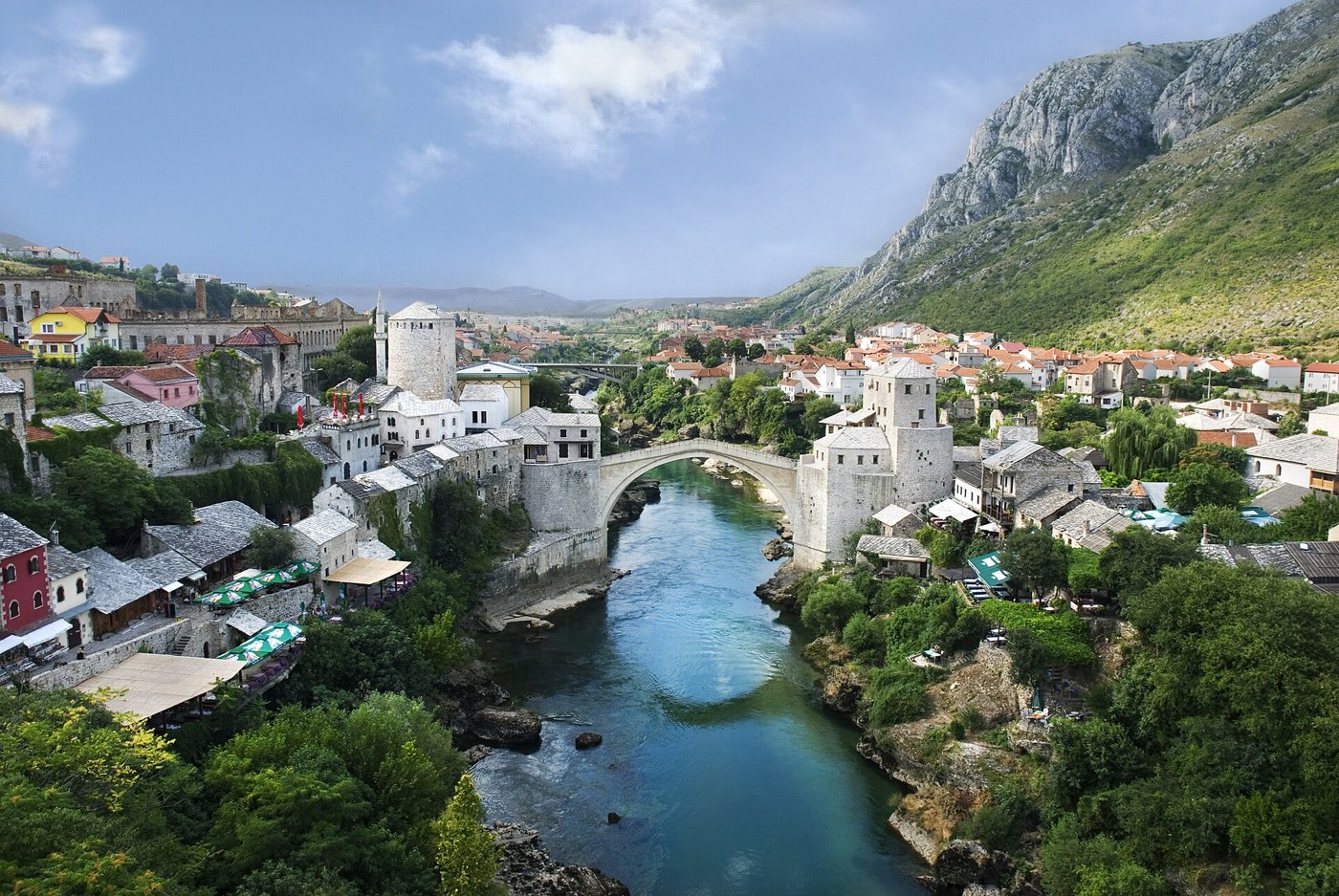
- It is a reconstruction of the sixteenth-century bridge, which was destroyed in 1993 and reopened in 2004.
- Which river does the Višegrad bridge cross?
- The Drina. It is distinct from Mostar’s bridge over the Neretva.
- Are stećci found only in Bosnia and Herzegovina?
- No. The UNESCO inscription is shared with Croatia, Montenegro and Serbia, although most component sites are in Bosnia and Herzegovina.
More about Bosnia and Herzegovina: landmarks
Mostar’s Stari Most was completed in 1566, destroyed during the war in 1993 and reopened after reconstruction in 2004. Its old bridge area is a World Heritage property. The Mehmed Paša Sokolović Bridge at Višegrad is a separate UNESCO-listed crossing over the Drina, associated with the Ottoman architect Sinan. Near Stolac, Radimlja’s carved stećci form part of a World Heritage property shared by Bosnia and Herzegovina, Croatia, Montenegro and Serbia.
Počitelj rises above the Neretva with a fortified hill-town landscape. Jajce combines a fortress, medieval history and a waterfall where the Pliva meets the Vrbas. Sarajevo’s Gazi Husrev-beg Mosque and nearby bazaar reveal Ottoman urban patronage; other buildings preserve Habsburg and later layers. Sacred sites and memorials deserve attentive behaviour. Sights on the map are selected learning points, with some marking broad landscapes rather than an entrance or a verified walking route.
Communities, artists and a diaspora
A national population includes many identities, with cultural lives extending across borders.
- Does 3.531 million describe the current population?
- It is the 2013 census total reported by the Agency for Statistics. A current estimate needs a separate date and source.
- Do Bosnian and Bosniak mean the same thing?
- No. Bosnian can describe a connection with the country or region, while Bosniak denotes a particular ethnic identity.
- What did Ivo Andrić write?
- The Bridge on the Drina, among other works. He received the Nobel Prize in Literature in 1961.
More about Bosnia and Herzegovina: people & society
The Agency for Statistics reported 3,531,159 residents in the 2013 census. This is a dated census total, not a present-day population estimate. Bosniaks, Serbs and Croats are the three constituent peoples named in the Constitution, alongside Others and citizens. Roma, Jewish and other communities also belong to the country. Bosnian can describe a connection with the country or its historical region; Bosniak is a particular ethnic identity, so the words are not interchangeable.
Ivo Andrić, born near Travnik, received the 1961 Nobel Prize in Literature and wrote The Bridge on the Drina. Meša Selimović and Mak Dizdar offer other important literary voices. Film, music and sport provide further introductions, from filmmaker Danis Tanović to footballer Edin Džeko. A large diaspora maintains family and cultural connections abroad. Individual language, belief and identity should not be inferred from a person’s town or the entity in which they live.