Facts about Belarus
Explore Belarus from Minsk and the castles of Mir and Nesvizh to northern lakes, western forests and the wetlands of Polesia. Learn six regions and Minsk city, place sixteen cities and towns, follow five rivers, discover sixteen heritage and nature sights and read ten illustrated topics.
- Population, 2019 census
- 9,413,446
- Area
- 207,600 km²
- Capital
- Minsk
- Currency
- Belarusian ruble (BYN)
- Official languages
- Belarusian and Russian
- Highest point
- Dzyarzhynskaya Hill, about 345 m
Belarus · 0 of 20 rounds passed
Two timed rounds per topic, 20 seconds a question
Belarus lies between Poland, Lithuania, Latvia, Russia and Ukraine. Minsk stands near its centre, Grodno and Brest anchor the west, Vitebsk faces the Western Dvina in the northeast, and Gomel lies beside the Sozh in the southeast. Low hills, glacial lakes, farmland and broad river valleys give each part of the country a different character.
Mir and Nesvizh connect the landscape with the Grand Duchy of Lithuania and the Radziwiłł family; Polotsk introduces early religious and printing history. Forest and wetland habitats carry stories of their own. The city game uses two informal learning groups, separate from administrative regions. The linked course teaches Russian, one of the two official languages; Belarusian has a distinct literary and cultural tradition.
Low uplands, northern lakes and the rivers of Polesia
Belarus is a landlocked country in eastern Europe, bordering Poland, Lithuania, Latvia, Russia and Ukraine. Its 207,600 square kilometres are mostly plains and gently rolling uplands. The Belarusian Ridge crosses the interior, and Dzyarzhynskaya Hill near Minsk reaches about 345 metres. Glacial landscapes and numerous lakes distinguish the north; Polesia, also written Polesie or Palesse, is a wider cross-border lowland region extending across the south.
- Which countries border Belarus?
- Poland, Lithuania, Latvia, Russia and Ukraine. Belarus has no sea coast.
- Is Minsk city part of Minsk Region?
- Minsk is the national capital and a separate administrative unit from the surrounding Minsk Region. Belarus has six regions.
- Do all Belarusian rivers flow to the same sea?
- No. The Neman and Western Dvina drain towards the Baltic, while the Dnieper and tributaries such as the Pripyat drain towards the Black Sea.
More about Belarus: geography
Belarus is a landlocked country in eastern Europe, bordering Poland, Lithuania, Latvia, Russia and Ukraine. Its 207,600 square kilometres are mostly plains and gently rolling uplands. The Belarusian Ridge crosses the interior, and Dzyarzhynskaya Hill near Minsk reaches about 345 metres. Glacial landscapes and numerous lakes distinguish the north; Polesia, also written Polesie or Palesse, is a wider cross-border lowland region extending across the south.
The Dnieper, Berezina, Sozh and Pripyat belong to the Black Sea drainage basin. The Neman and Western Dvina flow towards the Baltic; the latter is called the Daugava in Latvia. Minsk is the capital and a separate administrative unit from Minsk Region. The country has six regions, or oblasts. This guide’s two city-map groups are teaching aids rather than a depiction of those administrative boundaries.
Polotsk, shared borderland histories and independence in 1991
Polotsk was an important early medieval principality in the East Slavic world. Much of present-day Belarus later formed part of the Grand Duchy of Lithuania, a multilingual state whose territory and identity cannot be equated with one modern nation. The Polish-Lithuanian Commonwealth was created in 1569; the Polish-Lithuanian victory at Grunwald in 1410 preceded it. The late-eighteenth-century partitions brought these lands under the Russian Empire.
- When did Belarus become independent?
- In 1991. The 1990 sovereignty declaration gained constitutional force on 25 August 1991 as the Soviet Union dissolved.
- Did the Polish-Lithuanian Commonwealth fight at Grunwald in 1410?
- The victory was won by the Kingdom of Poland and Grand Duchy of Lithuania with allies. The Commonwealth was established later, in 1569.
- Was Soviet Belarus a founding UN member?
- Yes. The Byelorussian Soviet Socialist Republic joined as a founding member in 1945, before Belarus became independent.
More about Belarus: history
Polotsk was an important early medieval principality in the East Slavic world. Much of present-day Belarus later formed part of the Grand Duchy of Lithuania, a multilingual state whose territory and identity cannot be equated with one modern nation. The Polish-Lithuanian Commonwealth was created in 1569; the Polish-Lithuanian victory at Grunwald in 1410 preceded it. The late-eighteenth-century partitions brought these lands under the Russian Empire.
The twentieth century brought revolution, competing state projects, changing borders and Soviet rule. The Nazi occupation during the Second World War caused immense civilian losses, including the destruction of Jewish communities in the Holocaust and the burning of villages. Soviet repression and deportations also shaped family histories. The Byelorussian SSR was a founding UN member in 1945. Its 1990 sovereignty declaration gained constitutional force on 25 August 1991, a key step towards independence as the Soviet Union dissolved.
Two official languages and a distinct Belarusian literary tradition
Belarusian and Russian are the official languages. Both are East Slavic, alongside Ukrainian, but Belarusian is a distinct language with its own grammar, vocabulary and literature. Modern standard Belarusian normally uses Cyrillic, including the letter ў. A Latin-script tradition called Łacinka also exists, illustrated by this section’s photograph. Дзякуй, often transliterated dziakuj, means thank you; добры дзень means good day.
- Is Belarusian a dialect of Russian?
- No. Belarusian and Russian are distinct East Slavic languages, and both have official status in Belarus.
- What is Łacinka?
- A Latin-script tradition for writing Belarusian. Modern standard Belarusian normally uses Cyrillic.
- Does the linked language course teach Belarusian?
- It teaches standard Russian, one of Belarus’s official languages. It is not a dedicated Belarusian course.
More about Belarus: language
Belarusian and Russian are the official languages. Both are East Slavic, alongside Ukrainian, but Belarusian is a distinct language with its own grammar, vocabulary and literature. Modern standard Belarusian normally uses Cyrillic, including the letter ў. A Latin-script tradition called Łacinka also exists, illustrated by this section’s photograph. Дзякуй, often transliterated dziakuj, means thank you; добры дзень means good day.
Russian is widely used in cities, education and public life. Belarusian remains important in literature, cultural activity and everyday speech, with regional varieties and mixed speech practices adding further complexity. Language use and national identity do not describe the same thing. Francysk Skaryna printed biblical books in Prague from 1517; Yanka Kupala, Yakub Kolas and Maksim Bahdanovich belong to the modern literary tradition. The linked lessons introduce standard Russian and are not a Belarusian course.
Kupalle, embroidered textiles and living craft traditions
Kupalle celebrations combine midsummer customs with the calendar of St John’s feast. Bonfires, wreaths, songs and stories about a flowering fern recur, though dates and practices vary. Winter Kalyady traditions include visiting, singing and masquerade. Embroidered shirts and rushniki, decorated ceremonial towels, have different uses: a towel is not the name of an embroidery pattern. Dudka pipes and other instruments accompany varied regional music traditions.
- What is Kupalle?
- A midsummer celebration with customs such as bonfires, wreaths and songs, linked with St John’s feast. Dates and local practices vary.
- What is a rushnik?
- A decorated ceremonial towel. It is an object with particular uses, rather than the name of an embroidery pattern.
- Are straw weaving and vytsinanka UNESCO World Heritage buildings?
- No. Straw weaving and vytsinanka paper cutting are living traditions on UNESCO’s intangible cultural heritage list, inscribed in 2022 and 2024 respectively.
More about Belarus: culture
Kupalle celebrations combine midsummer customs with the calendar of St John’s feast. Bonfires, wreaths, songs and stories about a flowering fern recur, though dates and practices vary. Winter Kalyady traditions include visiting, singing and masquerade. Embroidered shirts and rushniki, decorated ceremonial towels, have different uses: a towel is not the name of an embroidery pattern. Dudka pipes and other instruments accompany varied regional music traditions.
Straw weaving in Belarus was inscribed on UNESCO’s intangible heritage list in 2022; vytsinanka paper cutting followed in 2024. These recognise skills passed between people, rather than protected buildings. Vitebsk is associated with Marc Chagall and the Slavianski Bazaar arts festival. Theatre, contemporary writing, cinema, design and diaspora initiatives also contribute to cultural life. Belarusian heritage includes Jewish, Polish, Lithuanian, Russian, Tatar and other connections across changing borders.
Potash, machinery, agriculture and the Belarusian ruble
State-owned enterprises play a substantial role in Belarus’s economy alongside private businesses. Machinery, food processing, chemicals, forestry products and services are important activities. Minsk Tractor Works makes tractors; BELAZ, based in Zhodzina, manufactures large mining vehicles. Potash mining around Salihorsk supplies fertiliser production. Farms produce dairy products, grain, potatoes and flax, while software and other services connect businesses with customers abroad.
- Which currency does Belarus use?
- The Belarusian ruble, code BYN. The 2016 redenomination exchanged 10,000 old BYR for one BYN.
- Why is Salihorsk associated with fertiliser?
- Its potash deposits support mining and the production of potassium-based fertilisers.
- Does Belarus produce only farm goods?
- No. Machinery, chemicals, food processing, forestry products and services also contribute. State-owned enterprises retain a substantial role.
More about Belarus: economy
State-owned enterprises play a substantial role in Belarus’s economy alongside private businesses. Machinery, food processing, chemicals, forestry products and services are important activities. Minsk Tractor Works makes tractors; BELAZ, based in Zhodzina, manufactures large mining vehicles. Potash mining around Salihorsk supplies fertiliser production. Farms produce dairy products, grain, potatoes and flax, while software and other services connect businesses with customers abroad.
The currency is the Belarusian ruble, code BYN. A redenomination on 1 July 2016 replaced 10,000 old BYR with one new BYN. Russia is a major trade and energy partner, and Belarus belongs to the Eurasian Economic Union. Sanctions, political repression, business relocation and Russia’s war against Ukraine have affected trade and investment. Export rankings, market shares and software-sector figures need dates; they are not fixed national characteristics.
Formal institutions, concentrated power and relations with Russia
The constitution describes a presidential republic. The National Assembly comprises the House of Representatives and Council of the Republic, while the prime minister heads the government under the presidency. Formal institutions do not by themselves explain political practice: power is highly concentrated, independent media and opposition activity face severe restrictions, and UN human rights bodies have documented arbitrary detention, torture and other abuses, especially following the disputed 2020 presidential election.
- What is Belarus’s formal political system?
- A presidential republic. Power is highly concentrated in practice, with severe restrictions on opposition activity and independent media.
- Does the Union State mean Belarus and Russia are one country?
- No. The 1999 treaty created an integration framework; Belarus and Russia remain separate states.
- Why should a description include events after the 2020 election?
- The disputed election, protests and repression are central to current political conditions. UN human rights bodies have documented serious abuses.
More about Belarus: politics
The constitution describes a presidential republic. The National Assembly comprises the House of Representatives and Council of the Republic, while the prime minister heads the government under the presidency. Formal institutions do not by themselves explain political practice: power is highly concentrated, independent media and opposition activity face severe restrictions, and UN human rights bodies have documented arbitrary detention, torture and other abuses, especially following the disputed 2020 presidential election.
Alexander Lukashenko first became president in 1994. Belarus and Russia signed the Union State treaty in 1999, but remain separate states. Belarusian territory was used by Russian forces in the full-scale invasion of Ukraine in 2022. EU sanctions address both repression and Belarus’s involvement in that war. The 2022 constitutional amendments removed the stated aim of neutrality and nuclear-free status; this constitutional change should be distinguished from later decisions about weapons deployment.
Old-growth forest, European bison and wetland habitats
Białowieża Forest straddles Poland and Belarus; its Belarusian part is known as Belovezhskaya Pushcha. Old-growth woodland, dead wood and wetland habitats support diverse wildlife, including European bison, wolves and many birds. The World Heritage inscription began with the Polish site in 1979 and was extended into Belarus in 1992, with a further major extension in 2014. The dates refer to different stages of the same transboundary property.
- When did the Białowieża Forest inscription extend into Belarus?
- In 1992. The Polish site was first inscribed in 1979, and a further major extension followed in 2014.
- Which large animal is associated with Belovezhskaya Pushcha?
- The European bison, also known as the wisent.
- What is Polesia?
- A cross-border lowland region with extensive river floodplains, forests, peatlands and wetlands, including southern Belarus.
More about Belarus: nature & wildlife
Białowieża Forest straddles Poland and Belarus; its Belarusian part is known as Belovezhskaya Pushcha. Old-growth woodland, dead wood and wetland habitats support diverse wildlife, including European bison, wolves and many birds. The World Heritage inscription began with the Polish site in 1979 and was extended into Belarus in 1992, with a further major extension in 2014. The dates refer to different stages of the same transboundary property.
The Braslav lakes illustrate the glacial landscape of the north. Berezinsky Biosphere Reserve protects forests and wetlands in the Berezina basin, while southern Polesia contains floodplains, peatlands and the Pripyat river system. Drainage, peat extraction, fires and habitat fragmentation affect these landscapes. Fallout from the 1986 Chernobyl disaster contaminated parts of Belarus, especially in the south and southeast. Protected-area and exclusion-zone rules vary; a landscape pin does not establish public or safe access.
Draniki, rye bread, mushrooms and regional recipes
Draniki are fried grated-potato pancakes, often served with sour cream, meat or mushrooms. Babka is a baked grated-potato dish; kalduny can refer to filled dumplings or stuffed potato preparations, depending on the recipe. Machanka is a rich sauce or stew often served for dipping pancakes. Rye bread, buckwheat, cabbage, dairy produce and preserved mushrooms broaden the table beyond its best-known potato dishes.
- What are draniki?
- Fried grated-potato pancakes, served with accompaniments such as sour cream, mushrooms or meat.
- Is khaladnik a hot potato soup?
- No. It is a cold soup, commonly made with beetroot, cultured dairy, cucumber and herbs.
- What accompanies machanka?
- Pancakes are commonly dipped into this rich sauce or stew. Recipes vary.
More about Belarus: food & cuisine
Draniki are fried grated-potato pancakes, often served with sour cream, meat or mushrooms. Babka is a baked grated-potato dish; kalduny can refer to filled dumplings or stuffed potato preparations, depending on the recipe. Machanka is a rich sauce or stew often served for dipping pancakes. Rye bread, buckwheat, cabbage, dairy produce and preserved mushrooms broaden the table beyond its best-known potato dishes.
Khaladnik, also written kholodnik, is a cold soup commonly made with beetroot, cultured dairy, cucumber and herbs. Kvass is a fermented drink often made from rye bread. Soups and fillings vary by region and household, and dishes need not always contain meat. Cooking shares connections with Lithuanian, Polish, Ukrainian, Russian and Jewish traditions. A familiar dish can cross borders without having a single exclusive national origin.
Castles, riverfront cities and places of remembrance
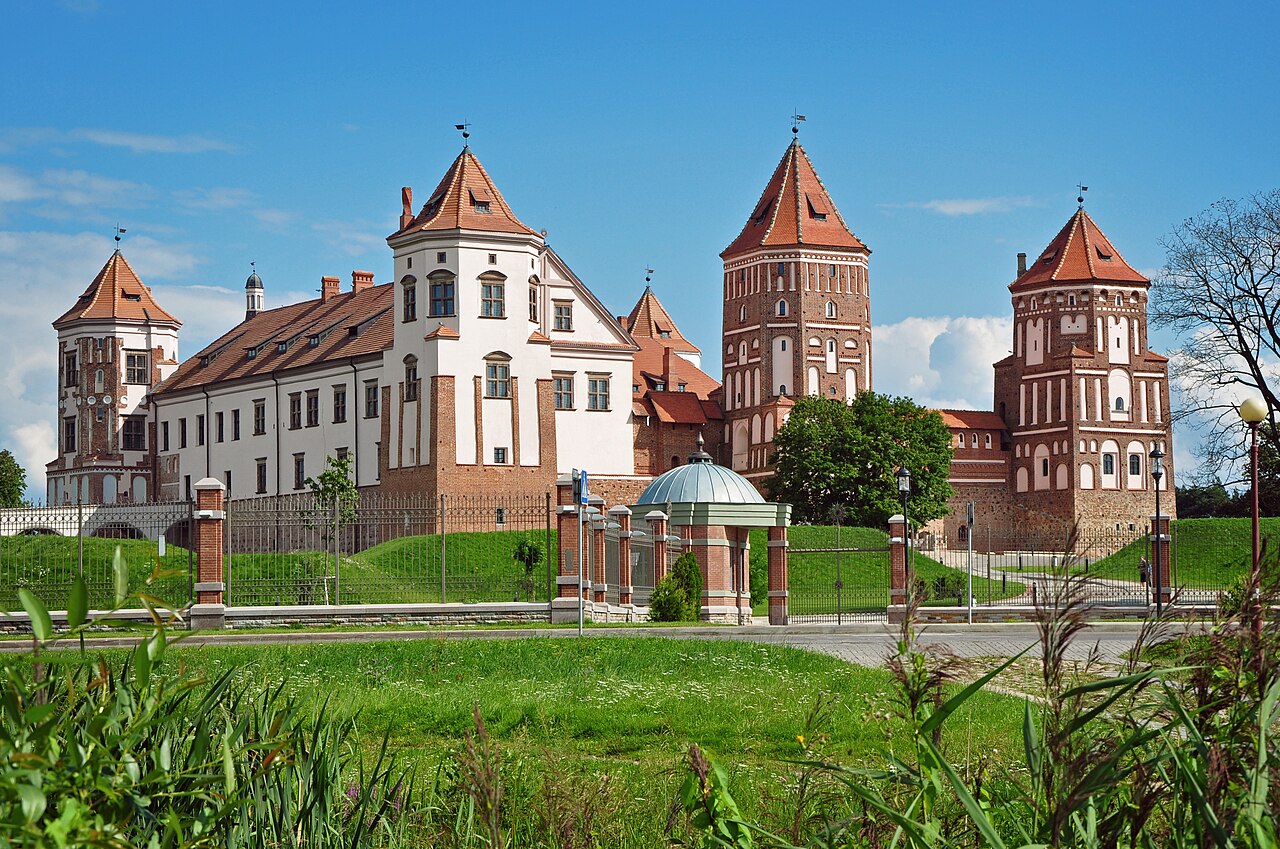
Mir Castle combines Gothic, Renaissance and Baroque elements. Nesvizh’s Radziwiłł residence, Corpus Christi Church and landscaped setting form a separate UNESCO World Heritage property. Grodno’s castles and Kalozha Church introduce a different western cityscape, while Polotsk’s Saint Sophia Cathedral links an early foundation with substantial later rebuilding. Minsk’s National Library is recognised for its faceted modern form.
- Are Mir and Nesvizh the same World Heritage site?
- No. Mir Castle and the Radziwiłł architectural and cultural complex at Nesvizh are separate UNESCO World Heritage properties.
- Are Khatyn and Katyn the same place?
- No. Khatyn in Belarus commemorates a village destroyed under Nazi occupation in 1943. Katyn in Russia is associated with the Soviet massacre of Polish prisoners in 1940.
- Does a sight pin confirm visitor access?
- No. The pins support learning. The UK FCDO advises against all travel to Belarus, checked on 20 October 2026; consult current official advice.
More about Belarus: landmarks
Mir Castle combines Gothic, Renaissance and Baroque elements. Nesvizh’s Radziwiłł residence, Corpus Christi Church and landscaped setting form a separate UNESCO World Heritage property. Grodno’s castles and Kalozha Church introduce a different western cityscape, while Polotsk’s Saint Sophia Cathedral links an early foundation with substantial later rebuilding. Minsk’s National Library is recognised for its faceted modern form.
Brest Fortress commemorates the defence against the German invasion in 1941. Khatyn remembers a village destroyed with its inhabitants in 1943 and the wider destruction of villages under Nazi occupation; it is distinct from Katyn in Russia. The Struve Geodetic Arc includes survey points in Belarus that helped establish the Earth’s shape and size. The sights section uses representative learning pins. Check current official advice before any travel: the UK FCDO advises against all travel to Belarus, checked on 20 October 2026.
Urban communities, a diverse heritage and writers heard worldwide
The 2019 census counted 9,413,446 residents. This is a dated census count, not a current population estimate. Minsk is the largest city, with Gomel, Vitebsk, Mogilev, Grodno and Brest among the regional centres. Belarusians form the ethnic majority alongside Russian, Polish, Ukrainian, Jewish, Tatar, Roma and other communities. Orthodox and Roman Catholic traditions have significant historical roles, alongside other faiths and nonreligious lives.
- How many people did Belarus’s 2019 census count?
- 9,413,446 residents. The figure is a dated census result rather than a current population estimate.
- Which Nobel Prize did Svetlana Alexievich receive?
- The 2015 Nobel Prize in Literature, for writing shaped by many individual testimonies.
- Were Kupala, Kolas and Bahdanovich only nineteenth-century writers?
- No. All were born in the nineteenth century, but their major literary work belongs to the early twentieth century and, for Kupala and Kolas, later decades too.
More about Belarus: people & society
The 2019 census counted 9,413,446 residents. This is a dated census count, not a current population estimate. Minsk is the largest city, with Gomel, Vitebsk, Mogilev, Grodno and Brest among the regional centres. Belarusians form the ethnic majority alongside Russian, Polish, Ukrainian, Jewish, Tatar, Roma and other communities. Orthodox and Roman Catholic traditions have significant historical roles, alongside other faiths and nonreligious lives.
Migration has connected families with communities abroad across several periods, including departures following the repression of 2020. Language, citizenship and ethnic identity should not be treated as interchangeable. Svetlana Alexievich received the 2015 Nobel Prize in Literature for documentary writing built from many individual voices. Artist Marc Chagall drew deeply on his Vitebsk background, while Skaryna, Kupala, Kolas and Bahdanovich offer different routes into the history of printing and literature.