Facts about Croatia
Explore Croatia from Zagreb and the plains of Slavonia to Istria, the Dalmatian coast and the islands of the Adriatic. Learn twenty counties and the City of Zagreb, place sixteen cities and towns, follow four rivers to the Adriatic, discover sixteen sights, read ten illustrated topics and begin Croatian.
- Population, 2021 census
- 3,871,833
- Land area
- 56,594 km²
- Capital
- Zagreb
- Currency
- Euro (€)
- Official language
- Croatian
- EU member since
- 2013
Croatia · 0 of 20 rounds passed
Two timed rounds per topic, 20 seconds a question
Croatia’s long Adriatic coast is only part of its geography. Zagreb and the hills of the northwest lead east towards Slavonia’s farms and the Danube, while Istria, the Kvarner Gulf and Dalmatia form distinct coastal settings. Mountain passes and ferry connections matter as much as straight-line distance when moving between them.
The maps teach twenty counties and the City of Zagreb, sixteen settlement locations in two informal learning groups, and the four rivers and sea that frame the country. Sixteen sights connect Roman and medieval towns with lakes, canyons, agricultural heritage and a memorial landscape. Croatian lessons and thirty answered questions provide a starting point for understanding the country beyond its beaches.
An Adriatic coast and a Pannonian interior
Croatia links Central Europe with the Adriatic. It borders Slovenia, Hungary, Serbia, Bosnia and Herzegovina, and Montenegro. Zagreb sits inland near the Sava, while the eastern region of Slavonia opens onto the Pannonian plain. The Dinaric mountains separate much of the interior from the coast. Istria is the northern peninsula; Dalmatia stretches along much of the southern coast and its islands.
- Where is Croatia?
- On the eastern Adriatic in Europe, with an inland arm extending towards the Danube.
- What is Croatia’s capital?
- Zagreb, an inland city near the Sava river.
- Are all of Croatia’s thousand-plus islands inhabited?
- No. The large total includes islets and rocks; only a few dozen islands have permanent residents.
More about Croatia: geography
Croatia links Central Europe with the Adriatic. It borders Slovenia, Hungary, Serbia, Bosnia and Herzegovina, and Montenegro. Zagreb sits inland near the Sava, while the eastern region of Slavonia opens onto the Pannonian plain. The Dinaric mountains separate much of the interior from the coast. Istria is the northern peninsula; Dalmatia stretches along much of the southern coast and its islands.
The Sava and Drava drain towards the Danube and the Black Sea, while short coastal rivers flow to the Adriatic. Limestone karst creates caves, sinkholes and rivers that sometimes disappear underground. More than a thousand islands, islets and rocks fringe the coast, but only a few dozen islands are inhabited. Brač, Hvar, Korčula, Krk and Cres are among the better-known larger islands; an island count depends on what categories are included.
Roman cities, borderlands and independence
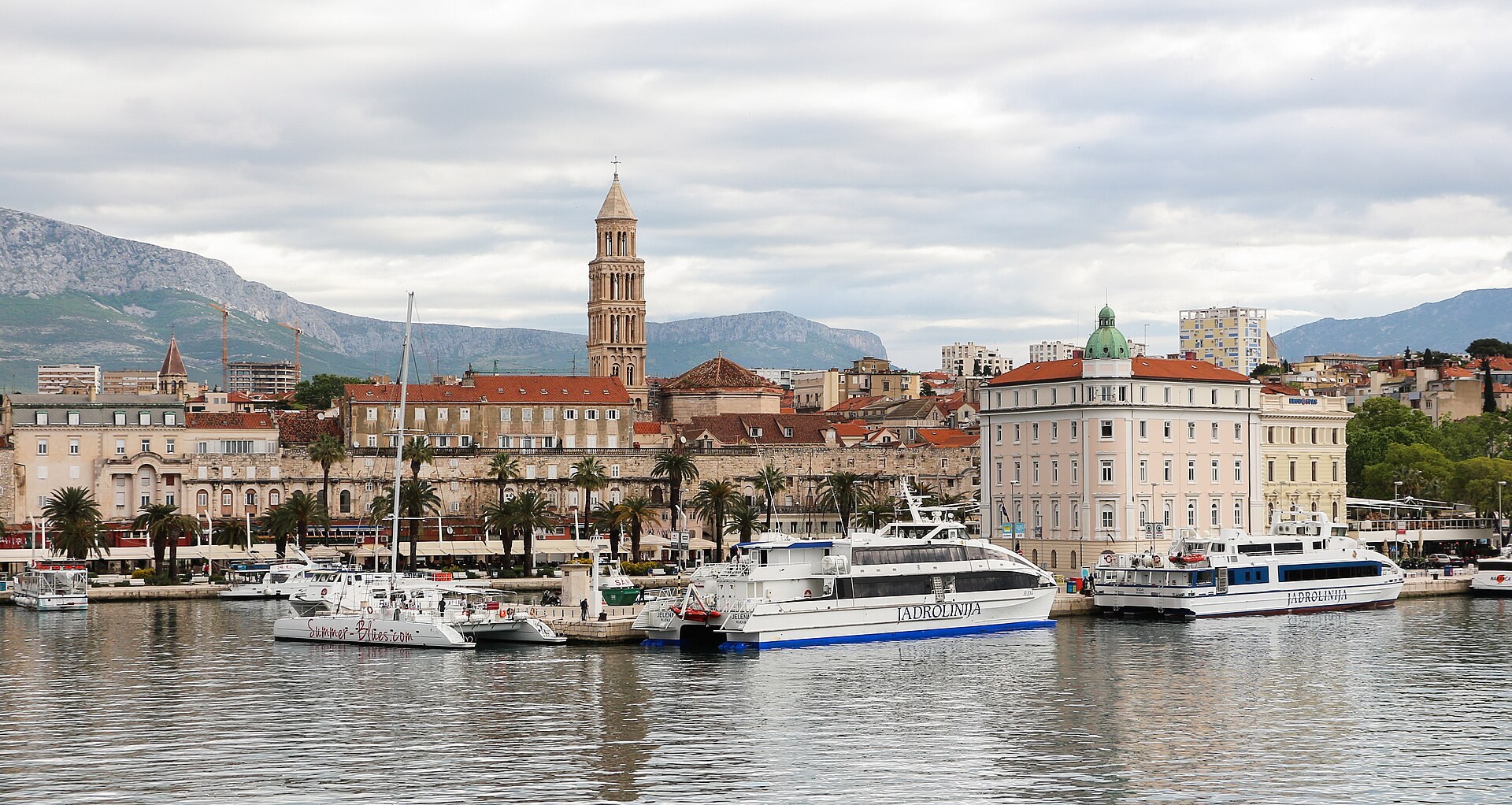
Roman remains are visible in Pula’s amphitheatre and in Split, where a living city grew within and around Diocletian’s palace. Medieval Croatian rulers were followed by a long association with the Hungarian crown from 1102. Later histories varied by region: Habsburg rule shaped much of the north and interior, Venice held many coastal towns, and Dubrovnik developed as the maritime Republic of Ragusa.
- What was Diocletian’s Palace?
- A Roman imperial palace built around the turn of the fourth century, whose fabric became part of Split’s historic centre.
- When did Croatia declare independence?
- In June 1991, during the breakup of Yugoslavia.
- Was Dubrovnik always ruled like the rest of Croatia?
- No. The Republic of Ragusa had its own maritime and diplomatic history, distinct from nearby Venetian and Habsburg territories.
More about Croatia: history
Roman remains are visible in Pula’s amphitheatre and in Split, where a living city grew within and around Diocletian’s palace. Medieval Croatian rulers were followed by a long association with the Hungarian crown from 1102. Later histories varied by region: Habsburg rule shaped much of the north and interior, Venice held many coastal towns, and Dubrovnik developed as the maritime Republic of Ragusa.
After 1918, Croatian lands entered the new South Slav kingdom. The Second World War brought occupation, the Ustaša regime’s persecution and mass killing, and a partisan resistance. Croatia became one of socialist Yugoslavia’s six republics after the war. It declared independence in June 1991; the ensuing war lasted until 1995, while the peaceful reintegration of eastern Slavonia was completed in 1998. Those milestones describe different stages of statehood and recovery.
Croatian, its dialects and the Latin alphabet
Croatian is the official language and uses the Latin alphabet, including letters such as č, ć, đ, š and ž. It is a South Slavic language closely related to Bosnian, Serbian and Montenegrin, with extensive mutual intelligibility. These standards have their own names, vocabulary choices and cultural traditions. Minority languages also have protected roles, including local official use where legal conditions are met.
- Which alphabet does Croatian use today?
- The Latin alphabet, with additional letters and letter combinations used for Croatian sounds.
- What does hvala mean?
- Thank you.
- What are the three traditional dialect groups?
- Kajkavian, Chakavian and Shtokavian; standard Croatian is based on Shtokavian.
More about Croatia: language
Croatian is the official language and uses the Latin alphabet, including letters such as č, ć, đ, š and ž. It is a South Slavic language closely related to Bosnian, Serbian and Montenegrin, with extensive mutual intelligibility. These standards have their own names, vocabulary choices and cultural traditions. Minority languages also have protected roles, including local official use where legal conditions are met.
The traditional dialect groups are Kajkavian, Chakavian and Shtokavian, named after forms of the word what: kaj, ča and što. Standard Croatian is based on Shtokavian. The Baška tablet preserves an important medieval Glagolitic inscription; Glagolitic belongs to Croatia’s written heritage rather than its everyday modern script. Dobar dan means good day, molim means please, and hvala means thank you. The linked lessons introduce Croatian for everyday situations.
Klapa voices, lace and contemporary city life
Klapa is multipart singing associated with Dalmatia, often performed without instruments. Other traditions have strong local roots: the Sinjska alka is an equestrian tournament in Sinj, and lace-making traditions are associated with Pag, Lepoglava and Hvar. UNESCO’s intangible heritage lists recognise living practices and skills; these are a different category from World Heritage buildings or landscapes.
- What is klapa?
- A tradition of multipart singing associated with Dalmatia, commonly performed a cappella.
- What is the Sinjska alka?
- An equestrian tournament in Sinj, recognised as intangible cultural heritage.
- Is intangible heritage the same as a World Heritage Site?
- No. Intangible heritage concerns living practices and skills, while World Heritage properties are recognised places.
More about Croatia: culture
Klapa is multipart singing associated with Dalmatia, often performed without instruments. Other traditions have strong local roots: the Sinjska alka is an equestrian tournament in Sinj, and lace-making traditions are associated with Pag, Lepoglava and Hvar. UNESCO’s intangible heritage lists recognise living practices and skills; these are a different category from World Heritage buildings or landscapes.
Zagreb’s theatres and museums, Dubrovnik’s summer performances and Split’s music and film events form part of contemporary cultural life. Sculptor Ivan Meštrović and the naive painters associated with Hlebine represent different artistic traditions. Coffee on a terrace is a familiar social ritual, but daily life also varies between an inland university city, a farming village and a tourist island. No single coastal festival represents every community.
Tourism, ports and an economy using the euro
Services form a large part of Croatia’s economy. Tourism supports accommodation, restaurants, ferries and seasonal employment, particularly along the coast and on the islands. Rijeka is a major seaport, while Zagreb concentrates business, administration and technology firms. Manufacturing includes food processing and pharmaceuticals; shipbuilding has a long history in coastal cities. Slavonia’s fields and vineyards connect the economy to the inland landscape.
- What currency does Croatia use?
- The euro, adopted on 1 January 2023; the kuna is the former currency.
- When did Croatia join the European Union?
- On 1 July 2013.
- Is Croatia’s economy only tourism?
- No. Tourism is important, alongside other services, manufacturing, trade, agriculture and technology.
More about Croatia: economy
Services form a large part of Croatia’s economy. Tourism supports accommodation, restaurants, ferries and seasonal employment, particularly along the coast and on the islands. Rijeka is a major seaport, while Zagreb concentrates business, administration and technology firms. Manufacturing includes food processing and pharmaceuticals; shipbuilding has a long history in coastal cities. Slavonia’s fields and vineyards connect the economy to the inland landscape.
Croatia adopted the euro on 1 January 2023, replacing the kuna, and entered the Schengen area on the same date. European Union membership began earlier, on 1 July 2013. Tourism’s economic contribution varies by year and by whether a measure includes indirect effects, so an undated share of GDP can mislead. Seasonal demand, housing costs, regional differences and population ageing all affect work and investment.
The Sabor and a parliamentary republic
Croatia is a unitary parliamentary republic. The prime minister heads the government, the president is head of state, and the Sabor is the national parliament. Zagreb is the seat of the main national institutions. Twenty counties and the City of Zagreb form the county-level administrative structure; Zagreb has a special status combining city and county responsibilities.
- What is the Croatian parliament called?
- The Sabor.
- Who leads the government?
- The prime minister; the president is head of state.
- How many counties does Croatia have?
- Twenty counties, plus the City of Zagreb with county-level status.
More about Croatia: politics
Croatia is a unitary parliamentary republic. The prime minister heads the government, the president is head of state, and the Sabor is the national parliament. Zagreb is the seat of the main national institutions. Twenty counties and the City of Zagreb form the county-level administrative structure; Zagreb has a special status combining city and county responsibilities.
Croatia joined NATO in 2009 and the European Union in 2013. Euro-area and Schengen membership followed in 2023. These memberships concern different institutions and rules. The guide’s coast-and-interior learning groups are geographic aids rather than county boundaries. A map pin for Zagreb identifies a settlement centre, not the boundary of the capital’s administrative area.
Waterfall lakes, mountain forests and wetlands
Plitvice Lakes National Park is known for linked lakes and waterfalls formed around active tufa barriers. Krka National Park protects another river landscape with striking waterfalls. Croatia has eight national parks, but this does not mean eight UNESCO-listed parks. Plitvice is a World Heritage property; other Croatian UNESCO designations include cultural sites and selected beech-forest areas within a wider transnational property.
- Why are Plitvice’s lakes distinctive?
- Water flows between lakes and over tufa barriers, creating a changing system of waterfalls.
- How many national parks does Croatia have?
- Eight; national park status and UNESCO recognition are different designations.
- Is Kopački Rit a national park?
- No. It is a nature park protecting a Danube–Drava floodplain landscape.
More about Croatia: nature & wildlife
Plitvice Lakes National Park is known for linked lakes and waterfalls formed around active tufa barriers. Krka National Park protects another river landscape with striking waterfalls. Croatia has eight national parks, but this does not mean eight UNESCO-listed parks. Plitvice is a World Heritage property; other Croatian UNESCO designations include cultural sites and selected beech-forest areas within a wider transnational property.
Paklenica and Northern Velebit reveal the limestone mountains above the Adriatic, while Kornati protects an island and marine landscape. Mljet, Brijuni and Risnjak complete the national park list. Kopački Rit, near the Drava–Danube confluence, is a nature park with floodplain wetlands, not a ninth national park. Griffon vultures are associated with the Kvarner islands. Swimming, boating and walking permissions vary by protected area and season.
Adriatic seafood, Zagorje pastry and Slavonian spice
Croatian cooking varies by region. Along the Adriatic, fish, shellfish, olive oil and vegetables feature prominently; crni rižot gets its dark colour from cuttlefish or squid ink. Dalmatian pašticada is a slow-cooked beef dish, often served with gnocchi. Peka describes cooking beneath a bell-shaped lid covered with embers, rather than one fixed recipe or ingredient.
- What is peka?
- A method of cooking food beneath a bell-shaped lid covered with hot embers.
- What are zagorski štrukli?
- A dough-and-cheese dish associated with Hrvatsko Zagorje, served in boiled or baked forms.
- Is Croatian wine only coastal?
- No. Slavonia and other inland areas are important wine regions as well as Istria, Dalmatia and the islands.
More about Croatia: food & cuisine
Croatian cooking varies by region. Along the Adriatic, fish, shellfish, olive oil and vegetables feature prominently; crni rižot gets its dark colour from cuttlefish or squid ink. Dalmatian pašticada is a slow-cooked beef dish, often served with gnocchi. Peka describes cooking beneath a bell-shaped lid covered with embers, rather than one fixed recipe or ingredient.
In the north, zagorski štrukli are made with dough and a cheese filling, with boiled and baked versions. Slavonia is known for kulen, a paprika-seasoned cured sausage, while Istria combines pasta, olive oil and truffles. Wine is made in both inland and coastal regions: Graševina is especially associated with Slavonia and Malvazija with Istria. Pag sheep’s cheese and Dalmatian cured ham add further local traditions. Recipes, diets and preferences vary between households.
Roman stonework and living Adriatic towns
Dubrovnik’s walls enclose the historic centre of the former Ragusan republic. Split’s World Heritage centre includes Diocletian’s Palace, but the palace is also part of a living neighbourhood rather than an isolated monument. Pula’s Roman amphitheatre offers another view of the ancient Adriatic. Trogir’s compact old town and Šibenik’s Cathedral of St James illustrate later architectural traditions.
- Where is Diocletian’s Palace?
- In Split, where its remains are integrated into the historic city centre.
- What is Pula Arena?
- A Roman amphitheatre in Pula, on the Istrian peninsula.
- What makes Poreč’s Euphrasian complex notable?
- Its early Christian architecture and mosaics, recognised as a World Heritage property.
More about Croatia: landmarks
Dubrovnik’s walls enclose the historic centre of the former Ragusan republic. Split’s World Heritage centre includes Diocletian’s Palace, but the palace is also part of a living neighbourhood rather than an isolated monument. Pula’s Roman amphitheatre offers another view of the ancient Adriatic. Trogir’s compact old town and Šibenik’s Cathedral of St James illustrate later architectural traditions.
Poreč’s Euphrasian episcopal complex is celebrated for its early Christian mosaics. Hvar’s Stari Grad Plain preserves an agricultural layout whose origins reach back to Greek settlement, while Korčula and Rovinj show different forms of coastal townscape. Inland, Zagreb’s Upper Town, Varaždin and eastern memorial sites widen the story beyond seaside walls. Heritage recognition, visitor opening and the condition of a particular building are separate matters.
An inland capital, regional identities and diaspora ties
The 2021 census counted 3,871,833 residents. This is a dated census total, not an estimate of today’s population. Most residents identified as Croats, alongside Serb and other minority communities. Roman Catholicism is the largest religious affiliation; Orthodox, Muslim, Protestant, Jewish and nonreligious communities also belong to the country’s social landscape. Citizenship, ethnicity, language and religion describe different aspects of identity.
- What population did the 2021 census record?
- 3,871,833 residents; this is a census count for 2021.
- Which city is Croatia’s largest?
- Zagreb, the capital and largest urban centre.
- Where was Nikola Tesla born?
- Smiljan, then in the Austrian Empire and now in Croatia, into a Serb family.
More about Croatia: people & society
The 2021 census counted 3,871,833 residents. This is a dated census total, not an estimate of today’s population. Most residents identified as Croats, alongside Serb and other minority communities. Roman Catholicism is the largest religious affiliation; Orthodox, Muslim, Protestant, Jewish and nonreligious communities also belong to the country’s social landscape. Citizenship, ethnicity, language and religion describe different aspects of identity.
Zagreb is the largest city, with Split, Rijeka and Osijek anchoring other regions. Emigration and population ageing have shaped recent demographic change, while diaspora links connect families across Europe and farther afield. Sport is highly visible, including football and tennis. Nikola Tesla was born in Smiljan to a Serb family, in the Austrian Empire on territory now in Croatia; his biography crosses modern national categories rather than fitting a simple single-country label.