Facts about Albania
Explore Albania from Tirana and the Adriatic ports to the northern Alps, Ottoman towns and Ionian Riviera. Learn twelve counties, place sixteen cities and towns, explore rivers, a lake and coastal waters, discover sixteen sights, read ten illustrated topics and begin Albanian.
- Population · 2023 census
- 2,402,113
- Area
- 28,748 km²
- Capital
- Tirana
- Currency
- Albanian lek (ALL)
- Official language
- Albanian
- Coasts
- Adriatic & Ionian
Albania · 0 of 20 rounds passed
Two timed rounds per topic, 20 seconds a question
A western Balkan country facing Italy across the Strait of Otranto, Albania brings coastal plains, mountain valleys and shared border lakes into a compact area. Tirana is the capital, Durrës a major port, Shkodër a northern centre, and Berat and Gjirokastër historic inland anchors.
Find the twelve counties and explore the waters, then place settlements on the city map. Its northern and southern groups are learning aids rather than county or municipal boundaries. Thirty answered questions connect the places with language, history, culture and daily life.
Two seas, mountain valleys and shared lakes
Albania sits on the western side of the Balkan Peninsula, where mountain valleys open onto the Adriatic and Ionian seas. Its compact size hides a varied landscape: northern alpine peaks, large border lakes, coastal plains and the southern Riviera.
- Where is Albania?
- In southeastern Europe, across the Strait of Otranto from Italy. Its land neighbours are Montenegro, Kosovo, North Macedonia and Greece.
- What is the capital of Albania?
- Tirana is the capital and largest city. Durrës is a major Adriatic port, while Shkodër anchors the north and Vlorë stands near the meeting of the two seas.
- How big is Albania?
- It covers 28,748 km². Mountains and hills occupy most of the country, so journeys inland can take longer than distances on a map suggest.
More about Albania: geography
Albania lies on the western side of the Balkan Peninsula, across the Strait of Otranto from Italy. It borders Montenegro, Kosovo, North Macedonia and Greece. The Adriatic coast opens onto low plains in the west; the Ionian coast runs below steep southern hills. Tirana, the capital and largest city, stands inland from the Adriatic port of Durrës. Mountains and hills occupy much of the country’s 28,748 square kilometres.
The Albanian Alps rise in the north around Theth and Valbona. Mount Korab, on the North Macedonian border, is the highest point. Lake Shkodër is shared with Montenegro, Lake Ohrid with North Macedonia, and the Prespa lake region reaches into Greece as well. Rivers including the Drin, Shkumbin and Vjosa link inland valleys to the coast. These landscapes help explain where towns grew and why short map distances can involve long mountain journeys.
From ancient cities to independence and isolation
Ancient settlements, Ottoman towns and communist bunkers mark different chapters of Albanian history. Independence arrived in 1912; much of the twentieth century was shaped by dictatorship and isolation before the return of multiparty politics.
- When did Albania become independent?
- On 28 November 1912, when Ismail Qemali and other delegates declared independence from the Ottoman Empire in Vlorë. The date is celebrated as Independence Day.
- Who was Skanderbeg?
- Gjergj Kastrioti, known as Skanderbeg, was the fifteenth-century leader who resisted Ottoman expansion. His stronghold at Krujë and his statue in Tirana keep his place as a national hero visible.
- Why are there so many bunkers in Albania?
- Enver Hoxha’s communist government built them across the country in preparation for a feared invasion. Some now house museums or businesses; many remain scattered through fields and towns.
More about Albania: history
Illyrian communities, Greek colonies, Roman roads and Byzantine churches all belong to the history of the land now called Albania. Apollonia and Butrint preserve several of those layers. Ottoman rule developed unevenly across the region over centuries. In the fifteenth century, Gjergj Kastrioti, known as Skanderbeg, led resistance to Ottoman expansion; Krujë became closely associated with his story. Ismail Qemali and other delegates declared independence in Vlorë on 28 November 1912.
The twentieth century brought King Zog’s monarchy, Italian occupation in 1939, German occupation and partisan warfare. Enver Hoxha’s communist regime took power in 1944 and restricted political, religious and economic life. Its successive breaks with Yugoslavia, the Soviet Union and China deepened isolation, while defensive bunkers spread across the landscape. The one-party system began to end in 1990 and multiparty elections followed in 1991. The collapse of pyramid investment schemes in 1997 caused another severe national crisis.
Shqip, a distinct Indo-European branch
Albanian, or shqip, forms its own branch of the Indo-European language family. It is neither a Slavic nor a Romance language, although centuries of contact have left borrowed words from neighbouring languages.
- What are the main Albanian dialects?
- Gheg is associated mainly with the north and Tosk with the south. Standard Albanian is based largely on Tosk, while regional speech remains an important part of everyday life.
- Which alphabet does Albanian use?
- A Latin-based alphabet of 36 letters, including ë and ç. The Congress of Manastir in 1908 was a key step in establishing a common alphabet.
- Is Albanian spoken outside Albania?
- Yes. It is widely spoken in Kosovo, parts of North Macedonia and other neighbouring areas, as well as in diaspora communities. The language crosses more borders than the modern Albanian state.
More about Albania: language
Albanian, called shqip by its speakers, is the official language. It forms its own branch of the Indo-European family rather than belonging to the Slavic or Romance branches. Gheg is associated mainly with the north and Tosk with the south, with the Shkumbin valley often used as a broad dividing line. Standard Albanian is based largely on Tosk, while regional speech remains important in daily life.
The Latin-based alphabet has 36 letters, including ë and ç and letter combinations such as sh and gj. The Congress of Manastir in 1908 was a key step towards a shared alphabet. Përshëndetje means hello and faleminderit means thank you. Albanian is also widely spoken in Kosovo, parts of North Macedonia and other neighbouring areas, as well as in diaspora communities. The linked Worldly lessons introduce Albanian without treating every regional variety as identical.
Hospitality, multipart singing and regional traditions
Hospitality, family gatherings and music are recurring threads in Albanian cultural life. Traditions differ between regions, from northern customary codes to the layered folk singing of the south.
- What does besa mean?
- Besa is a pledge of trust or honour: keeping your word and accepting responsibility toward others. It is often discussed alongside the importance of welcoming and protecting a guest.
- What is Albanian iso-polyphony?
- A form of multipart folk singing in which solo voices intertwine above a group drone. UNESCO recognised it in 2005 and placed it on the Representative List of Intangible Cultural Heritage in 2008.
- What is the Kanun?
- A body of traditional customary rules covering subjects such as family, property and hospitality, especially associated with northern Albania. It is part of cultural history, not the country’s modern legal system.
More about Albania: culture
Besa describes a pledge of trust or honour and is often discussed alongside the responsibility to welcome and protect a guest. The Kanun is a body of historical customary rules, especially associated with northern communities; it is distinct from Albania’s modern legal system. Regional dress also varies: the pleated fustanella and the northern xhubleta belong to different traditions rather than one universal national costume.
Southern iso-polyphony weaves solo voices over a sustained group drone. UNESCO proclaimed it a Masterpiece in 2005 and inscribed it on the Representative List in 2008. Valle group dances accompany celebrations, while Korçë is associated with serenades and Gjirokastër with its national folk festival. Contemporary film, literature, visual art and popular music continue alongside these traditions. Muslim, Bektashi, Orthodox, Catholic and secular experiences all contribute to cultural life.
Tourism, farming, hydropower and diaspora ties
Albania moved from a centrally planned economy toward a market economy after communist rule. Tourism, services, agriculture and construction support livelihoods, while money sent home by Albanians abroad remains economically important.
- What currency does Albania use?
- The Albanian lek, with the currency code ALL. The Bank of Albania issues the national banknotes and coins.
- Why does tourism matter to Albania?
- Visitors support accommodation, restaurants, transport and local businesses, from the coast to mountain villages. Growth also creates pressure to manage construction and protect natural and historic places.
- What are remittances?
- Money that people working abroad send home. For Albania, these transfers connect a large diaspora to household budgets and the wider economy.
More about Albania: economy
The transition from communist central planning to a market economy changed work, land ownership and migration after 1990. Services, tourism, agriculture and construction now support many livelihoods. Durrës is a major maritime gateway, while farms produce vegetables, grains, olives and fruit. Hydropower supplies much of domestic electricity generation, connecting energy production to river flows and making rainfall variability economically important.
Albania uses the lek, currency code ALL, issued by the Bank of Albania. Remittances sent by people working abroad help household budgets and connect the diaspora with the economy. Tourism supports businesses from the Riviera to mountain villages, but seasonal employment and rapid construction raise questions about infrastructure and conservation. Economic conditions differ between the Tirana–Durrës corridor, coastal destinations and inland communities; a growing visitor economy does not describe every household’s experience.
A parliamentary republic and European integration
Albania is a parliamentary republic. The prime minister leads the government, the president serves as head of state, and the national parliament is known as the Kuvendi.
- Does Albania have a king?
- No. It is a republic, although it was a kingdom under King Zog in the twentieth century before the Second World War.
- When did multiparty politics return?
- The one-party system began to end in 1990, and multiparty elections followed in 1991. The transition brought major political and economic changes after decades of communist rule.
- What does a parliamentary republic mean?
- The government depends on support in parliament. The roles of head of government and head of state are separate, rather than being combined in an executive presidency.
More about Albania: politics
Albania is a parliamentary republic under its 1998 constitution. The Kuvendi is the national parliament; the prime minister leads the government, while the president is head of state. Tirana houses the main national institutions. The country has twelve counties and 61 municipalities. This guide’s city map marks settlements, so its two learning groups do not represent either level of local government.
Albania joined NATO in April 2009 and applied for European Union membership that same month. It received EU candidate status in 2014, and accession negotiations formally opened in July 2022. NATO membership and EU accession are separate processes. Learning the constitutional roles and those dated milestones gives a more durable picture than memorising the name of a current officeholder.
Alpine habitats, wetlands and a protected wild river
Albania’s landscapes range from the Albanian Alps to coastal wetlands and clear southern springs. Rivers and border lakes connect these habitats to the wider Balkans.
- What is special about the Vjosa?
- It is one of Europe’s notable free-flowing river systems. In March 2023, Albania established the Vjosa Wild River National Park to protect the river and selected tributaries.
- Which countries share Albania’s large lakes?
- Lake Shkodër is shared with Montenegro, Lake Ohrid with North Macedonia, and the Prespa lake region extends across Albania, North Macedonia and Greece.
- What is the Blue Eye?
- Syri i Kaltër, the Blue Eye, is a freshwater spring in southern Albania, known for its intense blue centre and clear surrounding water. It is a spring, rather than a sea inlet.
More about Albania: nature & wildlife
The Albanian Alps contain limestone peaks, forests and high pastures around Theth and Valbona. Brown bears, wolves and other wildlife inhabit parts of the country’s mountain landscapes. At lower elevations, lagoons such as Karavasta provide important bird habitat, including for Dalmatian pelicans. Lake Ohrid is known for its ancient freshwater ecosystem and endemic species; its UNESCO property combines natural and cultural heritage across the Albanian–North Macedonian border.
In March 2023 Albania established Vjosa Wild River National Park, protecting the river and selected tributaries in the Albanian part of the basin. The river begins in Greece, where it is called Aoos. Near Sarandë, Syri i Kaltër, the Blue Eye, is a freshwater spring rather than a lake or sea inlet. Mountain weather, summer heat and protected-area rules shape visits. A landscape pin is a learning reference point, not a marked trail or confirmed entrance.
Byrek, baked yoghurt dishes and seasonal produce
Albanian cooking brings together Mediterranean ingredients and Balkan and Ottoman influences. Pastry, yoghurt, vegetables, lamb and white cheese appear in everyday dishes, with regional variations from the coast to the mountains.
- What is tavë kosi?
- A baked dish of lamb and rice with a yoghurt-and-egg topping, particularly associated with Elbasan. It is one of Albania’s best-known dishes.
- What is byrek?
- A savoury pastry made with thin layers of dough. Common fillings include cheese, spinach and meat, and it is sold in bakeries as well as made at home.
- What is fërgesë?
- A dish associated with Tirana, commonly made with peppers, tomatoes and curd cheese. Recipes vary, and some versions include meat or liver.
More about Albania: food & cuisine
Albanian kitchens combine Mediterranean ingredients with Balkan and Ottoman influences. Byrek wraps cheese, spinach, meat or other fillings in thin pastry. Tavë kosi, particularly associated with Elbasan, bakes lamb and rice beneath a yoghurt-and-egg topping. Fërgesë is associated with Tirana and commonly combines peppers, tomatoes and curd cheese; versions can also include meat or liver.
Olive oil, vegetables, bread, white cheese and yoghurt feature widely, while coastal fish and inland dairy reflect local conditions. Sweets such as baklava and trileçe appear in bakeries and at celebrations. Coffee is an everyday social occasion, and raki is a fruit spirit served in some households. Recipes, religious practice and personal preferences vary, so neither meat nor alcohol is a requirement of Albanian hospitality.
Ancient ruins, Ottoman towns and the modern capital
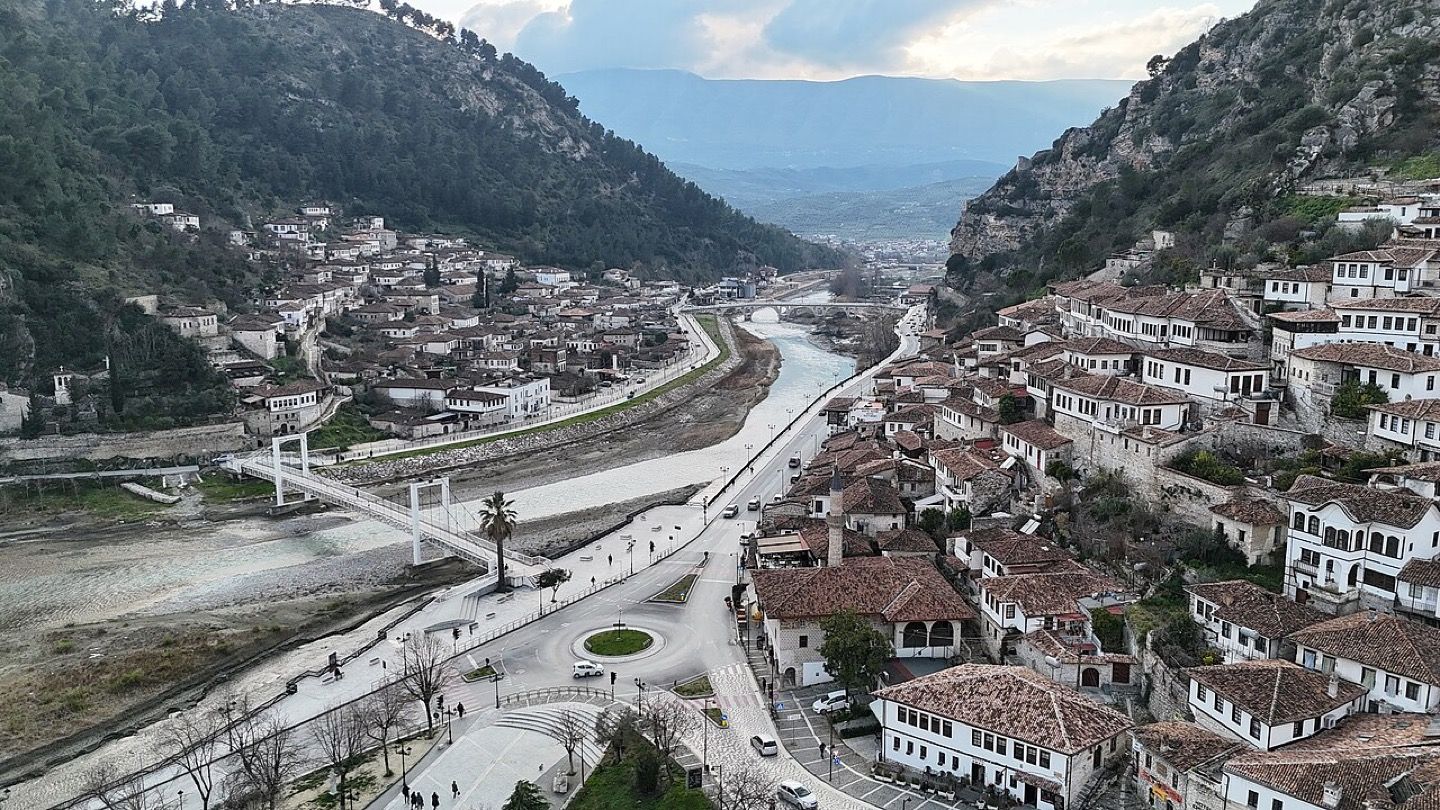
Albania’s historic places reward a closer look: a theatre beside a lagoon at Butrint, rows of hillside houses in Berat, and stone roofs below the fortress of Gjirokastër.
- What can you see at Butrint?
- An archaeological site with remains from several periods, including Greek, Roman, Byzantine and Venetian history. Its theatre, baptistery and fortifications sit within a landscape of woodland and water.
- Why are Berat and Gjirokastër UNESCO-listed?
- Their historic centres preserve distinctive Ottoman-period urban architecture. Berat is known for its hillside houses and windows; Gjirokastër for its stone houses, roofs and castle.
- Where is Skanderbeg Square?
- In central Tirana. Named for the national hero, it is a useful starting point for understanding the capital, beside landmarks including the Et’hem Bey Mosque and the clock tower.
More about Albania: landmarks
Butrint’s theatre, baptistery and fortifications preserve Greek, Roman, Byzantine and later layers beside a lagoon in the far south. Berat and Gjirokastër form a single UNESCO World Heritage property recognising two distinctive historic centres: Berat’s hillside neighbourhoods and Gjirokastër’s stone houses and roofs. Their castles offer context for the towns below, while inhabited streets make clear that these are living places.
Krujë Castle connects a mountain stronghold with Skanderbeg’s story. Rozafa Castle overlooks the river and lake setting near Shkodër, and Apollonia explains an ancient settlement near today’s Fier. In Tirana, Skanderbeg Square gathers the national hero’s statue, Et’hem Bey Mosque and the clock tower into one urban setting. Museums and surviving bunkers add the history of dictatorship. Heritage descriptions explain significance; opening times and access should be checked separately.
Residents, neighbouring communities and a global diaspora
Albania’s story extends well beyond its borders. Migration, neighbouring Albanian-speaking communities and generations of writers and artists link the country to the rest of Europe and the world.
- How many people live in Albania?
- The 2023 census counted 2,402,113 residents, or about 2.4 million. This is a dated census figure, not a count of everyone with Albanian heritage worldwide.
- Why is the Albanian diaspora important?
- Albanians abroad maintain family, cultural and economic ties with the country. Migration has a long history, with another major wave following the end of communist rule.
- Who was Ismail Kadare?
- An Albanian novelist born in Gjirokastër, known internationally for works including The General of the Dead Army. His fiction explores history, power and life under authoritarian rule.
More about Albania: people & society
The 2023 census counted 2,402,113 residents in Albania. This dated resident count differs from the number of people with Albanian citizenship or heritage worldwide. Migration has shaped the country for generations, with a major new wave after communist rule ended. Italy and Greece are important destinations, and family, cultural and financial ties connect communities abroad with towns and villages at home.
Albania includes Greek, Roma, Egyptian, Aromanian, Macedonian and other minority communities alongside the Albanian majority. Muslim, Bektashi, Orthodox, Catholic, other religious and non-religious identities are part of society. Novelist Ismail Kadare was born in Gjirokastër; Mother Teresa was born to an Albanian family in Skopje, now in North Macedonia. Their biographies show why ancestry, birthplace, citizenship and present national borders should be distinguished.