Facts about Bulgaria
Capital Sofia · Europe
10 topics · 20 lessons · about 20 minutes
Bulgaria sits in the eastern Balkans between the Danube and the Black Sea, and it is one of the oldest states in Europe, having kept the same name since 681. It gave the Slavic world the Cyrillic alphabet, and it joined the European Union in 2007 after four decades of communist rule.
Bulgaria is split across the middle by the Balkan Mountains, which run east to west and gave the whole peninsula its name. The Danube forms most of the northern border with Romania, the Black Sea coast to the east carries the beach resorts, and the Thracian Plain in the south is the agricultural heartland and the source of most Bulgarian wine. The southwest is the most mountainous corner, holding the Rila range and Musala, the highest peak anywhere in the Balkans.
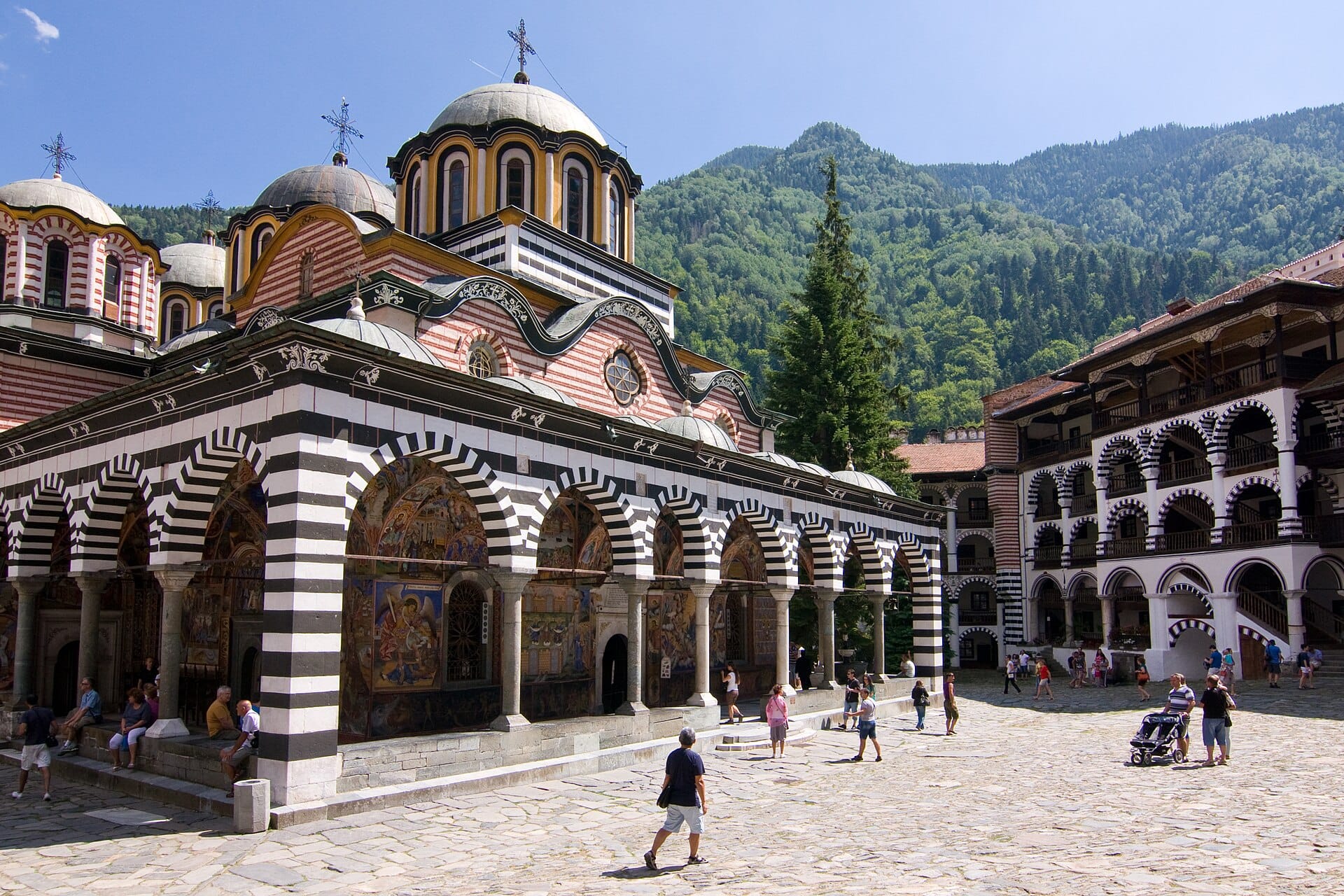
Sofia sits in a basin below Vitosha mountain and keeps growing while much of the countryside empties. Plovdiv is among the oldest continuously inhabited cities in Europe, Varna and Burgas anchor the Black Sea coast, and Veliko Tarnovo was the medieval capital. Visitors tend to divide between the summer coast, the ski resorts at Bansko and Borovets, and the monasteries and Roman remains inland, with Rila Monastery the single site most people make the trip for.
- Population
- 6.4 million
- Area
- 110,994 km²
- Currency
- Euro (€), adopted 2026
- Official language
- Bulgarian
- Provinces
- 28
- Highest point
- Musala, 2,925 m
The Bulgaria course
Geography of Bulgaria2 lessons
Mountains across the middle, the Danube to the north, and the Black Sea to the east.
History of Bulgaria2 lessons
The same name since 681, five Ottoman centuries, and the birthplace of the Cyrillic script.
Language of Bulgaria2 lessons
The first Slavic language written down, and it nods for no and shakes its head for yes.
Culture of Bulgaria2 lessons
Irregular folk meters, a song sent into interstellar space, and red and white threads each March.
Economy of Bulgaria2 lessons
The lowest labour costs in the EU, a flat 10 percent tax, and most of the world’s rose oil.
Politics of Bulgaria2 lessons
A parliamentary republic, repeated snap elections, and the euro adopted in 2026.
Nature & Wildlife of Bulgaria2 lessons
About 40 percent under protection, and bird migration funnelling down the Black Sea coast.
Food & Cuisine of Bulgaria2 lessons
A salad in the colors of the flag, more yoghurt than almost anyone, and Thracian wine.
Landmarks of Bulgaria2 lessons
A monastery that sheltered the language, Roman ruins under Sofia, and a theater still in use.
People & Society of Bulgaria2 lessons
Shrinking faster than almost any country on Earth since 1989.
Geography of Bulgaria
Bulgaria is divided across the middle by the Balkan Mountains, which run east to west and give the whole peninsula its name. The Danube forms most of the northern border with Romania, and the Black Sea coast to the east carries the beach resorts that draw much of the country’s tourism.
The southwest is the most mountainous part, holding the Rila range and Musala, which at 2,925 meters is the highest peak anywhere in the Balkans. The Thracian Plain in the south is the agricultural heartland and the source of most Bulgarian wine. The climate is continental in the interior with hot summers and genuinely cold, snowy winters.

History of Bulgaria
Thracians occupied these lands in antiquity, leaving gold hoards and tombs, and Spartacus is thought to have come from among them. The First Bulgarian Empire was founded in 681 and adopted Christianity in 864, after which the disciples of Cyril and Methodius developed the Cyrillic script here and spread it through the Slavic world.
Ottoman rule lasted nearly five centuries from 1396 until Russian intervention produced an autonomous Bulgaria in 1878, an event still marked as liberation day. The country backed the losing side in both world wars, then spent 1946 to 1989 as one of the closest Soviet allies. Bulgaria joined NATO in 2004, the EU in 2007 and adopted the euro in January 2026.
Language of Bulgaria
Bulgarian was the first Slavic language written down, and Old Church Slavonic developed from it as the liturgical language of Orthodox Christianity across eastern Europe. Modern Bulgarian has around eight million speakers and became the first official Cyrillic language of the European Union when the country joined.
It is unusual among Slavic languages in having dropped noun cases almost entirely while adding a definite article attached to the end of the word. It also keeps evidential verb forms that mark whether the speaker witnessed something or heard it secondhand. Bulgarians conventionally shake their head for yes and nod for no, which reliably confuses visitors.

Culture of Bulgaria
Bulgarian folk music uses irregular meters that sound off-balance to ears trained on Western rhythm, and the close harmonies of women’s choirs reached a global audience through the Mystère des Voix Bulgares recordings. A Bulgarian folk song was included on the Voyager Golden Record sent into interstellar space in 1977.
The Orthodox Church shapes the calendar, and Cyrillic Alphabet Day each May is a national holiday honoring writing itself. Martenitsa, a red and white thread given on the first of March and worn until a stork or blossom is seen, is the most distinctive Bulgarian custom, and it holds UNESCO heritage status.

Economy of Bulgaria
Bulgaria has the lowest labour costs in the European Union and a flat 10 percent income tax, which attracted outsourced manufacturing and a substantial software and IT services sector concentrated in Sofia and Plovdiv.
Agriculture remains significant, and the Rose Valley near Kazanlak produces a large share of the world’s rose oil, an essential ingredient in perfume that is worth more by weight than gold. The country also exports wine, wheat and sunflower oil. Emigration since 1989 has drained the workforce badly, and corruption and judicial independence remain the sharpest obstacles to catching up with western EU incomes.

Politics of Bulgaria
Bulgaria is a parliamentary republic with a directly elected president who serves largely as head of state, holding a veto that parliament can override. Executive power rests with the prime minister and cabinet.
The National Assembly has 240 members elected proportionally. Politics has been notably unstable in recent years, with repeated snap elections and caretaker governments after coalitions failed to hold, much of it driven by disputes over anti-corruption reform. Bulgaria joined the Schengen area fully in 2025 and the eurozone in 2026.

Nature & Wildlife of Bulgaria
Bulgaria is among the most biodiverse countries in Europe, with roughly a third of its territory forested and about 40 percent under some form of protection. Three national parks and a network of reserves cover the main mountain ranges.
Brown bears, wolves, jackals and chamois live in the Rila and Pirin mountains, and the country lies on the Via Pontica, a major bird migration route where hundreds of thousands of storks and pelicans pass along the Black Sea coast each autumn. Srebarna Lake near the Danube is a UNESCO-listed breeding ground for Dalmatian pelicans, and the Pirin national park holds glacial lakes with pine trees over a thousand years old.
Food & Cuisine of Bulgaria
Bulgarian food centers on vegetables, grilled meat and dairy, with the shopska salad of tomato, cucumber and white brine cheese as the national dish, its colors matching the flag. Bulgarians eat more yoghurt per person than almost anyone, and the bacterium responsible carries the name Lactobacillus bulgaricus.
Banitsa, a coiled filo pastry filled with cheese and eggs, is the standard breakfast, and fortune notes baked inside it mark the new year. Cold soups such as tarator, made from yoghurt, cucumber and walnut, suit the hot summers. Bulgaria has been making wine since Thracian times and produces distinctive reds from the native Mavrud and Melnik grapes.
Landmarks of Bulgaria
Rila Monastery, founded in the 10th century and rebuilt in the 1800s after a fire, is the largest in Bulgaria and a UNESCO site, with striped arcades and frescoes covering nearly every surface. It sheltered Bulgarian language and identity through the Ottoman centuries.
Sofia is built over Roman Serdica, with ruins visible beneath the modern streets, and the gold-domed Alexander Nevsky Cathedral dominates the skyline. Plovdiv is among the oldest continuously inhabited cities in Europe and keeps a Roman theater still used for performances, while the Thracian tomb at Kazanlak and the rock churches at Ivanovo carry World Heritage listing.

People & Society of Bulgaria
Bulgaria has around 6.4 million residents and has lost population faster than almost any country in the world since 1989, falling from a peak near nine million. Low fertility combined with heavy emigration to western Europe drives the decline.
Ethnic Bulgarians make up roughly 85 percent of the population, with Turkish and Roma minorities forming most of the remainder. About 76 percent live in cities, and Sofia continues to grow while much of the countryside empties, leaving hundreds of villages with only a handful of elderly residents. The Bulgarian diaspora across Germany, Spain and the United Kingdom now numbers over a million.

Reading is one thing, recall is another. Play the Bulgaria challenge to test what stuck. The lessons on all ten topics are open too, and a free account is what keeps your progress across them.