Facts about Slovakia
Explore Slovakia from Bratislava and the Danube lowlands to central mining towns, the High Tatras and the historic cities of the east. Learn eight regions, place sixteen cities and towns, follow five rivers, discover sixteen sights, read ten illustrated topics and begin Slovak.
- Population, Eurostat 2026
- 5,409,407
- Capital
- Bratislava
- Official language
- Slovak
- Currency
- Euro (€)
- Self-governing regions
- 8
- Independent republic since
- 1 January 1993
Slovakia · 0 of 20 rounds passed
Two timed rounds per topic, 20 seconds a question
Bratislava stands near Austria and Hungary at the southwestern edge of the country. Trnava and Nitra open onto the western lowlands, while Trenčín and Žilina follow the Váh valley towards the mountains. Banská Bystrica and Banská Štiavnica tell different stories of central Slovakia’s mining past. Poprad is a gateway to the High Tatras; Levoča, Spiš Castle, Prešov, Bardejov and Košice introduce the east.
Castles and timber villages sit alongside car factories, universities and contemporary city life. Slovakia and Czechia share a long twentieth-century history, but Slovak and Czech are distinct languages and the two republics have been separate since 1 January 1993. Slovakia uses the euro. Slovenia, farther southwest, is a different country with an Adriatic coast.
Geography of Slovakia
Carpathian mountains rise above the Danube lowlands.
- Which countries border Slovakia?
- Czechia, Austria, Hungary, Ukraine and Poland. Slovakia is landlocked and has no sea coast.
- What is Slovakia’s highest mountain?
- Gerlachovský štít in the High Tatras, about 2,655 metres above sea level.
- Does all of Slovakia drain to the Black Sea?
- No. Most rivers drain through the Danube towards the Black Sea, but the Poprad and Dunajec lead north towards the Baltic.
More about Slovakia: geography
Slovakia is a landlocked country in Central Europe, bordering Czechia, Austria, Hungary, Ukraine and Poland. The Carpathians cover much of its northern and central interior. Gerlachovský štít, in the High Tatras, is the highest summit at about 2,655 metres. The Low Tatras form a separate range farther south. Bratislava lies on the Danube in the southwest; Košice is the largest city in the east.
The Danubian Lowland in the southwest and the Eastern Slovak Lowland have flatter terrain than the mountain interior. The Váh flows through northern and western Slovakia to join the Danube at Komárno, while the Hron reaches the Danube farther east. Most of the country drains towards the Black Sea, but the Poprad and Dunajec carry water north towards the Baltic. Slovakia has eight self-governing regions. The city map’s two learning groups are separate from those administrative divisions.
History of Slovakia
Kingdoms, Czechoslovakia and the separate republic have different timelines.
- When did the present Slovak Republic become independent?
- On 1 January 1993, when Czechoslovakia peacefully separated into the Slovak and Czech republics.
- Are the Velvet Revolution and Velvet Divorce the same event?
- No. The Velvet Revolution ended communist rule in 1989. The Velvet Divorce describes Czechoslovakia’s dissolution at the start of 1993.
- Where was the centre of the Slovak National Uprising?
- Banská Bystrica was a principal centre of the uprising that began in August 1944 against the wartime regime and German occupation.
More about Slovakia: history
Great Moravia linked parts of the region in the ninth century, and Nitra became an important early political and religious centre. The lands of present-day Slovakia subsequently belonged to the Kingdom of Hungary for centuries. Mining towns such as Banská Štiavnica grew through the extraction of silver and gold. Bratislava, then known as Pressburg or Pozsony, served as a coronation city of the Kingdom of Hungary. In the nineteenth century, Ľudovít Štúr and other figures helped shape a Slovak national movement.
Czechoslovakia was established in 1918 after the First World War. The authoritarian Slovak state of 1939–1945 was allied with and dependent on Nazi Germany; its authorities participated in the persecution and deportation of Jews. The Slovak National Uprising began in 1944, with Banská Bystrica as a centre. Restored Czechoslovakia came under communist rule in 1948. The Velvet Revolution ended that regime in 1989. The peaceful dissolution known as the Velvet Divorce created the present Slovak and Czech republics on 1 January 1993.
Language of Slovakia
A West Slavic language with its own standard and regional varieties.
- Are Slovak and Czech the same language?
- No. They are closely related West Slavic languages, each with its own standard. Many speakers understand the other language through familiarity and exposure.
- How do you say thank you in Slovak?
- Ďakujem. Dobrý deň means good day, while prosím can mean please or you’re welcome.
- Who helped codify the modern Slovak literary language?
- Ľudovít Štúr and his collaborators developed a standard based on central Slovak dialects in the 1840s, after earlier work by Anton Bernolák.
More about Slovakia: language
Slovak, or slovenčina, is the official language. It belongs to the West Slavic branch of the Indo-European family and is closely related to Czech. Many speakers understand the other language, with comprehension influenced by exposure and experience. This closeness does not make them one language. Slovak uses a Latin-based alphabet with diacritics, including letters such as ľ, č and š. Vowel length can change meaning, and grammatical cases alter noun forms.
Dobrý deň is a polite greeting meaning good day, ďakujem means thank you and prosím can mean please or you’re welcome. Ahoj is an informal hello or goodbye. Ľudovít Štúr and his collaborators codified a literary standard based on central Slovak dialects in the 1840s, following earlier standardisation efforts by Anton Bernolák. Hungarian, Romani, Rusyn and other languages are also spoken in Slovakia. The linked lessons introduce standard Slovak.
Culture of Slovakia
Fujara music, puppet theatre and regional festivals remain living traditions.
- What is a fujara?
- A large wooden overtone flute associated with shepherds in central Slovakia. UNESCO recognises the instrument and its music as intangible cultural heritage.
- Which country shares Slovakia’s UNESCO puppetry inscription?
- Czechia. The shared inscription recognises a living performance tradition, rather than a group of historic buildings.
- What are Fašiangy celebrations?
- Carnival-season customs before Lent, often including masked processions, music and festive meals. Practices differ by locality.
More about Slovakia: culture
Slovak folk culture includes regional music, dance, embroidery and forms of dress. The large wooden fujara is an overtone flute associated with shepherds and central Slovakia. UNESCO recognises the instrument and its music as intangible cultural heritage. The Východná folklore festival brings performers together below the Tatras. Fašiangy celebrations before Lent often include masks, music and festive food, while Easter customs differ between communities and households.
Puppetry in Slovakia and Czechia shares a UNESCO intangible heritage inscription. It is a performance tradition, distinct from the World Heritage buildings and landscapes listed elsewhere in this guide. The painted timber houses at Čičmany and the preserved settlement of Vlkolínec are also different places with different heritage histories. Literature, theatre, film and jazz form part of contemporary culture, alongside the work of institutions such as the Slovak National Theatre and the Slovak National Gallery.
Economy of Slovakia
Car factories, services and energy connect Slovakia with European markets.
- When did Slovakia adopt the euro?
- On 1 January 2009, replacing the Slovak koruna. EU membership began earlier, in 2004.
- Which cities are associated with vehicle production?
- Examples include Bratislava, Trnava, Nitra and the Žilina area, with factories and suppliers connected to international manufacturers.
- Why are the tajchy important to mining history?
- These reservoirs and collecting channels supplied water and power for mining around Banská Štiavnica. They belong to the area’s technical heritage.
More about Slovakia: economy
Slovakia’s economy combines services with substantial manufacturing and exports. Vehicle production and component suppliers are especially important. Volkswagen in Bratislava, Stellantis in Trnava, Kia near Žilina and Jaguar Land Rover in Nitra connect several regions with European supply chains. Electrical equipment, metals and food processing also contribute. Reliance on external markets means that changes in demand abroad can affect local factories and jobs.
The euro replaced the Slovak koruna on 1 January 2009. EU membership had begun in 2004; joining the EU and adopting the euro were separate steps. Nuclear stations at Jaslovské Bohunice and Mochovce are important for electricity generation, alongside hydropower and other sources. Bratislava concentrates many business and public services, while employment opportunities vary by region. Tourism connects mountain resorts, spas and historic towns. Banská Štiavnica’s mining heritage shows how earlier industries also reshaped the landscape.
Politics of Slovakia
A 150-member parliament works alongside an elected president.
- What is Slovakia’s parliament called?
- The National Council of the Slovak Republic, or Národná rada Slovenskej republiky. Its single chamber has 150 members.
- How is the president chosen?
- By direct election for a five-year term. The president is head of state; the prime minister leads the government.
- When did Slovakia join the EU and NATO?
- Both in 2004: NATO on 29 March and the European Union on 1 May.
More about Slovakia: politics
Slovakia is a parliamentary republic. The prime minister leads the government, which is accountable to the National Council of the Slovak Republic. The National Council has one chamber with 150 members elected for four-year terms. The president is head of state and is directly elected for a five-year term. The presidency has constitutional powers, including roles in appointments and legislation, so it should not be described as entirely ceremonial. The Constitutional Court sits in Košice.
The constitution was adopted in 1992 before the present independent republic began in 1993. Municipalities and eight self-governing regions provide levels of local and regional government. Slovakia joined NATO on 29 March 2004 and the European Union on 1 May 2004, then entered the Schengen Area in December 2007. It belongs to the Visegrád Group with Czechia, Hungary and Poland. These memberships are enduring institutional facts; individual governments’ policies can change.
Nature & Wildlife of Slovakia
Alpine habitats, limestone caves and Danube wetlands support different ecosystems.
- Is Dobšiná Ice Cave in the Slovak Karst?
- It lies farther north in Slovak Paradise. It is included in the same transboundary World Heritage property as the caves of Aggtelek Karst and Slovak Karst.
- Are the High and Low Tatras the same range?
- No. They are separate Carpathian ranges. Gerlachovský štít is in the High Tatras; Ďumbier is the highest peak of the Low Tatras.
- What landscape does Dunajské luhy protect?
- Danube floodplain forests, wetlands and river habitats in southern Slovakia, rather than high mountain terrain.
More about Slovakia: nature & wildlife
The High Tatras contain rocky summits, glacial valleys and mountain lakes such as Štrbské pleso. Tatra National Park, established in 1949, protects the Slovak side of the range; Poland has a separate neighbouring park. The Low Tatras, Malá Fatra and Veľká Fatra have their own mountain landscapes. Brown bears, wolves and Eurasian lynx live in parts of the Carpathian forests. The Tatra chamois occupies high mountain habitats. Wildlife presence does not guarantee a sighting.
Slovak Paradise is known for limestone gorges, waterfalls and paths with ladders or chains. The Caves of Aggtelek Karst and Slovak Karst form a World Heritage property shared with Hungary. Domica is part of this cave landscape. Dobšiná Ice Cave, added to that property in 2000, lies farther north in Slovak Paradise rather than in the Slovak Karst itself. Along the Danube, floodplain forests and wetlands support a different set of habitats. Mountain trail closures and cave access vary by season, so map pins identify places for learning rather than open routes.
Food & Cuisine of Slovakia
Potato dumplings, sheep cheese and cabbage connect mountain and lowland kitchens.
- What are bryndzové halušky?
- Small potato dumplings mixed with bryndza sheep cheese, commonly topped with fried bacon.
- Are lokše a soup?
- No. They are thin potato flatbreads that can be served with savoury or sweet accompaniments.
- Is all Tokaj wine produced in Hungary?
- Hungary has the larger Tokaj wine area, but a Tokaj region also lies in southeastern Slovakia near the border.
More about Slovakia: food & cuisine
Bryndzové halušky combine small potato dumplings with bryndza, a sheep-milk cheese, and often fried bacon. The dish is closely associated with Slovakia’s pastoral traditions. Kapustnica is a sauerkraut soup whose additions vary by region and household; Christmas versions may include mushrooms, dried fruit or meat. Lokše are thin potato flatbreads eaten with savoury or sweet accompaniments. Rezeň is a breaded cutlet similar to schnitzel.
Other familiar foods include pirohy, stuffed dumplings, and sweet pastries with poppy seed, walnuts or quark. Vineyards grow on the southern slopes of the Little Carpathians and in other warmer areas. Slovakia also has a Tokaj wine region near Hungary’s larger Tokaj area. Slivovica is a plum spirit, while medovina is made by fermenting honey and water. Kofola originated in Czechoslovakia as a cola alternative. Contemporary cooking includes a wider range of diets than any single traditional menu.
Landmarks of Slovakia
Castles, mining works and wooden churches tell separate heritage stories.
- Are Slovakia’s wooden churches listed jointly with Poland and Ukraine?
- No. The eight churches in the Slovak Carpathian property are all in Slovakia. Poland and Ukraine share a separate wooden tserkvas property.
- Which Bratislava bridge carries the UFO observation deck?
- Most SNP. Starý most is a different Danube crossing used by trams, pedestrians and cyclists.
- What does Vlkolínec preserve?
- A traditional settlement of timber houses near Ružomberok. It is separate from Čičmany, another village known for its painted wooden houses.
More about Slovakia: landmarks
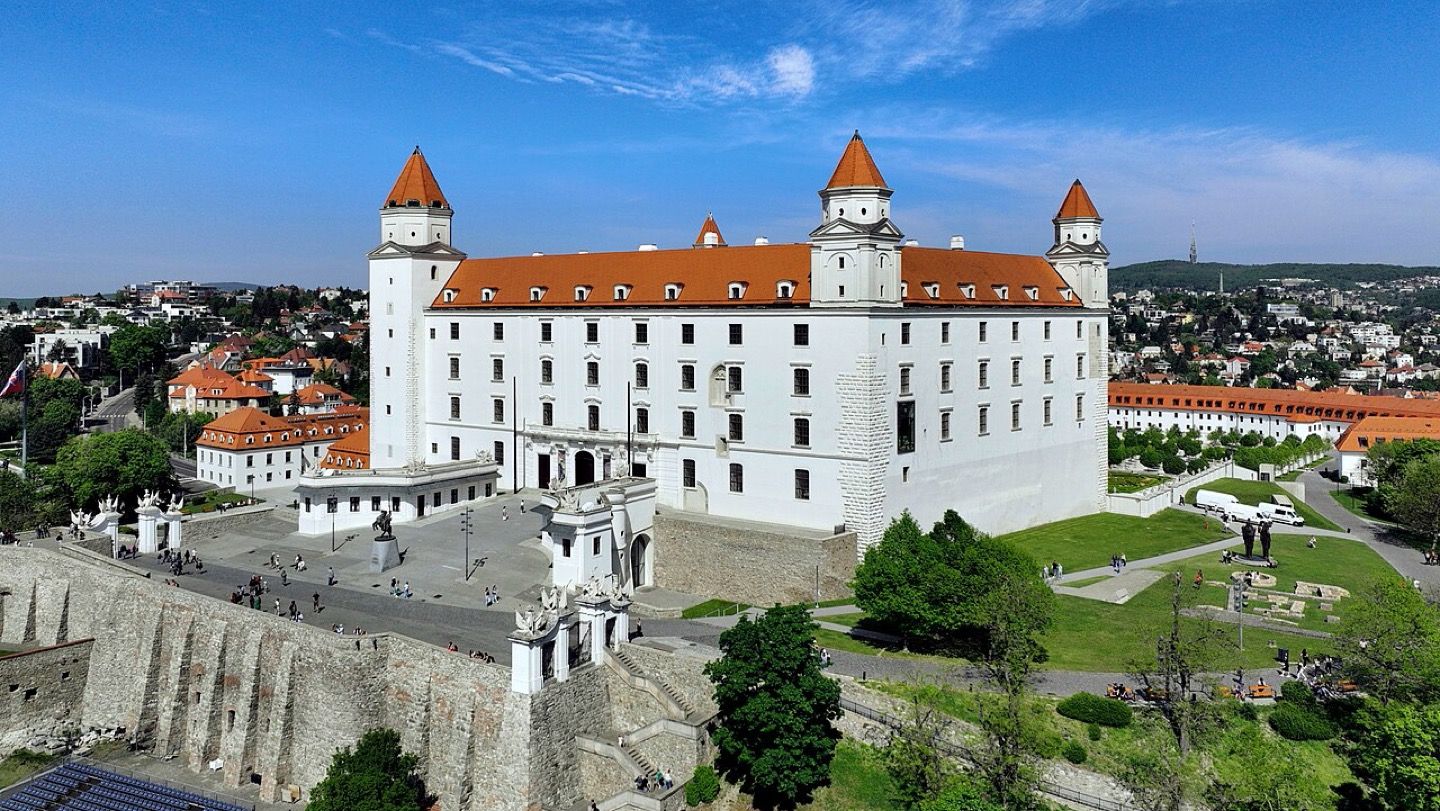
Bratislava Castle overlooks the Danube and houses the Slovak National Museum’s Museum of History. Devín Castle stands near the confluence of the Morava and Danube. The modern UFO observation deck belongs to Most SNP, a different bridge from Starý most. Farther east, Spiš Castle and associated monuments share a World Heritage property with Levoča. St Elisabeth’s Cathedral anchors the historic centre of Košice, while Bardejov’s town conservation reserve has its own UNESCO inscription.
Banská Štiavnica’s World Heritage property includes the historic town and technical monuments connected with mining, including the tajchy water-management system. Vlkolínec preserves a timber settlement near Ružomberok. Eight Wooden Churches of the Slovak part of the Carpathian Mountain Area form a separate World Heritage property entirely within Slovakia; they are not the transboundary wooden tserkvas property of Poland and Ukraine. Bojnice Castle’s romantic appearance and Orava Castle’s steep riverside setting offer further examples of the country’s varied architecture.
People & Society of Slovakia
Regional communities and a diaspora connect Slovakia with the wider world.
- How many people live in Slovakia?
- The EU country profile gives 5,409,407 residents using Eurostat’s 2026 figures. The date and statistical population differ from counts of the worldwide diaspora.
- How many consecutive men’s road-race world titles did Peter Sagan win?
- Three, in 2015, 2016 and 2017. His seven Tour de France green jerseys are a different achievement.
- What was Andy Warhol’s connection to Slovakia?
- His Rusyn parents came from Miková, now in northeastern Slovakia. Warhol himself was born in Pittsburgh in the United States.
More about Slovakia: people & society
The European Union’s country profile reports 5,409,407 residents using Eurostat’s 2026 figures. This is a dated population figure, not a count of everyone with Slovak ancestry abroad. Bratislava is the largest city and Košice the second largest. Slovaks form the majority, alongside Hungarian, Roma, Rusyn and other communities. Hungarian-speaking communities are particularly prominent in southern districts. Language, ethnicity and citizenship describe different characteristics, and census self-identification differs from estimates made using other methods.
Roman Catholicism is the largest religious affiliation, alongside other Christian traditions, other faiths and people with no religious affiliation. Milan Rastislav Štefánik combined astronomy and military service with a role in founding Czechoslovakia. Poet Pavol Országh Hviezdoslav and singer Edita Gruberová represent different artistic fields. Peter Sagan won three consecutive men’s road-race world titles, in 2015, 2016 and 2017. Andy Warhol was born in the United States to Rusyn parents from Miková in present-day Slovakia; birthplace, ancestry and national identity should be distinguished.