Facts about Singapore
Singapore is an island republic at the southern tip of the Malay Peninsula, where one city is also the whole country. Explore Marina Bay, the old ethnic quarters, the heartland new towns, the reservoirs and the islands offshore. Learn all fifty-five planning areas, trace four straits and seas, discover sixteen sights, read ten illustrated topics and begin Malay, Mandarin or Tamil.
- Capital
- Singapore (city-state)
- Land area, approximately
- 735 km²
- Population, 2024
- About 6 million
- Official languages
- English, Malay, Mandarin and Tamil
- Currency
- Singapore dollar (S$)
- Independence
- 9 August 1965
Singapore · 0 of 20 rounds passed
Two timed rounds per topic, 20 seconds a question
Singapore lies about 137 kilometres north of the equator, off the southern tip of the Malay Peninsula. The Straits of Johor separate it from Malaysia to the north, where the Causeway and the Second Link carry road traffic across. The Singapore Strait to the south divides it from Indonesia’s Riau Islands and links the Strait of Malacca with the South China Sea. Besides the main island there are more than sixty smaller ones, including Sentosa, Pulau Ubin, Pulau Tekong and the industrial Jurong Island.
Self-government came in 1959, when the People’s Action Party won power and Lee Kuan Yew became prime minister. Singapore joined Malaya, Sabah and Sarawak to form Malaysia on 16 September 1963, but political and communal disputes led to its separation on 9 August 1965, which is now National Day. Yusof Ishak became the first president. Lee led the government until 1990, followed by Goh Chok Tong, Lee Hsien Loong and, from May 2024, Lawrence Wong.
Geography of Singapore
A main island and sixty-odd islets at the southern exit of the Strait of Malacca.
- Is Singapore a city or a country?
- Both. It is a sovereign republic of one city, on one main island and more than sixty smaller ones, with no separate city government.
- What separates Singapore from Malaysia?
- The Straits of Johor, crossed by the Causeway and the Second Link. The Singapore Strait lies to the south, towards Indonesia.
- How has Singapore grown larger?
- By land reclamation. It has grown from about 580 square kilometres in the 1960s to more than 730 today.
More about Singapore: geography
Singapore lies about 137 kilometres north of the equator, off the southern tip of the Malay Peninsula. The Straits of Johor separate it from Malaysia to the north, where the Causeway and the Second Link carry road traffic across. The Singapore Strait to the south divides it from Indonesia’s Riau Islands and links the Strait of Malacca with the South China Sea. Besides the main island there are more than sixty smaller ones, including Sentosa, Pulau Ubin, Pulau Tekong and the industrial Jurong Island.
The land is low; Bukit Timah Hill, the highest natural point, rises only about 164 metres. Reclamation has grown the country from about 580 square kilometres in the 1960s to more than 730 today, and Marina Bay, East Coast Park, Changi Airport and Jurong Island all stand on filled land. The Urban Redevelopment Authority divides the territory into fifty-five planning areas in five regions, and its Master Plan decides what each plot of scarce land may be used for.
History of Singapore
Temasek, Raffles’s free port, the Japanese occupation and a sudden independence.
- When did Singapore become independent?
- On 9 August 1965, when it separated from Malaysia two years after joining it. The date is National Day.
- What happened in 1819?
- Stamford Raffles signed a treaty with the local Malay rulers and founded a British free port at the mouth of the Singapore River.
- What was Syonan-to?
- The name Japan gave Singapore during its occupation from February 1942 to 1945.
More about Singapore: history
A trading settlement called Temasek stood near the mouth of the Singapore River by the fourteenth century, and the island later fell within the Johor Sultanate. In 1819 Stamford Raffles of the British East India Company signed a treaty with Sultan Hussein Shah and the Temenggong to found a free port here. Singapore joined Penang and Malacca in the Straits Settlements in 1826 and became a crown colony in 1867. Japan captured it in February 1942 and renamed it Syonan-to; thousands of Chinese residents were killed in the Sook Ching massacre.
Self-government came in 1959, when the People’s Action Party won power and Lee Kuan Yew became prime minister. Singapore joined Malaya, Sabah and Sarawak to form Malaysia on 16 September 1963, but political and communal disputes led to its separation on 9 August 1965, which is now National Day. Yusof Ishak became the first president. Lee led the government until 1990, followed by Goh Chok Tong, Lee Hsien Loong and, from May 2024, Lawrence Wong.
Language of Singapore
Four official languages, with Malay as the national language and English as the common one.
- What are Singapore’s official languages?
- English, Malay, Mandarin and Tamil. Malay is the national language, and English is the common working language.
- What is Singlish?
- The informal English of everyday conversation, shaped by Malay, Hokkien, Tamil and other languages, with particles such as lah.
- Which languages do the lessons teach?
- Malay, Mandarin and Tamil, the three official mother tongues alongside English.
More about Singapore: language
English, Malay, Mandarin and Tamil are all official languages. The constitution names Malay as the national language, so the national anthem, Majulah Singapura, and military commands are in Malay. English is the main language of schools, government and business, and most pupils also study an official mother tongue: Mandarin, Malay or Tamil. Many older Chinese Singaporeans grew up speaking Hokkien, Teochew, Cantonese or Hakka, and the Speak Mandarin Campaign of 1979 encouraged a shift towards Mandarin.
Singlish is the informal English of everyday conversation, shaped by Malay, Hokkien, Tamil and other languages. It is known for sentence-final particles such as lah and lor and for borrowed words. The government’s Speak Good English Movement, launched in 2000, promotes standard English in formal settings. The lessons linked here introduce Malay, Mandarin and Tamil; Singapore uses simplified Chinese characters and Rumi, the Latin script, for Malay.
Culture of Singapore
Festivals of several faiths, Peranakan heritage and hawker culture listed by UNESCO.
- What did UNESCO list in 2020?
- Hawker culture in Singapore, added to the list of the intangible cultural heritage of humanity.
- Who are the Peranakans?
- Descendants of early Chinese and other migrants who adopted Malay customs, known for nyonya food, beadwork and bright shophouses.
- What is choping?
- Reserving a seat at a hawker centre by leaving a packet of tissues or another small item on the table.
More about Singapore: culture
The public holiday calendar mixes communities and faiths: Chinese New Year, Hari Raya Puasa and Hari Raya Haji, Deepavali, Vesak Day, Good Friday and Christmas. Chinatown, Little India around Serangoon Road and Kampong Glam around the Sultan Mosque grew from the ethnic quarters laid out in Raffles’s town plan. Peranakan culture, created by descendants of early Chinese and other migrants who adopted Malay customs, is known for its beadwork, bright shophouses and nyonya cooking.
Hawker culture was added to UNESCO’s list of the intangible cultural heritage of humanity in 2020; regulars often reserve a hawker-centre table by leaving a packet of tissues on it, a habit called choping. The Esplanade’s two spiky domes, nicknamed the durians, hold a concert hall and a theatre on Marina Bay. National Day on 9 August is marked by a parade, fly-pasts and fireworks.
Economy of Singapore
A trading port that became a hub for finance, refining and semiconductors.
- What currency does Singapore use?
- The Singapore dollar, which is interchangeable at par with the Brunei dollar.
- Why are cars so expensive?
- Buyers must first bid for a ten-year Certificate of Entitlement, and the number of certificates is capped.
- What is Jurong Island?
- An industrial island joined from seven islets by reclamation, home to oil refineries and petrochemical plants.
More about Singapore: economy
Singapore has no farmland to speak of and no oil, yet it is one of the richest countries in the world by output per person. The port is among the busiest anywhere and the world’s largest bunkering port for refuelling ships, and its terminals are moving west to Tuas. Jurong Island, joined from seven islets by reclamation, refines imported crude oil into fuels and petrochemicals. Electronics and semiconductors lead manufacturing, while finance, shipping and business services fill the towers around Raffles Place.
The Singapore dollar is interchangeable at par with the Brunei dollar under an agreement dating from 1967. GIC manages the government’s foreign reserves, and Temasek Holdings owns stakes in companies such as Singapore Airlines. Land and road space are rationed by price: a car buyer must first bid for a ten-year Certificate of Entitlement, and Electronic Road Pricing charges drivers automatically, succeeding the world’s first congestion charge, introduced in 1975.
Politics of Singapore
A parliamentary republic with an elected president and one long-governing party.
- Who leads Singapore’s government?
- The prime minister, Lawrence Wong since May 2024. The elected president is the head of state.
- Which party governs Singapore?
- The People’s Action Party, which has won every general election since 1959. The Workers’ Party is the largest opposition.
- Does Singapore have a city council?
- No. National ministries and statutory boards run city services, and town councils manage housing estates.
More about Singapore: politics
Singapore is a unitary parliamentary republic. The prime minister, currently Lawrence Wong, leads the cabinet and the government. The president has been directly elected since 1993 and holds custodial powers over the national reserves and key appointments; Tharman Shanmugaratnam took office in 2023. The People’s Action Party has won every general election since 1959, including that of May 2025, while the Workers’ Party is the largest opposition party. Many constituencies elect teams of members, which must include at least one candidate from a minority community.
There is no separate city government. National ministries and statutory boards such as the Housing and Development Board, the Land Transport Authority and the water agency PUB run what a city council would elsewhere, and town councils led by members of parliament look after housing estates. The legal system grew from English common law. Strict laws on littering and the sale of chewing gum are well known, caning remains a court sentence for some offences, and National Service has applied to male citizens and second-generation permanent residents since 1967.
Nature & Wildlife of Singapore
Rainforest, mangroves and reservoirs fitted into one of the most crowded countries.
- What is NEWater?
- High-grade water recycled from treated used water, one of the four national taps since 2003.
- Where is Singapore’s largest forest?
- In the Central Catchment and Bukit Timah nature reserves, in the middle of the island.
- What does the Marina Barrage do?
- It dams the mouth of Marina Bay, creating a freshwater reservoir in the city and helping to control floods.
More about Singapore: nature & wildlife
Bukit Timah Nature Reserve and the Central Catchment Nature Reserve protect the island’s largest remaining tropical forest, with the TreeTop Walk swaying above the canopy near MacRitchie Reservoir. Sungei Buloh Wetland Reserve shelters mangroves and migrating shorebirds on the north coast, and Chek Jawa on Pulau Ubin has rich intertidal flats. Smooth-coated otters have returned to rivers, reservoirs and even Marina Bay. In 1967 Lee Kuan Yew set out a vision of a Garden City, since renewed as a City in Nature.
With no large rivers or aquifers, Singapore plans its water as four national taps: rain gathered in reservoirs, water bought from Johor under an agreement that runs to 2061, NEWater recycled from used water since 2003, and desalinated seawater. The Marina Barrage, completed in 2008, dammed the mouth of Marina Bay to create a freshwater reservoir in the city centre that also controls floods.
Food & Cuisine of Singapore
Chicken rice, chilli crab, laksa and kaya toast, mostly eaten at hawker centres.
- What is a hawker centre?
- A covered food court of many licensed stalls selling cheap cooked meals, found across the housing estates.
- What is kaya?
- A sweet jam of coconut and egg, spread on toast for breakfast with soft-boiled eggs and kopi.
- Which dish is often called the national dish?
- Hainanese chicken rice: poached chicken with rice cooked in chicken stock and fat.
More about Singapore: food & cuisine
Hawker centres grew in the 1970s, when the government moved street sellers into covered sites with running water and inspections. Over a hundred now serve cheap meals across the housing estates. Hainanese chicken rice, poached chicken with rice cooked in stock and chicken fat, is often called the national dish. Chilli crab comes in a thick, sweet and spicy tomato and chilli sauce, while char kway teow fries flat rice noodles with dark soy sauce, cockles and Chinese sausage.
Breakfast is often kaya toast, spread with sweet coconut and egg jam, with soft-boiled eggs and kopi, the local coffee. Bak kut teh is a pork rib soup cooked with herbs and spices, and Katong laksa is a coconut curry noodle soup from the Peranakan east coast. In 2016 two hawker stalls, Liao Fan Hawker Chan’s soya sauce chicken rice and Hill Street Tai Hwa Pork Noodle, were among the first hawker stalls awarded Michelin stars.
Landmarks of Singapore
The Botanic Gardens, Marina Bay’s skyline and shophouse streets.
- What is Singapore’s World Heritage Site?
- The Singapore Botanic Gardens, inscribed in 2015. It is the country’s only one.
- What is the Rain Vortex?
- The indoor waterfall at Jewel Changi Airport, the tallest in the world, opened in 2019.
- What is a five-foot way?
- The covered walkway in front of a row of shophouses, required by Raffles’s town plan of 1822.
More about Singapore: landmarks
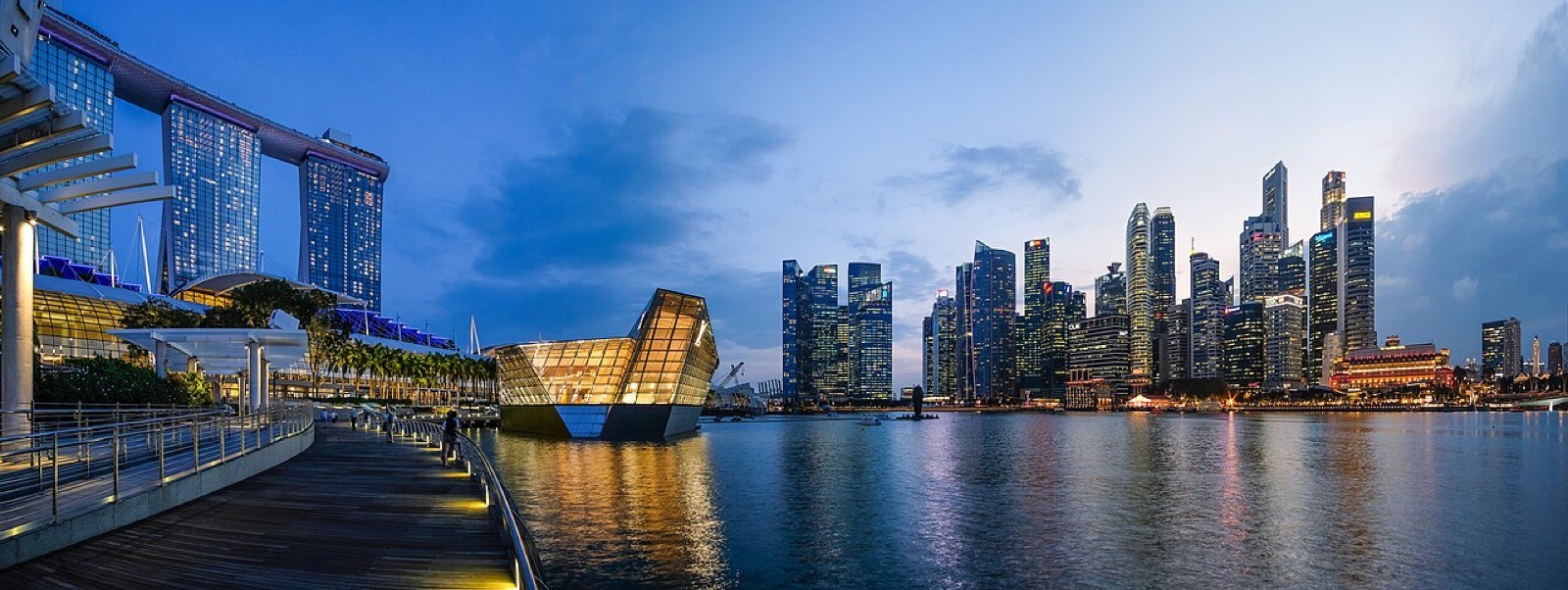
The Singapore Botanic Gardens, founded in 1859, became the country’s first and only UNESCO World Heritage Site in 2015; its National Orchid Garden holds hundreds of species and hybrids. Around Marina Bay stand the Merlion statue of 1972, the Esplanade, the Singapore Flyer and Moshe Safdie’s Marina Bay Sands, whose three towers have carried a sky park since 2010. Gardens by the Bay, opened in 2012, adds the Supertree Grove and the cooled Flower Dome and Cloud Forest.
Older streets keep rows of shophouses, with a shop below, a home above and a covered five-foot way in front. The Raffles Hotel of 1887, where the Singapore Sling was first mixed, and the National Gallery in the former Supreme Court and City Hall recall the colonial Civic District. Jewel Changi Airport, opened in 2019, wraps an indoor forest around the Rain Vortex, the world’s tallest indoor waterfall.
People & Society of Singapore
About six million people, most in public housing, counted as Chinese, Malay, Indian or Other.
- What does CMIO stand for?
- Chinese, Malay, Indian and Others, the four groups official statistics use for residents.
- How do most Singaporeans live?
- About eight in ten residents live in Housing and Development Board flats, most owned on 99-year leases.
- Who won Singapore’s first Olympic gold?
- Joseph Schooling, in the 100 metres butterfly at Rio de Janeiro in 2016.
More about Singapore: people & society
About six million people live in Singapore, roughly two thirds of them citizens or permanent residents and the rest workers, students and dependants from abroad. Official statistics group residents by the CMIO framework: Chinese, Malay, Indian and Others. Chinese Singaporeans make up about three quarters of the resident population, Malays about thirteen per cent and Indians about nine per cent. The constitution recognises the Malays as the indigenous people of Singapore.
About eight in ten residents live in flats built by the Housing and Development Board, most owned on 99-year leases. The Ethnic Integration Policy sets quotas for each community in every block, so neighbourhoods stay mixed. Joseph Schooling won Singapore’s first Olympic gold medal in the 100 metres butterfly in 2016, and the country’s four prime ministers have been Lee Kuan Yew, Goh Chok Tong, Lee Hsien Loong and Lawrence Wong.