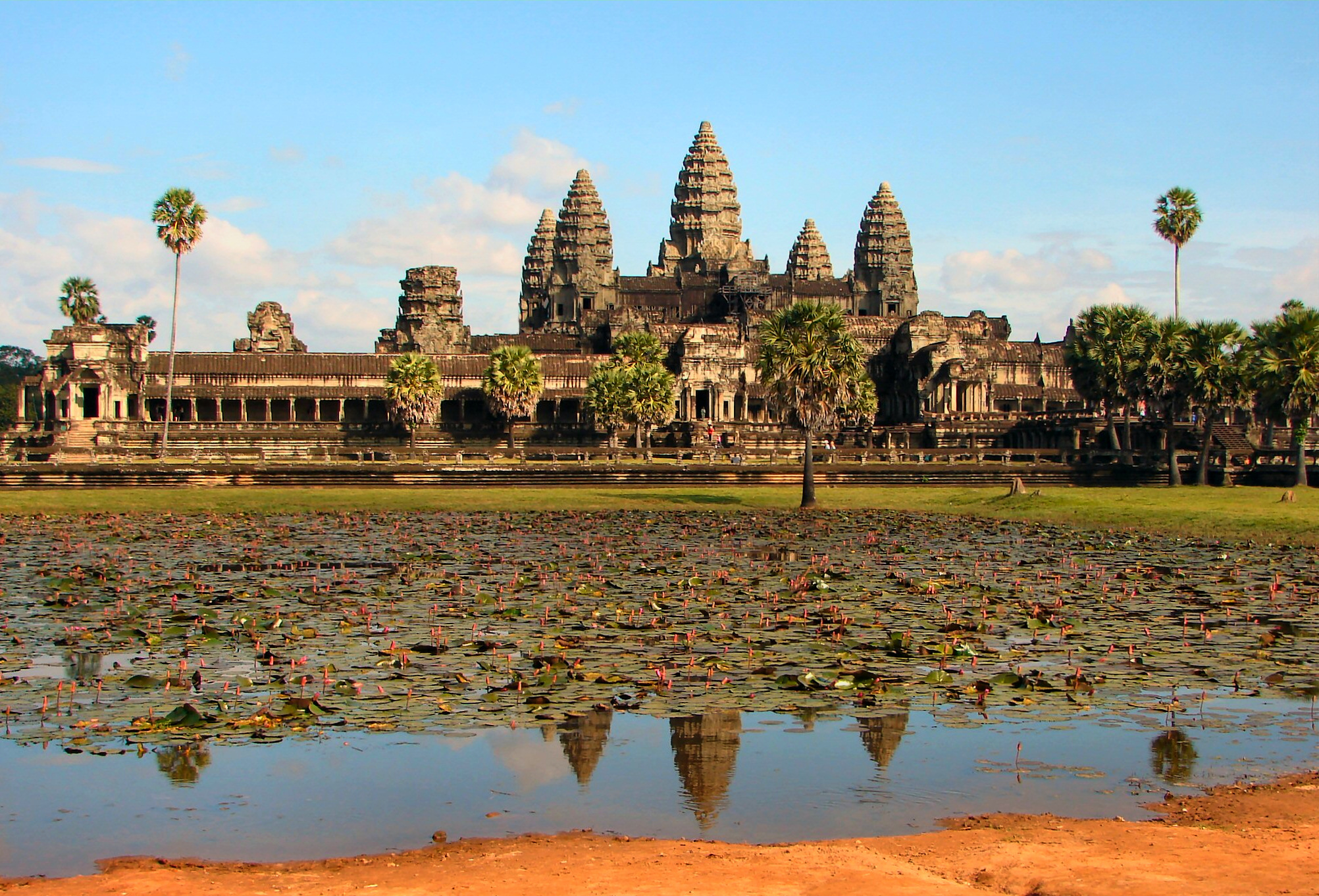
Facts about Cambodia
Follow Cambodia from Angkor and Tonle Sap to Phnom Penh, the Cardamom Mountains and the northeastern uplands. Explore the provinces, cities and rivers, discover Khmer language and living traditions, and connect ancient temple landscapes with the country’s modern history.
- Capital
- Phnom Penh
- Official language
- Khmer
- Currency
- Cambodian riel (KHR)
- Administrative areas
- 24 provinces + Phnom Penh
- Independence
- 9 November 1953
- UNESCO World Heritage
- 5 cultural properties
Cambodia · 0 of 20 rounds passed
Two timed rounds per topic, 20 seconds a question
Cambodia lies in mainland Southeast Asia, with Thailand to the west and northwest, Laos to the north and Vietnam to the east and southeast. The Gulf of Thailand forms its southwestern coast. Lowlands around the Mekong and Tonle Sap contrast with the Cardamom Mountains in the southwest and uplands in the northeast. Monsoon rainfall changes the lake, floodplain and rhythms of farming and fishing through the year.
Phnom Penh is the capital, at the meeting of the Mekong and Tonle Sap rivers, near the head of the Bassac. Siem Reap lies close to Angkor; Battambang is a western river city; Sihanoukville is a major seaport. Kampot and Kep connect the southern coast, while Banlung and Sen Monorom introduce the northeastern and eastern uplands. Twenty-four provinces and the separate Phnom Penh municipality form the first level of administration.
Geography of Cambodia
A monsoon floodplain between three neighbours, the Gulf coast and forested uplands.
- Which countries border Cambodia?
- Thailand, Laos and Vietnam. Cambodia also has a coast on the Gulf of Thailand.
- Why does the Tonle Sap River reverse its flow?
- High wet-season Mekong levels push water towards Tonle Sap Lake. In the dry season the river drains the lake towards the Mekong.
- Where are the Cardamom Mountains?
- In southwestern Cambodia. They are separate from the Dangrek escarpment along part of the northern Thai border.
More about Cambodia: geography
The Mekong enters Cambodia from Laos, passes Stung Treng, Kratie and Kampong Cham, then continues through the Phnom Penh area into Vietnam. Tonle Sap Lake occupies the central lowlands. When wet-season Mekong levels rise sufficiently, the connecting Tonle Sap River carries water towards the lake; in the dry season it drains towards the Mekong. This flood pulse supports fisheries, flooded forests and farming rather than producing one fixed lake size.
The Cardamom Mountains stretch across the southwest, and Phnom Aural is Cambodia’s highest mountain. The Dangrek escarpment runs along part of the northern frontier with Thailand. Ratanakiri and Mondulkiri have distinct upland landscapes in the east. Cambodia has a Gulf of Thailand coast, including the port of Sihanoukville, Koh Kong’s estuaries and islands such as Koh Rong. Thailand, Laos and Vietnam are its three land neighbours.
History of Cambodia
Early temple cities, Angkor, independence and the legacies of war and Khmer Rouge rule.
- Who commissioned Angkor Wat?
- Suryavarman II in the twelfth century. Jayavarman VII is associated with the later Angkor Thom and Bayon.
- When did Cambodia gain independence from France?
- On 9 November 1953. The French protectorate had begun in 1863.
- When did Khmer Rouge rule of Phnom Penh end?
- Vietnamese forces took Phnom Penh in January 1979 after an offensive begun in December 1978. Conflict continued afterwards.
More about Cambodia: history
Sambor Prei Kuk preserves temples of ancient Ishanapura from before Angkor’s great building campaigns. Jayavarman II is conventionally associated with the beginning of the Angkorian kingdom in 802. Suryavarman II commissioned Angkor Wat in the twelfth century; Jayavarman VII later developed Angkor Thom and the Bayon. Warfare with Ayutthaya, political change, shifting trade and environmental pressures all help explain Angkor’s decline. A single invasion is not a complete account.
A French protectorate began in 1863, and Cambodia gained independence on 9 November 1953. Civil war preceded the Khmer Rouge capture of Phnom Penh on 17 April 1975. Their rule brought forced labour, starvation, executions and genocide, including against Cham and Vietnamese communities. Vietnam’s military offensive began in December 1978 and took Phnom Penh in January 1979; conflict continued afterwards. The 1991 Paris Peace Agreements and UN-supported 1993 elections were later milestones. Memorials and survivor testimony remain central to understanding this history.
Khmer and Cambodia’s other languages
Khmer script and a generally non-tonal Austroasiatic language in a multilingual country.
- Which language do the linked lessons teach?
- Khmer, Cambodia’s official language and a member of the Austroasiatic family.
- Is standard Khmer a tonal language like Thai?
- No. Standard Khmer does not use lexical tone to distinguish words, unlike Thai and Vietnamese.
- Are Cham and Bunong varieties of Khmer?
- No. Cham is Austronesian; Bunong is a distinct Austroasiatic language. Cambodia is multilingual.
More about Cambodia: language
Khmer is Cambodia’s official language and belongs to the Austroasiatic family. Unlike Thai and Vietnamese, standard Khmer does not use lexical tone to distinguish words. Its script developed from South Indian writing traditions and uses consonant symbols with dependent vowel signs. It is an abugida, so comparing its number of letters with alphabetic scripts can be misleading. Romanisation varies: Takeo and Ta Keo, or Tonle Sap and Tonlé Sap, may refer to the same place.
Chum reap suor is a respectful greeting, while susadei is widely used in less formal contexts; pronunciation and transliterations vary. Forms of address reflect age, relationship and context. Cham, Bunong, Tampuan, Jarai, Vietnamese, Chinese varieties and other languages also form part of Cambodia’s language landscape. Cham and Jarai belong to the Austronesian family; Bunong and Tampuan are Austroasiatic. The linked lessons introduce Khmer rather than all the country’s languages.
Culture of Cambodia
Sampeah greetings, New Year, krama textiles, classical dance and shadow theatre.
- What is a sampeah?
- A greeting with palms joined and a slight bow. Its formality varies with age, relationship and context.
- How do Khmer New Year and Pchum Ben differ?
- Khmer New Year is celebrated in April; Pchum Ben is associated with ancestors and offerings at pagodas.
- What is a krama?
- A versatile woven textile used for clothing and everyday tasks. Related cultural practices entered UNESCO’s intangible heritage list in 2024.
More about Cambodia: culture
The sampeah greeting joins the palms with a slight bow; gesture and formality depend on the relationship. Choul Chnam Thmey, Khmer New Year, falls in April, while Pchum Ben is associated with remembering ancestors and offerings at pagodas. Bon Om Touk, the Water Festival, is linked to the river cycle and boat racing. Theravada Buddhism shapes many public traditions, but Cambodia also includes Muslim, Christian and other religious communities.
The Royal Ballet of Cambodia uses codified gestures, music and costume; the apsara dance is one well-known part of a wider classical tradition. Pinpeat ensembles accompany dance and ceremonial performance. Sbek Thom is large leather shadow-puppet theatre. The krama is a versatile woven textile used for clothing and everyday tasks; practices associated with it entered UNESCO’s intangible heritage list in 2024. These living traditions are different from the buildings and landscapes on the World Heritage List.
Economy of Cambodia
Garments, farming, fisheries, tourism and a riel economy where US dollars also circulate.
- What is Cambodia’s official currency?
- The Cambodian riel, abbreviated KHR. US dollars also circulate widely, but are not a second official national currency.
- Which activities connect Cambodia to overseas markets?
- Garment, footwear and travel-goods manufacturing, agricultural exports and tourism are important examples.
- When did Cambodia join ASEAN?
- In 1999. Sihanoukville’s port and land routes also connect the country with regional and global trade.
More about Cambodia: economy
Garment, footwear and travel-goods manufacturing connects Cambodia with international supply chains. Rice, cassava, rubber, cashews and other crops support farming and exports, while fisheries are important to food and livelihoods. Tourism links Angkor with cities, coastlines and local businesses. Construction and services have also shaped urban growth. These sectors face different pressures from overseas demand, changing travel conditions, debt and environmental change.
The official currency is the Cambodian riel, abbreviated KHR. US dollars also circulate widely, but they are not a second official national currency; payment practices vary by setting. Phnom Penh is the main commercial centre, and Sihanoukville’s port connects maritime trade. Cambodia joined ASEAN in 1999. Understanding employment, transport and trade relationships is more useful than treating a changing export share or exchange rate as a permanent country fact.
Politics of Cambodia
A constitutional monarchy with two parliamentary chambers and twenty-five first-level areas.
- How many first-level administrative areas are there?
- Twenty-five: twenty-four provinces and the separate Phnom Penh municipality. Phnom Penh is not a province.
- What are the roles of the king and prime minister?
- The king is head of state; the prime minister heads the government within Cambodia’s constitutional monarchy.
- What are Cambodia’s two parliamentary chambers?
- The National Assembly and Senate. The Cambodian People’s Party has dominated national politics for decades.
More about Cambodia: politics
Cambodia is a constitutional monarchy under the framework restored in 1993. The king is head of state; the prime minister heads the government. Parliament has two chambers, the National Assembly and Senate. The constitutional description does not by itself describe the balance of political power: the Cambodian People’s Party has dominated national politics for decades, and political opposition and civil liberties face substantial restrictions.
Twenty-four provinces and Phnom Penh municipality make up the first level of administration. Phnom Penh is not a twenty-fifth province, and Kandal is a separate surrounding province. Tbong Khmum was created from Kampong Cham in 2013. The maps preserve all twenty-five areas and distinguish small Kep and Pailin. Administrative reference boundaries do not settle international disputes or indicate whether a crossing, monument or road is open.
Nature & Wildlife of Cambodia
Flooded forests, Mekong dolphins, Cardamom habitats and northeastern protected landscapes.
- What supports Tonle Sap’s flooded forests and fisheries?
- The seasonal flood pulse changes water levels and inundates surrounding habitats, connecting river, lake and floodplain.
- Which dolphins live in Cambodia’s Mekong pools?
- Irrawaddy dolphins. The Mekong population is threatened, and sightings require respectful conservation practices.
- Can visitors expect to see a kouprey?
- No. Cambodia’s national animal has not been reliably recorded for decades and may be extinct.
More about Cambodia: nature & wildlife
Tonle Sap’s flooded forests and wetlands support fish, waterbirds and communities whose livelihoods follow the changing water. The Cardamom Mountains retain important forest habitats, while the northeast includes Virachey National Park and other protected landscapes. Asian elephants, gibbons and many other species belong to Cambodia’s biodiversity. Habitat loss, hunting, wildlife trade and changes to river flow threaten these environments; a protected-area name does not guarantee intact habitat everywhere.
A threatened freshwater population of Irrawaddy dolphins lives in the Mekong, including pools near Kampi north of Kratie. Wildlife observation should follow local conservation guidance. The kouprey is Cambodia’s national animal, but it has not been reliably recorded for decades and may be extinct; it is not an animal visitors should expect to see. Landmines and unexploded ordnance remain in affected areas, so established paths and current local advice matter when exploring rural and forest landscapes.
Food & Cuisine of Cambodia
Rice, freshwater fish, prahok, aromatic kroeung and dishes that differ by household and region.
- What are prahok and kroeung?
- Prahok is fermented fish paste; kroeung refers to aromatic seasoning pastes. They are different ingredients.
- What is fish amok?
- A steamed fish preparation often made with coconut milk and served in a banana-leaf container. Recipes vary.
- What is nom banh chok?
- A rice-noodle dish served with a fish-based sauce or other broths and fresh greens.
More about Cambodia: food & cuisine
Rice, fish, vegetables and herbs shape many Cambodian meals. Prahok is a fermented fish paste that adds savoury depth; kroeung refers to aromatic seasoning pastes that can include lemongrass, galangal and other ingredients. Fish amok is a steamed preparation often made with coconut milk and served in a banana-leaf container. Recipes vary, and neither prahok nor coconut milk appears in every dish.
Nom banh chok pairs rice noodles with a fish-based sauce or other broths and fresh greens. Kuy teav is a rice-noodle soup; lok lak commonly features stir-fried beef with a peppery dipping sauce. Kampot pepper has a protected geographical identity, while palm sugar, fruits and seafood connect different agricultural and coastal landscapes. Cambodian cuisine includes Khmer, Cham, Chinese and Vietnamese influences and many local traditions rather than a single fixed national menu.
Landmarks of Cambodia
Five World Heritage properties, from Angkor to memorials of twentieth-century repression.
- How many World Heritage properties does Cambodia have?
- Five as of October 2026: Angkor, Preah Vihear, Sambor Prei Kuk, Koh Ker and the Cambodian Memorial Sites.
- Are Angkor Wat, Bayon and Ta Prohm three UNESCO properties?
- No. They belong to the wider Angkor archaeological landscape, inscribed as one property in 1992.
- Which places form the Cambodian Memorial Sites property?
- Former M-13 prison, Tuol Sleng Genocide Museum and Choeung Ek Genocidal Center. The serial property was inscribed in 2025.
More about Cambodia: landmarks
Cambodia has five cultural World Heritage properties as of October 2026: Angkor, inscribed in 1992; the Temple of Preah Vihear in 2008; the Temple Zone of Sambor Prei Kuk in 2017; Koh Ker in 2023; and the Cambodian Memorial Sites in 2025. Angkor Wat, Bayon and Ta Prohm belong to the wider Angkor archaeological landscape rather than forming three separate inscriptions. Preah Vihear is a different property in the north, not part of Angkor near Siem Reap.
The Cambodian Memorial Sites property has three components: former M-13 prison, Tuol Sleng Genocide Museum and Choeung Ek Genocidal Center. They are places of remembrance, learning and reflection, with different histories within the system of repression. The Royal Palace and National Museum in Phnom Penh, Banteay Chhmar and Phnom Kulen add other places to the guide. A map pin is a reference location rather than a guarantee of access; the Preah Vihear temple area is subject to current border restrictions.
People & Society of Cambodia
Khmer, Cham and Indigenous communities, modern artists and connections across borders.
- Does Cambodian citizenship mean ethnic Khmer identity?
- No. Citizens belong to many communities, including Khmer, Cham, Indigenous peoples and others.
- Who was Vann Molyvann?
- An architect associated with New Khmer Architecture, whose work helped shape twentieth-century Cambodia.
- What is Loung Ung known for?
- Her memoir First They Killed My Father recounts her childhood under Khmer Rouge rule.
More about Cambodia: people & society
Most Cambodians identify as ethnic Khmer, but citizenship and ethnicity are different. Cham communities are predominantly Muslim and have their own languages and traditions. Bunong, Tampuan, Jarai and other Indigenous communities have distinct histories and relationships with land, especially in the northeast and eastern uplands. Vietnamese and Chinese communities also form part of Cambodian society. Broad labels should not replace the names and experiences of individual peoples.
Artists, architects and writers help explain modern Cambodia alongside its rulers. Sinn Sisamouth and Ros Serey Sothea are remembered for their music; Vann Molyvann shaped New Khmer Architecture; Loung Ung’s memoir First They Killed My Father recounts a childhood under the Khmer Rouge. Families and diasporas connect Cambodia with France, the United States, Australia and neighbouring countries. Memory, migration and cultural renewal take different forms across generations.