Facts about Iran
Explore Iran from the forested Caspian coast and mountain cities to Isfahan’s squares, Shiraz’s gardens, Yazd’s windcatchers and the southern shores. Connect its provinces and waters with Persian poetry, diverse communities, regional food and thousands of years of history.
- Capital
- Tehran
- Provinces
- 31
- Official language
- Persian (Farsi)
- Currency
- Iranian rial (IRR)
Iran · 0 of 20 rounds passed
Two timed rounds per topic, 20 seconds a question
Tehran stands below the Alborz mountains; Tabriz anchors the northwest, Mashhad the northeast, and Isfahan and Shiraz the central and southern interior. Gilan and Mazandaran face the Caspian, while Khuzestan and Hormozgan connect the southwest and south with the Gulf.
Use the sights map to locate sixteen heritage and natural places, then explore ten reading topics and the Persian and Kurdish lessons. Present visitor access and security conditions require a separate check of current official travel advice.
Geography of Iran
Caspian forests, the Alborz and Zagros mountains, desert basins and two southern waters.
- Which countries share land borders with Iran?
- Türkiye, Armenia, Azerbaijan, Turkmenistan, Afghanistan, Pakistan and Iraq. Azerbaijan’s Nakhchivan exclave also borders Iran.
- How many provinces does Iran have?
- 31 provinces, called ostans. Alborz is separate from Tehran; North, Razavi and South Khorasan are three separate provinces.
- Is all of Iran desert?
- No. The Caspian coast has humid forests and farmland, while the Alborz and Zagros contain high mountains. Desert basins occupy parts of the interior.
History of Iran
Achaemenid capitals, Islamic dynasties, constitutional change and the revolution of 1979.
- Are Persepolis and Pasargadae the same place?
- No. Pasargadae was an early Achaemenid royal centre associated with Cyrus the Great. Persepolis was developed under Darius I and his successors.
- What did the Constitutional Revolution change?
- The movement of 1905–1911 challenged royal authority and established a constitutional framework and parliament. It preceded the 1979 revolution by many decades.
- When did Iran become an Islamic republic?
- In 1979, after the revolution ended the Pahlavi monarchy. Iraq invaded Iran in 1980, and the resulting war lasted until 1988.
Persian and the languages of Iran
Persian uses a script derived from Arabic, but belongs to the Indo-European family.
- Are Persian and Arabic the same language?
- No. Persian belongs to the Indo-European family; Arabic is a Semitic language. Modern Persian uses a script derived from Arabic and has borrowed vocabulary, but its grammar and history are distinct.
- What does Farsi mean?
- Farsi is the Persian name for Persian. The lessons linked here introduce the language as used in Iran; Dari and Tajik are closely related varieties used elsewhere.
- Does everyone in Iran speak only Persian?
- No. Azerbaijani, Kurdish, Luri, Gilaki, Mazandarani, Baluchi, Arabic, Turkmen and many other languages are spoken, and many families are multilingual.
Culture of Iran
Nowruz, poetry, carpets, gardens and traditions shared across borders.
- Is Nowruz celebrated only in Iran?
- No. This new-year tradition around the spring equinox is shared by communities across many countries. Household customs and the name’s spelling vary.
- What is the Shahnameh?
- Ferdowsi’s Persian epic about legendary and historical kings. Its stories form an important part of Persian literary and artistic traditions.
- What is a Persian garden?
- A tradition of enclosed gardens using water, planting, shade and organised space. The UNESCO property includes nine gardens in different parts of Iran.
Economy of Iran
Oil and gas, manufacturing, farming and trade shaped by sanctions and water pressures.
- Does Iran’s economy consist only of oil?
- No. Oil and gas are important, but manufacturing, services, construction and agriculture also contribute. Regional economies differ.
- Why must a price’s unit be clear?
- Iran’s currency is the rial, but people may quote everyday amounts in tomans. Clarify the unit and denomination rather than assuming a number means the same amount in every context.
- How do sanctions and water scarcity affect the economy?
- Sanctions constrain finance and international trade. Water scarcity affects agriculture and urban supply, with consequences that vary across regions and households.
Politics of Iran
An Islamic republic with elected institutions and extensive religious oversight.
- How do the supreme leader and president differ?
- The supreme leader has extensive constitutional powers, including over the armed forces and major appointments. The president leads the executive government within that framework.
- What is the Guardian Council?
- A body that reviews legislation for constitutional and Islamic-law compatibility and supervises elections. Its candidate-vetting role restricts electoral competition.
- What is the Iranian parliament called?
- The Islamic Consultative Assembly, commonly called the Majles or Majlis. It is distinct from the Assembly of Experts, which selects the supreme leader.
Nature & Wildlife of Iran
Ancient Caspian forests, desert landforms and rare mountain and steppe wildlife.
- What makes the Hyrcanian forests distinctive?
- These moist broadleaf forests follow the southern Caspian coast and adjoining slopes, contrasting with Iran’s arid interior. The World Heritage property includes components in Iran and Azerbaijan.
- Where does the Asiatic cheetah survive in the wild?
- Its remaining wild population is in Iran. It is critically endangered; habitat protection and reducing other threats are central to conservation.
- Does the Lake Urmia map show its current water level?
- No. It uses a generalised lake outline. Rainfall, evaporation and water use cause the actual shoreline to change.
Food & Cuisine of Iran
Rice, herbs, stews, bread and regional flavours from the Caspian to the Gulf.
- What is tahdig?
- The crisp layer at the bottom of a cooking pot, often made from rice, bread or potato. It is one element of a much wider set of cooking traditions.
- What is ghormeh sabzi?
- An herb stew commonly prepared with beans, meat and dried lime. Recipes vary by household and region.
- What gives fesenjan its distinctive flavour?
- Walnuts and pomegranate, often prepared with poultry or other ingredients. The balance of sweet and sour varies between recipes.
Landmarks of Iran
Persepolis, Isfahan, Yazd, palaces, gardens and ingenious water systems.
- What is Naqsh-e Jahan Square?
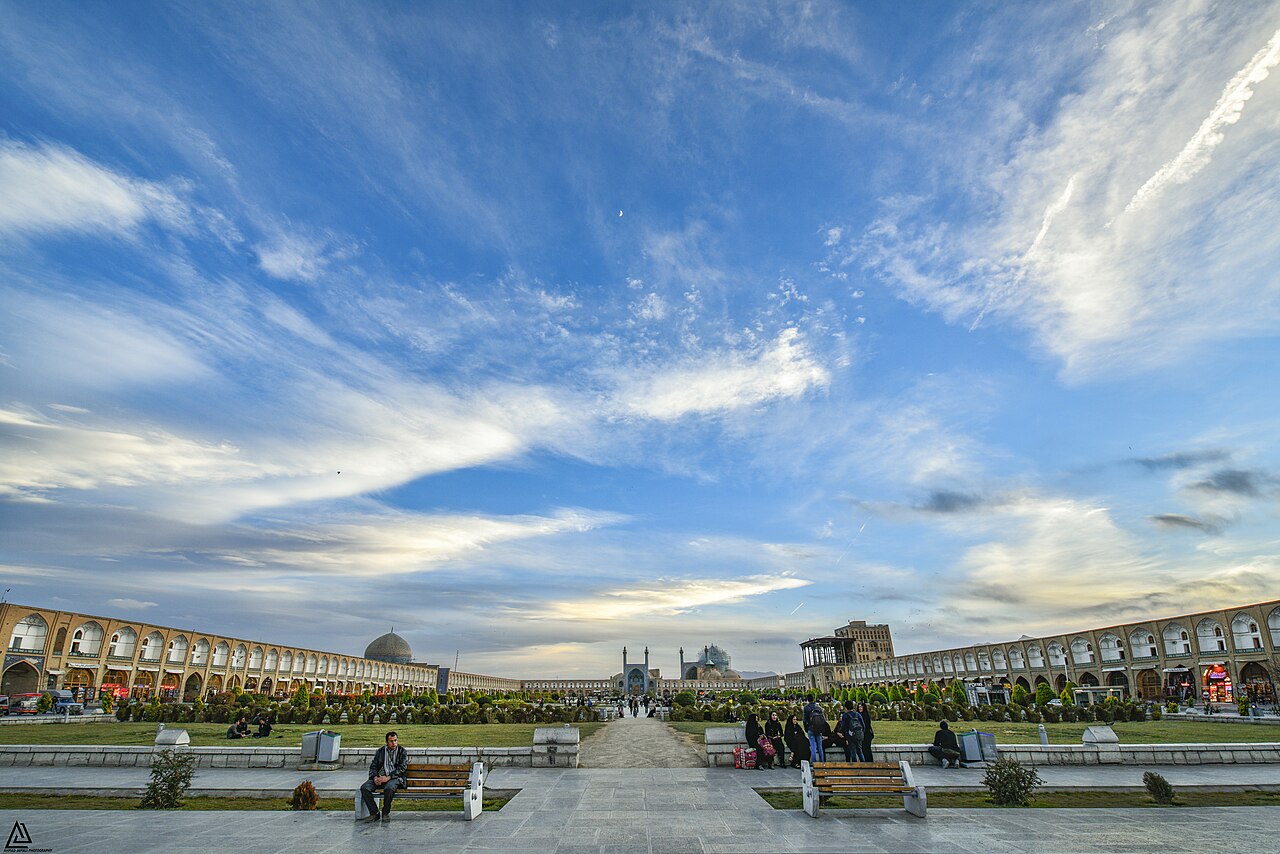
- A monumental square in Isfahan associated with the Safavid period, framed by mosques, Ali Qapu Palace and a bazaar entrance. UNESCO lists it as Meidan Emam, Esfahan.
- How did Yazd adapt to its arid setting?
- Qanats brought water through underground channels, while courtyard houses, windcatchers and earth construction helped manage heat. These systems work together within the historic city.
- What can the sights map tell you about a visit today?
- It identifies heritage places and explains their histories and landscapes. Opening, access and security conditions need a separate check of current official information.
People & Society of Iran
Many languages and communities, with distinct regional lives and a global diaspora.
- Do Iranian and Persian mean exactly the same thing?
- No. Iranian is a nationality; Persian can describe a language or cultural identity. Iran includes many communities beyond those identifying as Persian.
- Do province borders separate Iran’s ethnic groups?
- No. Communities and languages extend across provincial and national borders. Administrative maps should not be read as precise maps of identity.
- Is everyday life the same across Iran?
- No. Large cities, Caspian farming areas, mountain settlements and southern coastal communities have different routines. Iranian communities abroad add further experiences.