Facts about Brunei
Explore Brunei from Bandar Seri Begawan and Kampong Ayer to the oil coast and Temburong’s rainforest. Learn four districts, place eight settlements, follow the rivers to the sea and discover the country’s heritage.
- Capital
- Bandar Seri Begawan
- Official language
- Malay
- Currency
- Brunei dollar (BND)
- Districts
- 4
- Island
- Borneo
- Full independence
- 1 January 1984
Brunei · 0 of 20 rounds passed
Two timed rounds per topic, 20 seconds a question
Brunei Darussalam occupies two coastal territories on northwestern Borneo. Sarawak, a state of Malaysia, separates Temburong in the east from the western districts of Brunei-Muara, Tutong and Belait. Both territories meet the sea; Brunei is neither an island nor a landlocked enclave. The bridge across Brunei Bay now links them directly by road.
Bandar Seri Begawan is the capital on the Brunei River. Muara is a port town to the northeast, Jerudong lies on the western side of Brunei-Muara, and Tutong sits farther along the coast. Kuala Belait and Seria anchor the oil-producing southwest. Inland Labi introduces forest and farming landscapes, while Bangar is the main town of Temburong. The maps connect the four districts with eight settlement centres and the rivers that lead to Brunei Bay and the South China Sea.
Geography of Brunei
Two coastal territories on Borneo, four districts and rivers running towards the South China Sea.
- Which country shares a land border with Brunei?
- Malaysia, through Sarawak. Indonesia shares Borneo but does not border Brunei.
- What are the four districts?
- Brunei-Muara, Tutong, Belait and Temburong.
- How are the two territories connected by road?
- The Sultan Haji Omar Ali Saifuddien Bridge crosses Brunei Bay, avoiding the land route through Malaysia.
More about Brunei: geography
Brunei lies on Borneo’s northwestern coast. Malaysia’s state of Sarawak is its only land neighbour; Indonesia shares Borneo but has no border with Brunei. The South China Sea lies to the north, while Brunei Bay opens beside the capital and Temburong. The country has four districts: Brunei-Muara, Tutong, Belait and Temburong. Belait is the largest by area; Brunei-Muara contains the capital and much of the population.
Temburong is separated from the western districts by Sarawak’s Limbang area. The Sultan Haji Omar Ali Saifuddien Bridge crosses Brunei Bay, connecting the two parts by road without a journey through Malaysia. Coastal lowlands rise into forested hills inland, with Bukit Pagon on the Malaysian border in southeastern Temburong. The Brunei, Tutong, Belait and Temburong river systems connect settlements, wetlands and upland catchments. Rain and high humidity are features of the equatorial climate.
History of Brunei
Maritime trade, a contracting sultanate, British protection and independence in 1984.
- When did Brunei become fully independent?
- 1 January 1984. National Day celebrations take place on 23 February.
- What changed in 1888?
- Brunei became a British protected state; the Resident system followed in 1906.
- Did Brunei join Malaysia?
- No. It remained outside the federation and later became an independent state.
More about Brunei: history
Brunei’s history grew out of river settlements and maritime trade. Archaeology at Kota Batu records connections with wider Asian markets. An Islamic sultanate developed over centuries, reaching a period of strong regional influence in the fifteenth and sixteenth centuries. Its authority operated through ports, coastal communities and relationships with local rulers, rather than the fixed borders of a modern nation-state. Spanish forces briefly occupied the capital during the Castilian War of 1578.
In the nineteenth century, territorial losses to the Brooke rulers of Sarawak and other powers reduced the sultanate. Brunei became a British protected state in 1888, and a British Resident system began in 1906. Japanese occupation during the Second World War brought destruction and hardship. The 1959 constitution established internal self-government; an armed revolt in 1962 was suppressed, and emergency powers followed. Brunei remained outside the Malaysian federation and became fully independent on 1 January 1984. National Day is celebrated on 23 February, a separate anniversary.
Malay and the languages of Brunei
Official Malay, everyday Brunei Malay, Jawi writing and many community languages.
- What is Brunei’s official language?
- Malay. English is widely used in education and business without official-language status.
- What is Jawi?
- An Arabic-derived writing system adapted for Malay.
- Do the linked lessons teach every language in Brunei?
- No. They introduce general Malay; Brunei Malay and other community languages have their own features.
More about Brunei: language
Malay is the official language. Standard Malay serves formal writing and public institutions, while Brunei Malay is widely used in everyday conversation. They are related varieties with differences in pronunciation, vocabulary and grammar. The Latin alphabet, often called Rumi in Malay, appears alongside Jawi, an Arabic-derived script adapted to Malay sounds. Terima kasih means thank you; selamat pagi is a morning greeting.
English is widely used in education and business, but is not a second official language. Universiti Brunei Darussalam documents Malay, Kedayan, Dusun, Bisaya, Tutong, Belait and Murut among the country’s recognised Indigenous languages. Iban and Chinese languages also contribute to a wider multilingual society. These languages have different relationships and different prospects for transmission to younger speakers. The linked Worldly course teaches general Malay, rather than a dedicated Brunei Malay dialect course or all of Brunei’s community languages.
Culture of Brunei
Water-village life, woven cloth, small gongs and hospitality shaped by community and faith.
- What is Kampong Ayer?
- A network of inhabited stilt settlements on the Brunei River.
- What does MIB stand for?
- Melayu Islam Beraja: Malay Islamic Monarchy.
- What is a gulintangan?
- A row of small gongs at the centre of a traditional musical ensemble.
More about Brunei: culture
Kampong Ayer is a living network of settlements built on stilts over the Brunei River. Walkways, boats, homes, schools and places of worship support everyday life beside the land-based capital. Water taxis remain part of that relationship with the river. Its cultural gallery introduces local history and crafts, but the surrounding neighbourhoods are also people’s homes. Weaving, boatbuilding and metalwork connect skills with family and community histories.
Tenunan Brunei is woven cloth used in ceremonial dress and other settings, sometimes with metallic threads. Gulintangan ensembles centre on a row of small gongs, often played with larger gongs and drums. Islam shapes national ceremonies, the religious calendar and hospitality, while different communities maintain their own traditions. Melayu Islam Beraja, usually abbreviated MIB, means Malay Islamic Monarchy and names the official national philosophy. Hari Raya Aidilfitri follows Ramadan, bringing family visits, shared food and open-house hospitality.
Economy of Brunei
Seria’s oil, liquefied natural gas and the challenge of creating livelihoods beyond hydrocarbons.
- Where was commercial oil discovered in 1929?
- Seria, in Belait district.
- What does LNG mean?
- Liquefied natural gas, prepared for transport by cooling natural gas into liquid form.
- How does the Brunei dollar relate to Singapore’s?
- They exchange at par under the currency interchangeability agreement; this does not oblige every retailer to accept both.
More about Brunei: economy
Commercial oil was discovered at Seria in 1929. Oil and natural gas subsequently transformed state finances, exports and infrastructure. Brunei Shell Petroleum is a joint venture between the government and Shell; liquefied natural gas is exported through facilities at Lumut. Offshore production and coastal industry are economically important even though the capital lies farther northeast. Energy-sector output and public revenue remain exposed to changes in production and world prices.
Diversification includes downstream processing, services, food production and tourism. Wawasan Brunei 2035 sets goals for educated and skilled people, quality of life and a dynamic, sustainable economy. These goals extend beyond a single industry. The Brunei dollar, BND, is divided into 100 sen. Under the currency arrangement with Singapore, the two dollars exchange at par; the central banks and licensed banks exchange each other’s notes and coins under the agreement. Private retailers are not obliged to accept the other currency.
Politics of Brunei
A sultan with extensive executive powers, an appointed council and four administrative districts.
- What political system does Brunei have?
- An absolute monarchy in which the sultan holds extensive executive power.
- Is the Legislative Council elected in competitive national elections?
- No. Its members are appointed.
- Which regional organisation did Brunei join in 1984?
- ASEAN, shortly after full independence.
More about Brunei: politics
Brunei is an absolute monarchy. Sultan Hassanal Bolkiah, who acceded in 1967, is head of state and prime minister as of October 2026. The 1959 constitution and subsequent amendments underpin national institutions, while emergency powers have continued since the 1962 revolt. The Legislative Council considers legislation and the budget; its members are appointed rather than chosen through competitive national parliamentary elections. The sultan retains extensive executive authority.
Civil courts and Syariah courts operate within a legal system that draws on common law and Islamic law. Which provisions apply depends on the offence and the people involved. Political expression and organised opposition face substantial restrictions. Same-sex sexual activity is criminalised, and visitors should consult current official travel advice about local law. Brunei joined ASEAN in January 1984, shortly after independence, and is also a member of the United Nations and the Commonwealth. Its four districts are administrative areas, not four separate states.
Nature & Wildlife of Brunei
Dipterocarp forests, peat swamps and mangroves support different parts of Borneo’s biodiversity.
- What makes proboscis monkeys geographically distinctive?
- They are endemic to Borneo, including riverine and coastal habitats in Brunei.
- Where is Ulu Temburong National Park?
- In Temburong district, in Brunei’s eastern territory.
- Does forest cover always mean primary forest?
- No. Forest-cover totals can include different forest types and disturbance histories.
More about Brunei: nature & wildlife
Brunei’s forests include mixed dipterocarp forest, peat swamp, heath forest and montane habitats. Tall dipterocarp trees form much of the lowland canopy, while mangroves occupy tidal coasts and estuaries. Ulu Temburong National Park protects an extensive rainforest landscape in the eastern district. Its elevated canopy walkway offers a different view of forest structure from the river and forest floor. Protected forests also occur in the western districts, including around Labi and Sungai Liang.
Proboscis monkeys are native only to Borneo and use riverine and coastal habitats; males are recognised by their large noses. Hornbills, pitcher plants and a great variety of insects illustrate other parts of the island’s ecology. A forest’s conservation value includes water catchments, soils and less conspicuous species as well as large animals. Logging history, land use and protection affect habitats differently, so forest cover is not synonymous with untouched primary forest. River crocodiles, fragile trails and changing weather also make local guidance important.
Food & Cuisine of Brunei
Sago starch, sambal, leaf-wrapped rice and dishes shared across the Malay world.
- What is ambuyat made from?
- Sago starch mixed with hot water.
- What accompanies nasi katok?
- Fried chicken and sambal served with rice.
- How do kelupis and pulut panggang differ?
- Both are leaf-wrapped rice preparations; kelupis is steamed, while pulut panggang is grilled.
More about Brunei: food & cuisine
Ambuyat is made by mixing sago starch with hot water into a sticky, pale mass. Diners use a paired bamboo utensil called candas, also written chandas, to twirl portions and dip them into cacah sauces. The starch has a mild flavour, so accompaniments such as sour or spicy sauces, fish and vegetables shape the meal. Sago links this familiar Bruneian dish with food traditions elsewhere on Borneo.
Nasi katok combines rice, fried chicken and sambal. Kelupis is glutinous rice cooked with coconut milk and wrapped in leaves, while pulut panggang is grilled in its wrapping. Penyaram is a fried sweet with a raised rim, commonly made with rice flour and sugar. Markets such as Gadong offer everyday snacks and meals alongside dishes influenced by neighbouring countries and resident communities. Shared names often hide differences in recipes, and neither a fixed price nor one family’s version defines a dish for the whole country.
Landmarks of Brunei
A lagoon mosque, royal collections, archaeological sites and a bridge across Brunei Bay.
- Are the capital’s two famous mosques the same building?
- No. Omar Ali Saifuddien Mosque is central; Jame’ Asr Hassanil Bolkiah Mosque is in Kiarong.
- What does the Billionth Barrel Monument commemorate?
- Brunei’s cumulative oil production, at Seria.
- Why is Kota Batu important?
- Its archaeological remains and museums connect the capital with earlier settlement and maritime trade.
More about Brunei: landmarks
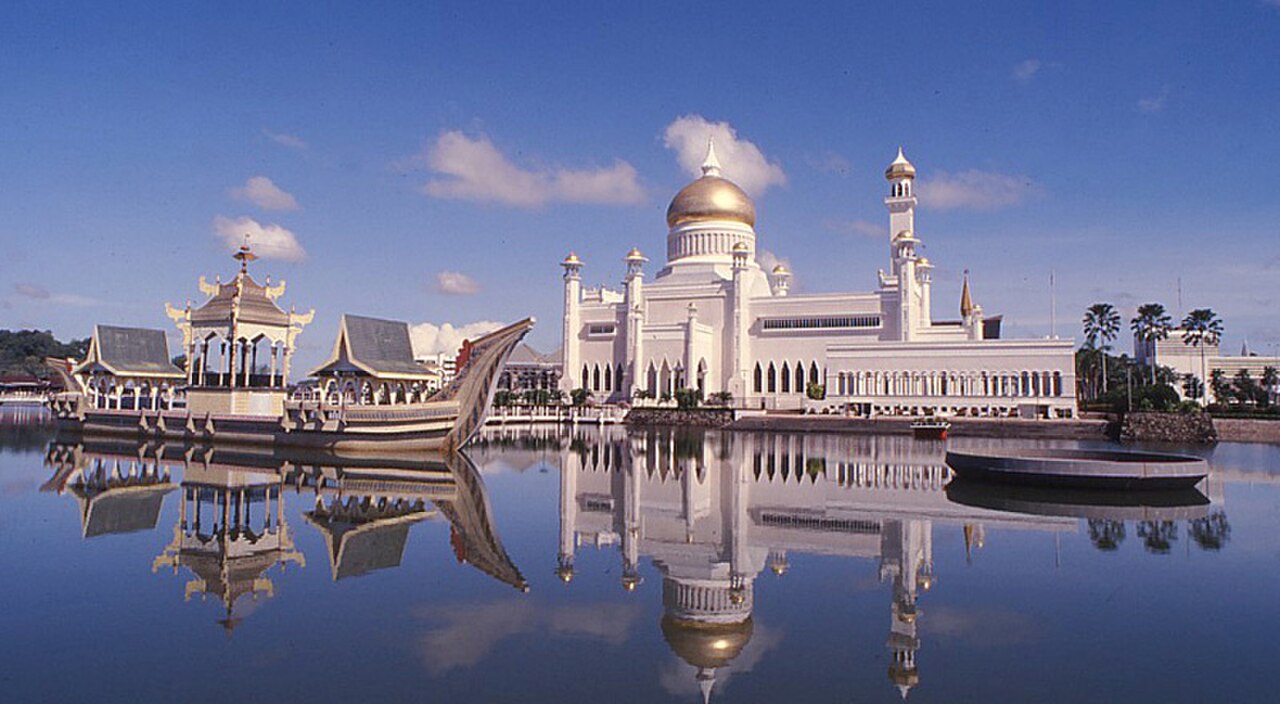
The Omar Ali Saifuddien Mosque stands beside a lagoon in central Bandar Seri Begawan, with a ceremonial barge nearby. Jame’ Asr Hassanil Bolkiah Mosque is a separate mosque in Kiarong, known for its multiple domes and gardens. The Royal Regalia Museum displays objects associated with royal ceremonies and state occasions. Nearby public spaces and the waterfront connect these monuments with the city’s daily life. Mosque visits depend on prayer times, dress requirements and local access rules.
Kota Batu contains archaeological remains and museums that introduce earlier settlement, technology and maritime exchange. Farther west, the Billionth Barrel Monument at Seria commemorates oil production. Tutong’s Tasek Merimbun offers a freshwater-lake landscape, while Temburong’s canopy walk turns attention towards the forest. The Sultan Haji Omar Ali Saifuddien Bridge, opened in 2020, is a modern engineering landmark linking the two territories. Sight pins identify places for learning; they are approximate locations rather than entrances or a promise of current public access.
People & Society of Brunei
Many languages, river and inland communities, and lives connecting education, work and family.
- Where is most of the population concentrated?
- In western Brunei, especially Brunei-Muara district.
- Do official ethnic labels identify everyone’s first language?
- No. Administrative categories, ancestry and language describe different things.
- Which town serves Temburong district?
- Bangar, on the Temburong River.
More about Brunei: people & society
Bruneian society includes Malay communities, Chinese residents and Indigenous communities with distinct languages and histories, alongside people who have moved to the country for work or family. Official categories of Malay identity include several recognised Indigenous groups, so a population chart’s labels do not describe every person’s language or ancestry. Kedayan histories include farming, while Kampong Ayer developed around river livelihoods; neither association fixes what people do today.
Most people live in the western part of the country, especially Brunei-Muara. Bandar Seri Begawan connects public administration, education and commerce; Kuala Belait and Seria have strong connections with the energy industry. Bangar serves the smaller eastern district of Temburong. Schools, universities, sport, creative work and family networks connect rural and urban lives. Citizens, permanent residents and temporary workers have different legal positions, and some long-established residents are stateless. A guide to the country should include these varied experiences alongside royal history.