Facts about Bhutan
Explore Bhutan through Himalayan valleys, dzongs, forest corridors and the lives of its many communities. Learn twenty districts, place twenty-two towns, follow eight rivers and discover sixteen sights, then explore ten illustrated topics and thirty answered questions.
- Capital
- Thimphu
- Area
- 38,394 km²
- Population
- 727,145 residents, 2017 census
- Currency
- Ngultrum (BTN)
- National language
- Dzongkha
- Districts
- 20 dzongkhags
Bhutan · 0 of 20 rounds passed
Two timed rounds per topic, 20 seconds a question
Between India and China in the eastern Himalayas, Bhutan rises from subtropical foothills to alpine valleys and northern peaks. Thimphu is the capital, Paro contains the principal international airport, and Trongsa, Bumthang, Mongar and Trashigang help orient the central and eastern country. Rivers and mountain passes connect places that can look deceptively close on a flat map.
The country is a democratic constitutional monarchy with twenty dzongkhags, or districts. Dzongkha is the national language, alongside many community languages and widespread educational use of English. Gross National Happiness, hydropower, farming, religious heritage and conservation all help explain contemporary Bhutan. The linked Nepali course teaches one language spoken in the south; it is not a Dzongkha course.
Geography of Bhutan
Eastern Himalayan valleys between India and China, with rivers flowing towards the Brahmaputra.
- Which countries border Bhutan?
- India and China. Bhutan is landlocked in the eastern Himalayas. Nepal and Bangladesh are geographically close, but neither shares a land border with Bhutan.
- What is a dzongkhag?
- A district, Bhutan’s main administrative division. There are twenty. A district and its administrative town are different geographic units, even when they share the same name.
- Where do Bhutan’s major rivers ultimately drain?
- They flow into the Brahmaputra system. The Pho Chhu and Mo Chhu meet at Punakha to form the Puna Tsang Chhu, known farther downstream as the Sankosh.
More about Bhutan: geography
Bhutan is a landlocked country in the eastern Himalayas, bordering China to the north and India to the west, south and east. Nepal and Bangladesh are nearby but do not share its border. Across about 38,394 square kilometres, subtropical southern foothills rise through forested valleys to northern alpine country. Gangkhar Puensum, usually given as 7,570 metres, is Bhutan’s highest mountain; mountaineering restrictions have kept its summit unclimbed.
Twenty districts, called dzongkhags, organise the country. Thimphu is the capital; Paro contains the principal international airport. Trongsa and Bumthang lie in the centre, while Mongar and Trashigang anchor eastern valleys. The Amo Chhu, Wang Chhu, Puna Tsang Chhu and rivers of the Manas system drain south towards the Brahmaputra. Steep ridges and passes mean that short distances on a map can involve long journeys. The learning boundaries are a dated reference and do not resolve Bhutan’s border negotiations with China.
History of Bhutan
Buddhist religious networks, seventeenth-century unification and a constitutional monarchy from 2008.
- Who helped unify Bhutan in the seventeenth century?
- Zhabdrung Ngawang Namgyal consolidated authority and developed a network of dzongs. Guru Rinpoche belongs to a much earlier religious history and should not be confused with him.
- When did the hereditary monarchy begin?
- In 1907, when Ugyen Wangchuck became the first hereditary king. The constitutional system introduced in 2008 came roughly a century later.
- What changed in 2008?
- Bhutan held its first parliamentary elections and adopted a written constitution. The monarchy continued within a democratic constitutional framework rather than being abolished.
More about Bhutan: history
Buddhist traditions connect Bhutan with the wider Himalayas. Guru Rinpoche, or Padmasambhava, is associated with eighth-century religious history and with sacred narratives surrounding Taktsang. In the seventeenth century, Zhabdrung Ngawang Namgyal consolidated authority across much of what became Bhutan, building a network of dzongs and a system combining religious and civil administration. His achievement did not erase the distinct histories of every valley or community.
Ugyen Wangchuck became the first hereditary king in 1907. Relations with British India were shaped by the 1865 Treaty of Sinchula and the 1910 Treaty of Punakha. Bhutan’s treaty with independent India dates to 1949 and was revised in 2007. Roads, public institutions and international connections expanded during the twentieth century; Bhutan joined the United Nations in 1971. The first parliamentary elections and adoption of the constitution in 2008 established the present democratic constitutional monarchy.
Language of Bhutan
Dzongkha is the national language; Tshangla, Nepali and many valley languages add to the picture.
- What is Bhutan’s national language?
- Dzongkha, written in the Tibetan script. English has a major educational role, while Tshangla, Nepali and several other languages are also spoken.
- Does everyone in Bhutan speak Dzongkha at home?
- No. Bhutan has many language communities. Tshangla is important in the east, Nepali is used by many southern Bhutanese, and several central valleys have distinct languages.
- What language do the linked lessons teach?
- Nepali, a language spoken by many people in southern Bhutan. The lessons do not teach Dzongkha, Bhutan’s national language, or represent all Bhutanese communities.
More about Bhutan: language
Dzongkha is Bhutan’s national language, written in the Tibetan script. Its name is often translated as the language of the fortress, reflecting the role of dzongs in administration and religious life. English is widely used in education and professional settings. Neither language describes every household’s mother tongue: Tshangla is important in the east, while Bumthang, Khengkha and other languages have their own communities and histories.
Nepali is spoken by many southern Bhutanese, including Lhotshampa communities. Language, citizenship and cultural identity have also been politically sensitive, especially in the displacement of Nepali-speaking people in the late twentieth century. The linked Nepali lessons introduce one language spoken in Bhutan; they are not Dzongkha lessons. In Dzongkha, kuzuzangpo is a familiar greeting and kadrinche expresses thanks, but pronunciation and polite forms take practice beyond a short transcription.
Culture of Bhutan
Tshechu masked dances, woven textiles, archery and living religious traditions.
- What is a tshechu?
- A religious festival associated with Buddhist teachings, often featuring masked dances and community gatherings. Different places hold their festivals on different dates.
- What are the gho and kira?
- Prominent Bhutanese forms of dress: the gho is a robe commonly worn by men, and the kira a wrapped garment commonly worn by women. Fabrics, styles and occasions vary.
- What is Bhutan’s national sport?
- Archery. Competitions can combine skilled shooting with songs, celebrations and lively exchanges between teams. Both traditional bows and modern equipment are used.
More about Bhutan: culture
Tshechu festivals bring religious dance, music and community gatherings to dzongs and monasteries. Masked cham dances convey Buddhist stories and teachings; dates and programmes differ by place. The Drametse mask dance is recognised by UNESCO as intangible cultural heritage. Buddhism is Bhutan’s spiritual heritage under the constitution, alongside protections for freedom of religion. Hindu traditions are important to many southern Bhutanese, and religious life is more varied than a single label suggests.
The gho and kira are prominent forms of dress, while weaving techniques and textile patterns vary across regions. Khoma is associated with richly patterned kishuthara textiles. Driglam Namzha refers to a code of etiquette and public conduct, including aspects of dress. Archery is the national sport and often includes songs and spirited exchanges among teams. Contemporary film, popular music, football and digital media also form part of cultural life.
Economy of Bhutan
Hydropower, farming, tourism and the broader aims of Gross National Happiness.
- Does Gross National Happiness replace GDP?
- No. It broadens development goals and measurement beyond economic output. Bhutan still measures GDP and faces practical questions about employment, income and public services.
- Why is hydropower important?
- Mountain rivers supply electricity for domestic use and exports, particularly to India. Hydropower projects also involve financing, environmental impacts and seasonal changes in river flow.
- What currency does Bhutan use?
- The ngultrum, abbreviated BTN, which is pegged at par to the Indian rupee. This monetary link reflects Bhutan’s close economic relationship with India.
More about Bhutan: economy
Hydropower is central to Bhutan’s electricity generation and exports to India. Agriculture, livestock, construction, public services and tourism also support livelihoods. Rice terraces occupy suitable valleys, while potatoes and buckwheat are important in cooler areas. The ngultrum, abbreviated BTN, is pegged at par to the Indian rupee. The close economic relationship with India influences trade, infrastructure and development finance.
Gross National Happiness broadens the goals of development to include well-being, culture, environmental conservation and good governance. It does not mean that Bhutan has stopped measuring GDP, nor that every person is happy. Tourism policy aims to manage visitor impact and includes a Sustainable Development Fee. Fees and exemptions can change, so current official requirements should guide travel planning. Youth employment, migration and the balance between growth and conservation remain significant questions.
Politics of Bhutan
A democratic constitutional monarchy with two parliamentary chambers and twenty districts.
- What form of government does Bhutan have?
- A democratic constitutional monarchy under the 2008 constitution. The king is head of state, while the prime minister heads the elected government.
- What are Bhutan’s two parliamentary houses?
- The National Council and the National Assembly. The Council includes twenty elected district members and five royal appointees; the Assembly has forty-seven elected members.
- What does the constitution require for forest cover?
- A minimum of sixty percent of Bhutan’s total land must remain under forest cover for all time. This is a constitutional minimum, not a statement of the measured forest percentage today.
More about Bhutan: politics
The 2008 constitution defines Bhutan as a democratic constitutional monarchy. The Druk Gyalpo is head of state, and the prime minister heads the elected government. Parliament comprises the king, the National Council and the National Assembly. The Council has twenty elected district representatives and five members appointed by the king; the Assembly has forty-seven elected members. The two houses have different functions and electoral arrangements.
Local administration operates through dzongkhags, gewogs and urban authorities. The constitution requires at least sixty percent of the country to remain under forest cover for all time. It also sets out fundamental rights and duties, including religious freedom. Bhutan maintains especially close ties with India and negotiates its northern border with China. Administrative outlines on a learning map should be read separately from the legal and diplomatic processes that determine international boundaries.
Nature & Wildlife of Bhutan
Subtropical forests, alpine habitats, takin and wintering black-necked cranes.
- Which bird winters in Phobjikha and Bumdeling?
- The black-necked crane. These valleys provide seasonal habitat; the cranes are not present in the same numbers throughout the year.
- What is the takin?
- A large mountain bovid and Bhutan’s national animal. It is a species in its own right, not a hybrid of a goat and another animal.
- Why connect protected areas with corridors?
- Connected habitats allow wildlife to move between protected areas and maintain populations. The corridors support multiple species rather than serving only tigers or one migration route.
More about Bhutan: nature & wildlife
Bhutan’s elevation range supports sharply different habitats. Elephants and hornbills occur in southern forests, red pandas use temperate mountain forests, and snow leopards inhabit high country. The takin, a large mountain bovid, is the national animal. Black-necked cranes winter in valleys including Phobjikha and Bumdeling. A wildlife pin or photograph identifies a habitat or species association rather than promising a sighting.
Protected areas and biological corridors aim to keep habitats connected for many species, including tigers. Royal Manas National Park adjoins India’s Manas landscape, while Jigme Dorji and Wangchuck Centennial national parks protect northern mountain ecosystems. Bhutan’s forests absorb substantial carbon, but claims about carbon negativity depend on how emissions and absorption are measured and are not unique to Bhutan. Glacier change, flood risk and pressure on habitat make conservation an ongoing task.
Food & Cuisine of Bhutan
Ema datshi, red rice, buckwheat, dumplings and salted butter tea.
- What is ema datshi?
- A dish of chillies and cheese. Chillies provide much of the substance of the dish, rather than being used only as a small amount of spice.
- Is red rice Bhutan’s only staple?
- No. Red rice is well known, but buckwheat, maize, wheat, other rice varieties and potatoes also matter. Farming and eating patterns vary with elevation and community.
- What is suja?
- Salted butter tea, a drink associated with Bhutan and wider Himalayan traditions. It differs from sweet milk tea and from ara, an alcoholic grain drink.
More about Bhutan: food & cuisine
Ema datshi combines chillies with cheese; the chillies are a substantial ingredient rather than simply a seasoning. Kewa datshi uses potatoes, while shamu datshi uses mushrooms. Red rice is associated with Bhutanese cooking, particularly western valleys, but it is not the only grain eaten. Buckwheat, maize, wheat and other foods reflect differences in altitude, farming and household preference.
Phaksha paa is a pork dish, jasha maroo a chicken preparation, and momo are dumplings shared with wider Himalayan food traditions. Suja is salted butter tea. Ara is a traditional alcoholic drink made from grains, with both fermented and distilled forms. Vegetarian choices exist alongside meat dishes. Southern Nepali-speaking communities contribute their own food traditions, so a single menu cannot represent every household in Bhutan.
Landmarks of Bhutan
Cliffside Taktsang, valley dzongs, Bumthang temples and eastern heritage.
- Where is the Tiger’s Nest?
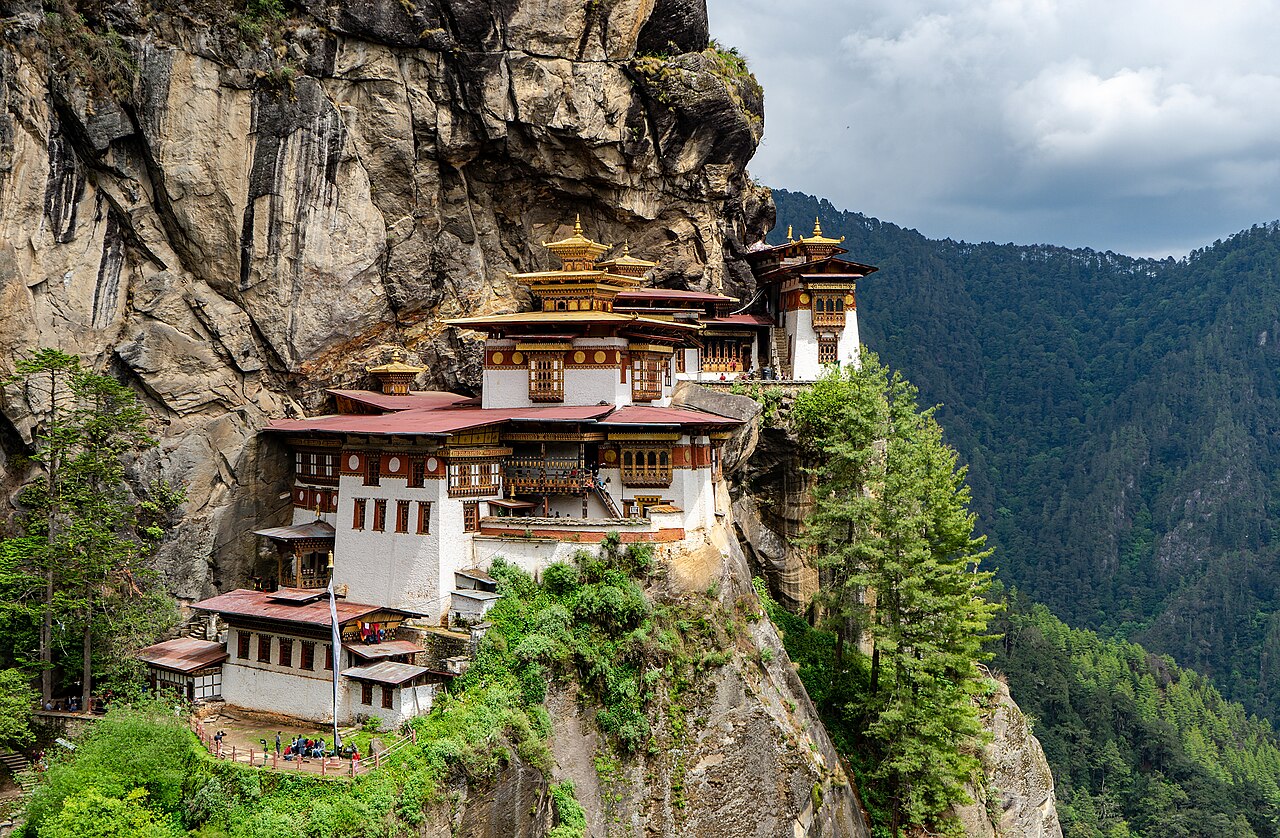
- Paro Taktsang stands on a cliff above the Paro valley. Its religious traditions are much older than the surviving monastery complex, which began in the seventeenth century.
- Why is Punakha Dzong’s location memorable?
- It stands at the confluence of the Pho Chhu and Mo Chhu. Their combined river continues south as the Puna Tsang Chhu, making the dzong a useful landmark for understanding the river map.
- Is a sight pin a confirmed entrance?
- No. It identifies the place for geographical learning. Sacred-site access, routes, opening hours and photography rules need current local checks, and landscape pins may mark a broad area.
More about Bhutan: landmarks
Paro Taktsang, widely called the Tiger’s Nest, clings to a cliff above the Paro valley. Its sacred narratives concern Guru Rinpoche; the present monastery complex began in the seventeenth century and was restored after a 1998 fire. Punakha Dzong stands where the Pho Chhu and Mo Chhu meet. Trongsa Dzong commands a central valley, and Rinpung Dzong overlooks Paro. These buildings combine religious, administrative and historical roles.
Thimphu contains Tashichho Dzong, the Memorial Chorten and the Buddha Dordenma statue. Bumthang’s Jambay and Kurjey temples reveal another concentration of religious heritage. Gangtey Monastery overlooks the Phobjikha valley; Chorten Kora and Drametse extend the picture eastwards. Sacred places remain active places of worship. Opening hours, dress, guides, permits and photography rules require current checks with the responsible authorities.
People & Society of Bhutan
Many language communities, rural and urban connections, and histories of migration and displacement.
- What does the population figure in this guide represent?
- The 2017 census counted 727,145 residents. It is explicitly dated and should not be read as a live estimate of Bhutan’s population today.
- Who are the Lhotshampa?
- A broad term associated with southern Bhutanese of Nepali heritage. Their histories include both life in Bhutan and the displacement of many people during the late twentieth century.
- Which Bhutanese film received an Oscar nomination?
- Lunana: A Yak in the Classroom, directed by Pawo Choyning Dorji, was nominated for International Feature Film at the 2022 Academy Awards. It tells a story set in a remote Bhutanese school.
More about Bhutan: people & society
Bhutan’s 2017 census counted 727,145 residents, a dated census figure rather than a current population estimate. Communities commonly described as Ngalop, Sharchop and Lhotshampa are part of a more complex social and linguistic picture. Highland groups such as Layap and Brokpa have distinct local traditions. Broad labels should not be treated as fixed boundaries between identical people; language, religion, region and personal identity overlap in different ways.
Many Nepali-speaking Bhutanese fled or were expelled during the late 1980s and early 1990s, following restrictive citizenship and cultural policies. Large refugee communities lived in Nepal, and many people later resettled in third countries. This history belongs alongside the country’s conservation and cultural achievements. Today, education, migration abroad and movement towards towns reshape family networks. Filmmakers such as Pawo Choyning Dorji, whose Lunana: A Yak in the Classroom received an Academy Award nomination, bring contemporary Bhutanese stories to international audiences.