Facts about Afghanistan
Explore Afghanistan through Herat’s tiled architecture, Kabul’s gardens, Bamiyan’s archaeological landscape and the high valleys of the Hindu Kush. Connect provinces, cities and rivers with poetry, regional cooking, living crafts and the experiences of Afghan communities at home and abroad.
- Capital
- Kabul
- Currency
- Afghani (AFN)
- Main state languages
- Dari and Pashto
- Provinces
- 34
- Coastline
- Landlocked
- UNESCO World Heritage
- 2 properties
Afghanistan · 0 of 20 rounds passed
Two timed rounds per topic, 20 seconds a question
Afghanistan is landlocked, meeting Iran in the west, Pakistan in the south and east, and Turkmenistan, Uzbekistan and Tajikistan in the north. The narrow Wakhan corridor reaches China. Kabul occupies a high eastern basin; Herat looks towards western trading routes; Kandahar anchors the southern plains; and Mazar-e Sharif lies near the northern borderlands. Mountain ridges, winter snow and long distances shape connections between these places.
Buddhist caves, Islamic monuments, carpet workshops and irrigated orchards reveal histories that extend beyond recent wars. Those wars, displacement and the Taliban’s return to power in 2021 have profoundly changed everyday life. Severe restrictions particularly affect women and girls. This guide supports learning about Afghanistan’s places and people; its heritage descriptions and map pins do not establish present visitor access or safe routes.
Geography of Afghanistan
The Hindu Kush connects high valleys with northern plains and southwestern deserts.
- Does Afghanistan have a coastline?
- No. It is landlocked and borders six countries, including China at the eastern end of Wakhan.
- How many provinces does Afghanistan have?
- Thirty-four, including Daykundi and Panjshir. Cities and provinces can share names, but they are different map features.
- Where does the Kabul River flow?
- East into Pakistan, where it joins the Indus. It is discussed here but is not included in the four-river map exercise.
History of Afghanistan
Bactrian cities, Buddhist monasteries and Islamic courts preceded the modern state.
- Who established the Durrani kingdom in 1747?
- Ahmad Shah Durrani. His kingdom was an important foundation of the modern Afghan state.
- What did Afghanistan regain in 1919?
- Control of its foreign affairs after the Third Anglo-Afghan War. Afghanistan had not been governed as part of British India.
- Was Bamiyan always an Islamic centre?
- No. Its archaeological landscape includes Buddhist monasteries and cave art, alongside later Islamic-period remains.
Dari, Pashto and Afghanistan’s other languages
Dari and Pashto share an Iranian language family, alongside many other languages.
- Is Dari Arabic?
- No. Dari is Afghan Persian, an Indo-European language written in an Arabic-based script.
- Are Dari and Pashto the same language?
- No. Both belong to the Iranian language group, but Pashto is a distinct language from Persian.
- Does the linked Persian course specifically teach Dari?
- No. It teaches Iranian Persian. Pronunciation and everyday vocabulary differ from Dari, so the guide makes that distinction explicit.
Culture of Afghanistan
Poetry, rubab music and textile skills connect families across regions and borders.
- What is a rubab?
- A plucked string instrument with a carved wooden body. Its crafting and playing traditions received a multinational UNESCO inscription in 2024.
- What is buzkashi?
- A horseback contest especially associated with northern Afghanistan and neighbouring parts of Central Asia.
- Do old music photographs show present performance freedoms?
- No. Taliban restrictions have endangered musicians and public musical life. Historical images document a particular time.
Economy of Afghanistan
Farms, orchards, livestock and workshops depend on water, trade and reliable services.
- What is Afghanistan’s currency?
- The afghani, abbreviated AFN. Afghan describes a person or something from the country.
- Which orchard products are associated with Afghanistan?
- Grapes and raisins, pomegranates and nuts are familiar examples, alongside crops such as wheat and saffron.
- Why do restrictions on women’s work affect the economy?
- They reduce employment, household income and access to skills and services, affecting the wider economy as well as individual families.
Politics of Afghanistan
Taliban rule since 2021 has brought a different system and severe restrictions on rights.
- What changed in August 2021?
- The previous Islamic Republic collapsed and the Taliban took Kabul, establishing a different governing system.
- Does the former republic’s elected parliament describe today’s system?
- No. Current rule rests on Taliban religious leadership and appointed authorities, rather than the former elected institutions.
- What education restrictions affect women and girls?
- UN reporting documents exclusion from secondary and university education, alongside extensive restrictions on work, movement and public life.
Nature & Wildlife of Afghanistan
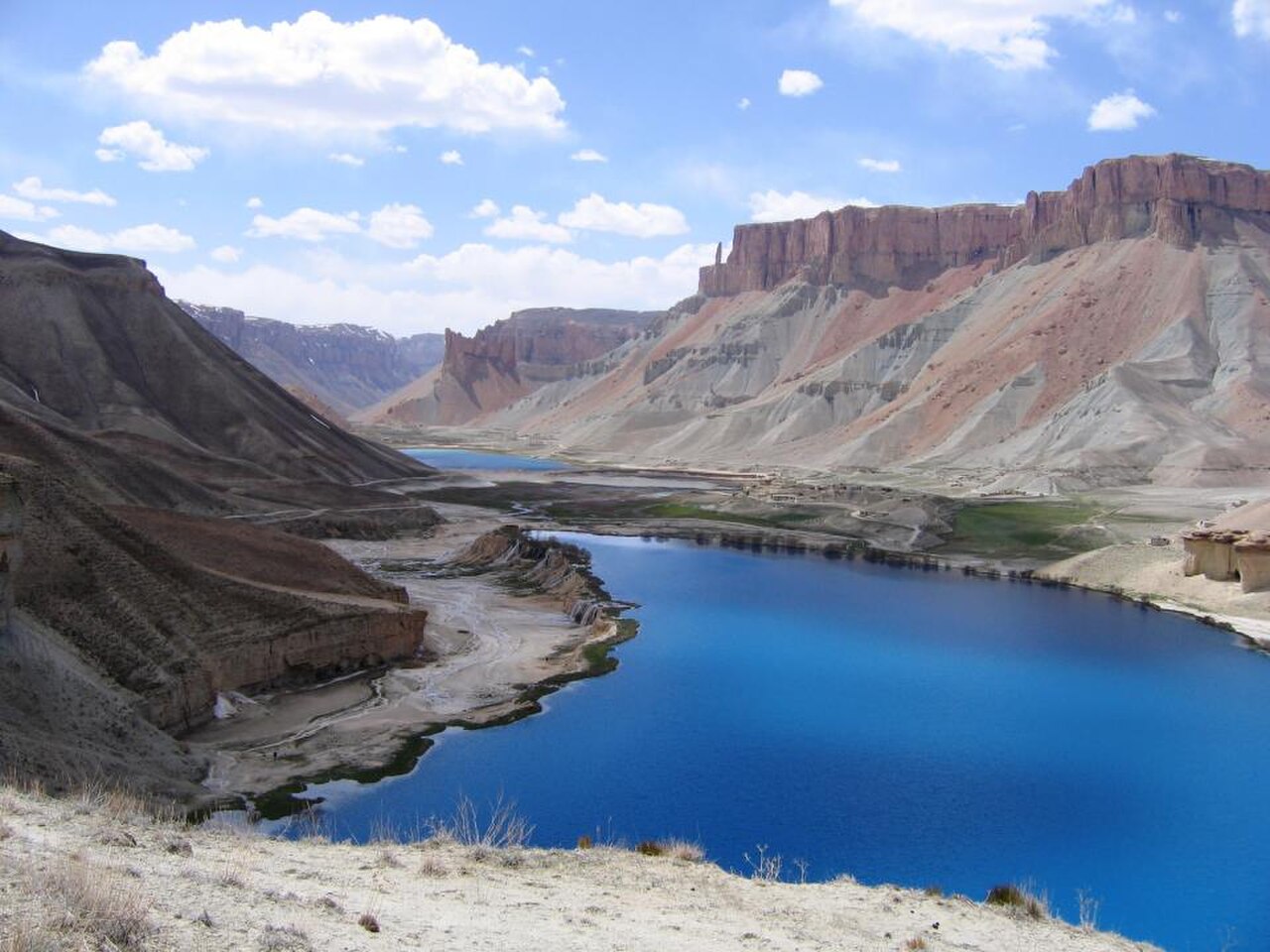
Travertine lake barriers, mountain wildlife and dryland habitats depend on scarce water.
- How did Band-e Amir’s natural lake barriers form?
- Mineral deposits built travertine barriers. They are natural formations rather than concrete dams.
- Which mountain region provides snow leopard habitat?
- Wakhan in the far northeast. Its high mountain habitats also support animals such as ibex.
- Why is mountain snow important beyond the highlands?
- Snowmelt helps feed rivers and irrigation downstream. Changes in snow, drought and flooding affect farming and settlements.
Food & Cuisine of Afghanistan
Rice dishes, dumplings, filled flatbreads and tea bring people around a shared meal.
- What is Kabuli palaw?
- A seasoned rice dish commonly served with meat, carrots and raisins. Recipes and spellings vary.
- What is the difference between mantu and bolani?
- Mantu are dumplings, often filled with meat and onion. Bolani are filled flatbreads, commonly with potatoes or greens.
- What often fills ashak?
- Greens such as leeks. Fillings and sauces vary between households and regions.
Landmarks of Afghanistan
Bamiyan and Jam are World Heritage properties; Herat and Kabul reveal other layers.
- How many UNESCO World Heritage properties does Afghanistan have?
- Two: the Bamiyan Valley cultural landscape and the Minaret and Archaeological Remains of Jam.
- Do Bamiyan’s giant standing Buddhas survive intact?
- No. The Taliban destroyed them in March 2001. Their niches, caves and wider archaeological landscape remain.
- Is a UNESCO Tentative List entry already a World Heritage inscription?
- No. Herat, Balkh, Band-e Amir and Bagh-e Babur have tentative status, distinct from the two inscribed properties.
People & Society of Afghanistan
Overlapping identities and a large diaspora connect villages, cities and many countries.
- Does one language identify every member of an ethnic community?
- No. Language, ethnicity, religion and regional identity overlap, and many Afghans are multilingual.
- Where do Afghan communities live?
- In Afghanistan and across a large diaspora, including neighbouring countries. Displacement and return migration shape many family networks.
- Why avoid presenting exact ethnic percentages as census results?
- Afghanistan has no recent comprehensive census. Population totals and community shares rely on estimates and are affected by displacement.