Facts about Russia
Capital Moscow · Europe
10 topics · 20 lessons · about 20 minutes
Russia is by far the largest country in the world, covering about an eighth of the inhabited land surface and stretching across eleven time zones from the Baltic to the Pacific. It holds enormous energy and mineral reserves, a literary and musical tradition of global weight, and a history of highly centralised rule that has outlasted every change of regime.
Russia covers roughly 17 million square kilometers across eleven time zones, nearly twice the size of the next largest country, and borders 14 states by land. The Ural Mountains form the conventional divide between European Russia, where most people live, and Siberia, which holds three quarters of the territory and a small fraction of the population. Much of the country is flat, permafrost underlies about two thirds of the land, and Lake Baikal in southern Siberia is the deepest lake in the world and holds around a fifth of unfrozen fresh surface water.
Moscow holds over 13 million residents and concentrates political and economic power to a degree few countries match. St Petersburg, laid out on marshland from 1703, is the imperial capital turned cultural one, while Novosibirsk, Yekaterinburg and Kazan anchor Siberia, the Urals and the Tatar republic. Vladivostok sits 9,289 rail kilometers away on the Pacific. Travel within the country has long meant the Trans-Siberian Railway, the two capitals, and Baikal, though Western sanctions and the war in Ukraine have sharply reduced foreign visitors since 2022.
- Population
- 144 million
- Area
- 17,098,246 km²
- Currency
- Russian ruble (₽)
- Official language
- Russian, plus ~35 in the republics
- Time zones
- 11
- Highest point
- Mount Elbrus, 5,642 m
The Russia course
Geography of Russia2 lessons
An eighth of the inhabited land surface, eleven time zones, and the deepest lake on Earth.
History of Russia2 lessons
Kievan Rus to the tsars, revolution in 1917, and a superpower that dissolved in 1991.
Language of Russia2 lessons
The most widely spoken Slavic language, in a Cyrillic alphabet named for a missionary.
Culture of Russia2 lessons
Tolstoy and Dostoevsky within decades of each other, plus ballet, chess and the banya.
Economy of Russia2 lessons
The biggest proven gas reserves in the world, redirected east under sanctions since 2022.
Politics of Russia2 lessons
A federal republic on paper, with power concentrated heavily in the presidency.
Nature & Wildlife of Russia2 lessons
A fifth of the world’s forest, Siberian tigers past 500, and 1,700 species unique to Baikal.
Food & Cuisine of Russia2 lessons
Preserving against long winters, soup as the center of the meal, and tea from a samovar.
Landmarks of Russia2 lessons
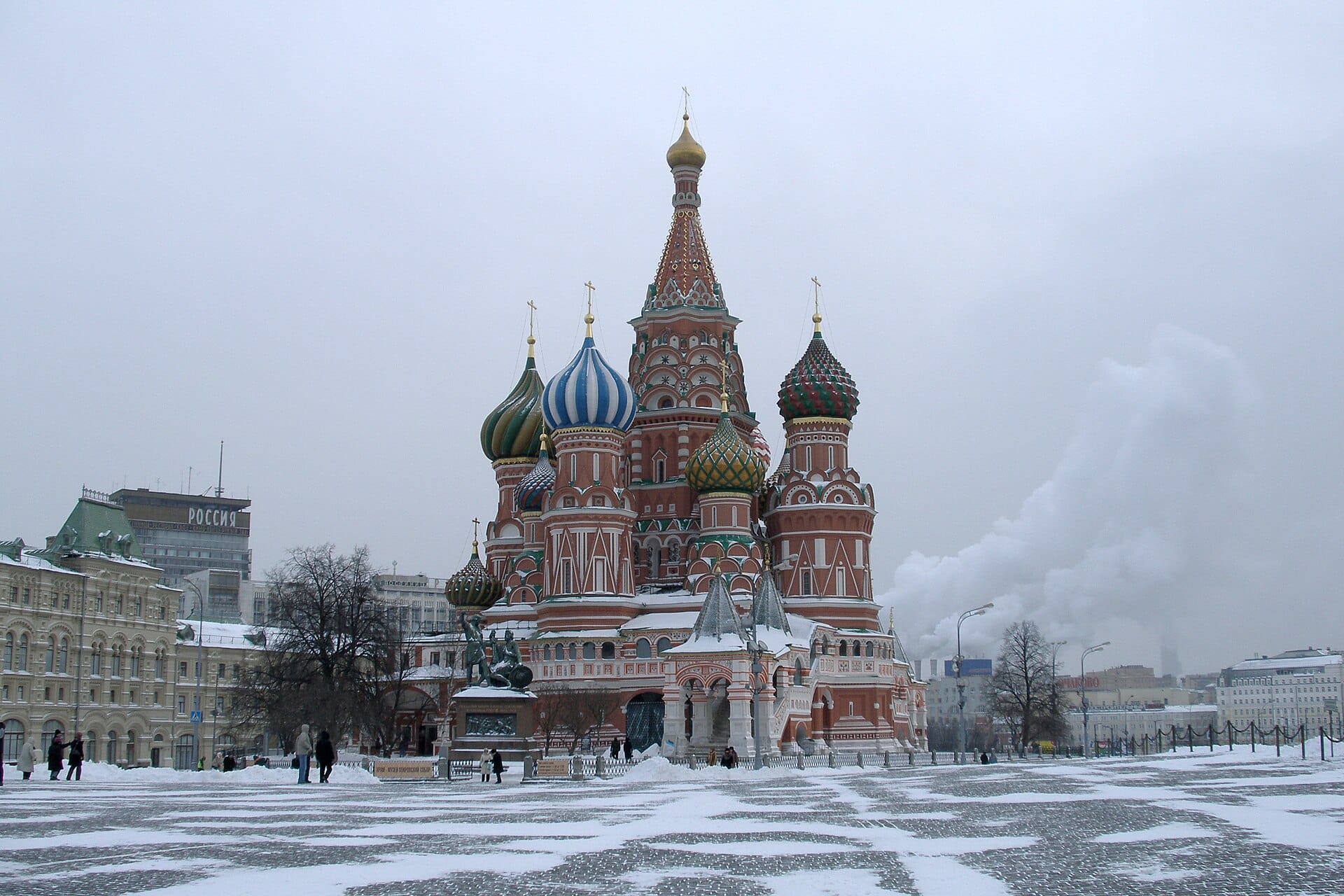
Nine chapels under mismatched onion domes, three million items in the Hermitage, and 9,289 km of track.
People & Society of Russia2 lessons
Shrinking for most of the period since 1991, and overwhelmingly concentrated in the west.
Geography of Russia
Russia covers roughly 17 million square kilometers, nearly twice the size of the next largest country, and borders 14 states by land. The Ural Mountains form the conventional divide between European Russia, where most people live, and Siberia, which holds three quarters of the territory and a small fraction of the population.
Much of the country is flat, with the West Siberian Plain among the largest lowlands on Earth, and permafrost underlies about two thirds of the land. Lake Baikal in southern Siberia is the deepest lake in the world at 1,642 meters and holds around 20 percent of unfrozen fresh surface water. Winters in the interior are severe, and Oymyakon in Yakutia is the coldest permanently inhabited place on the planet.

History of Russia
Kievan Rus, a federation of Slavic principalities centerd on Kyiv, adopted Orthodox Christianity in 988 before Mongol invasion broke it apart in the 13th century. Moscow gradually gathered the Russian lands, and Ivan IV took the title of tsar in 1547. Peter the Great modernised the state along European lines from 1682 and founded St Petersburg as a new capital.
The empire expanded east to the Pacific and south into Central Asia before revolution overthrew the monarchy in 1917 and brought the Bolsheviks to power. The Soviet Union industrialised at enormous human cost under Stalin, lost around 27 million people in the Second World War, and competed with the United States through the Cold War until it dissolved in December 1991. Vladimir Putin has led the country as president or prime minister since 1999.

Language of Russia
Russian is the most widely spoken Slavic language, with roughly 150 million native speakers and many more who learned it as a second language across the former Soviet republics. It uses the Cyrillic alphabet, adapted from Greek in the 9th century and named after the missionary Cyril.
The grammar has six cases and three genders, and verbs distinguish between completed and ongoing action through aspect pairs that learners generally find harder than the case system. Russia recognizes around 35 other official languages within its republics, including Tatar, Chechen and Bashkir, reflecting a population made up of well over a hundred ethnic groups.

Culture of Russia
Russian literature of the 19th century produced Tolstoy, Dostoevsky, Chekhov and Pushkin within a few decades, and their novels and plays remain fixtures of world literature. Composers including Tchaikovsky, Rachmaninoff, Stravinsky and Shostakovich carried similar weight in music.
Ballet has been a point of national pride since the imperial theaters of the 1800s, and the Bolshoi and Mariinsky companies still set international standards. Orthodox Christianity shapes ritual and architecture, having recovered institutional prominence after decades of Soviet suppression. Chess, space exploration and the traditions around the banya steam bath all feature heavily in how Russians describe themselves.

Economy of Russia
Russia is one of the largest producers of oil and natural gas in the world and holds the biggest proven gas reserves, which historically supplied a large share of European demand. Energy has typically provided a substantial part of federal budget revenue, making public finances sensitive to price swings.
The country is also a leading exporter of wheat, fertiliser, nickel, palladium and timber. Extensive Western sanctions imposed after the full-scale invasion of Ukraine in February 2022 cut access to many foreign markets and technologies, redirecting energy exports toward China, India and Turkey. Heavy military spending has sustained output while shrinking the civilian labour force.

Politics of Russia
Russia is formally a federal semi-presidential republic, though power is concentrated heavily in the presidency. Constitutional amendments approved in 2020 reset term limits, allowing Vladimir Putin to remain in office into the 2030s.
The Federal Assembly has a State Duma and a Federation Council, and the country is divided into 83 federal subjects, plus Ukrainian territories that Russia claims and most other states do not recognize. Independent media and opposition activity have been sharply restricted through foreign agent and extremism laws, and international observers no longer regard national elections as competitive.

Nature & Wildlife of Russia
Russia holds about a fifth of the world’s forest, most of it Siberian taiga, which forms the largest continuous forest belt on Earth and a carbon store of global significance. Tundra runs along the Arctic coast, and steppe grassland covers the southwest.
The Siberian tiger, the largest cat in the world, survives in the Far East, where a protection program has lifted numbers past 500. Other notable species include the Amur leopard, one of the rarest big cats anywhere, along with polar bears, brown bears and reindeer herds. Lake Baikal contains around 1,700 species found nowhere else, among them the nerpa, the only exclusively freshwater seal.

Food & Cuisine of Russia
Russian cooking developed around long winters, so preserving through pickling, salting and fermenting runs through it. Rye bread, cabbage, potatoes, mushrooms and root vegetables form the base, with soups treated as the center of the meal rather than a starter.
Borscht, made with beetroot, and shchi, a cabbage soup, are the two great examples, usually served with sour cream. Blini pancakes are eaten through the Maslenitsa festival before Lent, pelmeni dumplings came from Siberia, and caviar from sturgeon in the Caspian remains the most prestigious product. Tea brewed strong from a samovar has been the standard drink since the 1700s.

Landmarks of Russia
Saint Basil’s Cathedral on Red Square, completed in 1561 under Ivan the Terrible, is the most recognized building in Russia, with nine chapels under painted onion domes of which no two match. The Kremlin beside it is a fortified complex that has housed Russian power for over five centuries.
St Petersburg was laid out on marshland from 1703 and holds the Winter Palace, whose Hermitage collection runs to around three million items. The Trans-Siberian Railway covers 9,289 kilometers from Moscow to Vladivostok as the longest rail line in the world, and Lake Baikal draws visitors to water clear enough to see 40 meters down.

People & Society of Russia
Russia has around 144 million residents and a population that has been shrinking for most of the period since 1991, driven by low fertility, high mortality among working-age men and, more recently, emigration. Life expectancy for men remains well below the European average.
Ethnic Russians make up roughly 80 percent of the population, alongside more than 190 recognized groups including Tatars, Chechens, Bashkirs and Chuvash, many with their own republics. About 75 percent of people live in cities, overwhelmingly in the European west, and Moscow alone holds over 13 million residents while much of the Far East continues to lose people.

Reading is one thing, recall is another. Play the Russia challenge to test what stuck. The lessons on all ten topics are open too, and a free account is what keeps your progress across them.