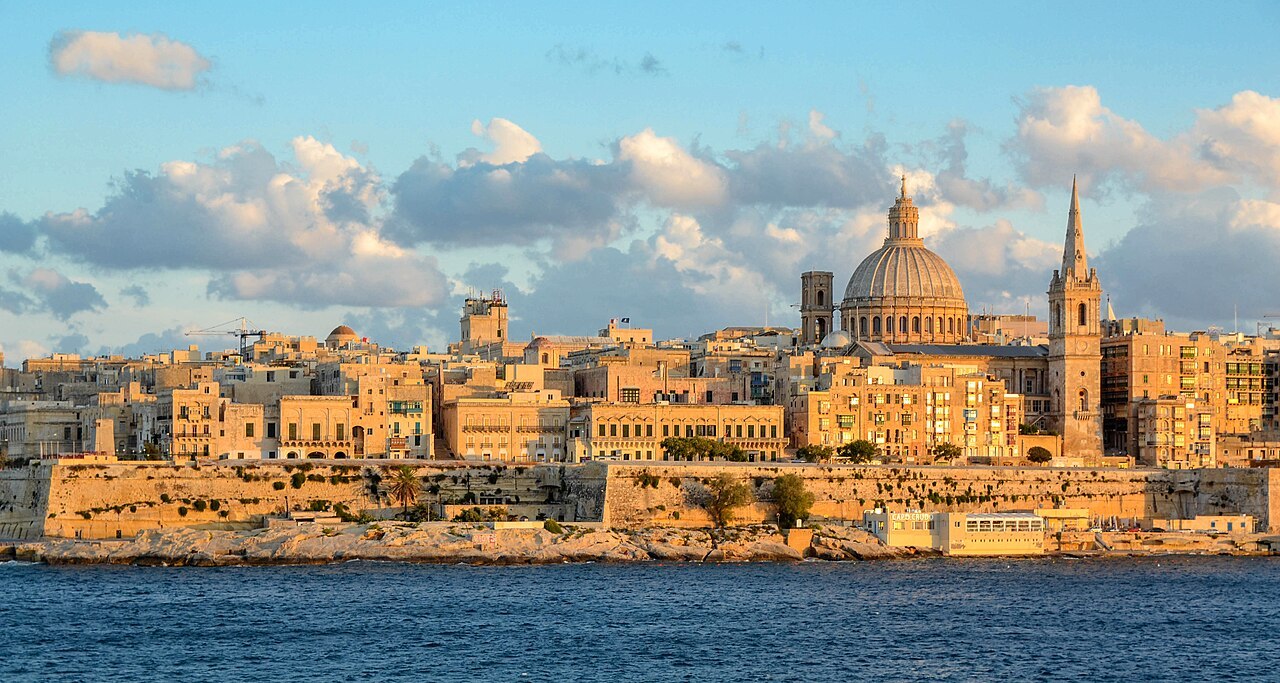
Facts about Malta
Explore Malta from Valletta’s fortified harbours to the villages of Gozo and the channels around Comino. Place sixteen cities and towns, trace eight named waters, discover sixteen sights, read ten illustrated topics and begin Maltese.
- Capital
- Valletta
- Land area, approximately
- 316 km²
- Residents, 2021 census
- 519,562
- Official languages
- Maltese and English
- Currency
- Euro (€)
- Independence
- 21 September 1964
Malta · 0 of 20 rounds passed
Two timed rounds per topic, 20 seconds a question
Malta is an archipelago in the central Mediterranean, south of Sicily and east of Tunisia. Malta is the largest island; Gozo lies to its northwest, with Comino between them. Smaller islands include Cominotto, Filfla and the Saint Paul’s Islands. Valletta stands on the peninsula between Grand Harbour and Marsamxett Harbour. Inland Mdina is an older fortified centre, while Victoria, also called Rabat, is Gozo’s main town.
French forces captured Malta in 1798. A local uprising and British assistance brought the French occupation to an end in 1800; British sovereignty was formally recognised in 1814. During the Second World War, Axis attacks placed the islands under siege. George VI awarded Malta the George Cross in 1942. Independence came on 21 September 1964, republic status on 13 December 1974, and the last British forces left in 1979.
Geography of Malta
Limestone islands south of Sicily, with sheltered harbours and scarce freshwater.
- Where are the main islands?
- Malta lies southeast of Gozo, with Comino between them in the central Mediterranean.
- Does Malta have permanent rivers?
- No. Rain can flow through valleys seasonally, but there are no permanent rivers.
- How far does the water map extend?
- The Mediterranean reaches its wider basin, while bays and channels keep their local geographical extents.
More about Malta: geography
Malta is an archipelago in the central Mediterranean, south of Sicily and east of Tunisia. Malta is the largest island; Gozo lies to its northwest, with Comino between them. Smaller islands include Cominotto, Filfla and the Saint Paul’s Islands. Valletta stands on the peninsula between Grand Harbour and Marsamxett Harbour. Inland Mdina is an older fortified centre, while Victoria, also called Rabat, is Gozo’s main town.
The country covers about 316 square kilometres and has no land borders or permanent rivers. Limestone plateaus, dry valleys and coastal cliffs shape the landscape. The north and south channels around Comino connect open Mediterranean waters; the Blue Lagoon is a smaller inlet on Comino’s western side. Water-learning areas mark geographical features rather than territorial seas. The Mediterranean continues far beyond Malta, towards Gibraltar in the west and the Levant in the east.
History of Malta
Prehistoric temples, the Knights of Saint John and a twentieth-century republic.
- When did the Knights rule?
- The Knights of Saint John ruled from 1530 until French forces captured Malta in 1798.
- When did British rule begin?
- British control began in 1800; formal recognition of British sovereignty followed in 1814.
- When did Malta become independent?
- Independence came in 1964, followed by a republic in 1974 and British military departure in 1979.
More about Malta: history
Malta’s Neolithic communities built monumental stone temples, including Ġgantija on Gozo and Ħaġar Qim on Malta. The temple-building period spans roughly 3600–2500 BCE. Phoenician, Roman, Byzantine, Arab and Norman periods followed. The Knights of Saint John received Malta in 1530 and resisted the Ottoman siege of 1565. Construction of Valletta began in 1566, under Grand Master Jean de Valette, whose name the city carries.
French forces captured Malta in 1798. A local uprising and British assistance brought the French occupation to an end in 1800; British sovereignty was formally recognised in 1814. During the Second World War, Axis attacks placed the islands under siege. George VI awarded Malta the George Cross in 1942. Independence came on 21 September 1964, republic status on 13 December 1974, and the last British forces left in 1979.
Language of Malta
A Semitic language written in Latin letters, alongside official English.
- Which languages are official?
- Maltese and English are official; Italian is widely understood but has no equivalent national status.
- Where did Maltese develop from?
- It developed from medieval Siculo-Arabic, with substantial later vocabulary from Italian, Sicilian and English.
- What does grazzi mean?
- Grazzi means thank you in Maltese; the linked lessons introduce everyday words and expressions.
More about Malta: language
Maltese and English are Malta’s official languages. Maltese developed from medieval Siculo-Arabic, the Arabic varieties once spoken in Sicily and Malta, rather than directly from modern Tunisian Arabic. It has a Semitic grammatical foundation and extensive vocabulary from Sicilian, Italian and English. It is written in the Latin alphabet, including distinctive letters such as ċ, ġ, ħ and ż and the digraph għ.
Maltese became an official European Union language when Malta joined in 2004. English has a strong role in education, business and public life, reflecting British rule and later international connections. Italian is also widely understood, but is not an official national language. The linked course introduces Maltese: bonġu is a greeting, grazzi means thank you, and iva and le mean yes and no. Everyday pronunciation cannot always be guessed from English spelling.
Culture of Malta
Village festas, band clubs, fishing boats and traditions of song and craft.
- What does a village festa celebrate?
- A village festa honours a patron saint through religious observances and wider community celebrations.
- What is a luzzu?
- A luzzu is a traditional painted fishing boat, often decorated with eyes on its bow.
- What is bizzilla?
- Bizzilla is Maltese lace, commonly made using bobbins and especially associated with craftspeople on Gozo.
More about Malta: culture
Village festas honour patron saints through religious observances and community celebrations. Processions, band clubs, street decorations and fireworks are characteristic, though arrangements differ by locality. UNESCO inscribed the Maltese village festa on its intangible heritage list in 2023. Carnival belongs to the period before Lent and is associated with costumes and floats; it is separate from the summer calendar of many village feasts.
The luzzu is a traditional brightly painted fishing boat, often with eyes on its bow. Marsaxlokk is a familiar place to see these boats. Għana is a Maltese folk-song tradition, while bizzilla is lace commonly made with bobbins, especially associated with Gozo. Valletta’s theatres, museums and contemporary events add other cultural layers. Heritage is lived and changing, rather than a single custom shared identically by everyone on the islands.
Economy of Malta
Tourism, ports, services and manufacturing within a small island economy.
- When was the euro introduced?
- Malta adopted the euro in January 2008, four years after joining the European Union.
- Where is the container Freeport?
- It is at Birżebbuġa beside Marsaxlokk Bay, separate from the older Grand Harbour complex.
- Is Malta’s economy only tourism?
- No. Services, digital businesses, port activity and manufacturing contribute alongside tourism to the island economy.
More about Malta: economy
Tourism, financial and professional services, digital businesses and manufacturing all contribute to Malta’s economy. Pharmaceuticals and electronics are among its manufacturing activities. The Malta Freeport at Birżebbuġa is a container transshipment hub beside Marsaxlokk Bay. Grand Harbour has a different maritime history, including naval use, ship repair and trade. These two harbour areas occupy different parts of the main island.
Malta joined the European Union in 2004 and adopted the euro on 1 January 2008, replacing the Maltese lira. English use and EU market access support international business, but Malta’s legal system is mixed rather than purely English common law. Film locations, water tanks and production services attract screen projects. Limited land and freshwater constrain farming; desalination, imports, housing pressure and transport are important practical parts of island life.
Politics of Malta
An elected parliament, a president and constitutional neutrality.
- Who leads the government?
- The prime minister leads the government, while the president serves as Malta’s head of state.
- Is Malta a NATO member?
- No. Constitutional neutrality and non-alignment coexist with membership of the European Union, a separate organisation.
- Is the Order of Malta the republic?
- No. The Sovereign Military Order of Malta is legally distinct from the independent Republic of Malta.
More about Malta: politics
Malta is a parliamentary republic. The president is head of state, while the prime minister leads the government. The House of Representatives is the national legislature, elected using the single transferable vote. Labour and the Nationalist Party have long dominated parliamentary politics. Local councils handle municipal matters; Malta’s regions and councils are distinct from the geographical grouping of Malta, Gozo and Comino.
The constitution establishes neutrality and non-alignment, and Malta is not a NATO member. Its membership of the European Union is a separate matter from military alliances. The Sovereign Military Order of Malta is legally distinct from the Republic of Malta. Same-sex marriage became legal in 2017, after several other EU countries had already introduced it. The 2017 assassination of investigative journalist Daphne Caruana Galizia prompted continuing questions about accountability, corruption and press freedom.
Nature & Wildlife of Malta
Cliffs, small wetlands and Mediterranean seagrass instead of permanent rivers.
- What grows in seagrass meadows?
- Posidonia oceanica, a marine flowering plant that provides habitat for fish and other Mediterranean wildlife.
- What happened to the Azure Window?
- The natural limestone arch at Dwejra on Gozo collapsed during a storm in March 2017.
- Why do Malta’s wetlands matter?
- Small reserves such as Għadira provide resting and feeding habitat along migration routes between Europe and Africa.
More about Malta: nature & wildlife
Hot, dry summers and generally mild, wetter winters give Malta a Mediterranean climate. Rain may flow through valleys seasonally, but there are no permanent rivers or large natural freshwater lakes. Groundwater and seawater desalination are both important water sources. Dingli Cliffs rise along the southwestern coast of Malta, while Gozo’s Dwejra area shows how waves and weather shape limestone. The Azure Window there collapsed in March 2017.
Posidonia oceanica is a marine flowering plant, not seaweed. Its underwater meadows support fish and other marine life. Malta lies on bird-migration routes between Europe and Africa; Għadira and Simar are small wetland reserves. Loggerhead turtles use surrounding waters and sometimes nest on beaches. Hunting and trapping regulations are contested and change, so a blanket claim that Malta has permanently banned spring hunting of both quail and turtle doves is inaccurate.
Food & Cuisine of Malta
Pastizzi, bread with olive oil, rabbit dishes and seasonal lampuki.
- What fills pastizzi?
- Common fillings are ricotta or a pea mixture, enclosed in a flaky savoury pastry shell.
- Are lampuki dolphins?
- No. Lampuki are dolphinfish, also called mahi-mahi, and are fish rather than marine mammals.
- Are imqaret only a Carnival food?
- No. These date-filled pastries are sold throughout the year, including at markets and community festivities.
More about Malta: food & cuisine
Pastizzi are flaky savoury pastries commonly filled with ricotta or a pea mixture. Ħobż biż-żejt means bread with oil and often includes tomato, capers, olives or tuna, with variations by household. Ftira is a traditional bread associated with Malta; its craft was recognised by UNESCO in 2020. Gozo’s baked ftira preparations can also carry toppings, so the word does not describe one identical dish in every setting.
Rabbit, or fenek, is cooked in several ways, including stews and dishes using wine and garlic. Lampuki are dolphinfish, also called mahi-mahi, rather than marine mammals; they appear in seasonal fish pies. Imqaret are date-filled pastries sold throughout the year, not exclusively at Carnival. Qubbajt is nougat, often sold at festas. Kinnie is a local soft drink flavoured with bitter orange and aromatic herbs.
Landmarks of Malta
Fortified cities, underground archaeology and temples on two islands.
- Where is the Hypogeum?
- The underground prehistoric burial and ritual complex is at Paola, southeast of Valletta on Malta.
- Which towns are the Three Cities?
- Birgu, Senglea and Cospicua form the Three Cities across Grand Harbour from Valletta’s fortified peninsula.
- Are the two Rabats the same place?
- No. Rabat on Malta is beside Mdina; Rabat on Gozo is also known as Victoria.
More about Malta: landmarks
UNESCO recognises the City of Valletta, the Ħal Saflieni Hypogeum and the Megalithic Temples of Malta as three separate World Heritage properties. The Hypogeum at Paola is an underground prehistoric burial and ritual complex. The temple property includes sites on both Malta and Gozo, including Ġgantija. Heritage Malta manages important sites, but access, opening times and booking requirements should be checked directly rather than inferred from a map pin.
Saint John’s Co-Cathedral in Valletta contains Caravaggio’s The Beheading of Saint John the Baptist. Fort Saint Elmo guards the tip of the Valletta peninsula. Across Grand Harbour, the Three Cities are Birgu, Senglea and Cospicua. Mdina is inland, beside the town of Rabat on Malta; it is separate from Victoria, which is also called Rabat, on Gozo. Gozo’s Cittadella rises above Victoria, while Comino’s Blue Lagoon is a coastal landscape rather than a historic building.
People & Society of Malta
An island population connected by migration, public life and the arts.
- What does the census figure describe?
- The 519,562 figure counts residents in the 2021 census, rather than all Maltese people worldwide.
- Who was Agatha Barbara?
- She was a Maltese politician who became the country’s first woman president in 1982.
- What is Joseph Calleja known for?
- He is an operatic tenor whose international career connects Malta with leading concert halls and opera houses.
More about Malta: people & society
The 2021 census recorded 519,562 residents in Malta. This is a dated resident count, not a current estimate or a count of all Maltese people worldwide. Communities in Australia, Britain, Canada and elsewhere reflect earlier emigration, while more recent immigration has diversified the resident population. Catholic traditions remain influential, but nationality, religious identity and language use are separate aspects of a person’s life.
Agatha Barbara became Malta’s first woman president in 1982. Joseph Calleja is an internationally known operatic tenor. Dun Karm Psaila wrote the words of the national anthem, L-Innu Malti. Daphne Caruana Galizia worked as an investigative journalist before her assassination in 2017. Jean de Valette is central to the islands’ sixteenth-century history, but was born in what is now France; association with Malta does not automatically mean Maltese birth.