Facts about Latvia
Explore Latvia from Riga’s spires and Art Nouveau streets to Baltic ports, the Gauja valley and Latgale’s lakes. Learn its local authorities, place sixteen cities and towns, explore the Daugava and coastal waters, discover sixteen sights, read ten illustrated topics and begin Latvian.
- Capital
- Riga
- Population, 2021 census
- 1,893,223
- Official language
- Latvian
- Currency
- Euro (€)
- Highest point
- Gaiziņkalns · 312 m
- EU and NATO member since
- 2004
Latvia · 0 of 20 rounds passed
Two timed rounds per topic, 20 seconds a question
Latvia’s western Baltic coast leads past Liepāja and Ventspils towards Cape Kolka, where the open sea meets the Gulf of Riga. Inland, Riga anchors the Daugava corridor, the Gauja valley links Sigulda and Cēsis, and Latgale opens into lakes and towns with diverse religious and language traditions.
Connect sixteen settlement locations and sixteen heritage and landscape sights with readings about the country’s history, language, institutions and daily life. The city map teaches where places are; its two learning groups do not represent administrative or historical boundaries.
Baltic shores, river valleys and eastern lakes
Latvia occupies the middle of the three Baltic states, with Estonia to the north, Lithuania to the south, Russia to the east and Belarus to the southeast. Its western shore faces the Baltic Sea; the Gulf of Riga cuts into the northern coast. Riga, the capital and largest city, stands near the mouth of the Daugava. Liepāja and Ventspils are western seaports, while Daugavpils lies inland on the Daugava in the southeast.
- Which countries border Latvia?
- Estonia, Lithuania, Russia and Belarus.
- Where is Riga?
- Near the mouth of the Daugava, at the southern end of the Gulf of Riga.
- Are the city map’s learning groups administrative regions?
- No. They group settlement locations for practice and do not represent municipal or historical-land boundaries.
More about Latvia: geography
Latvia occupies the middle of the three Baltic states, with Estonia to the north, Lithuania to the south, Russia to the east and Belarus to the southeast. Its western shore faces the Baltic Sea; the Gulf of Riga cuts into the northern coast. Riga, the capital and largest city, stands near the mouth of the Daugava. Liepāja and Ventspils are western seaports, while Daugavpils lies inland on the Daugava in the southeast.
Glaciers left lowlands, rolling uplands, lakes and peatlands. The Gauja winds through sandstone valleys in the north, the Lielupe crosses the agricultural plains of Zemgale, and the Venta flows through Kuldīga towards Ventspils. Lake-rich Latgale occupies the east. Gaiziņkalns, at about 312 metres, is the highest point. Kurzeme, Zemgale, Vidzeme, Latgale and Sēlija are historical lands; the map’s two learning groups organise settlement locations rather than teaching their boundaries.
A trading crossroads and independence restored
Baltic-speaking peoples and Finnic-speaking Livonians inhabited the region before medieval crusades brought German-speaking religious and military rulers. Riga, founded in 1201, became a Hanseatic trading city. Later centuries divided today’s Latvian territory between different powers, including the Polish–Lithuanian Commonwealth, Sweden and the Duchy of Courland and Semigallia. By the end of the eighteenth century, the territory lay within the Russian Empire.
- Why does Latvia commemorate both 18 November and 4 May?
- 18 November marks the 1918 proclamation of independence; 4 May marks the 1990 declaration restoring the republic, initially with a transition period.
- When was full independence restored?
- On 21 August 1991, ending the transition period declared in May 1990.
- What was the Baltic Way?
- A peaceful human chain through Estonia, Latvia and Lithuania on 23 August 1989, fifty years after the Molotov–Ribbentrop Pact.
More about Latvia: history
Baltic-speaking peoples and Finnic-speaking Livonians inhabited the region before medieval crusades brought German-speaking religious and military rulers. Riga, founded in 1201, became a Hanseatic trading city. Later centuries divided today’s Latvian territory between different powers, including the Polish–Lithuanian Commonwealth, Sweden and the Duchy of Courland and Semigallia. By the end of the eighteenth century, the territory lay within the Russian Empire.
Latvia proclaimed independence on 18 November 1918 and secured it through the War of Independence. Kārlis Ulmanis’s 1934 coup ended parliamentary democracy. Soviet occupation and annexation in 1940 were followed by Nazi German occupation in 1941 and renewed Soviet occupation from 1944–45. The Holocaust devastated Latvia’s Jewish community; Soviet repression and deportations also marked many families. The Baltic Way human chain in 1989 and the January 1991 barricades became landmarks of the independence movement. The 4 May 1990 declaration began restoration of independence, with full independence restored on 21 August 1991.
A Baltic language with its own sounds
Latvian is the official language and belongs to the Baltic branch of the Indo-European family. Lithuanian is its closest surviving relative. The three Baltic countries do not share a language family: Estonian is a Finnic language in the Uralic family. Latvian uses a Latin-based alphabet with letters such as ā, č, ē, ģ, ī, ķ, ļ, ņ, š, ū and ž. Long vowels matter, and stress usually falls on the first syllable.
- Is Latvian a Slavic language?
- No. Latvian is an Indo-European Baltic language, most closely related to Lithuanian.
- How do you say thank you in Latvian?
- Paldies means thank you; labdien is a polite daytime greeting.
- Is Livonian another name for Latvian?
- No. Livonian is a distinct indigenous Finnic language, related to Estonian and Finnish rather than to the Baltic languages.
More about Latvia: language
Latvian is the official language and belongs to the Baltic branch of the Indo-European family. Lithuanian is its closest surviving relative. The three Baltic countries do not share a language family: Estonian is a Finnic language in the Uralic family. Latvian uses a Latin-based alphabet with letters such as ā, č, ē, ģ, ī, ķ, ļ, ņ, š, ū and ž. Long vowels matter, and stress usually falls on the first syllable.
Labdien is a daytime greeting, sveiki means hello and paldies means thank you. Nouns change form through grammatical cases. Latgalian has a distinct written tradition, protected in Latvian law as a historical variant of Latvian. Livonian, an indigenous Finnic language, has its own revival efforts and heritage, especially on the northern Kurzeme coast. Russian and other community languages are also spoken. The linked lessons teach standard Latvian.
Dainas, song celebrations and midsummer
Short folk-song texts called dainas connect poetry with everyday work, family life, seasons and belief. Krišjānis Barons helped collect and organise a vast body of this oral tradition; the Dainu skapis, or Cabinet of Folksongs, is recognised in UNESCO’s Memory of the World register. Latvia’s national song celebration tradition dates to Riga in 1873. Baltic song and dance celebrations are recognised jointly by UNESCO across Latvia, Estonia and Lithuania.
- What are dainas?
- Traditional short Latvian folk-song texts passed down orally and later collected in writing.
- When did Latvia’s national song celebration tradition begin?
- In Riga in 1873; it forms part of the shared Baltic song and dance celebration tradition.
- What are Līgo and Jāņi?
- Midsummer celebrations centred on the evening of 23 June and Jāņi on 24 June, with singing, wreaths and bonfires.
More about Latvia: culture
Short folk-song texts called dainas connect poetry with everyday work, family life, seasons and belief. Krišjānis Barons helped collect and organise a vast body of this oral tradition; the Dainu skapis, or Cabinet of Folksongs, is recognised in UNESCO’s Memory of the World register. Latvia’s national song celebration tradition dates to Riga in 1873. Baltic song and dance celebrations are recognised jointly by UNESCO across Latvia, Estonia and Lithuania.
Līgo evening on 23 June leads into Jāņi on 24 June, with singing, wreaths, bonfires and caraway cheese during the short summer nights. The kokle, a plucked string instrument, belongs to both traditional and contemporary music. Theatre, choral performance, literature and design extend this cultural life beyond festivals. Rainis and Aspazija are major literary figures; regional traditions include Latgalian pottery and the Livonian coast’s maritime heritage.
Baltic ports, wood products and digital services
Latvia’s economy combines services, manufacturing, agriculture and transport. Riga concentrates finance, business services, information technology and higher education. Riga, Ventspils and Liepāja connect the country to Baltic shipping. Wood processing, food production, electrical equipment and pharmaceuticals are among its industries. Grain fields and dairy farms link rural districts with urban markets and exports.
- When did Latvia adopt the euro?
- On 1 January 2014, replacing the lats.
- Which cities are major seaports?
- Riga, Ventspils and Liepāja.
- What does Latvia produce?
- Products include processed wood, food, electrical equipment and pharmaceuticals, alongside a substantial services sector.
More about Latvia: economy
Latvia’s economy combines services, manufacturing, agriculture and transport. Riga concentrates finance, business services, information technology and higher education. Riga, Ventspils and Liepāja connect the country to Baltic shipping. Wood processing, food production, electrical equipment and pharmaceuticals are among its industries. Grain fields and dairy farms link rural districts with urban markets and exports.
Latvia joined the European Union on 1 May 2004 and adopted the euro on 1 January 2014, replacing the lats. These were separate steps in European integration. Forest resources support exports and employment, while raising questions about biodiversity and sustainable use. The Daugava’s hydroelectric stations contribute to electricity generation. Population ageing, emigration, return migration and differences between Riga and smaller settlements influence employment and public services.
The Saeima and a parliamentary republic
Latvia is a parliamentary republic. Its constitution, the Satversme, was adopted in 1922 and restored to full operation in 1993. The Saeima is the unicameral parliament, with one hundred members elected by proportional representation. Parliament elects the president, who is head of state. The prime minister leads the government, which requires the confidence of the Saeima.
- What is Latvia’s parliament called?
- The Saeima, a unicameral parliament with one hundred members.
- Is Latvia’s president directly elected by voters?
- No. The Saeima elects the president; the prime minister leads the government.
- Did EU membership and euro adoption happen in the same year?
- No. Latvia joined the EU in 2004 and adopted the euro in 2014.
More about Latvia: politics
Latvia is a parliamentary republic. Its constitution, the Satversme, was adopted in 1922 and restored to full operation in 1993. The Saeima is the unicameral parliament, with one hundred members elected by proportional representation. Parliament elects the president, who is head of state. The prime minister leads the government, which requires the confidence of the Saeima.
Latvia joined NATO on 29 March 2004 and the European Union on 1 May 2004. Its national flag has dark red, white and dark red horizontal bands; the white band is narrower than either red band. Local governments administer municipalities and state cities, while historical lands describe a different cultural geography. Citizenship and residence are distinct legal statuses. This guide introduces Latvia’s institutions; it does not provide a dedicated naturalisation examination course.
Sandstone valleys, bogs and coastal forests
Latvia’s four national parks protect contrasting landscapes. Gauja National Park combines river valleys, sandstone outcrops, forests and historic settlements. Ķemeri, west of Riga, includes raised bogs, wet forests and sulphurous springs. Slītere protects coastal forests and former shorelines in northern Kurzeme, close to the Livonian coast. Rāzna National Park centres on the lake country of Latgale.
- How many national parks does Latvia have?
- Four: Gauja, Ķemeri, Slītere and Rāzna.
- What makes Ķemeri distinctive?
- Its raised bogs, wet forests and sulphurous springs, west of Riga.
- Where is Latvia’s lake-rich eastern national park?
- Rāzna National Park is in Latgale, around Lake Rāzna and nearby uplands.
More about Latvia: nature & wildlife
Latvia’s four national parks protect contrasting landscapes. Gauja National Park combines river valleys, sandstone outcrops, forests and historic settlements. Ķemeri, west of Riga, includes raised bogs, wet forests and sulphurous springs. Slītere protects coastal forests and former shorelines in northern Kurzeme, close to the Livonian coast. Rāzna National Park centres on the lake country of Latgale.
Peatlands store carbon and support specialised plants, while coastal wetlands and meadows provide habitat for migratory birds. White storks nest near many rural settlements; beavers, deer, wolves and lynx are among the country’s mammals. Mushroom and berry gathering connect many people with forest landscapes. Use marked bog boardwalks and protected-area routes; a landscape pin on the guide identifies a representative place rather than an entrance or trailhead.
Rye bread, grey peas and caraway cheese
Dark rye bread, or rupjmaize, is a familiar staple. Traditional cooking draws on potatoes, barley, dairy foods, pork, cabbage and Baltic fish. Pelēkie zirņi ar speķi combines grey peas with bacon and often onions, a dish especially associated with festive winter tables. Pīrāgi are small filled buns, commonly made with bacon and onion. Smoked fish connects coastal kitchens with the Baltic.
- What is rupjmaize?
- Traditional dark rye bread, a familiar Latvian staple.
- What are sklandrauši?
- Open rye pastries filled with potato and carrot, especially associated with Kurzeme and Livonian heritage.
- Which cheese is linked with midsummer?
- Jāņu siers, traditionally flavoured with caraway.
More about Latvia: food & cuisine
Dark rye bread, or rupjmaize, is a familiar staple. Traditional cooking draws on potatoes, barley, dairy foods, pork, cabbage and Baltic fish. Pelēkie zirņi ar speķi combines grey peas with bacon and often onions, a dish especially associated with festive winter tables. Pīrāgi are small filled buns, commonly made with bacon and onion. Smoked fish connects coastal kitchens with the Baltic.
Jāņu siers is a caraway-flavoured cheese associated with midsummer. Sklandrauši are open rye pastries filled with potato and carrot, especially linked with Kurzeme and Livonian heritage. Forest berries, mushrooms, honey and seasonal garden produce appear in both home cooking and contemporary restaurants. Vegetarian cooking and international influences are part of everyday food too; festive dishes describe traditions rather than everyone’s daily diet.
Riga’s streets, palaces and river castles
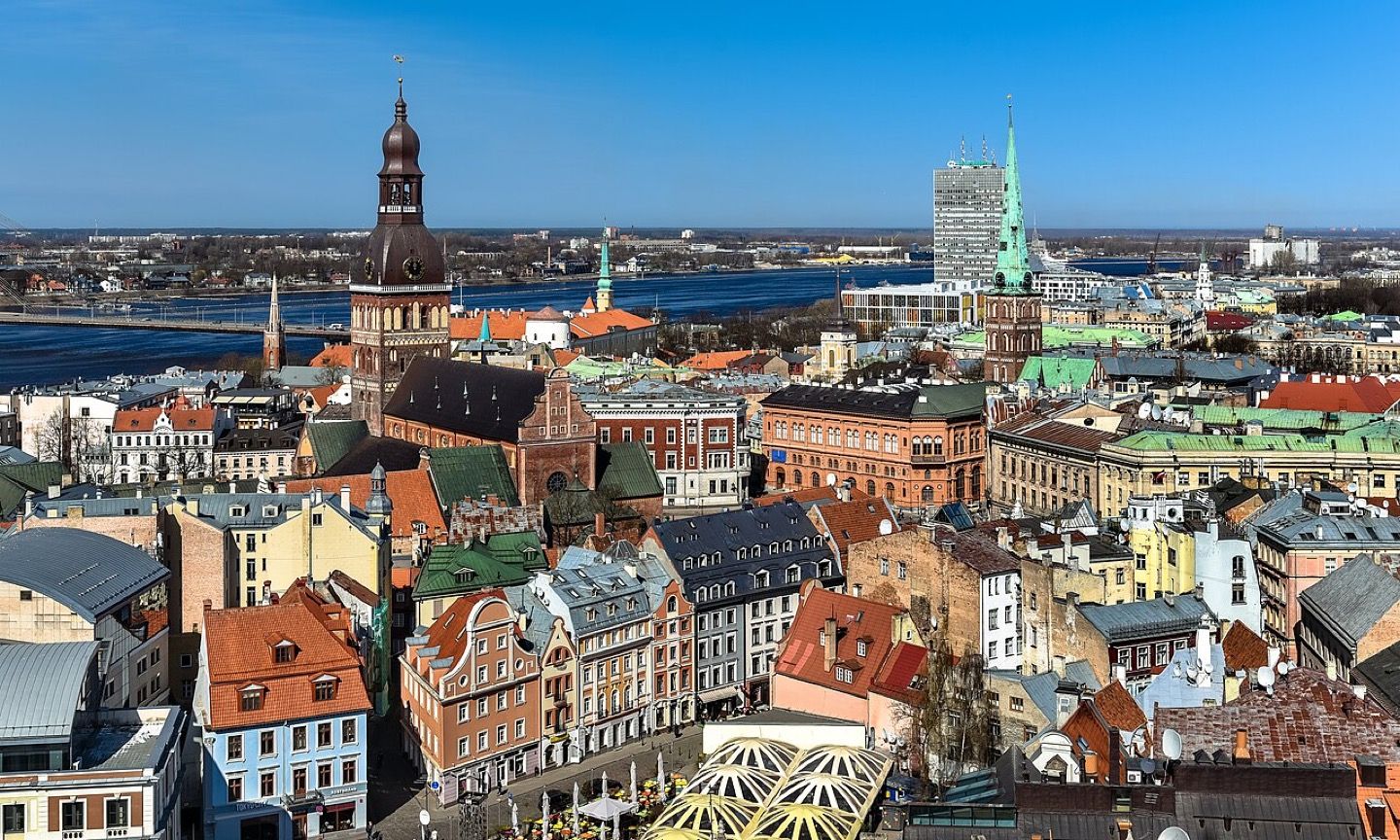
Riga’s UNESCO-listed historic centre includes medieval streets, wooden architecture and an exceptional concentration of Art Nouveau buildings. The Old Town and the Alberta iela district reveal different periods of the capital’s growth. Kuldīga’s old town, inscribed on the World Heritage List in 2023, preserves an urban landscape shaped by the Duchy of Courland and Semigallia. The broad Venta Rapid lies beside it.
- What is special about Riga’s architecture?
- Its historic centre combines medieval streets, wooden buildings and a notable concentration of Art Nouveau architecture.
- Is Kuldīga on the World Heritage List?
- Yes. The old town was inscribed in 2023 for its historic urban landscape.
- Where is Rundāle Palace?
- In southern Latvia near Bauska, in the historical land of Zemgale.
More about Latvia: landmarks
Riga’s UNESCO-listed historic centre includes medieval streets, wooden architecture and an exceptional concentration of Art Nouveau buildings. The Old Town and the Alberta iela district reveal different periods of the capital’s growth. Kuldīga’s old town, inscribed on the World Heritage List in 2023, preserves an urban landscape shaped by the Duchy of Courland and Semigallia. The broad Venta Rapid lies beside it.
Rundāle Palace in the south is a major baroque and rococo ensemble designed by Bartolomeo Rastrelli. Turaida and Cēsis castles connect the Gauja region with medieval Livonian history; Āraiši presents a reconstructed early medieval lake settlement. Aglona Basilica is a Catholic pilgrimage centre in Latgale, and Daugavpils Fortress preserves nineteenth-century military architecture. Latvia also participates in the transnational Struve Geodetic Arc World Heritage property. Not every castle or landscape in the guide is UNESCO-listed.
Regional identities and a worldwide diaspora
Latvia’s 2021 census counted 1,893,223 residents on 1 January 2021. This dated count is not a current population estimate. Riga is the largest city; Daugavpils, Liepāja and other regional centres have distinct histories and communities. Ethnic Latvians form the majority, alongside Russian, Belarusian, Ukrainian, Polish, Lithuanian, Roma, Jewish and other communities. Ethnicity, language, citizenship and residence describe different aspects of a person’s life.
- What population figure does this guide use?
- The 2021 census count of 1,893,223 residents on 1 January 2021, not a current estimate.
- Do language and citizenship mean the same thing?
- No. A person’s language, ethnic identity, citizenship and residence are distinct.
- Which five historical lands are recognised?
- Vidzeme, Latgale, Kurzeme, Zemgale and Sēlija; these are not the map’s two practice groups.
More about Latvia: people & society
Latvia’s 2021 census counted 1,893,223 residents on 1 January 2021. This dated count is not a current population estimate. Riga is the largest city; Daugavpils, Liepāja and other regional centres have distinct histories and communities. Ethnic Latvians form the majority, alongside Russian, Belarusian, Ukrainian, Polish, Lithuanian, Roma, Jewish and other communities. Ethnicity, language, citizenship and residence describe different aspects of a person’s life.
The five historical lands have overlapping regional identities, and Latgalian and Livonian traditions form important parts of the country’s heritage. Latvia’s Jewish history includes the lives of communities before the Holocaust as well as remembrance of its victims. Exile during the Second World War and later emigration created diaspora networks across Europe, North America, Australia and elsewhere. Return migration and new arrivals continue to shape families, schools and workplaces.