Facts about Greece
Capital Athens · Europe
10 topics · 20 lessons · about 20 minutes
Greece sits at the southern end of the Balkan Peninsula and gave the world democracy, formal philosophy, theater and the Olympic Games. Modern Greece is a much younger state, independent only since 1830, built around a mountainous mainland and roughly six thousand islands.
Greece has around 13,700 kilometers of coastline, more than any other country in Europe, and roughly 6,000 islands and islets scattered across the Aegean and Ionian seas, though fewer than 230 are inhabited. About 80 percent of the mainland is mountainous, dominated by the Pindus range, which historically kept regions apart and made sea travel easier than land travel. Crete is the largest island, Mount Olympus at 2,917 meters was held to be the home of the gods, and the Mediterranean climate leaves the country exposed to summer wildfire and water shortage.
Athens holds over a third of the national population and sits below the Acropolis, while Thessaloniki in the north is the second city and the gateway to Macedonia and Thrace. Patras anchors the northern Peloponnese and Heraklion the island of Crete. Over 30 million visitors a year come for some combination of the classical sites, the islands and the food, with Santorini and Mykonos taking the largest share of the Cyclades traffic and Crete, Rhodes and Corfu drawing their own long-established crowds.
- Population
- 10.4 million
- Area
- 131,957 km²
- Currency
- Euro (€)
- Official language
- Greek
- Islands
- About 6,000, roughly 230 inhabited
- Highest point
- Mount Olympus, 2,917 m
The Greece course
Geography of Greece2 lessons
More coastline than any country in Europe, and mountains that made the sea the easier road.
History of Greece2 lessons
City-states and Alexander, then Rome, a thousand years of Byzantium, and independence in 1830.
Language of Greece2 lessons
The longest written record of any Indo-European language, and the first alphabet with vowels.
Culture of Greece2 lessons
Philosophy, theater and the Olympics, and an Orthodox calendar built around Easter.
Economy of Greece2 lessons
Tourism and the largest merchant fleet in the world, after a crisis that cut output by a quarter.
Politics of Greece2 lessons
A parliamentary republic since 1975, with a seat bonus to help produce workable majorities.
Nature & Wildlife of Greece2 lessons
More plant species than almost anywhere in Europe, and monk seals in the Sporades.
Food & Cuisine of Greece2 lessons
The archetype of the Mediterranean diet, more olive oil per person than anyone, and shared mezedes.
Landmarks of Greece2 lessons
A temple with curves correcting for the eye, an oracle at the center of the world, and a caldera.
People & Society of Greece2 lessons
Shrinking since 2011, one of the oldest societies in Europe, a third of it in Athens.
Geography of Greece
Greece has around 13,700 kilometers of coastline, more than any other country in Europe and among the longest in the world relative to its size. Some 6,000 islands and islets are scattered across the Aegean and Ionian seas, though fewer than 230 are inhabited, with Crete the largest.
Roughly 80 percent of the mainland is mountainous, dominated by the Pindus range, which historically kept regions separate and made sea travel easier than land travel. Mount Olympus reaches 2,917 meters and was held in antiquity to be the home of the gods. The climate is Mediterranean, with hot dry summers that leave the country exposed to wildfire and water shortage.

History of Greece
Minoan Crete and Mycenaean Greece formed the earliest complex societies here, followed after a dark age by the rise of independent city-states. Athens developed direct democracy in the 5th century BC while Sparta built a military society, and their rivalry ran through the Peloponnesian War. Alexander the Great spread Greek language and ideas from Egypt to India before dying at 32.
Rome absorbed Greece by 146 BC, then the Byzantine Empire carried Greek-speaking Christian civilisation for another thousand years until Constantinople fell in 1453. Ottoman rule lasted until the war of independence beginning in 1821. The 20th century brought population exchange with Turkey, occupation, civil war and a military junta that fell in 1974, after which Greece joined the European Communities in 1981.

Language of Greece
Greek has the longest documented history of any Indo-European language, with written records going back about 3,400 years to the Mycenaean Linear B tablets. It is spoken today by roughly 13 million people and uses an alphabet adapted from Phoenician around the 9th century BC, the first to write vowels as separate letters.
The language supplied the scientific and technical vocabulary of the West, so words including democracy, biology, philosophy and telephone are all Greek in origin. A long-running split between formal katharevousa and everyday demotic Greek was settled in 1976 when demotic became the official standard.

Culture of Greece
Ancient Greece produced the foundations of Western philosophy through Socrates, Plato and Aristotle, along with the first tragedies and comedies performed at the festivals of Athens. The Olympic Games began at Olympia in 776 BC and were revived in Athens in 1896.
Modern Greek identity is bound tightly to the Orthodox Church, which around 90 percent of the population identifies with and which shapes the calendar through Easter as the central festival. Family ties are strong, hospitality carries near-obligatory force under the concept of filoxenia, and social life is organized around long evenings in tavernas and cafés.

Economy of Greece
Tourism is the backbone of the Greek economy, contributing roughly a fifth of output and drawing over 30 million visitors a year to the islands and archaeological sites. Shipping is the other great earner, and Greek owners control the largest merchant fleet in the world by tonnage.
Agriculture remains significant, with Greece a leading producer of olive oil, olives, feta and cotton. The debt crisis that began in 2009 shrank the economy by roughly a quarter and brought three bailout programs with severe austerity conditions attached, driving unemployment above 27 percent at its peak. Recovery since 2018 has been steady though incomes have yet to return to pre-crisis levels.

Politics of Greece
Greece is a parliamentary republic under a constitution adopted in 1975, after a referendum abolished the monarchy following the collapse of the colonels’ junta. The president is head of state with limited powers, elected by parliament rather than by voters.
The prime minister leads the government and answers to a single-chamber parliament of 300 members, elected proportionally with a bonus of extra seats for the leading party to help produce workable majorities. Greece joined NATO in 1952 and the eurozone in 2001. Relations with Turkey over Aegean maritime boundaries and the division of Cyprus remain the principal foreign policy concerns.
Nature & Wildlife of Greece
Greece holds more plant species than almost any other European country of its size, with a high rate of endemism on the islands where populations evolved in isolation. Crete alone has several hundred plants found nowhere else.
The loggerhead turtle nests on beaches in Zakynthos and the Peloponnese, protected by marine parks that restrict summer access to nesting sand. The Mediterranean monk seal, one of the rarest seals in the world, has an important colony around the Northern Sporades. Brown bears and wolves survive in the Pindus mountains near the Albanian and North Macedonian borders, and summer wildfires have become the dominant threat to forest cover.

Food & Cuisine of Greece
Greek cooking is the archetype of the Mediterranean diet, built on olive oil, vegetables, pulses, fish and yoghurt, and that pattern of eating has been studied for decades for its association with long life. Greece consumes more olive oil per person than any other country.
Familiar dishes include moussaka layered with aubergine and béchamel, souvlaki grilled on skewers, and spanakopita wrapped in filo pastry. Feta holds protected origin status and can be made only in specified regions from sheep and goat milk. Meals are structured around shared plates of mezedes rather than individual courses, and ouzo or tsipouro usually accompanies them.

Landmarks of Greece
The Parthenon has stood on the Acropolis above Athens since 438 BC, built as a temple to Athena and refined with subtle curves that correct for optical distortion. Much of its sculptural frieze was removed by Lord Elgin in the early 1800s and remains in the British Museum, a dispute Greece has pressed for decades.
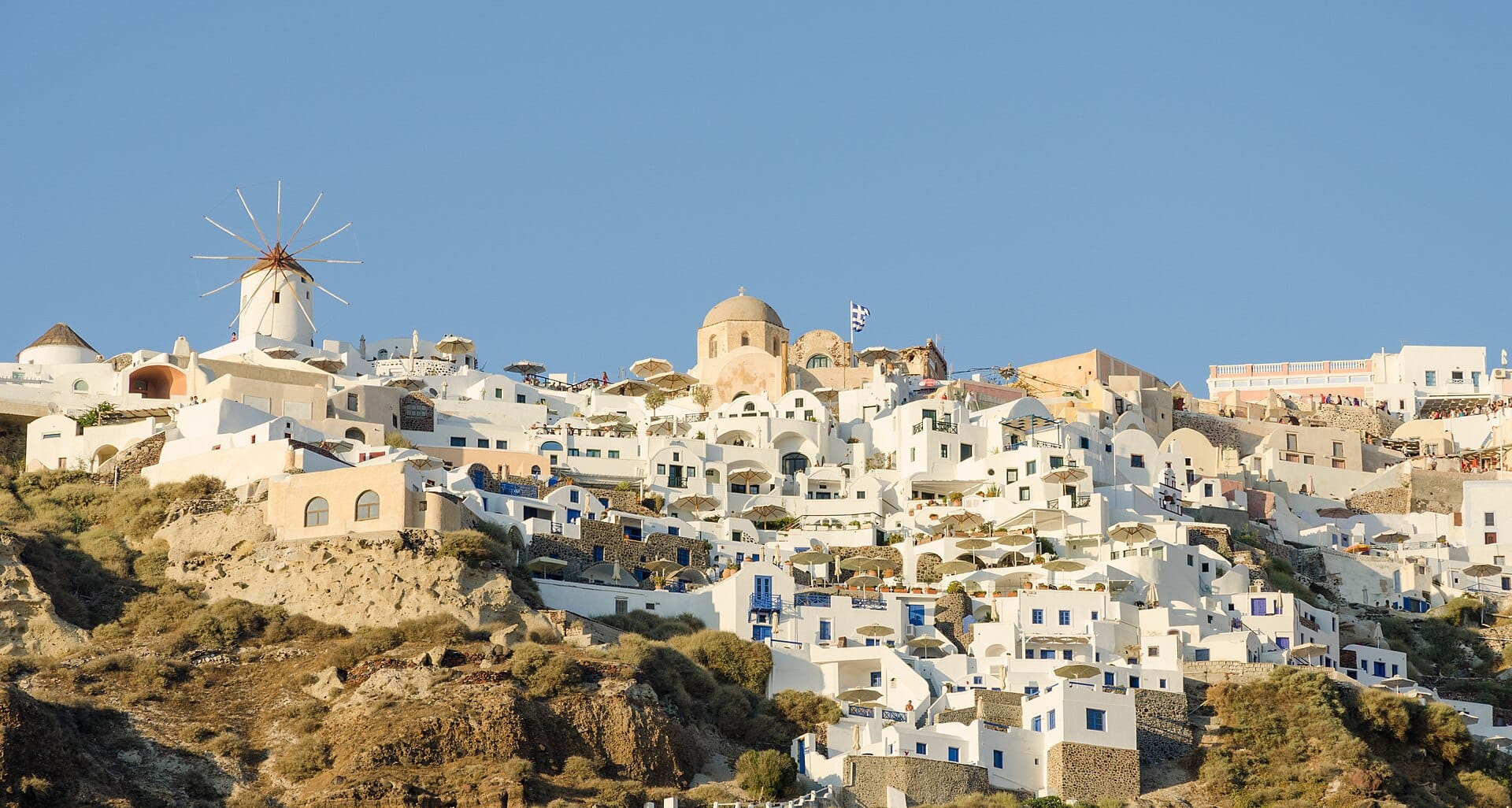
Delphi was regarded in antiquity as the center of the world and home to the most consulted oracle in Greece. Other major sites include the theater at Epidaurus with acoustics that carry a whisper to the back row, the monasteries perched on rock pillars at Meteora, and the cliff villages of Santorini overlooking a flooded volcanic caldera.
People & Society of Greece
Greece has around 10.4 million residents and a population that has been shrinking since 2011, pushed down by very low fertility near 1.4 births per woman and by emigration during the debt crisis, when hundreds of thousands of young Greeks left for work abroad.
The median age of about 46 makes Greece one of the oldest societies in Europe. Roughly 80 percent live in cities, and Athens alone holds over a third of the national population. The Greek diaspora is large, with substantial communities in the United States, Australia and Germany, and Greece has been a primary arrival point for refugees crossing the eastern Mediterranean since 2015.

Reading is one thing, recall is another. Play the Greece challenge to test what stuck. The lessons on all ten topics are open too, and a free account is what keeps your progress across them.