The Brazil course
Facts about Brazil, for your next trip
Explore ten topics about Brazil, from its rivers and regional cultures to everyday food and Portuguese. Play the available facts rounds as you move through the course.
Capital Brasília · South America · 10 topics · 20 rounds · 80 questions · 20 seconds each
Brazil is the largest country in South America and the fifth largest in the world, covering nearly half the continent and holding most of the Amazon rainforest. It is the only Portuguese-speaking country in the Americas, a legacy of the 1494 treaty that split the New World between Portugal and Spain.
Brazil is a federation of 26 states and a federal district covering nearly half of South America, and it borders every country on the continent except Chile and Ecuador. The Amazon basin fills the north with the largest river system on Earth, the Brazilian Highlands south of it carry the coffee and soy belt, and the semi-arid sertão of the northeast suffers recurrent drought. Most of the 213 million people live along the 7,400 kilometers of Atlantic coastline rather than in the vast interior.
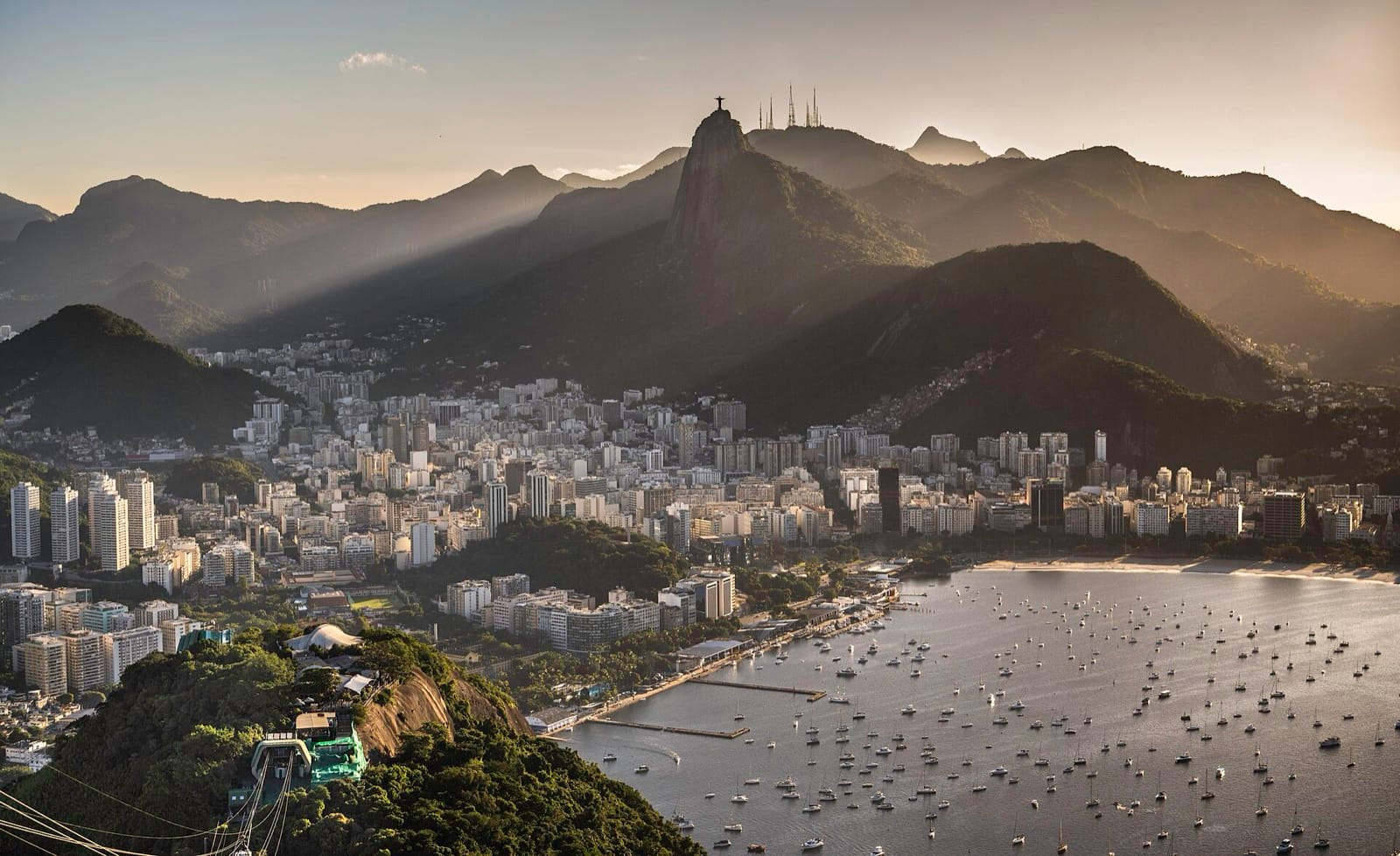
São Paulo is the economic engine and the largest metropolitan area in the southern hemisphere, while Rio de Janeiro holds the beaches, the mountains and most of the country’s image abroad. Brasília was built from nothing in the interior between 1956 and 1960 to pull development inland, Salvador is the center of Afro-Brazilian culture, and Manaus sits deep in the Amazon a thousand kilometers from the sea. Visitors usually pick between Rio and the coast, the Amazon or the Pantanal for wildlife, and Iguazu Falls on the Argentine border.
- Population
- 213 million
- Area
- 8,515,767 km²
- Currency
- Real (R$)
- Official language
- Portuguese
- States
- 26 states and a federal district
- Highest point
- Pico da Neblina, 2,995 m
Brazil · Geography
Geography of Brazil
Follow the Amazon across the north, then explore the highlands and the long Atlantic coast. The state borders help make sense of a country that covers much of South America.
Commonly asked
- How many states does Brazil have?
- Brazil has 26 states and a Federal District, where Brasília is located. IBGE groups them into five major regions: North, Northeast, Central-West, Southeast and South.
- Which countries border Brazil?
- Brazil borders every South American country except Chile and Ecuador. Its eastern coast faces the Atlantic Ocean.
Brazil · History
History of Brazil
Indigenous societies lived here long before Portuguese ships arrived in 1500. Colonial plantations and mining shaped the economy, followed by an independent empire and eventually a republic.
Commonly asked
- When did Brazil become independent?
- Brazil declared independence from Portugal in 1822. Pedro I became emperor, and the monarchy lasted until the republic was proclaimed in 1889.
- When was slavery abolished in Brazil?
- Slavery was abolished in 1888. Enslaved Africans and their descendants had been forced to work in plantations, mines and households for centuries, leaving a profound legacy of inequality.
Brazil · Language
Portuguese in Brazil
Portuguese connects people across Brazil, with regional accents and vocabulary shaped by Indigenous and African languages. Brazilian usage differs from the European Portuguese taught in the linked lessons.
Commonly asked
- Why does Brazil speak Portuguese?
- Brazil was colonised by Portugal. Portuguese became the dominant language through colonial administration and settlement, often at the expense of Indigenous languages.
- Is Brazilian Portuguese the same as European Portuguese?
- They are varieties of the same language, with differences in pronunciation, everyday vocabulary and some grammatical usage. The Portuguese lessons on Worldly currently focus on Portugal, so some expressions will differ from those heard in Brazil.
Brazil · Culture
Culture of Brazil
Samba and bossa nova are part of a much wider musical landscape. Regional celebrations and Afro-Brazilian traditions give different parts of the country their own cultural rhythms.
Commonly asked
- What is capoeira?
- Capoeira combines movement, music and elements of martial art within a circle of participants. It developed in Afro-Brazilian communities, and the capoeira circle is recognised by UNESCO as intangible cultural heritage.
- Is Carnival the same across Brazil?
- No. Rio is known for samba school parades, while other cities have their own traditions. Salvador is associated with large street celebrations, and Recife and Olinda with frevo and other local forms.
Brazil · Economy
Economy of Brazil
Farms and mines supply exports, while services and manufacturing support urban economies. Coffee growing and sugarcane cultivation connect the economy to landscapes shaped over centuries.
Commonly asked
- What does Brazil produce?
- Brazil produces agricultural goods including coffee and soybeans, alongside iron ore and petroleum. Its industrial sector also makes vehicles and aircraft.
- What currency does Brazil use?
- The Brazilian real, written R$ and identified internationally as BRL. The current real was introduced in 1994 as part of a programme to stabilise prices.
Brazil · Politics
Government of Brazil
Brasília is the seat of the federal government. The country has a president and a two-chamber National Congress, while states and municipalities have their own elected governments.
Commonly asked
- What is the capital of Brazil?
- Brasília became the capital in 1960, replacing Rio de Janeiro. It was built in the interior as part of a project to shift development inland.
- What are the two chambers of Congress?
- The Chamber of Deputies and the Federal Senate. Together they form the National Congress, which meets in Brasília.
Brazil · Nature & Wildlife
Nature and wildlife in Brazil
The Amazon is one part of a much broader natural landscape. Savanna and seasonally flooded wetlands support different wildlife, while forests also extend along parts of the Atlantic coast.
Commonly asked
- What are Brazil’s six major biomes?
- IBGE identifies the Amazon, Atlantic Forest, Cerrado, Caatinga, Pantanal and Pampa. They range from humid forest to dry vegetation and southern grassland.
- Is the Pantanal part of the Amazon?
- The Pantanal is a separate biome, a vast seasonal wetland in the upper Paraguay River basin. Its cycle of flooding and drying shapes the habitats used by jaguars and waterbirds.
Brazil · Food & Cuisine
Brazilian food
Rice and beans are everyday staples, but regional cooking varies widely. Cassava appears in many forms, and African influences are especially visible in the cooking of Bahia.
Commonly asked
- What is feijoada?
- A stew usually made with black beans and pork, often served with rice and accompaniments such as greens and orange. Recipes and serving traditions vary.
- What is pão de queijo?
- Small cheese breads associated with Minas Gerais. Cassava starch gives them their characteristic chewy texture, and they are commonly eaten as a snack or with coffee.
Brazil · Landmarks
Landmarks of Brazil
Rio’s mountain-and-sea landscape contrasts with the planned avenues of Brasília. Farther south, Iguaçu Falls lies on the border with Argentina inside a protected forest landscape.
Commonly asked
- Where are Iguaçu Falls?
- On the border between Brazil and Argentina. The Brazilian national park is in Paraná, adjoining Argentina’s Iguazú National Park. Both are UNESCO World Heritage properties.
- Who designed Brasília?
- Lúcio Costa designed the urban plan, while Oscar Niemeyer designed many of its landmark public buildings. UNESCO recognises the city for its modernist planning and architecture.
Brazil · People & Society
People and society in Brazil
Brazilian society reflects Indigenous roots and the history of African enslavement, alongside Portuguese colonisation and later migration. Regional identities remain strong across its cities and rural communities.
Commonly asked
- Are Rio and São Paulo the same city?
- No. They are separate cities in neighbouring southeastern states. São Paulo is a major business centre, while Rio was Brazil’s capital before Brasília.
- Do Indigenous communities still live in Brazil?
- Yes. Many distinct Indigenous peoples live in Brazil, in cities as well as rural areas and Indigenous territories. They have their own languages and histories, so they should not be treated as a single culture.