Facts about Colombia
Colombia connects Caribbean islands and Pacific rainforest with Andean coffee valleys, eastern savannas and the Amazon. Learn its places through maps, then discover the regional food, music and communities that give those places their character.
- Capital
- Bogotá
- Currency
- Colombian peso (COP)
- Departments
- 32, plus Bogotá’s Capital District
- National official language
- Spanish
- Coasts
- Caribbean and Pacific
- Andean ranges
- Western, Central and Eastern
Colombia · 0 of 20 rounds passed
Two timed rounds per topic, 20 seconds a question
Bogotá stands on a high Andean plateau, Medellín sits in the Aburrá Valley and Cali faces the Cauca River. Cartagena, Barranquilla and Santa Marta look towards the Caribbean, while Buenaventura connects the interior with the Pacific. Pereira, Manizales and Armenia anchor the coffee region. East of the mountains, Villavicencio opens onto the Llanos, and Leticia lies beside the Amazon at the country’s southern tip.
The maps include all 32 departments and Bogotá’s separate Capital District, plus 24 selected cities and ten waters. San Andrés and Providencia are shown in their real Caribbean location far northwest of the mainland. Spanish lessons introduce everyday phrases, while the reading also recognises Indigenous languages and the distinct creole traditions of Palenque and the archipelago.
Geography of Colombia
Three Andean ranges divide the country into mountain valleys, while rivers connect the eastern plains and Amazon forest with distant seas.
- Which seas and oceans border Colombia?
- The Caribbean Sea lies along the northern coast and belongs to the Atlantic system. The Pacific Ocean borders the western coast.
- Why do Bogotá and Cartagena have different climates?
- Bogotá’s high elevation keeps it cool despite its tropical latitude. Cartagena lies near sea level on the Caribbean coast and has a much warmer climate.
- How many departments does Colombia have?
- There are 32 departments. Bogotá is a separate Capital District, so this guide’s regions map has 33 selectable areas.
More about Colombia: geography
Colombia occupies the northwestern corner of South America, bordering Panama, Venezuela, Brazil, Peru and Ecuador. It faces the Caribbean Sea to the north and the Pacific Ocean to the west. The Andes divide into the Western, Central and Eastern cordilleras. The Magdalena runs between the Central and Eastern ranges, while the Cauca flows between the Western and Central ranges.
Bogotá stands high on the Eastern Cordillera, Medellín occupies the Aburrá Valley and Cali lies beside the Cauca. East of the mountains, the Llanos drain towards the Orinoco; southern forests belong to the Amazon basin. The Caribbean islands of San Andrés and Providencia lie far northwest of the mainland. Colombia has 32 departments and a separate Capital District for Bogotá.
History of Colombia
Muisca goldwork, independence campaigns and a long peace process connect places across the country.
- What was Gran Colombia?
- It was the republic formed during the independence period, bringing together territories now belonging to Colombia, Venezuela, Ecuador and Panama. It broke apart around 1830.
- Why are 1810 and 1819 both important dates?
- 20 July 1810 marks the uprising celebrated on Independence Day. The 1819 campaign, including the Battle of Boyacá, helped secure military control of New Granada.
- Did the 2016 agreement end all armed conflict?
- The agreement was between the government and the FARC. It did not settle every conflict with other armed groups. The UN Verification Mission monitors implementation of the agreement.
More about Colombia: history
Muisca communities occupied the central highlands, while Tairona societies developed settlements in the Sierra Nevada de Santa Marta. San Agustín’s stone sculpture and Tierradentro’s underground tombs preserve other histories from before Spanish conquest. Colonial New Granada grew around mountain towns and Caribbean ports, with Indigenous communities and enslaved Africans subjected to coercive labour and dispossession.
The uprising commemorated on 20 July 1810 began a contested independence process. Simón Bolívar’s campaign and the Battle of Boyacá in 1819 helped secure the liberation of New Granada. Gran Colombia later broke apart, with Venezuela and Ecuador separating in 1830. Panama separated in 1903. Twentieth-century political violence developed into a prolonged armed conflict. The 2016 agreement with the FARC began a peace process whose implementation continues.
Languages of Colombia
Spanish connects the country, alongside Indigenous languages, Palenquero and the archipelago’s creole traditions.
- Is Spanish Colombia’s only official language?
- Spanish is official nationally. The constitution also recognises the languages of ethnic groups as official within their territories.
- What is Palenquero?
- Palenquero is a Spanish-based creole associated with San Basilio de Palenque. It is a distinct language, rather than simply a regional Spanish accent.
- Is the same Spanish spoken everywhere in Colombia?
- No. Pronunciation and everyday expressions differ between regions. Usted, tú and vos are used in different ways, so general Spanish lessons are a starting point.
More about Colombia: language
Spanish is Colombia’s national official language. Under Article 10 of the constitution, the languages of ethnic groups are also official in their territories. Wayuunaiki is spoken by Wayuu communities in La Guajira and across the Venezuelan border. Nasa Yuwe belongs to Nasa communities, while many distinct languages are spoken in Amazonian regions.
Palenquero, a Spanish-based creole, is associated with San Basilio de Palenque, a community founded by people who escaped enslavement. The Raizal communities of San Andrés and Providencia have an English-based creole tradition. Spanish itself varies across the country in accent and expressions. These lessons teach general Spanish phrases rather than representing every Colombian variety.
Culture of Colombia
Cumbia, vallenato, salsa and literature express different regional histories.
- Where does vallenato come from?
- Vallenato is rooted in Colombia’s Caribbean region, especially around Valledupar. Its familiar ensemble uses accordion, caja drum and guacharaca scraper.
- What is Barranquilla’s carnival known for?
- It brings together dance, music, costumes and satire from different Colombian traditions. UNESCO recognises it as intangible cultural heritage.
- Which Colombian writer won the 1982 Nobel Prize in Literature?
- Gabriel García Márquez, whose novels include One Hundred Years of Solitude and Love in the Time of Cholera.
More about Colombia: culture
Cumbia developed through the interaction of Indigenous, African and European traditions in the Caribbean region. Vallenato is associated with accordion-led storytelling around Valledupar, accompanied by the caja drum and guacharaca scraper. Barranquilla’s carnival brings many regional dances and musical forms into public celebration. Cali has a strong salsa scene, shaped by local musicians, dancers and international influences.
Gabriel García Márquez received the Nobel Prize in Literature in 1982. His fiction, including One Hundred Years of Solitude, draws on memory, politics and the Caribbean world of his childhood. Fernando Botero became internationally known for paintings and sculptures with enlarged forms. Culture also lives in neighbourhood festivals, craft traditions and the music of the Pacific and Llanos.
Economy of Colombia
Coffee farms and flower growers share an economy with energy exports, manufacturing and urban services.
- Is Colombia’s economy mainly coffee?
- Coffee is a prominent agricultural export, but the economy also includes energy, manufacturing, flower growing and a large service sector.
- What does the Coffee Cultural Landscape protect?
- It recognises a living farming landscape with coffee plots, settlements and traditions shaped by cultivation on Andean slopes. It is more than a scenic collection of plantations.
- What currency does Colombia use?
- The Colombian peso, with the currency code COP. It is separate from the currencies called peso in other countries.
More about Colombia: economy
Colombia’s economy includes petroleum, coal, agriculture, manufacturing and services. Coffee and cut flowers are internationally recognised exports, while Bogotá and Medellín concentrate business services and industrial activity. Buenaventura connects the interior with Pacific shipping routes; Cartagena and Barranquilla link trade with the Caribbean.
The Coffee Cultural Landscape recognises farming communities and settlements in parts of Caldas, Risaralda, Quindío and Valle del Cauca. Small farms adapted coffee cultivation to steep mountain slopes. Coffee is important without representing the whole economy. Rural infrastructure, informal employment and unequal access to opportunities remain significant challenges.
Government and politics of Colombia
A presidential republic governed by the 1991 constitution, with departments and a separate Capital District.
- Is Colombia a federal country?
- No. Colombia is a unitary republic with decentralised local administration. Departments are administrative divisions rather than federal states.
- How long is the presidential term?
- Four years. Under the current constitutional rules, a person who has served as president cannot be re-elected.
- What is an acción de tutela?
- It is a constitutional legal mechanism for seeking prompt protection of fundamental rights when they are threatened or violated. Article 86 establishes it.
More about Colombia: politics
Colombia is a unitary presidential republic. The president is both head of state and head of government, serving a four-year term. Presidential re-election is prohibited. Congress has two chambers, the Senate and House of Representatives. The Constitutional Court reviews constitutional questions, while other courts perform different judicial roles.
The 1991 constitution recognises ethnic and cultural diversity and provides mechanisms such as the acción de tutela for protecting fundamental rights. Departments have elected governors and assemblies, while municipalities have mayors and councils. Bogotá has a distinct district administration. Colombia’s decentralised local government operates within a unitary state rather than a federation.
Nature and wildlife of Colombia
Cloud forest, páramo, Amazonian rivers and two coasts support a remarkable range of wildlife.
- What is a páramo?
- It is a tropical high-mountain ecosystem above the forest line. Its plants and soils hold water that supplies rivers and Andean communities.
- Where can Colombia’s tall wax palms be seen?
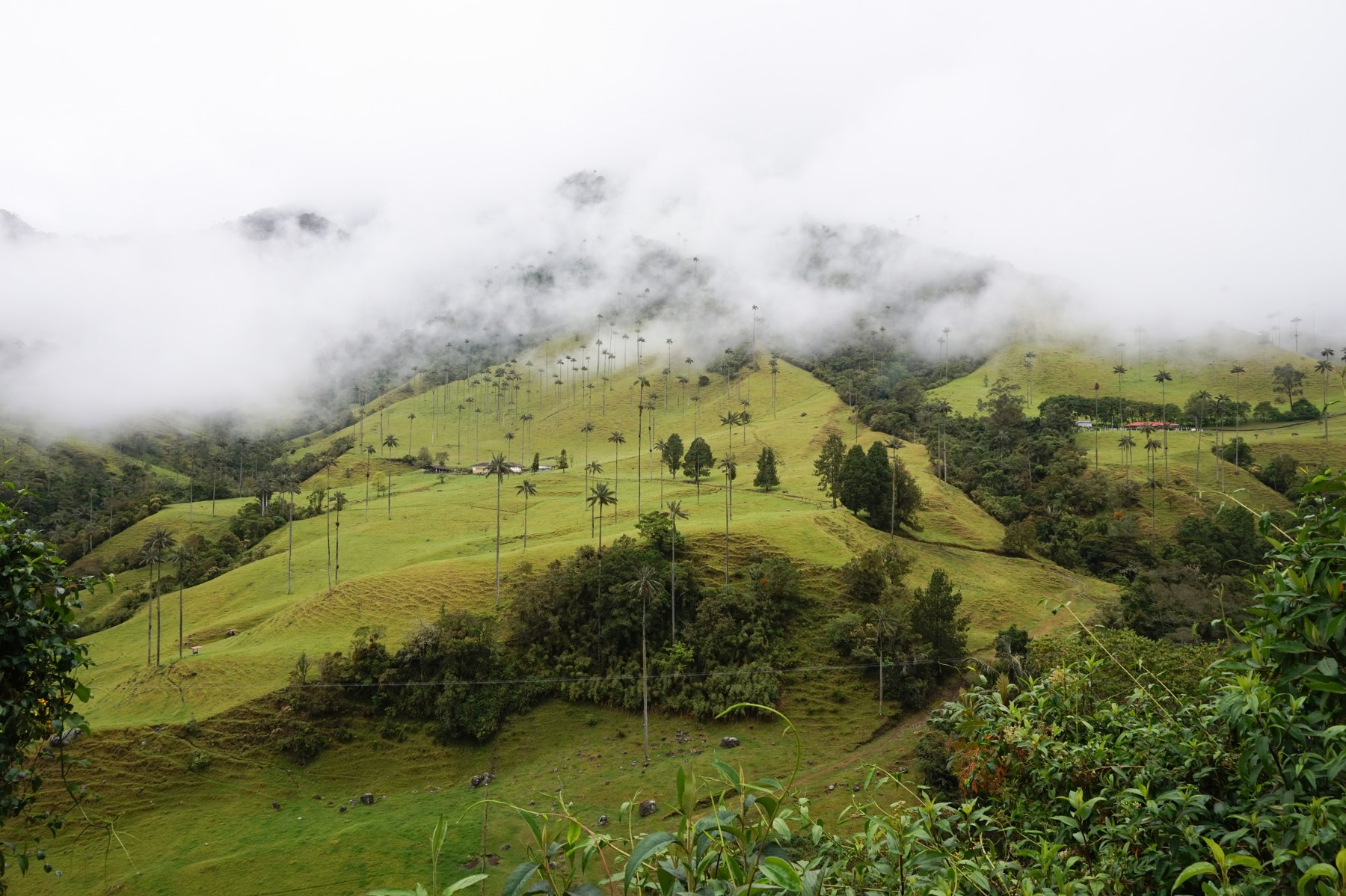
- The Cocora Valley near Salento in Quindío is a well-known place to see the Quindío wax palm, Colombia’s national tree.
- Does Colombia have Amazon rainforest?
- Yes. Large southern areas lie within the Amazon basin. Leticia stands on the main Amazon River, while tributaries cross much more of the country.
More about Colombia: nature & wildlife
Colombia’s habitats include Amazon rainforest, Pacific mangroves, Caribbean dry forest, Llanos savanna and high Andean páramo. This variety supports jaguars, spectacled bears, river dolphins and many hummingbirds. The páramo lies above the mountain forest and below permanent snow where present. Its vegetation and soils help store and regulate water feeding rivers and cities.
In the Cocora Valley near Salento, Quindío wax palms rise above the mountain landscape and can reach about 60 metres. Natural forest is important for their regeneration. Offshore, Malpelo protects a Pacific marine environment known for sharks and other large fish. Deforestation, habitat fragmentation and pressure on water resources make conservation an ongoing concern.
Food of Colombia
Regional arepas, highland soups and coastal seafood make the country’s cooking as varied as its landscapes.
- Are arepas Colombian or Venezuelan?
- Both countries have longstanding arepa traditions. Preparation, fillings and the place of arepas in a meal vary by region.
- What is ajiaco santafereño?
- It is a soup associated with Bogotá, made with chicken, varieties of potato, maize and guascas. Cream and capers are common accompaniments.
- What does tinto mean when ordering in Colombia?
- In everyday Colombian café usage, a tinto is a small black coffee. In a wine context, the word can still mean red wine.
More about Colombia: food & cuisine
Arepas are maize cakes made in many regional styles, including plain, cheese-filled and egg-filled versions. They belong to long food traditions in both Colombia and Venezuela. Bogotá’s ajiaco combines chicken, potatoes, maize and the herb guascas. Bandeja paisa, associated with Antioquia and the wider paisa region, brings beans, rice, meat and accompaniments together on a generous plate.
Fish, coconut and plantains are important in many Caribbean and Pacific dishes. Tolima is associated with lechona, made with pork and peas, while Santander has a tradition of hormigas culonas, toasted leafcutter ants. Markets display fruits such as lulo, guanábana and granadilla. A small black coffee is often called a tinto in Colombian usage.
Landmarks of Colombia
Pre-Columbian sculpture, Caribbean fortifications and mountain sanctuaries reveal different layers of history.
- What is San Agustín known for?
- Its archaeological park preserves monumental stone sculptures and funerary sites from societies that lived in the region before Spanish conquest.
- How is Tierradentro different from San Agustín?
- Tierradentro is especially known for decorated underground tombs. San Agustín is especially associated with monumental stone figures and burial complexes.
- Where is Las Lajas Sanctuary?
- Near Ipiales in Nariño, close to the Ecuadorian border. The church stands across a gorge above the Guáitara River.
More about Colombia: landmarks
San Agustín in Huila preserves monumental stone figures and burial sites made long before Spanish conquest. Tierradentro in Cauca is known for underground tombs with painted decoration. These UNESCO-listed places represent distinct archaeological traditions. Cartagena’s port, fortresses and monuments tell a later story of Caribbean trade and colonial defence.
The Coffee Cultural Landscape honours living farming communities across several departments. Las Lajas Sanctuary near Ipiales spans a gorge in Nariño, while the Cocora Valley offers a very different landmark in its tall wax palms. The Sierra Nevada de Santa Marta contains the archaeological site commonly called Ciudad Perdida, in a landscape that remains important to Indigenous communities.
People and society of Colombia
Regional identities and diverse communities connect mountain cities, coasts, plains and forest.
- Who are the Raizal people?
- They are an ethnic community associated with San Andrés, Providencia and Santa Catalina, with cultural traditions including an English-based creole language.
- Do all Colombians share one regional culture?
- No. Mountain, Caribbean, Pacific, plains and Amazonian communities have different histories and traditions. Regional labels are useful orientation, not fixed descriptions of individuals.
- Why do migration and displacement matter to Colombian society?
- They have changed where people live, how cities grow and how families maintain connections. Internal displacement and international migration describe different processes.
More about Colombia: people & society
Colombian society includes Indigenous peoples, Afro-Colombian communities, people of mixed ancestry and many other backgrounds. The country’s constitution recognises ethnic and cultural diversity. Wayuu communities live across La Guajira, Nasa communities have a strong presence in Cauca and many distinct peoples live in Amazonian territories. Raizal identity belongs to the Caribbean archipelago.
Regional identities such as paisa, costeño and llanero reflect particular places and traditions without describing everyone who lives there. Most residents live in urban areas, while migration and internal displacement have reshaped cities and family networks. Colombian communities abroad maintain ties with home, and migration into Colombia has also contributed to changing daily life.