Facts about Chile
Explore Chile from the Atacama Desert and Andean highlands to Santiago’s central valleys, southern lakes and Patagonian fjords. Connect its regions, cities and waters with the histories, food and communities behind the places, including the distinct Polynesian heritage of Rapa Nui.
- Capital
- Santiago
- Currency
- Chilean peso (CLP)
- Regions
- 16, including Ñuble
- Main language
- Spanish
- Congress
- Valparaíso
- Western coast
- Pacific Ocean
Chile · 0 of 20 rounds passed
Two timed rounds per topic, 20 seconds a question
Arica and Iquique face the northern Pacific, while Calama and San Pedro de Atacama lie inland in the desert. La Serena opens onto the Elqui Valley. Santiago is the national capital, and Valparaíso is home to Congress. Farther south, Chillán is the capital of Ñuble, the sixteenth region, and Concepción stands near the mouth of the Biobío River.
Valdivia, Puerto Varas and Puerto Montt connect the southern lake district with Chiloé and Patagonia. Coyhaique is the capital of Aysén; Puerto Natales is a gateway to Torres del Paine, and Punta Arenas faces the Strait of Magellan. Three learning maps cover sixteen regions, twenty-four cities and towns and ten waters. The reading also visits Rapa Nui and Juan Fernández, outside the map frame. Spanish lessons introduce general phrases, with context on Chile’s Indigenous languages.
Geography of Chile
A long Pacific coastline, the Andes and a journey from desert to glaciers.
- Which countries border Chile?
- Chile borders Peru to the north, Bolivia to the northeast and Argentina along much of its eastern side. The Pacific Ocean lies to the west.
- Is all of Chile desert?
- No. The north is arid, central valleys have a Mediterranean climate and much of the south has forests, lakes, fjords and glaciers.
- Where is Rapa Nui?
- Rapa Nui, also called Easter Island, is a Polynesian island in the southeastern Pacific, far west of mainland Chile. Administratively it belongs to Valparaíso Region.
More about Chile: geography
Chile stretches along western South America between the Pacific Ocean and the Andes, bordering Peru, Bolivia and Argentina. The Atacama Desert occupies much of the north, while central Chile has fertile valleys and a Mediterranean climate. Santiago sits in an inland basin; Valparaíso faces the Pacific to its west. The Atacama administrative region is only part of the larger desert.
Farther south, lakes, temperate forests and volcanoes give way to Patagonian fjords and icefields. Tierra del Fuego is shared with Argentina. Chile also includes Pacific islands, including Rapa Nui, a Polynesian island far from the mainland, and the Juan Fernández archipelago. The learning maps focus on South American Chile and nearby islands; remote Pacific islands and Chile’s Antarctic claim are outside their frame.
History of Chile
Indigenous societies, independence and the return to elected civilian government in 1990.
- Why does Chile celebrate 18 September?
- It marks the formation of the first national governing junta in 1810. The formal proclamation of independence came later, on 12 February 1818.
- Who was Bernardo O’Higgins?
- O’Higgins was a leader of Chile’s independence struggle and later Supreme Director. O’Higgins Region is named in his honour.
- When did elected civilian government return?
- Patricio Aylwin took office on 11 March 1990, following the dictatorship that began with the coup of 11 September 1973.
More about Chile: history
Indigenous peoples lived across these territories long before Spanish colonisation, with distinct Andean, Mapuche, island and southern maritime societies. Colonial expansion met sustained Indigenous resistance, particularly in Mapuche territories. The first national governing junta formed on 18 September 1810. The independence struggle continued, and Chile formally proclaimed independence on 12 February 1818. Bernardo O’Higgins and José de San Martín were important independence leaders.
Nineteenth-century state expansion changed borders and involved the dispossession of Indigenous communities. In 1973 a military coup overthrew Salvador Allende’s elected government. The dictatorship led by Augusto Pinochet committed grave human-rights abuses. After the 1988 plebiscite and subsequent elections, elected civilian government returned in March 1990. The Museum of Memory and Human Rights in Santiago preserves testimony about the dictatorship and its victims.
Languages of Chile
Spanish in everyday life, alongside living Indigenous languages and revitalisation efforts.
- What language do most people speak in Chile?
- Spanish is the main language of everyday communication. Local accents and vocabulary vary across the country.
- Are Indigenous languages still spoken in Chile?
- Yes. They include Mapuzugun, Aymara, Quechua, Rapa Nui, Kawésqar and Yagán, with different levels of community use and language support.
- Is Rapa Nui a variety of Spanish?
- No. Rapa Nui is a Polynesian language. Spanish is also widely used on the island, but the two languages have different origins.
More about Chile: language
Spanish is the main language of everyday communication, education and public life. Chilean Spanish has regional accents and vocabulary, so listening locally may feel different from a general Spanish course. The linked lessons introduce useful Spanish for greetings, meals, directions and everyday conversations. They are a foundation for communication rather than a dedicated course in Chilean speech.
Indigenous languages include Mapuzugun, also called Mapudungun, Aymara, Quechua, Rapa Nui, Kawésqar and Yagán. Rapa Nui is a Polynesian language, while Mapuzugun belongs to Mapuche communities on both sides of the Andes. Speaker numbers, teaching opportunities and community use vary considerably. Ckunsa, associated with Lickanantay communities in the Atacama area, is undergoing revitalisation. These languages belong to living communities and are part of Chile’s present as well as its history.
Culture of Chile
Cueca, regional music, poetry and traditions shaped by very different landscapes.
- What is cueca?
- Cueca is Chile’s recognised national dance. Its music and dancing have regional forms, and it is often performed during Fiestas Patrias.
- Who was Violeta Parra?
- Parra was a Chilean musician, songwriter and artist whose work helped preserve and renew folk traditions.
- Does Rapa Nui share the mainland’s cultural origins?
- Rapa Nui has a distinct Polynesian heritage. Chile’s cultural life includes its island traditions alongside many mainland Indigenous and other traditions.
More about Chile: culture
Chile’s cultural life changes across its regions. Andean music and festivals connect northern communities with the wider Altiplano, while Mapuche traditions have their own music, crafts and ceremonies. Cueca is recognised as the national dance, with regional forms rather than one uniform performance. Rapa Nui’s Polynesian traditions have a distinct history from those of the South American mainland.
Poetry has a prominent place in Chilean literature, including the work of Gabriela Mistral and Pablo Neruda. Violeta Parra helped collect and renew folk music, while Víctor Jara is associated with the Nueva Canción movement. Fiestas Patrias celebrations in September bring food, music and dancing to many communities. Museums, neighbourhood arts and contemporary music add to traditions that continue to change rather than remaining fixed in the past.
Economy of Chile
Copper and lithium in the north, farming valleys and a Pacific trading network.
- Why is copper important to Chile?
- Copper is a major export and connects northern mining districts with processing, infrastructure and Pacific ports.
- Where is Chuquicamata?
- The copper mine is near Calama in Antofagasta Region, in northern Chile’s desert interior.
- What currency does Chile use?
- Chile uses the Chilean peso, with the currency code CLP. It is separate from the pesos used in other countries.
More about Chile: economy
Mining is central to Chile’s exports, especially copper. Northern mining centres include the Antofagasta region and the area around Calama, near Chuquicamata. Lithium is another important mineral resource, including production from salt-flat brines. Mining links inland operations with coastal ports and raises questions about water, energy and the effects on neighbouring communities and ecosystems.
The economy also includes extensive services, fruit growing, wine production, forestry, fishing and aquaculture. Irrigated central valleys supply agricultural exports, while southern regions support different forest and marine industries. Pacific ports connect these activities with international markets. Chile uses the Chilean peso, abbreviated CLP. The importance of mining does not mean that most people work in mines or that every region has the same economic base.
Politics and regions of Chile
A unitary presidential republic with sixteen regions and Congress in Valparaíso.
- How many regions does Chile have?
- Chile has sixteen regions, including Ñuble. The regions are divided into provinces and communes.
- Is Valparaíso Chile’s capital?
- Santiago is the national capital. Valparaíso is the seat of the National Congress and the capital of Valparaíso Region.
- How long is a Chilean presidential term?
- The term is four years. The constitution prohibits re-election for the immediately following presidential term.
More about Chile: politics
Chile is a unitary republic with a presidential system. The president serves as head of state and government for a four-year term and cannot be re-elected for the immediately following term. Santiago is the national capital and home to La Moneda, the seat of the executive. The National Congress meets in Valparaíso and consists of the Senate and the Chamber of Deputies.
The country has sixteen regions, divided into provinces and communes. Ñuble became a separate region in 2018, with Chillán as its capital, after previously forming part of Biobío. Santiago Metropolitan is a region in its own right, distinct from Valparaíso. Regional governments and municipalities have their own responsibilities within the unitary state; the regions are not federal states. La Serena is the capital of Coquimbo Region, while Puerto Montt is the capital of Los Lagos.
Nature and wildlife of Chile
Desert highlands, temperate forests and the wildlife of Patagonian steppe.
- What is a guanaco?
- A guanaco is a wild South American camelid, related to llamas. It is characteristic of open Patagonian landscapes.
- What wildlife lives in Torres del Paine?
- The park supports guanacos, pumas, foxes, condors and many other birds. A visit does not guarantee a sighting of any particular animal.
- Is Chilean Patagonia entirely forested?
- No. It includes steppe, glaciers, mountains and fjords as well as forests. Habitats change with rainfall, terrain and altitude.
More about Chile: nature & wildlife
Chile’s north-to-south span creates sharply contrasting habitats. Northern deserts and high Andean wetlands differ from the central valleys and wetter southern forests. The lake district contains forests and volcanic landscapes, while Patagonia includes fjords, glaciers, woodland and open steppe. Geography and elevation matter as much as latitude: a mountain plateau and a nearby coast can support very different living conditions.
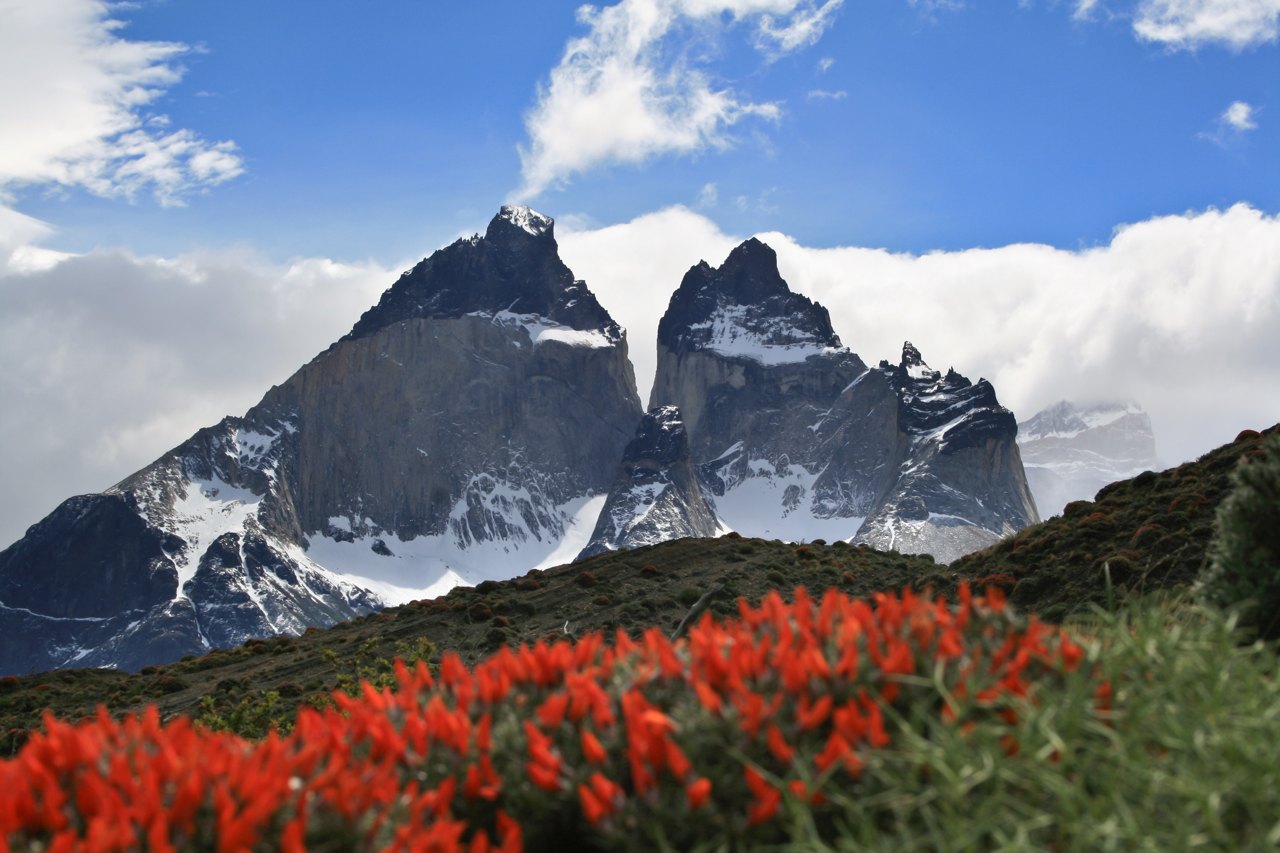
Torres del Paine National Park protects a mosaic of Patagonian habitats. Guanacos graze on open ground, condors soar above the mountains and pumas inhabit the park. Foxes and many waterbirds also live there, while the huemul is a native deer of southern mountain and forest landscapes. Wildlife viewing requires distance and patience. Follow current park rules, keep to designated routes and check official conditions before setting out.
Food of Chile
Empanadas, corn dishes and seafood traditions from a long Pacific coast.
- What is pastel de choclo?
- It is a baked dish with a corn topping, commonly covering a savoury filling. Choclo is a word for corn used in Chile and other Andean countries.
- What is curanto?
- Curanto is associated with Chiloé. Its traditional earth-oven preparation uses hot stones to cook shellfish and other ingredients.
- What is an empanada de pino?
- It is a filled pastry with a seasoned beef-and-onion mixture. Recipes and additional ingredients vary.
More about Chile: food & cuisine
Chilean food reflects regional crops, Indigenous knowledge, coastal resources and migration. Empanadas are filled pastries; a familiar version contains pino, a seasoned mixture based on beef and onion. Pastel de choclo is a baked dish topped with corn, while humitas wrap a corn mixture in husks. Cazuela is a substantial soup or stew whose ingredients vary between households and places.
Fish and shellfish feature along the coast. Chiloé is associated with curanto, traditionally prepared using heated stones in an earth oven, with shellfish and other ingredients. Southern Patagonia has its own lamb and seafood traditions. Central valleys are known for wine, while bread, tea and conversation are part of the meal often called once. These examples introduce the cuisine; they do not stand for every community’s everyday diet.
Landmarks and heritage of Chile
Rapa Nui’s moai, Valparaíso’s hills and the wooden churches of Chiloé.
- What are the moai?
- Moai are monumental figures created by the Rapa Nui people. Many stand on ceremonial platforms, while others remain around quarry sites.
- Why are Chiloé’s churches recognised by UNESCO?
- The listed wooden churches reflect a distinctive architectural tradition that combines local materials and craftsmanship with European church forms.
- Is Torres del Paine a World Heritage Site?
- It is a national park and UNESCO biosphere reserve, but it is not inscribed on the World Heritage List. These are different designations.
More about Chile: landmarks
Rapa Nui National Park preserves monumental moai and ceremonial places created by the island’s Polynesian society. These sites are part of a living cultural landscape. On the mainland, Valparaíso’s historic port quarter climbs steep hills above the Pacific. Chiloé’s listed wooden churches reflect local craftsmanship and the meeting of Indigenous and European building traditions.
Humberstone and Santa Laura preserve the history of desert saltpeter works, while Sewell records a mountain mining settlement. The Chinchorro sites in Arica y Parinacota contain evidence of an early tradition of artificial mummification. Chile also shares the Qhapaq Ñan Andean road heritage with neighbouring countries. Torres del Paine is a national park and UNESCO biosphere reserve; it is not an inscribed World Heritage Site.
People and society of Chile
Urban communities, Indigenous identities and migration across a geographically varied country.
- Is Santiago a single municipality?
- No. Greater Santiago extends across many communes. Santiago commune is one part of the larger urban area.
- Do Indigenous communities live only in rural Chile?
- No. Indigenous people live in cities as well as rural and ancestral territories. Identity cannot be reduced to where someone lives.
- Which communities have contributed to recent migration?
- The 2024 census identifies Venezuela, Peru and Colombia as major birthplaces among international migrants, alongside many other countries.
More about Chile: people & society
Chile’s population is concentrated in urban areas, especially in the central part of the country. Greater Santiago extends across many communes rather than forming one municipality. Other important urban centres include Greater Valparaíso and Greater Concepción. Northern mining communities, southern lake towns and remote Patagonian settlements have different histories, services and patterns of daily life.
Mapuche, Aymara, Rapa Nui and other Indigenous peoples are part of contemporary Chilean society, with communities in cities as well as ancestral territories. Identity and language use are not interchangeable: someone can identify with an Indigenous people without speaking its language. Migration has also shaped the country, including communities from Venezuela, Peru, Colombia and elsewhere. Census results help describe this diversity, but national totals do not capture every local experience.