Facts about Paraguay
Paraguay’s rivers connect the Chaco with eastern cities, mission ruins and border markets. Discover a country where Guaraní and Spanish share everyday life, harp music accompanies local traditions, and maize and cassava shape the table.
- Capital
- Asunción
- Currency
- Guaraní (PYG)
- Departments
- 17, plus Asunción’s capital district
- Official languages
- Spanish and Guaraní
- Natural regions
- Eastern region and Chaco
- Neighbours
- Argentina, Bolivia and Brazil
Paraguay · 0 of 20 rounds passed
Two timed rounds per topic, 20 seconds a question
Asunción stands on the Paraguay River, in a capital district separate from neighbouring Central Department. Concepción lies farther north on the same river, while Ciudad del Este looks across the Paraná towards Brazil and Encarnación faces Argentina. West of the Paraguay River, Filadelfia anchors part of the central Chaco and Fuerte Olimpo lies near the northern wetlands.
The maps cover all 17 departments and the capital district, 20 selected cities and towns, five rivers and the shared Itaipú reservoir. Ten illustrated topics connect those places with history, society, nature and food. Both Guaraní and Spanish lessons are available, reflecting the country’s two official languages while recognising its wider Indigenous linguistic diversity.
Geography of Paraguay
The Paraguay River divides a landlocked country into the broad Chaco and a more densely settled eastern region.
- Which countries border Paraguay?
- Bolivia lies to the northwest, Brazil to the east and northeast, and Argentina to the south and southwest. Paraguay is landlocked.
- What separates Paraguay’s two natural regions?
- The Paraguay River separates the western Chaco from the eastern region. These broad natural regions are different from the country’s 17 administrative departments.
- Is Asunción one of Paraguay’s departments?
- No. Asunción is a separate capital district. Neighbouring Central Department has its capital at Areguá.
More about Paraguay: geography
Paraguay lies in the interior of South America, between Bolivia, Brazil and Argentina. The Paraguay River separates the western region, or Chaco, from the eastern region. The Chaco extends across more than half the country, with dry forest, savannas and seasonally flooded lowlands. The east contains rolling hills, farming country and most of the population. Asunción stands on the Paraguay River, on the eastern side of this divide.
The Paraná River follows important stretches of the Brazilian and Argentine borders. Ciudad del Este faces Brazil across the river, while Encarnación faces Argentina farther south. Paraguay has no coastline, but its rivers connect with the Río de la Plata system and Atlantic trade routes. The country has 17 departments and the separate capital district of Asunción. Three departments form the Chaco: Presidente Hayes, Boquerón and Alto Paraguay.
History of Paraguay
Indigenous societies, independence in 1811, devastating wars and a transition from dictatorship shaped the country.
- When did Paraguay become independent?
- Paraguay commemorates the independence movement of 14 and 15 May 1811. Political steps towards the independent republic continued afterwards.
- Who fought Paraguay in the War of the Triple Alliance?
- Brazil, Argentina and Uruguay formed the alliance against Paraguay. The war lasted from 1864 to 1870 and caused devastating losses.
- When did Stroessner’s dictatorship end?
- Stroessner was overthrown in 1989 after ruling since 1954. A new constitution was adopted in 1992 during the subsequent political transition.
More about Paraguay: history
Guaraní and other Indigenous peoples lived in the region long before Spanish colonisation. Asunción became an important colonial settlement, while Jesuit missions brought Guaraní communities into a new religious and economic system. The missions combined Indigenous skills and traditions with European religious institutions; they were also part of a wider colonial transformation. Paraguay’s independence movement unfolded on 14 and 15 May 1811, followed by further steps towards a separate republic.
The War of the Triple Alliance, fought from 1864 to 1870 against Brazil, Argentina and Uruguay, devastated Paraguay’s population and economy. The Chaco War against Bolivia followed from 1932 to 1935, with a peace treaty in 1938. Alfredo Stroessner ruled from 1954 until his overthrow in 1989. The 1992 constitution followed the end of that dictatorship and established the framework of the present republic. These events remain central to public memory without being the whole story of Paraguayan life.
Languages of Paraguay
Spanish and Guaraní are official languages, and Guaraní has a broad role in everyday national life.
- What are Paraguay’s official languages?
- Spanish and Guaraní are both official under Article 140 of the constitution. Other Indigenous languages also form part of the country’s cultural heritage.
- Is Guaraní only spoken by Indigenous communities?
- No. Guaraní is used widely across Paraguayan society. Indigenous communities also speak a range of distinct languages.
- What is Jopará?
- Jopará commonly describes everyday speech mixing Guaraní and Spanish. The balance between the languages varies with the speaker and situation.
More about Paraguay: language
Article 140 of the constitution names Spanish and Guaraní as official languages and describes Paraguay as multicultural and bilingual. Guaraní is widely used beyond Indigenous communities, in homes, music, conversation and public life. This national role should not obscure the country’s other Indigenous languages. Different peoples maintain distinct linguistic traditions, and not every Indigenous Paraguayan speaks Guaraní as a first language.
Jopará commonly refers to speech that mixes Guaraní and Spanish, although usage varies between speakers and settings. People may change language according to family, workplace or topic. Written Guaraní uses marks and letters that carry pronunciation information, including nasal vowels. The Guaraní lessons introduce everyday expressions, while the Spanish course offers another route into the country’s bilingual life. Neither course represents every regional variety or Indigenous language.
Culture of Paraguay
Harp music, guarania, ñandutí lace and the shared ritual of tereré connect craft with everyday life.
- What is guarania?
- Guarania is an expressive Paraguayan musical genre developed by José Asunción Flores. UNESCO recognised it as intangible cultural heritage in 2024.
- What is ñandutí?
- Ñandutí is a lace-making tradition associated especially with Itauguá. Its fine radiating patterns are often compared with a spider’s web.
- Why is tereré culturally important?
- Preparing and sharing tereré is a social practice involving conversation and knowledge of yerba mate and traditional herbs. UNESCO recognised these practices in 2020.
More about Paraguay: culture
The Paraguayan harp is a prominent voice in national music. Paraguayan polka has a lively rhythmic character, while guarania is associated with a slower, expressive sound. Composer José Asunción Flores developed guarania in the twentieth century. UNESCO inscribed guarania on its intangible cultural heritage list in 2024. Songs in Guaraní and Spanish give music a close relationship with the country’s bilingual identity.
Ñandutí is a delicate lace tradition strongly associated with Itauguá, while Areguá is known for ceramics. Sharing tereré brings people together over a cold infusion of yerba mate. The knowledge surrounding tereré and pohã ñana, traditional herbs, received UNESCO recognition in 2020. Family gatherings, football and religious celebrations add other rhythms to daily life. Customs differ between communities, cities and rural areas rather than following one national pattern.
Economy of Paraguay
Farming, border commerce, river transport and shared hydroelectric dams connect Paraguay with its neighbours.
- What does Paraguay export?
- Important exports include soybeans, beef and electricity. Agriculture, hydroelectric generation and river transport link the economy with neighbouring countries and wider markets.
- Which countries share Itaipú?
- Paraguay and Brazil share Itaipú on the Paraná River. Paraguay shares the separate Yacyretá project with Argentina.
- What currency does Paraguay use?
- The currency is the Paraguayan guaraní, with the international code PYG. It is different from the Guaraní language despite sharing the name.
More about Paraguay: economy
Soybeans, beef and other agricultural products are important exports. Farming in the eastern region and cattle production in the Chaco connect rural livelihoods with processing, transport and overseas markets. Asunción is a centre for services and administration, while Ciudad del Este has a major role in border commerce. Economic conditions differ greatly between commercial farms, small producers, formal businesses and people working informally.
Hydroelectric power is another major resource. Itaipú is shared with Brazil and Yacyretá with Argentina, both on the Paraná River. Paraguay exports surplus electricity, while barges carry goods along the Paraguay–Paraná waterway. Drought can affect harvests, river navigation and power generation at the same time. The guaraní is the national currency, with the code PYG; it shares its name with a language but refers to a separate part of national life.
Politics of Paraguay
A presidential republic with two congressional chambers, 17 departments and a separate capital district.
- Is Paraguay a federal country?
- No. Paraguay is a unitary republic. Its departments have local institutions, but they are not federal states.
- What are Paraguay’s two congressional chambers?
- The National Congress consists of the Senate and the Chamber of Deputies.
- How long is Paraguay’s presidential term?
- The constitution provides for a five-year term and prohibits presidential re-election.
More about Paraguay: politics
The 1992 constitution defines Paraguay as a unitary republic with a presidential system. The president is head of state and government. The National Congress consists of a Senate and a Chamber of Deputies, while courts form the judicial branch. The constitution sets a five-year presidential term and prohibits presidential re-election. This structure differs from the federal systems of neighbouring Brazil and Argentina.
Departments have elected governors and departmental boards; municipalities have their own local authorities. Asunción is the national capital and a separate district rather than part of Central Department. The constitution recognises Indigenous peoples and sets out rights concerning identity and community life. Land, public services and the legacy of dictatorship are enduring themes in political discussion. Institutional rules explain the framework, while political participation and access to services shape how people experience it.
Nature and wildlife of Paraguay
Dry Chaco forest, northern wetlands and eastern Atlantic Forest support very different habitats.
- Is the Chaco a desert?
- The Chaco is not simply a desert. It includes dry forests, scrub, grasslands and seasonally flooded areas, with substantial differences in rainfall and vegetation.
- What is a taguá?
- Taguá is a local name for the Chacoan peccary, a mammal associated with the dry forests of the Gran Chaco.
- Does Paraguay have Atlantic Forest?
- Yes. Eastern Paraguay contains remnants of the Upper Paraná Atlantic Forest. The ecosystem extends into neighbouring Brazil and Argentina.
More about Paraguay: nature & wildlife
The Chaco is a mosaic of dry forest, thorn scrub, grasslands and wetter river margins. It supports wildlife such as armadillos, giant anteaters and the Chacoan peccary, also called taguá. Jaguars survive where habitat and prey remain. In the north, wetlands along the Paraguay River connect with the broader Pantanal region. Seasonal rain and flooding change the landscape, so a dry-season view gives only part of the picture.
Eastern Paraguay includes remnants of the Upper Paraná Atlantic Forest, a habitat shared with Brazil and Argentina. Forest clearance, agricultural expansion and fires put pressure on wildlife and ecological connections. Protected areas such as Defensores del Chaco and Mbaracayú preserve different environments. Conservation also concerns the territories and livelihoods of Indigenous peoples. The Chaco is a living landscape with communities and varied ecosystems, rather than an empty wilderness.
Food of Paraguay
Maize, cassava and cheese appear in chipa, mbejú and the surprisingly solid sopa paraguaya.
- Is sopa paraguaya a soup?
- No. Despite its name, sopa paraguaya is a baked maize dish, commonly containing cheese and onion.
- What is chipa?
- Chipa refers to a family of Paraguayan breads. A familiar variety uses cassava starch and cheese; ingredients and shapes vary.
- How does tereré differ from mate?
- Both use yerba mate leaves. Tereré is prepared with cold water, often with herbs, while mate is usually prepared hot.
More about Paraguay: food & cuisine
Sopa paraguaya is a baked maize dish, commonly made with cheese, onion, eggs and milk, despite a name that translates as “Paraguayan soup”. Chipa covers a family of breads, often made with cassava starch and cheese. Mbejú is a starch-based pancake cooked on a hot surface. Chipa guasu uses fresh maize and has a different texture from starch-based chipa. Recipes vary between households and regions.
Cassava, known locally as mandioca, is a familiar accompaniment to meals. Vori vori is a broth with small maize-and-cheese dumplings, while grilled meat and river fish also feature in local cooking. Tereré uses cold water with yerba mate, often with herbs; mate is generally prepared hot. Both drinks belong to a wider regional family of traditions, with tereré especially prominent in Paraguay. Food offers a practical way to hear Guaraní words used in daily conversation.
Landmarks of Paraguay
Guaraní Jesuit missions, Asunción’s historic buildings and the engineering scale of Itaipú tell different stories.
- Where are Paraguay’s UNESCO-listed Jesuit missions?
- La Santísima Trinidad de Paraná and Jesús de Tavarangue are in Itapúa Department, northeast of Encarnación. They are two separate mission sites.
- Is Itaipú in Asunción?
- No. Itaipú is on the Paraná River near Hernandarias, north of Ciudad del Este, on the border with Brazil.
- What is the Casa de la Independencia?
- It is a historic house and museum in Asunción associated with the people who organised the independence movement of May 1811.
More about Paraguay: landmarks
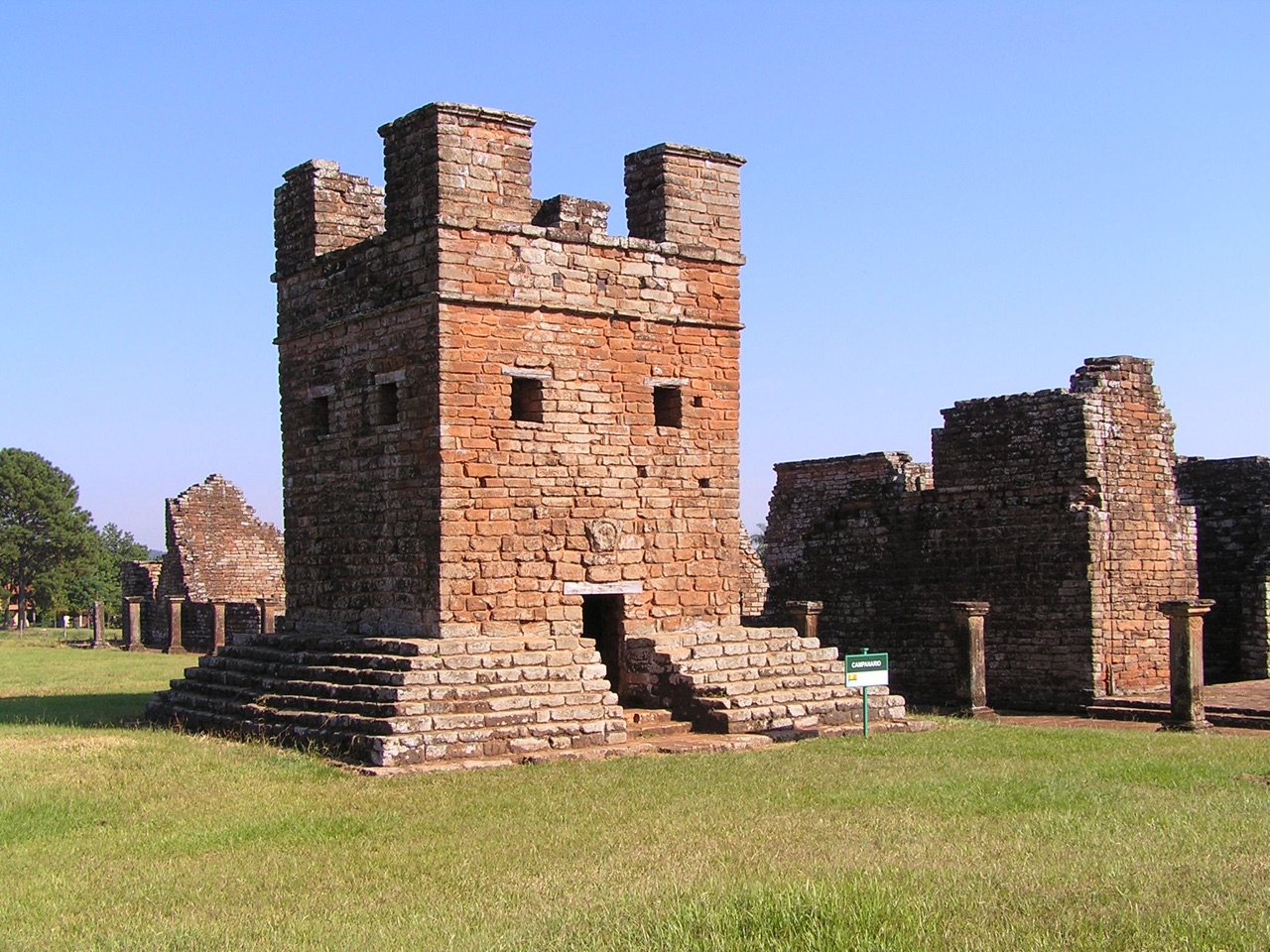
La Santísima Trinidad de Paraná and Jesús de Tavarangue are UNESCO-listed Jesuit mission sites in Itapúa, northeast of Encarnación. Their stone remains preserve church architecture and the layouts of settlements built within the wider mission system. They reflect Indigenous craftsmanship and European religious institutions, as well as the unequal conditions of colonial society. The two sites are separate places, rather than different names for the same ruins.
In Asunción, the Palacio de López faces the riverfront, while the Casa de la Independencia connects a surviving historic house with the 1811 independence movement. Caacupé’s basilica is an important religious landmark east of the capital. Itaipú stands on the Paraná near Hernandarias, north of Ciudad del Este, and demonstrates the scale of shared hydroelectric engineering. Areguá and San Bernardino offer another perspective around Lake Ypacaraí, where settlement, recreation and environmental pressures meet.
People and society of Paraguay
Bilingual national life coexists with distinct Indigenous peoples and communities shaped by migration.
- Where do most Paraguayans live?
- Most live in the eastern region, including the Asunción metropolitan area and other cities. The much larger western Chaco is more sparsely populated.
- Are all Indigenous Paraguayans Guaraní?
- No. Paraguay has distinct Indigenous peoples with languages from several language families, including communities in both the Chaco and the east.
- Is Asunción’s metropolitan area the same as its capital district?
- No. The metropolitan area extends beyond the capital district into surrounding municipalities, especially in Central Department.
More about Paraguay: people & society
Most Paraguayans live in the eastern region, with a large urban concentration around Asunción and Central Department. Ciudad del Este, Encarnación and other departmental capitals connect their surrounding regions with trade, education and services. The Chaco covers a broad area with much more widely spaced settlements. This uneven distribution matters when comparing the population of a city, its metropolitan area and an entire department.
Guaraní and Spanish heritage are important to national identity, but they do not describe everyone’s history. Paraguay’s Indigenous peoples include communities with distinct languages and traditions in both the Chaco and the east. Mennonite communities have established farming settlements in the Chaco, while other migration has shaped eastern towns and border regions. Language use, livelihoods and family histories vary considerably. A bilingual national identity can exist alongside this wider cultural diversity.