Facts about Argentina
Argentina stretches from subtropical forest and high Andean valleys to the Pampas, Patagonian glaciers and Tierra del Fuego. Explore the country through its provinces, cities and waters, then discover the histories, food and communities behind those places.
- Capital
- Buenos Aires
- Currency
- Argentine peso (ARS)
- Provinces
- 23, plus autonomous Buenos Aires
- Main language
- Spanish
- Highest mountain
- Aconcagua
- Eastern coast
- Atlantic Ocean
Argentina · 0 of 20 rounds passed
Two timed rounds per topic, 20 seconds a question
Buenos Aires stands beside the Río de la Plata, Córdoba anchors the central interior and Rosario faces the Paraná River. Mendoza lies beneath the Andes in the west, while Salta and Jujuy open onto northwestern valleys and highlands. In the northeast, Puerto Iguazú connects with the waterfalls and Misiones’ forest. La Plata is the capital of Buenos Aires Province, which is separate from Buenos Aires city.
Farther south, Bariloche sits beside Nahuel Huapi in the Andean lake district. Puerto Madryn looks towards Península Valdés, El Calafate is a base for Los Glaciares and Ushuaia faces the Beagle Channel on Tierra del Fuego. Three maps cover the 23 provinces and autonomous capital, 24 selected cities and ten waters. Spanish lessons introduce everyday phrases, while the reading explains voseo and recognises Indigenous languages.
Geography of Argentina
The Andes rise along the west, the Pampas spread across the centre and Patagonia stretches towards Tierra del Fuego.
- Which countries border Argentina?
- Chile lies to the west and south. Bolivia and Paraguay border the north, Brazil the northeast and Uruguay the east across the Uruguay River and Río de la Plata.
- What are the Pampas?
- The Pampas are broad plains in central and eastern Argentina and neighbouring Uruguay. Their grasslands and fertile soils support crop farming and cattle raising.
- Is Patagonia only in Argentina?
- No. Patagonia extends across southern Argentina and Chile. Argentine Patagonia includes dry steppe, Atlantic coast and the eastern side of the Andes.
More about Argentina: geography
Argentina occupies much of southeastern South America, bordering Chile, Bolivia, Paraguay, Brazil and Uruguay. The Andes form its western mountain spine. Aconcagua in Mendoza is the highest mountain outside Asia. The northeast has subtropical forest and wetlands, while the fertile Pampas around Buenos Aires support farming and large cities.
Patagonia combines dry steppe with Andean lakes, forests and glaciers. The island of Tierra del Fuego is shared with Chile, with Ushuaia on its Argentine side. The Paraná and Uruguay rivers feed the Río de la Plata estuary beside Buenos Aires. Argentina’s long span of latitude and large changes in elevation produce very different climates, so Patagonia’s weather does not describe the whole country.
History of Argentina
Indigenous societies, independence in Tucumán and the long struggle over who would govern the new republic.
- When did Argentina declare independence?
- The Congress of Tucumán declared independence on 9 July 1816. The May Revolution in Buenos Aires happened earlier, in 1810.
- Who was José de San Martín?
- San Martín was an independence leader whose Army of the Andes crossed from Argentina into Chile in 1817. He also played an important part in Peru’s independence.
- When did democracy return after the last dictatorship?
- Elected civilian government returned in 1983, with Raúl Alfonsín taking office on 10 December. The dictatorship had ruled since the military coup of 1976.
More about Argentina: history
Indigenous peoples inhabited the region long before Spanish colonisation, with distinct societies in the northwest, northeast, Pampas and far south. Buenos Aires became the capital of the Viceroyalty of the Río de la Plata in 1776. The May Revolution of 1810 established a local governing junta, while the Congress of Tucumán declared independence on 9 July 1816. José de San Martín led armies across the Andes in the wider South American independence struggle.
Disputes between central authority and provincial autonomy shaped the nineteenth century. The 1853 constitution established a federal framework, and Buenos Aires became the federal capital in 1880. State expansion into the Pampas and Patagonia involved violent dispossession of Indigenous communities. Large immigration waves transformed cities and farming regions. The military dictatorship of 1976–1983 carried out disappearances and other abuses. Elected civilian government returned in 1983.
Languages of Argentina
Spanish with regional accents, widespread use of vos and living Indigenous language traditions.
- What does vos mean in Argentine Spanish?
- Vos is a familiar singular “you”, widely used in Argentina. It has forms such as vos sos, “you are”, and vos tenés, “you have”.
- Does everyone in Argentina speak with a Buenos Aires accent?
- No. Rioplatense Spanish is prominent around Buenos Aires and the Río de la Plata, but speech varies across the northwest, northeast, central provinces and Patagonia.
- Are Indigenous languages still spoken in Argentina?
- Yes. Living languages include Guaraní, Quechua, Mapudungun, Qom and Wichí. Spanish is the main everyday language nationally, but it is not the country’s only language.
More about Argentina: language
Spanish is the main language of public life and everyday communication. Rioplatense Spanish, associated with Buenos Aires and the Río de la Plata region, commonly uses vos instead of tú for the informal singular “you”. Forms include vos tenés, meaning “you have”, and vos sos, meaning “you are”. Many speakers pronounce ll and y with a sound resembling English “sh” or the sound in “measure”, although pronunciation varies by region and generation.
Argentina also has Indigenous languages including Guaraní, Quechua, Mapudungun, Qom and Wichí. Their communities and legal recognition differ between provinces. Immigration has added further linguistic traditions. The Spanish lessons here introduce broadly useful phrases. When listening locally, expect regional vocabulary, voseo and accents that differ from examples taught in other Spanish-speaking countries.
Culture of Argentina
Tango beside the Río de la Plata, regional folk music and football loyalties that fill city neighbourhoods.
- Did tango develop only in Argentina?
- No. Tango developed in communities around the Río de la Plata in both Argentina and Uruguay. The two countries jointly share UNESCO’s recognition of the tradition.
- What is a bandoneón?
- It is a bellows-driven instrument with buttons, closely associated with tango. Its expressive sound is central to many tango orchestras.
- What is chamamé?
- Chamamé is a music and dance tradition associated especially with Corrientes and northeastern Argentina. It reflects regional cultural connections, including Guaraní heritage.
More about Argentina: culture
Tango developed in the urban Río de la Plata communities of Argentina and Uruguay, drawing on several cultural traditions. Its music, dance and poetry are shared across the estuary. The bandoneón gives many tango ensembles their distinctive sound. Folk traditions vary beyond Buenos Aires, including chacarera in Santiago del Estero and chamamé in the northeast.
Football connects local clubs with national identity, while rugby, hockey and other sports also have strong followings. Writers such as Jorge Luis Borges and Julio Cortázar shaped literature well beyond Argentina. Gaucho traditions recall rural horse culture, while mate drinking and shared meals connect everyday social life across regions. No single dance, city or sporting tradition represents everyone in the country.
Economy of Argentina
Pampas farming, Paraná export ports and industries that reach from Mendoza’s vineyards to Patagonia’s energy fields.
- Why is Rosario important for trade?
- Rosario and nearby ports stand on the Paraná River beside major farming regions. They handle agricultural exports and connect inland Argentina with ocean-going trade.
- Where is Argentina’s best-known wine region?
- Mendoza, beside the Andes in western Argentina, is the best-known wine region. Irrigation supports vineyards in its dry climate, and Malbec is a prominent variety.
- What is Vaca Muerta?
- Vaca Muerta is a geological formation with major shale oil and gas resources, especially in Neuquén. Its name refers to the rock formation rather than a single town or oil well.
More about Argentina: economy
Agriculture connects the Pampas with grain and oilseed exports, cattle production and food processing. Ports along the Paraná near Rosario link inland farming regions with overseas markets. Industry includes vehicles, machinery and chemicals, alongside a substantial services economy. Mendoza’s irrigated valleys produce wine, with Malbec closely associated with the region.
Oil and gas resources include the Vaca Muerta formation, especially in Neuquén. Lithium extraction takes place in northwestern salt-flat basins and raises questions about water use and local communities. Inflation, debt and exchange-rate instability have repeatedly affected household budgets and businesses.
Politics of Argentina
A federal presidential republic with 23 provinces and Buenos Aires as a separate autonomous city.
- How many provinces does Argentina have?
- Argentina has 23 provinces, plus the separate Autonomous City of Buenos Aires. The city is not one of the provinces.
- Is Buenos Aires the capital of Buenos Aires Province?
- No. La Plata is the provincial capital. Buenos Aires city is Argentina’s national capital and a separate autonomous jurisdiction.
- How long is an Argentine presidential term?
- The president and vice-president serve four-year terms. The constitution allows one consecutive re-election, followed by a term out of those offices before another election.
More about Argentina: politics
Argentina is a federal republic. Its 23 provinces have their own governments, and the Autonomous City of Buenos Aires has a separate constitutional status. Buenos Aires Province is a different jurisdiction, with its capital at La Plata. The national president is head of state and government, elected with a vice-president for a four-year term. The constitution permits one consecutive re-election.
The National Congress has a Chamber of Deputies and a Senate. Deputies represent electoral districts, while each province and Buenos Aires city elects three senators. Courts form a separate branch of government. The constitution recognises the prior existence of Indigenous peoples and sets out rights relating to identity, education and community lands. Federal structure does not mean every province has the same geography, resources or political priorities.
Nature and wildlife of Argentina
Subtropical forest, Iberá wetlands and Patagonian coasts with whales and penguins.
- Where can southern right whales be seen in Argentina?
- Península Valdés and nearby Chubut coastal waters are important seasonal breeding areas. Whale presence varies through the year, so sightings are not guaranteed.
- Is all of Patagonia covered in forest?
- No. Much of Argentine Patagonia is dry steppe. Forests are concentrated along the wetter Andean side, with substantial variation between places.
- Where are the Iberá wetlands?
- The Iberá wetlands lie in Corrientes Province in northeastern Argentina. They contain marshes, lagoons and grasslands with rich freshwater wildlife.
More about Argentina: nature & wildlife
Argentina’s habitats range from Misiones’ Atlantic Forest to the Gran Chaco, Iberá wetlands and Andean highlands. Iguazú National Park protects forest around the waterfalls, with wildlife including coatis, toucans and jaguars. Corrientes’ Iberá wetlands support marsh deer, capybaras and many waterbirds. The dry northwestern mountains have very different ecosystems from these humid northeastern landscapes.
In Patagonia, guanacos inhabit the steppe and Andean condors soar above mountain terrain. Península Valdés is important for southern right whales and other marine wildlife. Magellanic penguins breed at coastal sites including Punta Tombo. The forests and glaciers around the southern Andes face pressures from climate change, while habitat loss affects northern forests. Visiting wildlife areas responsibly means giving animals space and following local park rules.
Food of Argentina
Asado gatherings, regional empanadas and mate shared through everyday life.
- What is mate?
- Mate is an infusion of yerba mate leaves. A bombilla is the filtered straw used to drink it. The tradition is shared with several neighbouring countries.
- What is an Argentine empanada?
- An empanada is a filled pastry, baked or fried. Fillings and preparation vary between regions, so there is no single recipe for the whole country.
- What is dulce de leche?
- Dulce de leche is a sweet milk preparation made by slowly cooking milk with sugar. It is used in desserts including many alfajores, cakes and pastries.
More about Argentina: food & cuisine
Asado refers to both a style of grilling meat and the meal that brings people together around it. Empanadas have many regional fillings and preparations, including varieties associated with Salta and Tucumán. Locro, a hearty stew often made with maize, beans and meat, is associated with national holidays. Northern food traditions draw on Andean crops and cooking, while seafood and lamb feature in different southern settings.
Mate is an infusion of yerba mate leaves, commonly drunk through a metal straw called a bombilla. It is shared across Argentina and neighbouring countries, rather than belonging to Argentina alone. Italian migration helped shape popular pizza and pasta traditions. Dulce de leche flavours desserts such as alfajores, whose fillings and coatings vary. Mendoza’s wine and regional produce add further variety to a cuisine that extends well beyond beef.
Landmarks of Argentina
Iguazú’s cascades, the glaciers near El Calafate and prehistoric hand paintings in Santa Cruz.
- Is Iguazú Falls in Argentina or Brazil?
- The waterfall system lies on the border, with national parks and visitor viewpoints in both Argentina and Brazil. Puerto Iguazú is the nearby Argentine city.
- Where is the Perito Moreno glacier?
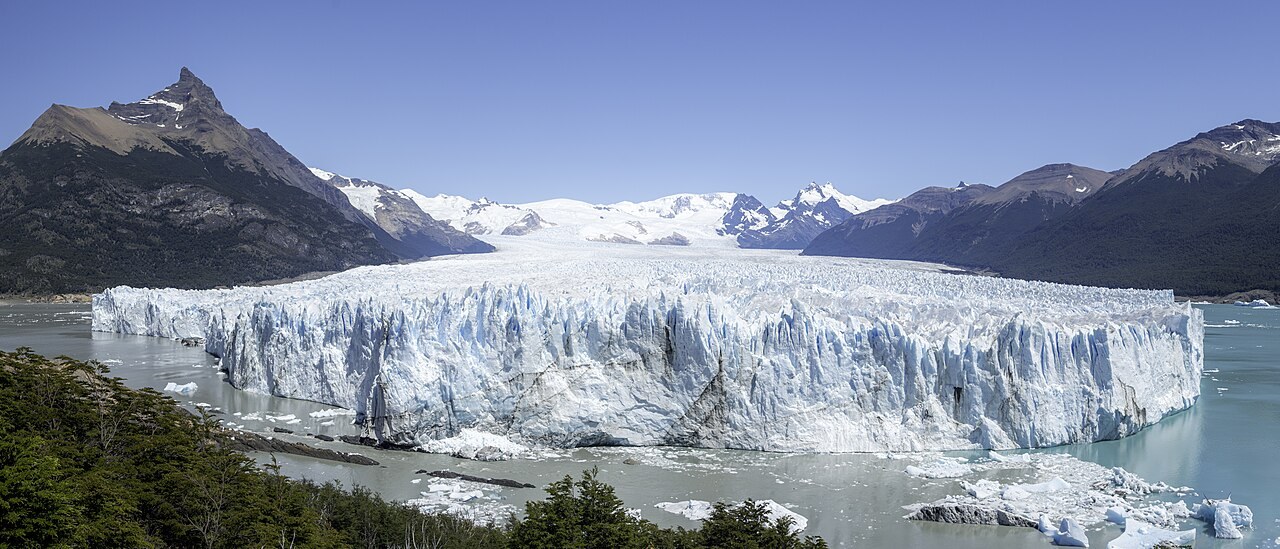
- It lies in Los Glaciares National Park in Santa Cruz Province, west of El Calafate. Its front reaches Lago Argentino.
- What is Cueva de las Manos?
- It is a rock-art site in Santa Cruz, known for prehistoric hand stencils and other paintings. Its name means “Cave of the Hands”.
More about Argentina: landmarks
Iguazú Falls straddle the border between Argentina and Brazil, in a subtropical forest landscape near Puerto Iguazú. Far south, Los Glaciares National Park includes the Perito Moreno glacier and the mountains around El Chaltén, including Fitz Roy. Perito Moreno flows into Lago Argentino. These sites sit in different climates and are separated by a substantial journey across the country.
Cueva de las Manos in Santa Cruz preserves prehistoric rock art, including hand stencils. In the northwest, the Quebrada de Humahuaca follows a long-used Andean route through Jujuy. Buenos Aires’ Teatro Colón is a major opera house, while the House of Independence in Tucumán marks the 1816 declaration. Argentina’s landmarks tell stories of Indigenous societies, political change and dramatic landscapes, with much to explore beyond the capital.
People and society of Argentina
An urban society with regional identities shaped by Indigenous communities and successive migrations.
- Do most Argentines live in cities?
- Yes. Argentina is highly urbanised, with its largest metropolitan concentration around Buenos Aires and other major urban centres across the country.
- Are Indigenous peoples part of Argentina today?
- Yes. Indigenous communities live in many regions, with distinct identities and languages. The constitution recognises their prior existence and specific rights.
- What is the difference between Buenos Aires city and Greater Buenos Aires?
- Buenos Aires city is an autonomous jurisdiction. The wider metropolitan area includes surrounding municipalities in Buenos Aires Province, so metropolitan population figures cover more than the city alone.
More about Argentina: people & society
Most Argentines live in urban areas. Buenos Aires city and its surrounding metropolitan municipalities form the largest population centre, but the city and province are separate jurisdictions. Córdoba, Rosario, Mendoza and Tucumán anchor other major urban regions. The population is concentrated unevenly, with much greater distances between settlements across parts of Patagonia.
Argentina’s society includes Indigenous peoples, descendants of European and African migrants and communities shaped by more recent migration from neighbouring countries and elsewhere. Italian and Spanish immigration had a large influence, but an exclusively European account leaves out important parts of the country’s history and present. Local identity can be tied to province, city, neighbourhood or football club. Daily life in Buenos Aires differs considerably from life in a northern farming community or a Patagonian town.