Facts about Somaliland
Explore Somaliland from the Gulf of Aden coast to the Golis highlands and Haud plateau. Ten illustrated topics connect cities, rock art and maritime trade with history, Somali language, food and everyday life.
- Capital
- Hargeisa
- Official language
- Somali
- Second language
- Arabic · Constitution, Article 6
- Local currency
- Somaliland shilling
- Coast
- Gulf of Aden
- Independence declared
- 18 May 1991
Somaliland · 0 of 20 rounds passed
Two timed rounds per topic, 20 seconds a question
Hargeisa is the capital in the western interior. Borama, Baki and Gabiley introduce the western highlands and farming belt; Zeila and Lughaya face the Gulf of Aden. Berbera connects the coast with Sheikh, Burao and Oodweyne inland. Erigavo and Las Anod locate eastern areas with competing territorial claims.
Find twelve cities and towns, ten heritage and landscape sights, and four regional waters. The Gulf of Aden, Bab el Mandeb, Red Sea and Arabian Sea retain their full geographic extent beyond the country’s opening view. The guide follows Worldly’s retained outline rather than changing lines of control.
Geography of Somaliland
From the Gulf of Aden to the high plateau
- Where is Somaliland?
- In the northwestern Horn of Africa, on the southern shore of the Gulf of Aden.
- Which landscapes connect the coast and interior?
- The Guban coastal plain, Golis escarpment and Ogo highlands lead towards the Haud plateau.
- Why do the waters extend beyond Somaliland?
- Seas and straits are continuous geographic features; political borders do not end their shapes.
More about Somaliland: geography
Somaliland lies in the northwestern Horn of Africa, facing Yemen across the Gulf of Aden. Hargeisa is the capital and largest city; Berbera is its principal commercial port. Djibouti lies to the northwest and Ethiopia to the south and west. The hot Guban coastal plain rises towards the Golis escarpment, the Ogo highlands and the dry Haud grazing country, which continues into Ethiopia.
The landscape depends on seasonal rainfall, wells and groundwater. Toggas are seasonal watercourses; they can carry sudden floods after rain even where their beds are usually dry. The city map follows Worldly’s retained Somaliland outline. Eastern territorial claims and political control are disputed, so the outline should be read as a learning convention. The waters map follows whole geographic features well beyond that outline.
History of Somaliland
Rock shelters, trading ports and the 1960 union
- When did British Somaliland become independent?
- On 26 June 1960, five days before the union that formed the Somali Republic.
- What happened in Burao in 1991?
- A conference declared the restoration of Somaliland’s independence after the collapse of Siad Barre’s government.
- What does Laas Geel reveal?
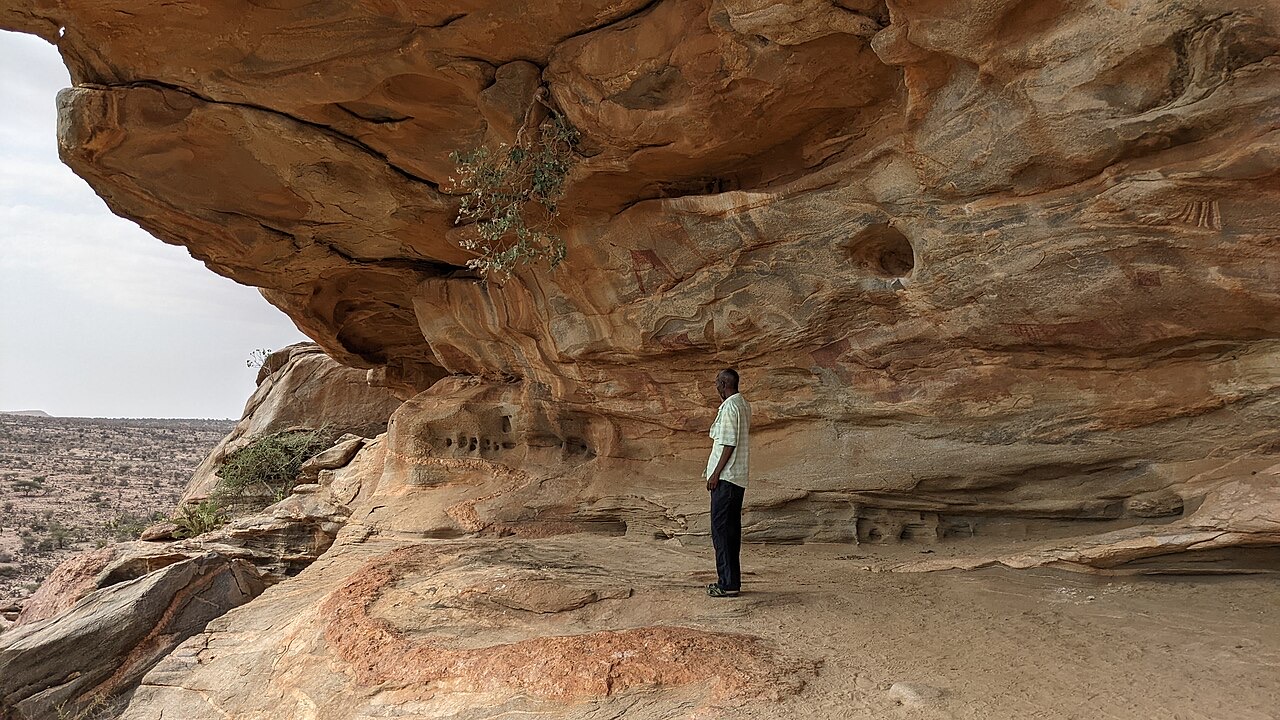
- Rock paintings depict cattle and people, providing evidence of early pastoral life in the region.
More about Somaliland: history
The painted cattle and human figures at Laas Geel record an early pastoral world thousands of years before modern states. Coastal settlements such as Zeila and Berbera later connected the interior with Red Sea and Indian Ocean trade. Britain established a protectorate through agreements in the late nineteenth century. British Somaliland became independent on 26 June 1960, then united on 1 July with the former Italian-administered trust territory to form the Somali Republic.
Siad Barre’s dictatorship and the war against the Somali National Movement brought devastating violence to northern communities, including the bombardment of Hargeisa in 1988. In May 1991, leaders meeting in Burao declared the restoration of Somaliland’s independence. Subsequent reconciliation conferences, including Borama in 1993, helped build separate institutions. The independence claim, the 1960 union and present territorial disputes remain distinct parts of this history.
Somali and languages in Somaliland
Somali words, writing and multilingual lives
- Is Somali a form of Arabic?
- No. Somali is Cushitic and Arabic is Semitic, within the wider Afroasiatic family.
- Which script is widely used for Somali today?
- A Latin-based orthography, officially adopted in 1972.
- What does the constitution say about languages?
- It identifies Somali as the official language and Arabic as the second language.
More about Somaliland: language
Somali belongs to the Cushitic branch of the Afroasiatic language family. Northern Somali varieties are widely spoken in Somaliland and connect communities across modern borders. The constitution names Somali as the official language and Arabic as the second language. Arabic has an important place in religious study; English also appears in education, business and international communication.
The Latin-based Somali orthography was officially adopted in 1972. Earlier writing included Arabic-based and locally developed scripts, alongside rich oral traditions; Somali was never a language without intellectual history before standardisation. Poetry, radio, books and digital media all carry it today. Try “Salaan” for a greeting and “Mahadsanid” for thank you, then use the linked Somali lessons to practise everyday expressions.
Culture of Somaliland
Poetry, customary law and a living literary scene
- What is gabay?
- A classical form of Somali poetry, traditionally composed and performed orally.
- What is xeer?
- A body of customary law and negotiated obligations used in community relations and mediation.
- When did the Hargeisa International Book Fair begin?
- In 2008; it has developed into a meeting place for literature, discussion and performance.
More about Somaliland: culture
Poetry is a major form of public expression across Somali-speaking communities. Gabay is a classical poetic form; buraanbur is especially associated with women’s composition and performance. Stories, songs and debate connect family occasions with public life. The Hargeisa International Book Fair began in 2008, bringing writers and readers together across the Horn and the diaspora.
Xeer refers to customary law and negotiated obligations, often involving elders. Clan and kinship networks can support mutual assistance and mediation, while also shaping political divisions and unequal access to power. Somaliland includes Isaaq, Gadabuursi, Issa, Dhulbahante, Warsangeli and minority communities, among others. No single clan, style of dress or social custom describes everyone; urban, rural and diaspora experiences differ.
Economy of Somaliland
Livestock, Berbera and money sent home
- Why is Berbera important?
- It is a commercial gateway for livestock, containers and trade connecting Somaliland with regional markets.
- What are remittances?
- Money that people living abroad send to relatives or others at home.
- Which currencies circulate?
- The Somaliland shilling and the US dollar are both used; payments also move through mobile services.
More about Somaliland: economy
Livestock connects pastoral households, traders, transporters and the port of Berbera. Sheep, goats and camels are important to livelihoods and export trade, especially with markets across the Gulf. Berbera also handles containers and other cargo. DP World’s port investment and the corridor towards Ethiopia link the coast with a large landlocked neighbour, although infrastructure plans and diplomatic agreements should not be confused with completed outcomes.
Remittances from relatives abroad support household spending, education and businesses. Money-transfer firms and mobile payments, including Zaad, are part of everyday commerce. The Somaliland shilling circulates alongside the US dollar. Limited international recognition complicates access to financial institutions and development funding, but does not prevent all trade. Drought, animal health restrictions and changing import demand can put pressure on pastoral incomes.
Politics of Somaliland
Separate institutions and a disputed international status
- What is the Guurti?
- The upper house of Somaliland’s parliament, historically rooted in the role of elders.
- Which state recognised Somaliland in December 2025?
- Israel, on 26 December 2025; that recognition did not settle the wider dispute.
- Does this map show current control?
- No. It uses Worldly’s retained outline and settlement locations rather than changing lines of control.
More about Somaliland: politics
Somaliland maintains its own presidency, government, courts and currency. Its parliament has an elected House of Representatives and an upper house, the Guurti, associated with elders. Competitive elections and transfers of power form part of its political record, alongside election delays, representation debates and disputes over territory. Formal institutions do not imply uniform political control throughout the claimed territory.
Israel recognised Somaliland on 26 December 2025. This was a diplomatic change, not a settlement of its wider status: Somalia rejects the independence claim, and the United Nations and African Union continue to affirm Somalia’s sovereignty and territorial integrity. Eastern areas, particularly around Sool and Sanaag, have competing claims and local political histories. Worldly’s separate entry provides a way to learn about Somaliland without deciding these disputes.
Nature & Wildlife of Somaliland
Dryland wildlife and highland refuges
- Where are Somaliland’s highland forests?
- Woodland survives in parts of the northern highlands, including the Daallo area near Erigavo.
- What is frankincense?
- An aromatic resin obtained from Boswellia trees, used in incense and perfume.
- Why are cheetahs a conservation concern?
- Wild populations face habitat pressures and the illegal capture and trafficking of cubs.
More about Somaliland: nature & wildlife
Arid coast, scrubland, grazing plateaus and highland woodland support different habitats. Daallo near Erigavo is associated with the Golis highlands and pockets of forest, rather than a continuous green belt across Somaliland. Frankincense comes from Boswellia trees; myrrh comes from Commiphora. Both resins connect dryland ecology with long histories of trade.
Cheetah conservation in the Horn faces habitat pressures and illegal trafficking of cubs across the Gulf of Aden. Rescued animals are evidence of trafficking, not a reliable census of wild populations. Drought, vegetation loss and charcoal production also affect communities and wildlife. Gu and Deyr are the main rainy seasons in much of the region, but their timing, strength and local effects vary; rain does not arrive evenly everywhere.
Food & Cuisine of Somaliland
Canjeero, spiced rice and shared meals
- What is canjeero?
- A fermented pancake, also known as laxoox in northern usage.
- What is bariis iskukaris?
- A seasoned rice dish, often cooked with a Somali spice mixture and other ingredients.
- What does shaah mean?
- Tea, commonly served sweet and flavoured with spices.
More about Somaliland: food & cuisine
Somaliland’s food belongs to a wider Somali culinary world, shaped by pastoral life and trade. Canjeero, also called laxoox in northern usage, is a fermented pancake often eaten with breakfast accompaniments or sauces. Rice dishes, pasta, breads and meat stews appear in different households and settings. Hilib ari means goat meat; bariis iskukaris is a seasoned rice dish.
Shaah is tea, often sweetened and flavoured with spices such as cardamom. Halwo is a dense sweet commonly made with starch, sugar and fat. Dates and sambuusas are familiar parts of Ramadan meals, though families prepare many different dishes. Camel milk is culturally important in pastoral communities; descriptions of customary consumption are not advice to drink untreated milk. Ingredients and meal routines vary with place, income and availability.
Landmarks of Somaliland
Painted shelters, old ports and mountain landscapes
- What is Laas Geel famous for?
- Painted rock shelters with cattle and human figures associated with early pastoral communities.
- Where is Amud?
- Near Borama in Awdal, in the western part of Somaliland.
- What does Hargeisa’s aircraft memorial recall?
- The destruction and civilian suffering associated with the 1988 bombardment of the city.
More about Somaliland: landmarks
Laas Geel, northeast of Hargeisa, is known for painted rock shelters with striking cattle and human figures. Researchers describe paintings associated with early herding communities around the third millennium BCE; precise dates should be treated cautiously. Dhambalin is another rock-art location inland from the coast. These fragile sites are archaeological records, not outdoor surfaces to touch or climb.
Zeila recalls medieval coastal trade and Islamic history, while Berbera’s old town records successive layers of port life. Hargeisa’s aircraft war memorial recalls the violence of 1988. Amud near Borama preserves traces of an earlier settlement; Sheikh and the Daallo highlands add landscape context. Sight pins identify approximate learning locations and broad areas, rather than entrances, safe routes or present access conditions.
People & Society of Somaliland
Cities, pastoral communities and the diaspora
- How does the diaspora stay connected?
- Through family ties, remittances, business, cultural activity and visits.
- What is Edna Adan Ismail known for?
- Nursing, midwifery training, her Hargeisa hospital and service as foreign minister.
- Why avoid a precise population quiz?
- Estimates differ, and incomplete data and changing definitions make exact totals uncertain.
More about Somaliland: people & society
People make their lives in Hargeisa and other towns, in farming communities and through mobile livestock herding. Islam has a central place in public and family life. Somali identity spans borders, while clan, language variety, gender, occupation and migration history shape different experiences. Population totals and the share of people practising pastoralism depend on definitions and incomplete data; a single confident number can hide that uncertainty.
The diaspora maintains family, business and cultural connections with Somaliland. Edna Adan Ismail is known for nursing, midwifery education and the hospital she founded in Hargeisa, as well as her service as foreign minister. Teachers, writers, health workers, traders and farmers contribute less visible stories. Displacement, drought and unequal opportunities also shape daily life, so neither a success story nor a conflict narrative alone captures the society.