Facts about Chad
Explore Chad from the Chari and Lake Chad to southern savannas, the Tibesti and the Ennedi. Twelve city and town pins, ten heritage and landscape locations and ten illustrated topics connect geography with histories, languages and everyday life.
- Capital
- N’Djamena
- Area
- About 1.284 million km²
- Official languages
- Arabic and French
- Currency
- Central African CFA franc (XAF)
- Independence
- 11 August 1960
- Highest summit
- Emi Koussi · Tibesti
Chad · 0 of 20 rounds passed
Two timed rounds per topic, 20 seconds a question
N’Djamena stands near the Chari–Logone confluence in the southwest. Bongor, Moundou, Doba and Sarh introduce river corridors, southern farming country and the oil-producing basin. Mao and Bol orient the Lake Chad region, while Mongo connects the central Guéra landscape and Abéché the eastern Wadai region.
Faya-Largeau is an oasis centre in Borkou; Fada introduces the sandstone Ennedi, and Bardaï lies within the Tibesti Mountains farther north. The city pins mark settlements rather than administrative units. The heritage locations range from Gaoui and Ouara to Ounianga’s lakes and Zakouma’s savannas.
Geography of Chad
From the volcanic Tibesti and sandstone Ennedi to the Chari and southern savannas.
- Which countries border Chad?
- Libya, Sudan, the Central African Republic, Cameroon, Nigeria and Niger.
- How do the Tibesti and Ennedi differ?
- The Tibesti includes volcanic mountains; the Ennedi is known for sandstone plateaux, arches and canyons.
- Why does Lake Chad’s mapped size vary?
- Rainfall, river inflow and water use change its open water and wetlands; season and measurement method matter.
More about Chad: geography
Chad is a landlocked country in north-central Africa, covering about 1.284 million square kilometres. It borders Libya, Sudan, the Central African Republic, Cameroon, Nigeria and Niger. N’Djamena, the capital, stands near the meeting of the Chari and Logone rivers opposite Cameroon. Northern Chad is Saharan; the central belt belongs to the Sahel, while the south has a wetter, Sudanian savanna climate. Rainfall and the length of the wet season generally increase southward.
The Tibesti Mountains include Emi Koussi, the highest summit in Chad and the Sahara. Farther east, the Ennedi is a sandstone massif rather than a volcanic range. In the southwest, the Chari–Logone system supplies most of Lake Chad’s inflow. Open water, marshes and islands change with rainfall and river flow. The lake has contracted greatly since the 1960s, but a single percentage without dates or a definition of water extent hides this changing wetland landscape.
History of Chad
Lake-basin states, colonial conquest and independence on 11 August 1960.
- When did Chad become independent?
- On 11 August 1960, from France.
- Were Kanem-Bornu, Baguirmi and Wadai the same state?
- No. They were distinct, changing centres of power connected with the wider Lake Chad and Saharan worlds.
- What is Toumaï?
- The nickname of a Sahelanthropus tchadensis fossil skull discovered in Chad in 2001, about seven million years old.
More about Chad: history
Kanem and later Bornu linked the Lake Chad basin with Saharan commerce and Islamic learning over many centuries. Baguirmi and Wadai were other important states, with different centres of power. Trade included salt, livestock and enslaved people; these histories should not be reduced to a single empire covering today’s borders. The fossil skull nicknamed Toumaï, found in the Djurab in 2001, belongs to Sahelanthropus tchadensis, about seven million years old. Its precise place in human evolution remains debated.
French conquest around 1900 brought the region under colonial rule; French Equatorial Africa was organised in 1910. Chad became independent on 11 August 1960, with François Tombalbaye as its first president. Civil wars, repression and conflict with Libya shaped later decades. Hissène Habré ruled from 1982 to 1990; a special court in Senegal convicted him in 2016 of crimes against humanity, war crimes and torture. Idriss Déby took power in 1990, and his death in 2021 was followed by a military-led transition.
Arabic, French and Chad’s languages
Arabic and French share public life with Sara languages, Teda, Dazaga and many others.
- Which languages are official?
- Arabic and French.
- Is Chadian Arabic the same as the linked general Arabic course?
- No. Chadian Arabic is a local spoken variety; the course introduces general Arabic.
- Does Sara name just one uniform language?
- No. It is used collectively for several related languages associated mainly with southern communities.
More about Chad: language
Arabic and French are Chad’s official languages. Chadian Arabic is a spoken Arabic variety and a widely used language of communication between communities; it is not simply a pidgin or identical to formal written Arabic. French is important in administration and much formal schooling, while Arabic also has educational and religious roles. Which languages people use at home, in markets and in classrooms varies by locality and individual experience.
Sara is a collective name associated with several related languages in southern Chad, rather than one uniform language spoken by everyone there. Teda and Dazaga are associated with Toubou communities in the north; Maba, Kanembu, Masa and many other languages add to the country’s diversity. Language classifications and counts depend on how varieties are distinguished. The linked Arabic lessons teach general Arabic rather than a dedicated Chadian dialect course; the French lessons likewise introduce general French.
Culture of Chad
Film, music, dance and craft traditions tell different Chadian stories.
- Who directed Daratt and A Screaming Man?
- Chadian filmmaker Mahamat-Saleh Haroun.
- What is a kakaki?
- A long metal trumpet used in ceremonial traditions in parts of the region.
- Why avoid describing one festival as all of Chadian culture?
- Different communities have their own histories, artistic forms and celebrations.
More about Chad: culture
Mahamat-Saleh Haroun has brought Chadian stories to international cinema through films including Daratt and A Screaming Man. His work explores relationships, loss and the effects of conflict without making one character stand for the whole country. Oral storytelling, praise, music and dance also preserve histories and social knowledge. Instruments include drums, string instruments and, in some traditions, the long metal kakaki trumpet; repertoires and occasions differ among communities.
Pottery, leatherwork, weaving and decorated everyday objects connect artistic skill with local materials and livelihoods. Gaoui near N’Djamena is associated with pottery and a museum in a former ruler’s residence. Weddings and community gatherings have distinct regional forms. Wodaabe Gerewol performance traditions occur in the wider Sahel, including Chad, but do not represent all Chadian celebrations. A photograph of one wedding records a particular occasion, not a national dress code or a ceremony shared by everyone.
Economy of Chad
Oil exports connect with cotton, herding, fishing and everyday market trade.
- Which currency does Chad use?
- The Central African CFA franc (XAF), issued by the BEAC.
- Where does the oil export pipeline lead?
- Through Cameroon to the Atlantic coast near Kribi.
- Do oil exports describe most households’ work?
- No. Farming, herding, fishing and market trade remain important livelihoods.
More about Chad: economy
Farming, livestock keeping and small-scale commerce support many households in Chad. Millet and sorghum are important grains; cotton has a long history as a cash crop. Herding connects grazing country with town markets, while fishing and farming sustain communities around the Chari, Logone and Lake Chad. Gum arabic, gathered from acacia-type trees, is another traded product. Seasonal rains, floods, access to land and movement across borders affect these livelihoods.
Oil exports began in 2003, with a pipeline from southern Chad through Cameroon to the Atlantic coast near Kribi. Petroleum makes up a large share of export earnings and public revenue, but this does not mean most people work in the oil industry. Transport costs and regional insecurity complicate trade for a landlocked country. Chad uses the Central African CFA franc, currency code XAF, issued by the BEAC; it is distinct from the West African CFA franc used by Niger.
Politics of Chad
A 2021 transition, elections in 2024 and a parliament with two chambers.
- Who led the council that took power in 2021?
- Mahamat Idriss Déby, following his father Idriss Déby’s death.
- Which two chambers make up parliament?
- The National Assembly and the Senate.
- When did French forces complete their withdrawal?
- In January 2025, following the end of the defence cooperation agreement.
More about Chad: politics
After Idriss Déby’s death in April 2021, a Transitional Military Council headed by his son Mahamat Idriss Déby took power. A new constitution followed a referendum in December 2023. Mahamat Idriss Déby was declared the winner of the May 2024 presidential election, whose result the main challenger disputed. Parliamentary elections in December 2024 were boycotted by major opposition parties. The National Assembly and a Senate established in 2025 form a bicameral parliament; older descriptions of a single chamber are incomplete.
Constitutional amendments adopted in October 2025 extended presidential terms to seven years and removed term limits. Security, political participation, services and displacement remain central issues. France completed its troop withdrawal in January 2025, so earlier quiz wording about a continuing French base is historical. Fighting in neighbouring Sudan has driven people into eastern Chad. Official travel advice identifies serious risks in several regions; heritage pins introduce places for learning and do not indicate current safe access.
Nature & Wildlife of Chad
Zakouma’s savannas and floodplains contrast with northern desert refuges.
- What kinds of habitats does Zakouma protect?
- Savanna, woodland and seasonal floodplains in southeastern Chad.
- What is distinctive about scimitar-horned oryx horns?
- They curve backward like scimitars, rather than spiralling.
- What is a guelta?
- A water pool or waterhole in desert terrain, often within a rocky valley.
More about Chad: nature & wildlife
Zakouma National Park in southeastern Chad protects savanna, woodland and seasonal floodplain habitats. Elephants, Kordofan giraffes, buffalo and many birds depend on this wider ecosystem. The Government of Chad and African Parks began their management partnership in 2010 after severe poaching losses. Wildlife protection involves surrounding communities, employment and grazing and land-use questions as well as patrols. Population totals change, so a conservation success should be described with dates and context rather than timeless numbers.
Farther north, the Ouadi Rimé–Ouadi Achim reserve is a focus of antelope restoration. Scimitar-horned oryx releases began in 2016; the species was reassessed as Endangered in 2023 after having been Extinct in the Wild. Its horns curve backward, unlike the spiralling horns of the addax. In the Ennedi, gueltas are persistent water pools within rocky desert terrain. Lake Chad and Lake Fitri support fish, wetland birds and people, with seasonal water and land-use changes shaping the habitats.
Food & Cuisine of Chad
Boule, sauces, fish and grain connect meals with local landscapes.
- What is boule?
- A thick cooked grain staple, commonly served with a sauce.
- What is dihé?
- Dried spirulina traditionally harvested from suitable alkaline ponds in the Lake Chad region.
- Why do ingredients vary across Chad?
- Local crops, water, herding, markets, seasons and household traditions shape meals.
More about Chad: food & cuisine
Boule is a thick cooked grain staple, often made with millet, sorghum or maize and served with sauces. Vegetables, leaves, groundnuts, meat or fish may accompany it, depending on household, season and region. Kisra is a thin fermented grain bread shared with neighbouring food traditions. Rice and wheat-based foods also appear in meals, especially through town markets. No one dish describes every Chadian household or every day’s cooking.
Fish is important around lakes and rivers and may be fresh, dried or smoked. Dried spirulina, often called dihé, is traditionally harvested from suitable alkaline ponds in the wider Lake Chad area; it is not collected from every part of the lake. Dairy products and meat connect food with pastoral life. Bili-bili is a fermented grain drink in some communities, while tea and other non-alcoholic drinks are common in many settings. Food and drinking customs differ by community and religious practice.
Landmarks of Chad
Ounianga’s desert lakes, Ennedi’s rock art and the earthen heritage of Gaoui.
- Which two Chadian properties are on the World Heritage List?
- The Lakes of Ounianga and the Ennedi Massif: Natural and Cultural Landscape.
- Are all Ounianga lakes freshwater?
- No. Their salinity and chemistry vary, and groundwater helps sustain the system.
- Why is Ennedi both natural and cultural heritage?
- Its eroded sandstone landscape also preserves extensive rock art and long histories of human use.
More about Chad: landmarks
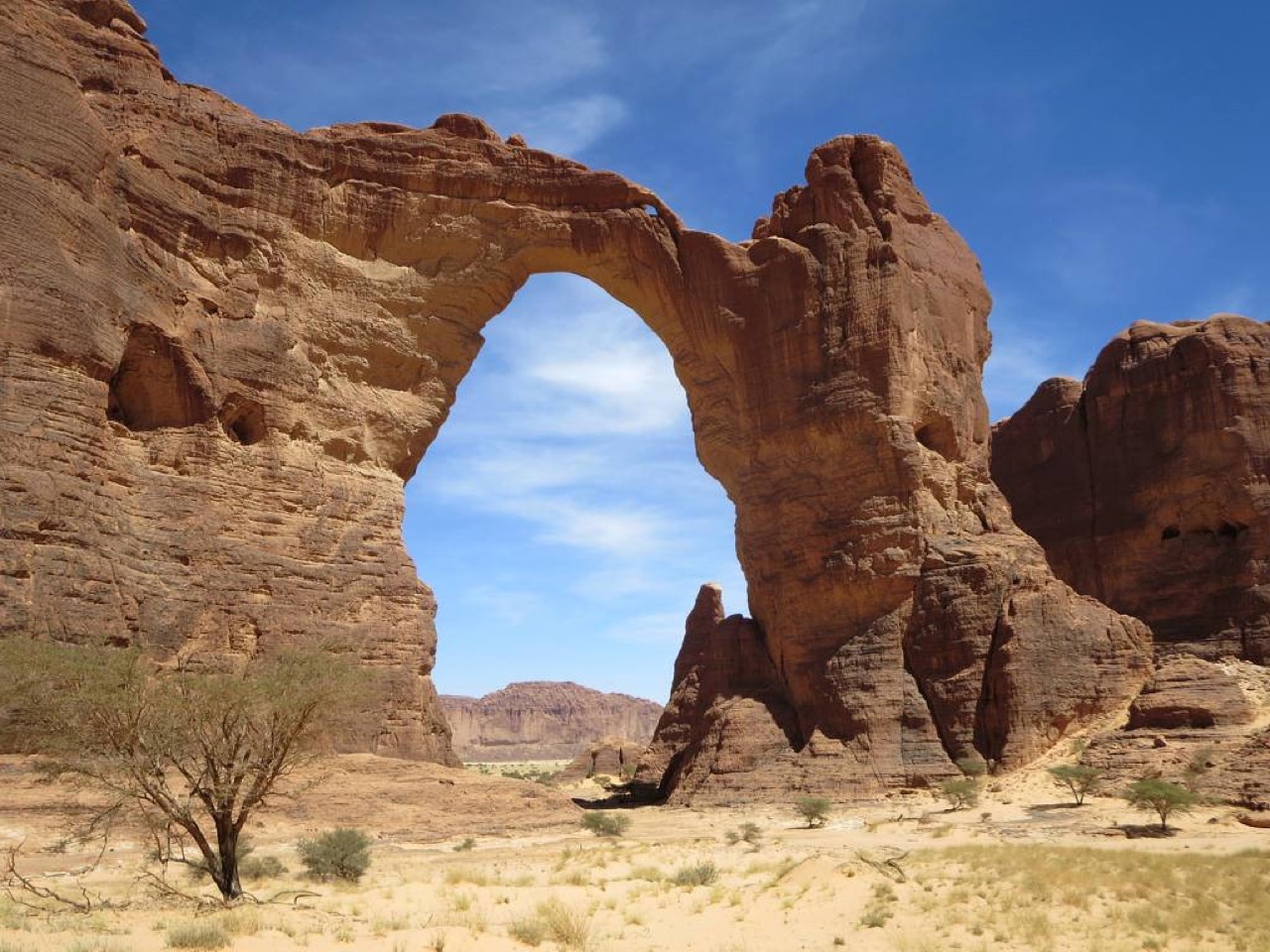
Chad’s two inscribed UNESCO World Heritage properties are the Lakes of Ounianga, listed in 2012, and the Ennedi Massif: Natural and Cultural Landscape, listed in 2016. Ounianga contains desert lakes with different water chemistry; groundwater helps sustain them despite very low rainfall and intense evaporation. They are not all freshwater lakes. The Ennedi combines sandstone arches and canyons with rock paintings and engravings that document long human relationships with a changing environment.
Aloba Arch and the Guelta d’Archei are distinctive Ennedi locations. In the Tibesti, Emi Koussi and Trou au Natron reveal a different, volcanic landscape. Gaoui’s former ruler’s residence and museum introduce earthen architecture and local history near the capital. Ouara, north-northwest of Abéché, preserves remains associated with the earlier Wadai capital. These places have different heritage designations: being included in this guide does not make each an individually inscribed UNESCO site.
People & Society of Chad
Many communities, mobile livelihoods and towns connected across borders.
- Does ethnic identity determine a person’s livelihood?
- No. Communities and families have varied languages, jobs and ways of life.
- Why should displacement figures be dated?
- New arrivals, returns and changing registration methods alter the figures.
- What is Jacqueline Moudeina known for?
- Her legal and human-rights work with survivors seeking accountability for Hissène Habré’s abuses.
More about Chad: people & society
Chad’s people include communities identified as Sara, Arab, Kanembu, Maba, Toubou, Zaghawa, Masa and many other names. These labels do not define a person’s occupation, language, religion or political views. Farming, livestock keeping, fishing and urban work often overlap within extended families. N’Djamena draws people from across the country, while smaller towns connect regional markets, schools, hospitals and rural settlements.
Islam, Christianity and local religious traditions form part of a varied social landscape; a simple north–south split misses many local differences. Conflict and displacement have affected both Chadian communities and people arriving from neighbouring countries, especially Sudan. Population totals and refugee figures require a date and source because conditions change. Chadian public life also includes writers, teachers, artists and human-rights advocates such as lawyer Jacqueline Moudeina, who worked with survivors seeking justice for Hissène Habré’s abuses.