Facts about Botswana
Explore Botswana from Gaborone and the eastern towns to the Kalahari, Makgadikgadi pans and Okavango Delta. Sixteen city and town pins, twelve heritage and landscape locations and ten illustrated topics connect geography with history and everyday life.
- Capital
- Gaborone
- Population
- 2,359,609 (2022 census)
- Area
- 581,730 km²
- National language
- Setswana
- Currency
- Pula (BWP)
- Independence
- 30 September 1966
Botswana · 0 of 20 rounds passed
Two timed rounds per topic, 20 seconds a question
Gaborone anchors the southeast, with Lobatse, Kanye, Molepolole and Mochudi nearby. Palapye, Serowe and Francistown introduce the eastern settlement corridor; Selebi-Phikwe, Letlhakane, Orapa and Jwaneng connect town histories with mining. Ghanzi and Tsabong orient the dry western and southern interior.
Maun is a gateway to the Okavango, while Kasane sits by the Chobe River near the country’s northern tip. The delta and Tsodilo are Botswana’s two UNESCO World Heritage properties. The city map marks settlement centres, and the sight map uses representative pins for large landscapes rather than administrative or park boundaries.
Geography of Botswana
Kalahari sands, an inland delta and a short river border with Zambia.
- Which countries border Botswana?
- Namibia, South Africa, Zimbabwe and Zambia.
- Does the Okavango reach the ocean?
- No. It spreads into an inland wetland system, with most water lost through evaporation and plant transpiration.
- Is the Kalahari all bare desert?
- No. Its sandy basin also supports savanna, scrub and woodland, with strong seasonal variation.
More about Botswana: geography
Botswana is a landlocked country in southern Africa, bordered by Namibia, South Africa, Zimbabwe and Zambia. Gaborone lies in the southeast, near South Africa. Much of the country is a flat or gently rolling plateau covered by the sands of the Kalahari Basin. The Kalahari includes grassland, scrub and woodland as well as dry sandy country; it is not an uninterrupted sea of dunes. The eastern corridor holds many of the larger settlements.
The Okavango rises in Angola, passes Namibia and spreads into an inland delta in northwestern Botswana. Most of its water returns to the atmosphere through evaporation and plant transpiration rather than reaching an ocean. Floodwater arrives after a long journey, often expanding the delta during Botswana’s dry season. The Makgadikgadi salt pans farther east are remnants of a much larger ancient lake. At Kazungula, Botswana and Zambia share a short Zambezi boundary; the four nearby countries do not meet at one exact point.
History of Botswana
Community histories, the Bechuanaland Protectorate and independence in 1966.
- When did Botswana become independent?
- On 30 September 1966, from Britain.
- Why did the three dikgosi travel to Britain in 1895?
- They opposed the transfer of their territories to the British South Africa Company.
- What changed in the 2024 election?
- The Umbrella for Democratic Change won, bringing Duma Boko to the presidency and ending the BDP’s long period in power.
More about Botswana: history
Rock art, archaeological sites and oral histories reveal long and varied human histories in the region. San communities, farming and cattle-keeping societies, and later Tswana polities shaped different parts of what is now Botswana. These histories cross today’s borders. Britain established the Bechuanaland Protectorate in 1885. In 1895, Khama III, Bathoen I and Sebele I travelled to Britain to oppose the transfer of their territories to Cecil Rhodes’s British South Africa Company.
Botswana became independent on 30 September 1966, with Seretse Khama as its first president and Gaborone as its new capital. Khama’s marriage to Ruth Williams had earlier provoked opposition from colonial and apartheid authorities. Diamond discoveries, including Orapa in 1967, transformed public revenues after independence. Elections and civilian government continued through successive presidencies. In 2024, the Umbrella for Democratic Change won the election and Duma Boko became president, ending the Botswana Democratic Party’s uninterrupted national rule since independence.
Setswana, English and Botswana’s languages
Setswana, English and a wider landscape of community languages.
- What is Botswana’s national language?
- Setswana, a Bantu language widely used as a lingua franca.
- Does every Motswana speak only Setswana?
- No. Botswana is multilingual, and citizenship does not imply one home language.
- How do you say thank you in Setswana?
- Ke a leboga.
More about Botswana: language
Setswana is Botswana’s national language and a widely used lingua franca; English is used in government, legislation and much formal business and education. Setswana belongs to the Sotho–Tswana group within the Bantu languages. The related names Botswana, Batswana, Motswana and Setswana refer respectively to the country, people, one person and language. In national usage, Batswana can mean citizens of any ethnic background, not only ethnic Tswana.
Ikalanga, Shekgalagari, Shiyeyi, Thimbukushu and several San languages are among Botswana’s other languages. Some languages use click consonants, but “Khoisan” is an umbrella label rather than a single established language family. Community names and language names should not be treated as interchangeable. Dumela is a common Setswana greeting; dumelang addresses more than one person or expresses respect. Ke a leboga means “thank you”, while pula means “rain”, a word with significance far beyond weather.
Culture of Botswana
Kgotla discussion, basket weaving and changing musical traditions.
- What is a kgotla?
- A community meeting place and institution for consultation and customary proceedings.
- Where is basket weaving particularly associated with?
- Northwestern communities around the Okavango, though makers and traditions are varied.
- Are the detective novels a complete guide to Botswana?
- No. They are fictional works set in Botswana, alongside a much wider literature and cultural life.
More about Botswana: culture
A kgotla is a place and institution for community meetings, consultation and customary proceedings, traditionally associated with a kgosi or other local leader. Its role differs from the elected National Assembly. Cattle have long carried economic and social significance in many Tswana communities, including in family relationships and exchanges. Practices vary between households and communities, and contemporary urban life forms as much a part of Botswana’s culture as rural traditions.
Basket weaving is especially associated with communities in the northwest, including around the Okavango. Palm fibres, natural dyes and geometric patterns combine practical uses with artistic expression. Setapa and phatisi are distinctive dance traditions; choirs, popular music and contemporary artists also shape public life. The word pula appears as a celebratory call as well as the name of the currency. Literature ranges from Bessie Head’s work written in Serowe to Alexander McCall Smith’s Botswana-set detective novels, which are fiction rather than a complete portrait of the country.
Economy of Botswana
Diamonds, cattle and tourism, alongside the challenge of diversification.
- What is Debswana?
- A diamond-mining joint venture between Botswana’s government and De Beers.
- What is Botswana’s currency?
- The pula, divided into 100 thebe.
- Why does diversification matter?
- Diamond dependence exposes public finances, exports and jobs to changes in global demand.
More about Botswana: economy
Diamonds have played a central role in Botswana’s exports and government revenue since the early years of independence. Debswana is a joint venture between the government and De Beers, with operations including Jwaneng and Orapa. Gaborone is a centre for administration, services and diamond sorting and valuation. The currency is the pula, divided into 100 thebe; it was introduced in 1976, replacing the South African rand.
Tourism supports accommodation, guiding and transport, especially in the Okavango and Chobe regions. Cattle farming and beef exports connect rural livelihoods with international markets. Botswana belongs to the Southern African Customs Union and hosts the Southern African Development Community secretariat in Gaborone. Dependence on diamond demand, limited water, unemployment and inequality make diversification a continuing policy challenge. Mineral wealth has supported infrastructure and public services, but it has not removed economic vulnerability.
Politics of Botswana
An elected assembly, customary leadership and the 2024 transfer of power.
- Is the president elected in a separate popular presidential ballot?
- No. The constitutional selection process is linked to the National Assembly election and parliamentary support.
- What is Ntlo ya Dikgosi?
- An advisory body of traditional leaders consulted on specified matters, including customary law.
- Who became president after the 2024 election?
- Duma Boko, following the Umbrella for Democratic Change’s victory.
More about Botswana: politics
Botswana is a constitutional republic with a president who serves as head of state and government. General elections choose constituency members of the National Assembly; the presidential selection process is linked to parliamentary support rather than a separate direct popular presidential ballot. Ntlo ya Dikgosi is an advisory body of traditional leaders, consulted on specified matters including customary law. It should not be described as an elected second chamber with the same powers as the Assembly.
The Botswana Democratic Party governed from independence in 1966 until the 2024 election. The Umbrella for Democratic Change won a parliamentary majority, and Duma Boko took office as president in November 2024 after Mokgweetsi Masisi conceded. This peaceful transfer is a dated event, not a claim that one party still wins every election. Public debate includes employment, inequality, resource revenue, health, land and the representation of different communities.
Nature & Wildlife of Botswana
Flood pulses, elephant herds, dryland wildlife and conservation choices.
- Which park is especially associated with elephants?
- Chobe National Park, in northern Botswana.
- What drives the Okavango’s seasonal change?
- Floodwater arriving from Angola combines with local rainfall and evaporation to change wetland extent.
- Which country shares Kgalagadi Transfrontier Park?
- South Africa.
More about Botswana: nature & wildlife
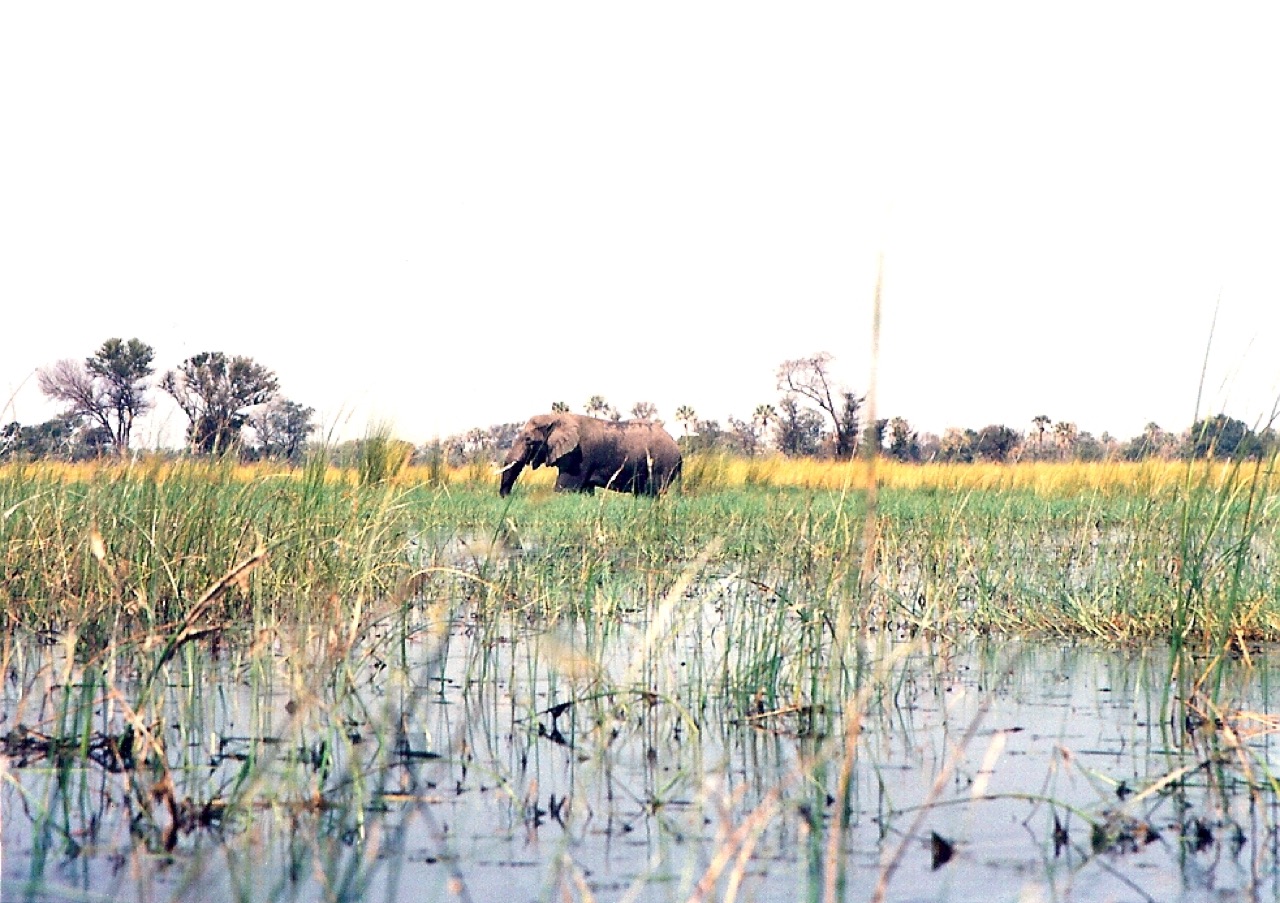
The Okavango’s seasonal flood pulse supports channels, reed beds, islands and floodplains in an otherwise dry region. Moremi Game Reserve protects part of this wetland mosaic. Chobe National Park in the north is well known for elephants, while the Central Kalahari Game Reserve protects extensive dryland habitats. Botswana is an important stronghold for African savanna elephants and African wild dogs, although populations move across borders and estimates depend on survey dates and methods.
Summer rain can bring water and birdlife to the Makgadikgadi pans, including flamingos when conditions are suitable. Zebra migrations link seasonal grazing areas; dry salt flats and flooded wetlands are different phases of the same landscape. Kgalagadi Transfrontier Park is shared with South Africa. Conservation involves people as well as animals: water use, veterinary fences, livestock livelihoods, tourism and Indigenous land rights can create competing needs. No single natural barrier guarantees protection for the delta.
Food & Cuisine of Botswana
Seswaa, bogobe, leafy morogo and foods that vary with place.
- What is seswaa?
- Slow-cooked meat that is pounded or shredded, often served with porridge.
- Are phane actually worms?
- No. They are the edible caterpillars of the mopane moth.
- Is morogo one particular vegetable species?
- No. The term covers a range of edible leafy greens.
More about Botswana: food & cuisine
Seswaa is slow-cooked meat, commonly beef, pounded or shredded after cooking and often served at communal occasions. Bogobe is a thick porridge made from grains such as sorghum or maize and eaten with meat, vegetables or other accompaniments. Dikgobe combines beans or other pulses with grain. Morogo describes edible leafy greens rather than one single botanical species. Ingredients and recipes vary with region, season and household.
Madila is soured or fermented milk, while phane are edible mopane caterpillars, often dried for later preparation. They are insects, despite the common English name “mopane worms”. Kalahari melons have provided moisture and food in dry environments, though availability varies. Sorghum also goes into traditional fermented drinks. Botswana’s food includes contemporary town meals, market cooking and regional exchanges as well as dishes commonly presented as national traditions.
Landmarks of Botswana
Tsodilo’s rock art, the Okavango and salt-pan landscapes.
- What are Botswana’s two World Heritage properties?
- Tsodilo and the Okavango Delta.
- Why is Tsodilo culturally significant?
- Its extensive rock art and continuing spiritual associations form a major cultural landscape.
- When did Kazungula Bridge open?
- In May 2021, linking Botswana and Zambia across the Zambezi.
More about Botswana: landmarks
Botswana has two UNESCO World Heritage properties: Tsodilo, inscribed in 2001, and the Okavango Delta, inscribed in 2014. Tsodilo’s hills contain more than 4,500 recorded rock paintings and retain spiritual importance for local communities. The paintings belong to a cultural landscape, not an abandoned city. The delta is a natural wetland property whose flood processes and wildlife are central to its significance.
Makgadikgadi’s pans, Kubu Island’s rocky outcrop and the baobabs painted by Thomas Baines near Nxai Pan offer different ways to read the dry interior. In Gaborone, the Three Dikgosi Monument commemorates the 1895 delegation to Britain. The Kazungula Bridge across the Zambezi opened in May 2021, connecting Botswana and Zambia. Sight pins for parks and broad landscapes are representative learning locations, not park gates or precise boundaries.
People & Society of Botswana
Batswana citizenship, varied community identities and public figures.
- How many people did the 2022 census count?
- 2,359,609; this is the census total for 2022, not a current estimate.
- Does Batswana refer only to ethnic Tswana people?
- In national usage it can refer to all Botswana citizens, whatever their ethnic background.
- What did Letsile Tebogo win at Paris 2024?
- The men’s 200-metre Olympic title.
More about Botswana: people & society
Botswana’s 2022 population census counted 2,359,609 people. This is a dated census total, not a current estimate. Settlement is uneven: the eastern corridor and centres such as Gaborone and Francistown contrast with sparsely settled areas of the Kalahari. Maun and Kasane connect northern communities with tourism and regional transport. Rural and urban households are linked through work, education, family and mobility.
Batswana is used for the country’s citizens collectively, while Motswana refers to one person. Tswana, Kalanga, San, Kgalagadi, Wayeyi, Hambukushu, Herero and other identities reflect distinct histories and languages, with no single way of life defining everyone. Bessie Head made Serowe an important literary setting. Public figures include first president Seretse Khama, 1999 Miss Universe Mpule Kwelagobe, world 400-metre champion Amantle Montsho and Letsile Tebogo, who won the men’s 200 metres at the Paris 2024 Olympics.