Facts about Cameroon
Explore Cameroon from the Wouri estuary and Atlantic coast to the western highlands, Adamawa Plateau, northern savannas and southeastern forests. Twelve cities and towns, ten heritage and landscape locations and ten illustrated topics connect places with history and everyday life.
- Capital
- Yaoundé
- Area
- About 475,000 km²
- Official languages
- English and French
- Currency
- Central African CFA franc (XAF)
- Independence
- 1 January 1960
- Southern Cameroons joined
- 1 October 1961
Cameroon · 0 of 20 rounds passed
Two timed rounds per topic, 20 seconds a question
Yaoundé is the inland capital, Douala a major commercial port and Kribi a coastal port farther south. Buea lies below Mount Cameroon, while Bamenda, Bafoussam and Foumban introduce the western highlands.
Ngaoundéré stands on the Adamawa Plateau; Garoua and Maroua lead north toward the Benue and Lake Chad basins. Bertoua is an eastern regional centre, beyond which rainforest landscapes extend toward the Sangha.
Geography of Cameroon
An Atlantic coast, volcanic highlands, forest plateaus and the Lake Chad basin.
- Is Douala the capital of Cameroon?
- No. Yaoundé is the national capital; Douala is a major commercial and port city.
- Which ocean borders Cameroon?
- The Atlantic Ocean, through the Gulf of Guinea in the southwest.
- What does “Africa in miniature” mean?
- It is a nickname for Cameroon’s diverse landscapes, not a claim that every African environment occurs there.
More about Cameroon: geography
Cameroon covers about 475,000 square kilometres at the meeting of western and central Africa. Its southwestern coast faces the Gulf of Guinea, part of the Atlantic Ocean. Nigeria lies to the west; Chad, the Central African Republic, the Republic of the Congo, Gabon and Equatorial Guinea complete its six land neighbours. Yaoundé, the capital, lies inland among hills. Douala stands on the Wouri estuary and is a major commercial and port city; Kribi is another important port farther south.
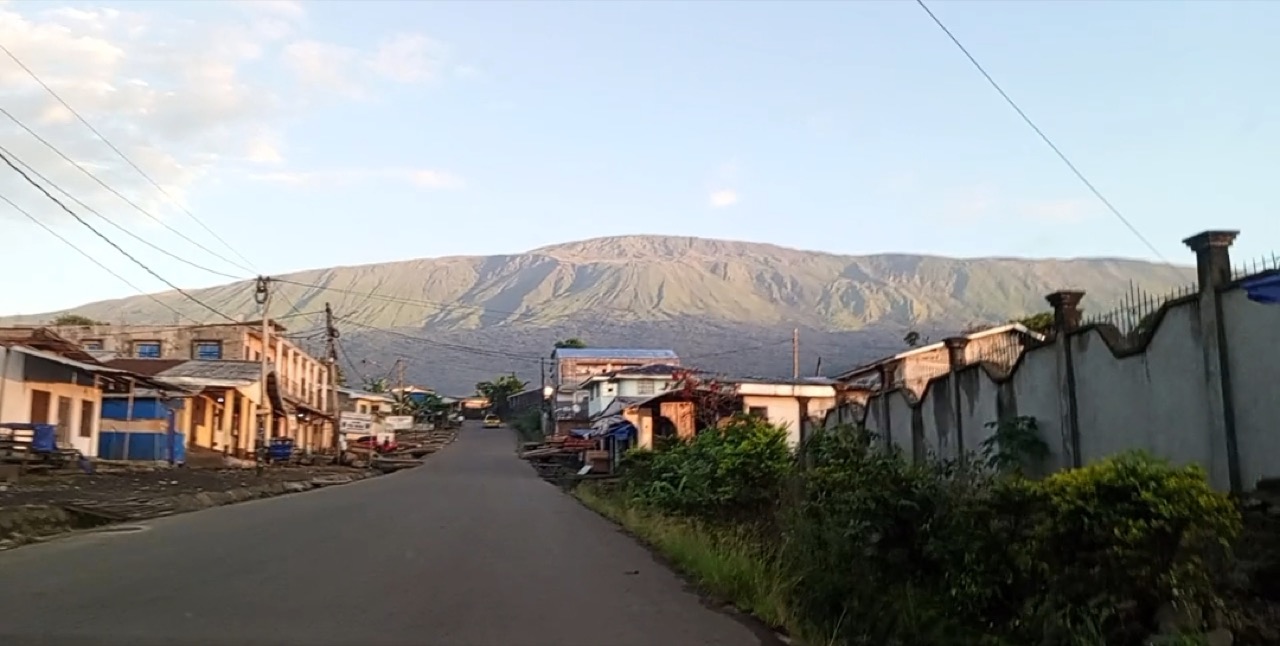
The country’s nickname, “Africa in miniature”, describes its varied landscapes rather than a literal collection of every African ecosystem. Mount Cameroon is an active volcano near Buea, rising above 4,000 metres. The western highlands lead toward the Adamawa Plateau, while southern and eastern forests form part of the Congo Basin. Farther north, savannas and the Mandara Mountains approach the seasonally changing waters and wetlands of the Lake Chad basin. The Sanaga flows toward the Atlantic, while the Benue connects northern Cameroon with the Niger River system.
History of Cameroon
Kingdoms, German rule, divided administration and the 1961 federation.
- When did French-administered Cameroon become independent?
- On 1 January 1960.
- Did all British Cameroons join Cameroon in 1961?
- No. Southern Cameroons joined Cameroon; Northern Cameroons joined Nigeria.
- What changed in 1972?
- A unitary state replaced the federal structure established in 1961.
More about Cameroon: history
Cameroon’s history long predates its modern borders. Grassfields kingdoms and chiefdoms, including Bamum around Foumban, developed political institutions, court arts and trading networks. Fulani-led emirates expanded in the north in the nineteenth century. Coastal Duala communities connected inland and Atlantic commerce. Portuguese sailors called the Wouri Rio dos Camarões, “river of prawns”, a name from which Cameroon eventually developed. Germany established the colony of Kamerun in 1884; conquest, forced labour and resistance accompanied colonial rule.
After Germany’s defeat in the First World War, France and Britain administered separate League of Nations mandates, later UN trust territories. French-administered Cameroon became independent on 1 January 1960 under Ahmadou Ahidjo. In the 1961 UN-supervised plebiscites, British Southern Cameroons voted to join the Republic of Cameroon, while Northern Cameroons voted to join Nigeria. Southern Cameroons joined on 1 October 1961 in a federal republic. A 1972 referendum replaced the federation with a unitary state. These distinct colonial and legal histories remain relevant to debates about language, education and representation.
English, French and Cameroon’s many languages
Official French and English within a much wider multilingual society.
- Which languages are official?
- English and French have equal official status under Article 1 of the constitution.
- Is Camfranglais the same as Cameroonian Pidgin English?
- No. They are distinct forms of multilingual communication.
- What does the linked language course teach?
- General French, one of Cameroon’s official languages.
More about Cameroon: language
Article 1 of Cameroon’s constitution identifies English and French as official languages with equal status and calls for the protection and promotion of national languages. Their official role reflects the French and British administrations that followed German rule. English-language education and common-law traditions are particularly associated with the Northwest and Southwest regions, but neither region is linguistically uniform. French is used widely in administration and schooling elsewhere. Official bilingualism does not mean that every resident speaks both official languages.
Hundreds of community languages are spoken. Fulfulde serves as a lingua franca across much of the north; Ewondo, Duala, Basaa and many Grassfields languages have different regional roots. Bantu languages belong to the wider Niger–Congo family, rather than accounting for all Cameroonian speech. Cameroonian Pidgin English connects speakers across language backgrounds. Camfranglais is an urban speech variety drawing on French, English and local languages, distinct from Pidgin. The linked Worldly course teaches general French; it is not a dedicated Cameroonian Pidgin, Camfranglais or community-language course.
Culture of Cameroon
Makossa, bikutsi, palace arts and living community traditions.
- Which musician recorded “Soul Makossa”?
- Manu Dibango, in 1972.
- What is Nguon?
- Bamoun rituals of governance and associated cultural expressions, recognised by UNESCO in 2023.
- Are Nguon and a World Heritage building the same type of UNESCO recognition?
- No. Nguon is intangible cultural heritage; the World Heritage List concerns cultural and natural properties.
More about Cameroon: culture
Makossa developed around Douala, combining local musical foundations with urban dance-band influences. Saxophonist Manu Dibango brought it to international audiences through “Soul Makossa” in 1972. Bikutsi has roots in Beti musical traditions of the central and southern regions and has also developed electric and popular forms. These styles are part of a broader musical landscape, alongside northern, coastal and Grassfields traditions and contemporary artists working across genres.
Foumban is associated with Bamum court arts, including carving, metalwork and the script developed under Sultan Njoya. In 2023 UNESCO inscribed Nguon, rituals of governance and associated expressions in the Bamoun community, on its Representative List of the Intangible Cultural Heritage of Humanity. Nguon includes public dialogue and accountability between the ruler and community, alongside performance and celebration. Other communities maintain their own institutions and festivals. Beaded elephant masks belong to particular Grassfields traditions; no single mask, dance or palace represents every Cameroonian community.
Economy of Cameroon
Agriculture, energy, services and ports connecting coast and interior.
- What currency does Cameroon use?
- The Central African CFA franc, code XAF.
- Which central bank is headquartered in Yaoundé?
- BEAC, the Bank of Central African States; CEMAC’s headquarters are in Bangui.
- Why are Douala and Kribi important?
- Their ports connect Cameroon and neighbouring landlocked countries with maritime trade.
More about Cameroon: economy
Agriculture supports livelihoods in very different environments: cocoa and bananas in humid areas, coffee in suitable highland zones, and cereals, cotton and livestock in parts of the north. Cassava, plantains, maize and other food crops supply domestic markets. Petroleum, timber, manufacturing, trade and public services also contribute to the economy. The aluminium smelter at Edéa is an established industrial site. These activities have different local effects; export earnings alone do not describe household livelihoods.
Douala’s estuary port and Kribi’s deep-water port connect Cameroon with overseas markets and landlocked neighbours, including Chad and the Central African Republic. Roads and the railway through Yaoundé to Ngaoundéré link coast and interior, with road connections continuing north. Cameroon uses the Central African CFA franc, currency code XAF, issued by the Bank of Central African States, BEAC, whose headquarters are in Yaoundé. This is distinct from CEMAC’s institutional headquarters in Bangui. Infrastructure gaps, regional insecurity and exposure to commodity prices affect businesses and communities.
Politics of Cameroon
A strong presidency, two parliamentary chambers and regional institutions.
- What are the two parliamentary chambers?
- The National Assembly and the Senate.
- How long is a presidential term?
- Seven years under Article 6 of the constitution as amended in 2008.
- What changed in the April 2026 constitutional amendment?
- It restored an appointed vice presidency and changed the arrangements for presidential succession.
More about Cameroon: politics
Cameroon’s constitution describes a decentralised unitary state. The president is head of state and appoints the prime minister, who heads the government. Parliament has two chambers, the National Assembly and the Senate. Under Article 6 of the constitution as amended in 2008, the presidential term is seven years and the president is eligible for re-election; the earlier limit on re-election was removed. Law No. 2026/002 of 14 April 2026 restored a vice presidency appointed by the president, changing the succession arrangements in the event of a presidential vacancy. Ten regions form part of the territorial organisation. Constitutional rules describe formal institutions, not the full experience of political participation.
Ahmadou Ahidjo was the first president of independent Cameroon, and Paul Biya succeeded him in 1982. The Cameroon People’s Democratic Movement, CPDM, was established in 1985 as successor to the Cameroon National Union; it did not exist under its current name at independence. Demands concerning language rights, courts, education and political representation in the Northwest and Southwest developed into a conflict involving state forces and armed separatists. Communities hold different political views, and civilians have suffered displacement and interrupted schooling. The Far North faces a separate security crisis linked to armed groups in the Lake Chad basin. Consult current reporting for elections and officeholders.
Nature & Wildlife of Cameroon
Rainforest, mountain habitats and northern savannas support different wildlife.
- Which park is Cameroon’s part of Sangha Trinational?
- Lobéké National Park, in the southeast.
- Is Waza a tropical rainforest park?
- No. Waza is in the northern savanna environment.
- Is the Cross River gorilla a separate species?
- It is a critically endangered subspecies of western gorilla.
More about Cameroon: nature & wildlife
Dja Faunal Reserve protects a large tropical forest landscape almost encircled by the Dja River. It was inscribed on the World Heritage List in 1987. Lobéké National Park in the southeast is Cameroon’s component of the Sangha Trinational, a transboundary World Heritage property inscribed in 2012 with protected areas in the Central African Republic and the Republic of the Congo. Forest elephants, western lowland gorillas and other species depend on these connected habitats. Conservation must also address the rights and livelihoods of neighbouring and Indigenous communities.
Waza National Park lies in the Far North’s savanna environment, unlike the southeastern rainforest. Mount Cameroon’s slopes pass through different vegetation zones with increasing altitude. The critically endangered Cross River gorilla survives in the Cameroon–Nigeria border region; it is a subspecies of western gorilla, not a mountain gorilla. The goliath frog occurs in parts of Cameroon and Equatorial Guinea. Habitat loss, hunting and pressures on rivers and forests threaten wildlife. Historical photographs and map pins describe habitats and places, not guaranteed animal sightings or present visitor access.
Food & Cuisine of Cameroon
Leafy stews, steamed bean puddings and staples that vary by region.
- What are the core ingredients of ndolé?
- Bitter leaves and groundnuts, often with fish, meat or prawns.
- What is koki?
- A steamed black-eyed-pea and palm-oil preparation, often wrapped in leaves.
- Is every Cameroonian fufu made from the same ingredient?
- No. Preparations vary, including corn fufu and cassava-based water fufu.
More about Cameroon: food & cuisine
Ndolé combines bitter leaves with groundnuts and ingredients such as fish, meat or prawns. It is strongly associated with coastal food traditions and is widely recognised as a Cameroonian dish, without being everyone’s daily meal. Eru combines forest greens with other ingredients and is especially associated with the Southwest and neighbouring areas. Koki is a steamed preparation of black-eyed peas and palm oil, often wrapped in leaves. Poulet DG combines chicken, plantains and vegetables; its name plays on “directeur général”.
Cassava, maize, plantains, rice, yams and millet appear in different local food systems. The word fufu refers to several preparations; in Cameroon, corn fufu and water fufu made from cassava are important examples. Bâton de manioc is cassava paste wrapped in leaves and cooked. Grilled fish, meat skewers and market foods connect urban life with regional produce. Palm oil gives colour and flavour to many dishes, while palm wine is tapped in some southern areas. Recipes, ingredients and eating habits vary between households, religious communities and regions.
Landmarks of Cameroon
Volcanic peaks, waterfalls, palace heritage and two World Heritage properties.
- Which waterfall landscape lies near Kribi?
- The Lobé Waterfalls, where the river reaches the Atlantic.
- Are Foumban and Bafut on the inscribed World Heritage List?
- No. They are important cultural sites, distinct from Cameroon’s two inscribed natural properties.
- What does the Reunification Monument commemorate?
- Southern Cameroons joining the independent Republic of Cameroon in 1961.
More about Cameroon: landmarks
Mount Cameroon rises near the coast above Buea and Limbe, while the Ekom Nkam waterfalls lie inland in the Littoral Region. South of Kribi, the Lobé River reaches the Atlantic through coastal falls and rapids. Rhumsiki in the Mandara Mountains is known for striking volcanic plugs. These are different geological and river landscapes; Lobé is not the world’s only waterfall flowing into the sea. Landscape pins identify representative places rather than entrances or walking routes.
Foumban’s Royal Palace connects with Bamum history, while Bafut Palace and its Achum shrine reflect a different Grassfields kingdom. Yaoundé’s Reunification Monument commemorates the 1961 union, specifically Southern Cameroons joining the independent republic. Dja Faunal Reserve and Sangha Trinational are the two inscribed World Heritage properties represented in Cameroon. Foumban and Bafut are important cultural sites, but should not be labelled inscribed World Heritage properties. Regional conflict, conservation rules and local arrangements affect access; this educational map is not an itinerary.
People & Society of Cameroon
Many communities, mobile city populations and achievements across the arts and sport.
- Does Sawa name just one uniform community?
- No. It is a broad coastal identification encompassing several peoples.
- Which literary prize did Léonora Miano win in 2013?
- The Prix Femina, for La Saison de l’ombre.
- Do all Fulani people follow one occupation?
- No. Fulani communities include people with many livelihoods and ways of life.
More about Cameroon: people & society
Cameroonian society includes many communities with overlapping histories and identities. Bamileke and Bamum communities have strong connections with the western highlands; Beti communities with parts of the centre and south; and Fulani communities with northern and other regions. Sawa is a broad coastal identification encompassing several peoples. Baka, Bagyeli and other Indigenous forest communities have distinct languages, knowledge and contemporary aspirations. No list captures every identity, and ethnicity does not determine a person’s occupation, beliefs or way of life.
Douala and Yaoundé bring together residents from across the country, while family, business and diaspora connections link cities with smaller towns and rural areas. Christianity, Islam and Indigenous religious traditions all shape social life, sometimes in overlapping ways. Footballers Roger Milla and Samuel Eto’o, musician Manu Dibango and writers such as Léonora Miano illustrate different public achievements. Miano won the Prix Femina in 2013 for La Saison de l’ombre. Everyday work in farming, teaching, trade, care and the arts is equally part of the country’s story.