Facts about Vatican City
Vatican City fits a sovereign state, a great basilica, Renaissance collections and quiet gardens inside Rome. Learn how this small territory supports the Holy See, place eight landmarks on its map, discover twelve sights and explore ten illustrated topics before beginning Italian.
- Capital
- Vatican City
- Area
- 0.44 km² · 44 hectares
- Residents, 31 December 2024
- 882
- State established
- 1929
- Everyday administration
- Italian
- Currency
- Euro (€)
- UNESCO inscription
- 1984
Vatican City · 0 of 20 rounds passed
Two timed rounds per topic, 20 seconds a question
Saint Peter’s Square opens towards Rome on the eastern side of the state. The basilica stands to its west, with the Apostolic Palace and Sistine Chapel to the north. The Vatican Museums extend farther north, while gardens and service buildings occupy much of the western ground. These are places within one city-state, rather than separate cities or provinces.
Vatican City and the Holy See are closely connected but distinct. The state provides a territorial basis for the independence of the pope and the Catholic Church’s central government. Several Holy See properties elsewhere in Rome and at Castel Gandolfo enjoy treaty protections while remaining outside Vatican City. Sight pins identify places to learn about; museum collections, private offices and gardens have different access arrangements.
Geography of Vatican City
A landlocked enclave on Vatican Hill, entirely surrounded by Rome.
- Is Vatican City part of Italy?
- It is a sovereign state entirely surrounded by Rome, Italy.
- How large is Vatican City?
- Approximately 0.44 square kilometres, or 44 hectares.
- Is Castel Gandolfo inside Vatican City?
- No. It is outside the state, in the Alban Hills. Protected Holy See properties elsewhere are distinct from Vatican City’s territory.
More about Vatican City: geography
Vatican City occupies about 44 hectares on the right, western side of the Tiber. The river itself lies outside the state. Italy is its only land neighbour, and Rome surrounds it. Walls enclose much of the territory, but Saint Peter’s Square forms a more open eastern frontage. The small scale rewards close attention: the museum entrance on Viale Vaticano is a different destination from the entrance to the basilica.
The square and basilica occupy the southeast, the palace and museums extend northwards, and the gardens fill much of the west. The Lateran Basilica and Castel Gandolfo belong to a different geographic story: they are protected Holy See properties outside the state. Vatican City has no provinces or separate towns. Its map game therefore uses eight representative landmark locations, with zoom available to separate nearby pins.
History of Vatican City
An ancient Christian sanctuary became a modern state through the Lateran Treaty.
- When was Vatican City State established?
- In 1929, through the Lateran Treaty signed on 11 February and effective from 7 June.
- Were the Papal States the same territory?
- No. They covered a much larger part of central Italy and ended in 1870.
- Did Vatican II create the state?
- No. The Second Vatican Council took place from 1962 to 1965, decades after statehood.
More about Vatican City: history
The Vatican’s religious history long predates its statehood. An early basilica was built under Constantine over the site traditionally associated with Saint Peter’s burial. The present basilica replaced it during the sixteenth and seventeenth centuries. Papal patronage also transformed the nearby palace, chapels and collections. The Papal States once covered a much larger territory in central Italy; they ended when Italian forces took Rome in 1870.
A prolonged dispute over the papacy’s position in unified Italy followed. The Holy See and the Kingdom of Italy signed the Lateran Treaty on 11 February 1929, establishing Vatican City State; it took effect on 7 June. The new state secured the Holy See’s independence rather than restoring the old Papal States. The Second Vatican Council, held from 1962 to 1965, was a council of the Catholic Church, distinct from the creation of the territorial state.
Language of Vatican City
Italian in daily work, Latin in Church traditions and many international voices.
- Is Latin the everyday language of Vatican City?
- Italian is widely used in daily work and administration. Latin has a particular role in the Holy See’s traditions, documents and worship.
- Which language do the linked lessons teach?
- Italian. They introduce everyday language rather than Latin liturgy.
- What does grazie mean?
- Thank you, in Italian.
More about Vatican City: language
Italian is widely used in Vatican City’s administration, public information and everyday work. Latin has a special place in the Holy See’s documents, worship and historical scholarship. A Latin inscription on a building does not imply that staff speak Latin to one another throughout the day. The state’s laws and the Church’s international communications also show why “the language of the Vatican” needs a little context.
Clergy, employees, researchers and visitors bring many languages into this small space. The Vatican Library preserves manuscripts across languages and centuries, while modern Church communications address audiences around the world. This guide links to existing Italian lessons: buongiorno is a greeting, grazie means thank you and per favore means please. Those lessons introduce Italian rather than Latin liturgy or the language of every international community working here.
Culture of Vatican City
Working religious spaces also preserve extraordinary art and architecture.
- Who painted the Sistine Chapel ceiling?
- Michelangelo, completing it in 1512. His Last Judgement on the altar wall was completed later, in 1541.
- What does white smoke mean during a conclave?
- That a new pope has been elected.
- Who designed the colonnades of Saint Peter’s Square?
- Gian Lorenzo Bernini.
More about Vatican City: culture
The Sistine Chapel combines religious ceremony with major works of Renaissance painting. Michelangelo completed its ceiling in 1512 and the Last Judgement on the altar wall in 1541. Earlier frescoes by other artists remain part of the chapel’s story. The Raphael Rooms belong to a different suite in the Apostolic Palace. The Vatican Museums bring these spaces into a much wider collection of sculpture, painting and objects from different societies.
Catholic worship shapes the calendar through Christmas, Easter and other feasts. Papal ceremonies can fill Saint Peter’s Square, whose colonnades were designed by Gian Lorenzo Bernini. A conclave elects a pope, with white smoke announcing a successful election. The chapel, basilica and square retain religious functions alongside their artistic importance. Check official arrangements before visiting: ceremonies, conservation and access requirements can affect which spaces are available.
Economy of Vatican City
Museum admissions, services and collectible issues support a very unusual state.
- Does Vatican City use the euro?
- Yes, through a monetary agreement with the European Union. It is not an EU member.
- Are Vatican euro coins printed?
- Coins are minted. Vatican City can issue coins with national designs under the agreement’s conditions.
- Are the state’s finances the finances of the entire Catholic Church?
- No. Vatican City, the Holy See and Catholic organisations worldwide have distinct financial responsibilities.
More about Vatican City: economy
Museum admissions, visitor services and the sale of stamps and coins contribute to Vatican City’s state activities. Conservators, gardeners, security staff and maintenance teams help keep a small territory working while caring for collections of international importance. Vatican City’s budget, the Holy See’s finances and the resources of Catholic organisations worldwide describe different institutions; they should not be combined into a single measure of national wealth.
The state uses the euro under a monetary agreement with the European Union, although it is not an EU member. It can issue euro coins with its own national designs subject to the agreement’s conditions. Coins are minted rather than printed. The agreement also brings obligations, so euro use does not mean exemption from every European financial rule. Vatican postal issues provide another familiar expression of state identity.
Politics of Vatican City
The pope is sovereign; the Governorate administers the territorial state.
- Are Vatican City and the Holy See the same?
- Vatican City is the territorial state. The Holy See is the Catholic Church’s central governing authority and conducts its international diplomacy.
- Which Fundamental Law replaced the 2023 law?
- The Fundamental Law issued by Leo XIV on 31 July 2026.
- Is Vatican City a United Nations member?
- No. The Holy See has held permanent observer status since 1964; it is distinct from a UN member state.
More about Vatican City: politics
Vatican City is an elective monarchy whose sovereign is the pope. The Fundamental Law issued by Leo XIV on 31 July 2026 replaced the 2023 law. It affirms the pope’s legislative, executive and judicial authority. The Pontifical Commission exercises legislative functions under that authority; its president also heads the Governorate, which administers the state. This is a different role from the Holy See’s Secretary of State.
The Holy See is the Catholic Church’s central governing authority and conducts its international diplomacy. It has held permanent observer status at the United Nations since 1964; it is not a UN member state. Vatican City is the territory that supports its independence. The Roman Curia, the Governorate and the College of Cardinals have different responsibilities. During a vacancy of the papal office, special provisions maintain continuity until a new pope is elected.
Nature & Wildlife of Vatican City
Cultivated gardens and an urban hill landscape behind the monumental frontage.
- How much of the state do the gardens occupy?
- Approximately 22 hectares, about half of Vatican City.
- When did the Vatican Gardens develop?
- Their origins are associated with Nicholas III in the late thirteenth century, with many changes by later popes.
- Can visitors freely walk into the gardens?
- Garden visits require specific booking arrangements through the Vatican Museums. Check the official visitor information.
More about Vatican City: nature & wildlife
The Vatican Gardens cover approximately 22 hectares, about half of the state. Their development is associated with Nicholas III in the late thirteenth century and continued under later popes. Formal planting, trees, lawns, fountains and small buildings create a managed landscape for rest and reflection. The Casina Pio IV, a Renaissance garden building, illustrates how architecture and planting developed together.
This is urban green space within Rome, with generally hot, dry summers and wetter cool seasons. It is not a wilderness reserve or a system of national parks. Garden visits require specific arrangements through the Vatican Museums. Environmental work also concerns buildings, energy, transport and water: solar installations on the Paul VI Hall are one example. A papal environmental teaching such as Laudato si’ addresses a worldwide audience rather than describing only the ecology of these gardens.
Food & Cuisine of Vatican City
Roman cooking and an international workforce, rather than a separate national cuisine.
- Does Vatican City have a separate national cuisine?
- Its everyday food is closely connected with Rome and Italian cooking, alongside international tastes.
- What is cacio e pepe?
- A Roman pasta dish with Pecorino Romano cheese and black pepper.
- Did panettone originate in Vatican City?
- No. It comes from the Milanese tradition and became a widely shared Christmas food.
More about Vatican City: food & cuisine
Vatican City’s everyday food is closely connected with Rome and wider Italian cooking. Pasta, vegetables, bread and coffee belong to this shared setting. Cacio e pepe combines pasta with Pecorino Romano and black pepper; carbonara uses egg, cheese and cured pork. These are Roman dishes enjoyed in the surrounding city, rather than foods invented within Vatican City. The international community also brings varied personal and regional tastes.
The Catholic calendar influences food through feasts, fasting and abstinence, although practices depend on Church rules and local circumstances. Panettone originated in the Milanese tradition and became a widely shared Christmas food. Museum refreshment facilities serve visitors, while employee shops and dining facilities have separate purposes and access rules. When planning a meal, distinguish the museums’ visitor services from restaurants in the neighbouring Roman districts of Borgo and Prati.
Landmarks of Vatican City
The basilica, Bernini’s square and museum rooms each tell a different story.
- Is the Sistine Chapel inside Saint Peter’s Basilica?
- No. It belongs to the Apostolic Palace and is visited through the Vatican Museums.
- Is Saint Peter’s the cathedral of Rome?
- No. The cathedral is Saint John Lateran, outside Vatican City.
- Are the Library and museums the same institution?
- No. The Vatican Library is a research institution with separate access requirements.
More about Vatican City: landmarks
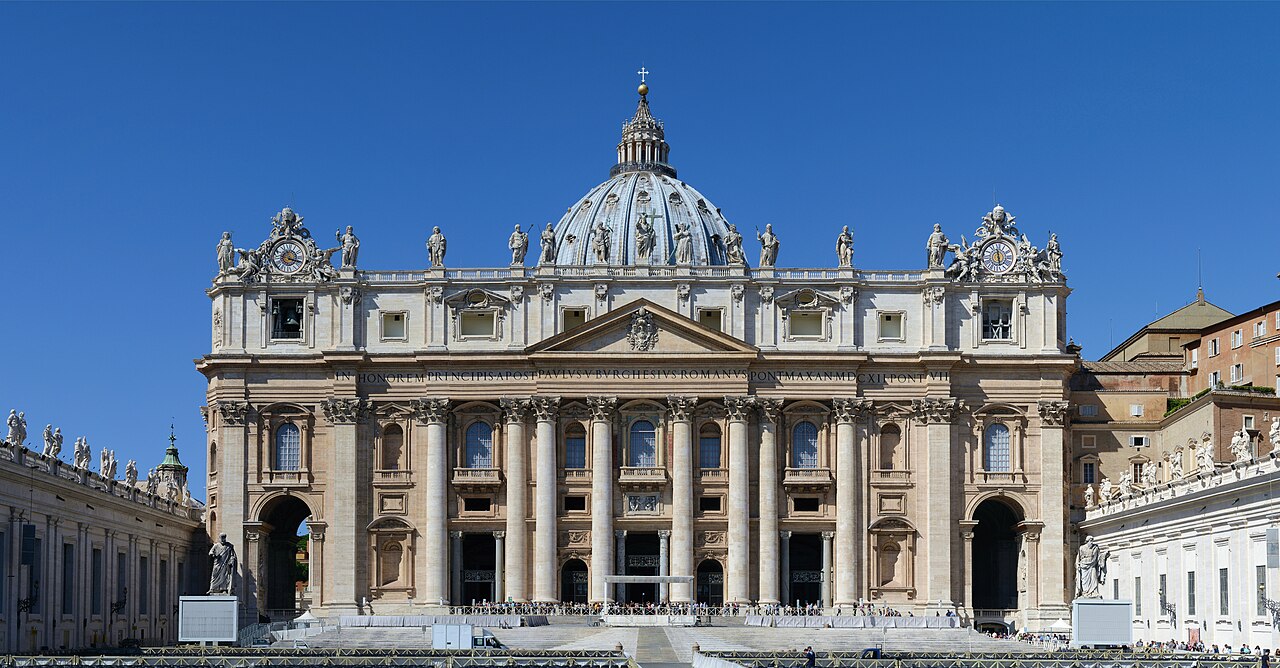
Saint Peter’s Basilica dominates the square, with a dome developed from Michelangelo’s design and a façade by Carlo Maderno. Bernini’s colonnades frame the approach. The obelisk in the square came to Rome in antiquity and was moved to its present position under Sixtus V. Despite its prominence, Saint Peter’s is not the cathedral of the bishop of Rome: that is Saint John Lateran, outside Vatican City.
The museum route includes the Sistine Chapel, Raphael Rooms and Gallery of Maps. The Library is a research institution with its own access requirements. The Governorate Palace stands behind the basilica near the gardens. The guide’s twelve sights include collections and institutions as well as buildings; their pins mark representative locations. They do not establish a walking route, promise public entry or replace the museums’ official visitor map.
People & Society of Vatican City
Residents, citizens, commuters and pilgrims make up different populations.
- How many people live in Vatican City?
- The Governorate recorded 882 residents on 31 December 2024, including citizens and non-citizens.
- Did Michelangelo design the modern Swiss Guard uniform?
- No. The familiar modern ceremonial uniform was introduced under Jules Repond in 1914.
- Are all workers Vatican residents?
- No. Many employees commute from Italy. Residents, citizens and the workforce are different populations.
More about Vatican City: people & society
The Governorate records 882 residents, including citizens and non-citizens, on 31 December 2024. That is a dated resident count, separate from citizenship totals, employees commuting from Italy and the much larger flow of visitors. Vatican citizenship is generally connected with service or office and is governed by specific rules. Birth or a tourist visit does not automatically create a right to citizenship or residence.
Clergy and religious communities work alongside lay professionals in conservation, administration, security and services. Julius II established the Pontifical Swiss Guard in 1506 to protect the pope; the Gendarmerie performs state policing duties. The Guard’s familiar modern ceremonial uniform was introduced under commandant Jules Repond in 1914, despite a persistent attribution to Michelangelo. The small resident community should therefore be understood through its varied roles rather than as a population made up entirely of clergy.