Facts about San Marino
Explore San Marino from the towers of Mount Titano to the market square of Borgo Maggiore and the nine castelli. Locate every municipality centre, discover twelve sights, read ten illustrated topics and begin Italian.
- Area
- About 61 km²
- Municipalities
- 9 castelli
- Capital
- Città di San Marino
- Official language
- Italian
- Currency
- Euro (€)
- Heads of state
- 2 Captains Regent
San Marino · 0 of 20 rounds passed
Two timed rounds per topic, 20 seconds a question
Mount Titano and the capital occupy the centre of the country, with Borgo Maggiore below the northwestern slope. Serravalle and Dogana lie towards Rimini in the northeast. Acquaviva is to the west, Chiesanuova to the southwest, Fiorentino and Montegiardino to the south, and Domagnano and Faetano towards the east. Roads and valleys connect these settlements to surrounding Italy.
Start with the nine castello centres, then explore the twelve sight pins. The towers, basilica and public palace cluster around the historic capital; the market square and Sanctuary of Valdragone are below it. The country has no separate coast or major lake district, so its map focuses on the municipalities. Italian lessons complement the reading about local language and culture.
Geography of San Marino
Nine castelli, a limestone ridge and one neighbour on every side.
- Is San Marino part of Italy?
- No. It is an independent republic completely surrounded by Italy.
- What are the nine castelli?
- They are the nine municipalities. The map teaches their main settlement locations rather than their boundaries.
- Is Dogana a separate castello?
- No. Dogana is a settlement in Serravalle.
More about San Marino: geography
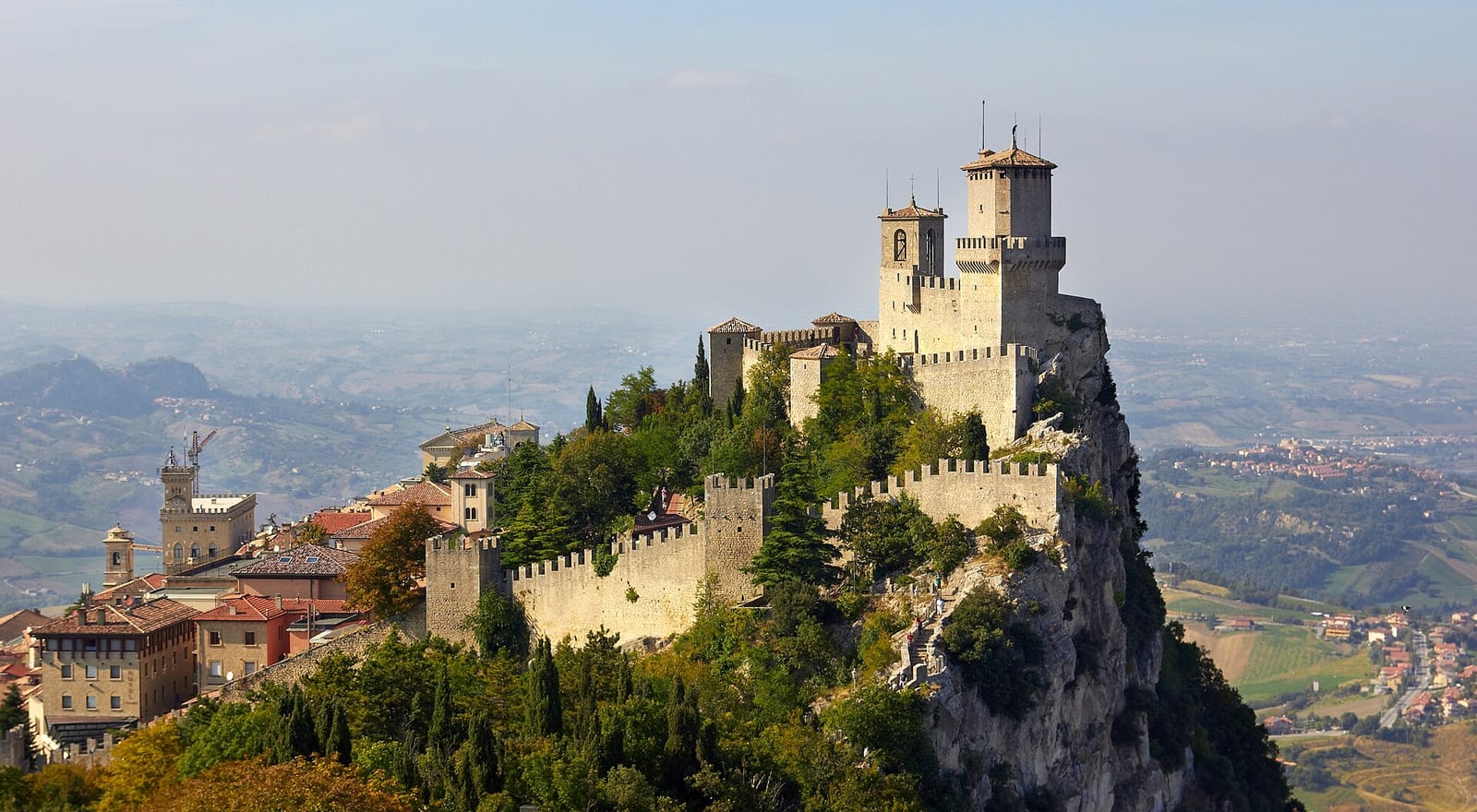
San Marino is a landlocked republic of about 61 square kilometres, entirely surrounded by Italy. It lies near the Adriatic coast between the Italian regions of Emilia-Romagna and Marche, but has no coastline of its own. Mount Titano rises to about 739 metres and carries the historic capital and its three towers. On clear days the views reach the Adriatic; seeing the sea does not mean the country touches it.
The nine municipalities are called castelli: Città di San Marino, Borgo Maggiore, Serravalle, Acquaviva, Chiesanuova, Domagnano, Faetano, Fiorentino and Montegiardino. Dogana is a settlement within Serravalle, rather than a tenth castello. Borgo Maggiore lies below the capital and is connected to it by cable car. The guide’s map pins mark settlement centres, not municipal borders or territorial centroids.
History of San Marino
A traditional foundation in 301 and a republic shaped over many centuries.
- Was San Marino founded in 301?
- 301 is the traditional foundation date associated with Saint Marinus; the republic’s documented institutions developed over later centuries.
- Why is Garibaldi remembered here?
- San Marino sheltered him and his followers in 1849.
- When did San Marino join the UN?
- In 1992.
More about San Marino: history
Local tradition traces San Marino’s foundation to Marinus, a Christian stoneworker associated with the island of Rab, in present-day Croatia, and the year 301. That is a foundation tradition, rather than evidence that today’s institutions have existed unchanged since Roman times. Medieval documents and institutions offer firmer ground for tracing the republic. The joint heads of state are documented from 1243, while the statutes of 1600 remain an important part of its constitutional heritage.
Territorial expansion in 1463 brought the republic close to its present extent. Cardinal Alberoni briefly occupied it in 1739; independence was restored in 1740. San Marino sheltered Giuseppe Garibaldi and his followers in 1849 and retained its sovereignty through Italian unification. Neutrality did not spare it bombing and fighting during the Second World War. It joined the United Nations in 1992. Its history combines survival, adaptation and close relationships with surrounding Italy.
Language of San Marino
Italian in public life, with a local Romagnol heritage.
- What is the official language?
- Italian.
- What is the traditional local speech?
- A variety of Romagnol, distinct from standard Italian.
- Which language do the lessons teach?
- Everyday Italian, including greetings, numbers and useful phrases.
More about San Marino: language
Italian is San Marino’s official language and the main language of education, administration and public broadcasting. Local traditional speech belongs to the Romagnol linguistic area. Romagnol and standard Italian are related but distinct varieties; calling the local language simply “Sammarinese” can obscure that relationship. The Italian phrase Città di San Marino names the capital, while Repubblica di San Marino names the state.
The linked lessons teach everyday Italian. Buongiorno means good morning or good day, grazie means thank you and per favore means please. Castello literally means castle, but in local administration it also means a municipality. Capitani Reggenti is the plural title of the two heads of state. Italian language use and Sammarinese citizenship are separate things: sharing a language with Italy does not make San Marino part of Italy.
Culture of San Marino
Crossbows, civic ceremony and a blue-and-white national identity.
- When is San Marino’s national day?
- 3 September, the feast of Saint Marinus and the traditional foundation of the republic.
- What is celebrated on 5 February?
- Saint Agatha’s feast and the restoration of independence after Alberoni’s occupation.
- Was the San Marino Grand Prix held here?
- No. It was held at Imola in Italy.
More about San Marino: culture
The feast of Saint Marinus and the foundation of the republic are celebrated on 3 September, with civic ceremonies and crossbow traditions. Saint Agatha’s feast on 5 February recalls liberation from Alberoni’s occupation and is a different celebration. Crossbow shooting and flag displays bring medieval imagery into modern public life. The two Captains Regent take office on 1 April and 1 October, giving the civic calendar a distinctive six-month rhythm.
The white and blue flag carries the coat of arms with three towers and the motto Libertas. The State Museum and National Gallery introduce archaeology, historic art and more recent Sammarinese cultural life. Eurovision and international sport connect the country with audiences far beyond its borders. The former Formula One San Marino Grand Prix was held at Imola in Italy; the race’s name did not place the circuit inside the republic.
Economy of San Marino
Manufacturing and services alongside the visitor economy.
- Which currency does San Marino use?
- The euro, under a monetary agreement with the European Union.
- When was the EEC customs agreement signed?
- 16 December 1991. It entered into force in 2002, following interim arrangements.
- Does the economy depend only on tourism?
- No. Manufacturing, trade, finance and other services also contribute.
More about San Marino: economy
Tourism is highly visible in the capital’s shops, museums and restaurants, but San Marino also has manufacturing, commerce, finance and other services. Industrial and commercial activity is especially evident along the road corridor towards Serravalle and Dogana. Italy is central to trade and transport, and cross-border commuting links the two economies. Postage stamps and commemorative coins have a collectors’ market, without explaining the whole national economy.
San Marino uses the euro under a monetary agreement with the European Union, which permits limited issues of coins with national designs. It is not an EU member. A separate cooperation and customs union agreement with the European Economic Community was signed in 1991 and entered into force in 2002, following interim arrangements. Currency use, customs cooperation and EU membership are different relationships. Small-scale vineyards and olive growing also contribute to the local food economy.
Politics of San Marino
Two heads of state and a sixty-member elected parliament.
- Why are there two heads of state?
- The joint office of the Captains Regent reflects a long tradition of shared authority and rotation.
- How long do the Captains Regent serve?
- Six months, with terms beginning on 1 April and 1 October.
- How many members sit in parliament?
- Sixty, in the Great and General Council.
More about San Marino: politics
San Marino is a parliamentary republic with two Captains Regent serving jointly as heads of state for six months. The Great and General Council, or Consiglio Grande e Generale, elects them from among its members. The council has sixty seats and a normal five-year legislative term. The Congress of State is the executive body. The regents are therefore not a hereditary monarchy, and their short terms differ from the parliamentary electoral cycle.
The constitutional framework includes the statutes of 1600 and the Declaration of Citizens’ Rights of 1974, with subsequent amendments. Each castello has local institutions distinct from the national government. San Marino is a member of the United Nations and the Council of Europe. The Council of Europe is separate from the European Union. Close ties with Italy coexist with independent citizenship, institutions and international representation.
Nature & Wildlife of San Marino
Wooded slopes and cultivated valleys beyond the towers.
- Is Mount Titano in the Alps?
- No. It belongs to the Apennine landscape.
- Does San Marino have a coast?
- No. The Adriatic can be seen from high viewpoints, but Italy separates the republic from the sea.
- Is the UNESCO site a nature reserve?
- It is a cultural World Heritage property, inscribed in 2008; the listing does not designate the whole country as a nature reserve.
More about San Marino: nature & wildlife
Mount Titano is a limestone ridge in the Apennine landscape, with steep rock faces, wooded slopes and viewpoints over the surrounding hills. Away from the historic centre, vineyards, olive groves, fields and woodland give the country a greener character than its densely visited summit suggests. Monte Cerreto near Acquaviva offers a different setting from the tower ridge, while the Marano valley runs along the eastern side of the country.
Summers are generally warm, while the higher ground can be cold in winter and occasionally receive snow. Elevation and exposure matter even over short distances. UNESCO inscribed the San Marino Historic Centre and Mount Titano in 2008 as cultural heritage; that designation does not turn the entire country into a nature reserve. Ridge paths and rural trails offer ways to explore the landscape, with routes and conditions best checked locally.
Food & Cuisine of San Marino
Piadina, homemade pasta and a cake named for the three peaks.
- What is piadina?
- A flatbread often filled with cheese, cured meats or vegetables.
- What is Torta Tre Monti?
- A layered wafer sweet associated with Mount Titano’s three peaks, with cream and chocolate and variations in flavour.
- What are fagioli con le cotiche?
- Beans cooked with pork rind.
More about San Marino: food & cuisine
Sammarinese cooking shares much with neighbouring Romagna and Marche. Piadina is a flatbread often served with cheese, cured meats or greens. Handmade pasta, grilled meat and beans also feature, including fagioli con le cotiche, beans cooked with pork rind. Recipes vary between households and restaurants, so a familiar regional dish can be local without being exclusive to the republic.
Torta Tre Monti is a layered wafer sweet associated with the three peaks of Mount Titano, commonly combining wafers, cream and chocolate; versions differ. Bustrengo is a traditional rustic cake made with household ingredients and dried fruit. Local wine and olive oil connect the table to the cultivated hills. Sangiovese and white wines belong to that agricultural landscape. The photographed Tre Monti cake is a pistachio-flavoured version, rather than the only recipe.
Landmarks of San Marino
Guaita, Cesta and Montale follow the crest above the capital.
- What are the three towers called?
- Guaita, Cesta and Montale.
- Where is the State Museum?
- In Palazzo Pergami Belluzzi, in the historic capital.
- Can you go inside Montale?
- It is generally viewed from outside. Check official visitor information for current access arrangements.
More about San Marino: landmarks
The First Tower, Guaita, is the oldest of the three fortifications. Cesta, also called the Second Tower or Fratta, houses the Museum of Ancient Arms. Montale, the Third Tower, stands farther along the ridge and is generally viewed from outside. The Passo delle Streghe connects the area between Guaita and Cesta. These places share a ridge but have different histories and visitor arrangements.
Palazzo Pubblico faces Piazza della Libertà and houses central institutions of the republic. The present palace was inaugurated in 1894, rather than being an untouched medieval building. Nearby stand the nineteenth-century Basilica of San Marino, the State Museum in Palazzo Pergami Belluzzi, and the Church of Saint Francis beside the old gate. Borgo Maggiore’s market square lies below the capital, adding a different layer to the World Heritage setting.
People & Society of San Marino
A small republic with communities and achievements beyond its borders.
- Who won San Marino’s first Olympic medal?
- Alessandra Perilli, in women’s trap at Tokyo 2020, held in 2021.
- Who was Bartolomeo Borghesi?
- An Italian-born scholar who settled in San Marino, known for numismatics and Latin epigraphy.
- Did women first vote in 1959?
- Voting rights were recognised in 1959; women first voted in national elections in 1964.
More about San Marino: people & society
Sammarinese identity includes citizens living in the republic and communities abroad. Residents, citizens and people commuting to work are different populations. Schools, neighbourhood associations, local councils and sport sustain daily life beyond the visitor streets of the capital. Women gained voting rights in 1959 and first voted in national elections in 1964; legal recognition and the first opportunity to exercise it are different dates.
Alessandra Perilli won San Marino’s first Olympic medal, a women’s trap bronze at Tokyo 2020, held in 2021. She then won mixed-team trap silver with Gian Marco Berti, while Myles Amine won freestyle wrestling bronze. The scholar Bartolomeo Borghesi, born in Italy, made San Marino his home and became renowned for numismatics and Latin inscriptions. These stories connect a small country with international sport and scholarship.