Facts about Slovenia
Explore Slovenia from Ljubljana and the Julian Alps to the Karst, the Adriatic coast and the eastern wine-growing hills. Learn twelve statistical regions, place sixteen cities and towns, follow three rivers and find the Adriatic, discover sixteen sights, read ten illustrated topics and begin Slovenian.
- Population, Eurostat 2026
- 2,135,107
- Area, EU country profile
- 20,273 km²
- Capital
- Ljubljana
- Currency
- Euro (€)
- Official language
- Slovenian (Slovene)
- Highest point
- Triglav, 2,864 m
Slovenia · 0 of 20 rounds passed
Two timed rounds per topic, 20 seconds a question
Slovenia brings Alpine peaks, limestone plateaus, a short Adriatic coast and Pannonian plains into a small area. Ljubljana stands near the centre; Maribor and Ptuj face the Drava in the east, Koper connects the country to the sea, and the Julian Alps rise in the northwest. Italy, Austria, Hungary and Croatia are its neighbours.
Lake Bled and Postojna Cave are familiar starting points, but the country also rewards attention to eastern towns, mercury-mining heritage in Idrija, the Soča valley and the everyday streets shaped by architect Jože Plečnik. The two city-map groups are learning aids rather than administrative regions. Slovenian lessons and thirty answered questions connect the places with language, history and daily life.
Alps, Karst, Adriatic and Pannonian plains
Slovenia lies where the Alps meet the northern Adriatic, the Dinaric landscape and the Pannonian basin. It borders Italy, Austria, Hungary and Croatia. The Julian Alps occupy the northwest, the Karawanks run along part of the Austrian frontier, and the Kamnik–Savinja Alps rise north of Ljubljana. Triglav, at 2,864 metres, is the highest mountain. The short coast includes Koper, Izola and Piran on the Gulf of Trieste.
- Which countries border Slovenia?
- Italy, Austria, Hungary and Croatia. Slovenia also has a short Adriatic coast.
- What is Slovenia’s highest mountain?
- Triglav, at 2,864 metres, in the Julian Alps.
- Why is the Kras region important to geography?
- Its limestone landscapes gave their name to karst, a term for terrain shaped by the dissolution of soluble rock.
More about Slovenia: geography
Slovenia lies where the Alps meet the northern Adriatic, the Dinaric landscape and the Pannonian basin. It borders Italy, Austria, Hungary and Croatia. The Julian Alps occupy the northwest, the Karawanks run along part of the Austrian frontier, and the Kamnik–Savinja Alps rise north of Ljubljana. Triglav, at 2,864 metres, is the highest mountain. The short coast includes Koper, Izola and Piran on the Gulf of Trieste.
The Sava, Drava and Mura belong to the Danube drainage basin and ultimately the Black Sea. The Soča crosses into Italy as the Isonzo and flows to the Adriatic. Limestone in the Kras, or Classical Karst, is dissolved by water, producing caves, sinkholes and underground drainage; the region gave its name to the international term karst. Prekmurje lies beyond the Mura in the northeast, with flatter landscapes than the Alpine west.
Roman towns, Habsburg lands and independence in 1991
Roman Emona, Celeia and Poetovio stood at the sites of Ljubljana, Celje and Ptuj. Slavic settlement and the early medieval principality of Carantania belong to later chapters. Much of the territory subsequently spent centuries within Habsburg lands, but modern Slovenia was not one unchanging historic province. Carniola, Styria, Carinthia, the coastal lands and Prekmurje had different political and cultural histories.
- When did Slovenia declare independence?
- On 25 June 1991, after the December 1990 independence plebiscite.
- What was the Ten-Day War?
- The brief armed conflict following Slovenia’s declaration of independence in 1991, involving Slovenian forces and the Yugoslav People’s Army.
- Was Slovenia one historic Habsburg province?
- No. Its modern territory includes parts of several historic lands, including Carniola, Styria, Carinthia and coastal areas, with Prekmurje following a different history.
More about Slovenia: history
Roman Emona, Celeia and Poetovio stood at the sites of Ljubljana, Celje and Ptuj. Slavic settlement and the early medieval principality of Carantania belong to later chapters. Much of the territory subsequently spent centuries within Habsburg lands, but modern Slovenia was not one unchanging historic province. Carniola, Styria, Carinthia, the coastal lands and Prekmurje had different political and cultural histories.
After the First World War, much of today’s Slovenia entered the new South Slav kingdom, while western territories came under Italy. The Second World War brought occupation, persecution, resistance and internal conflict. Slovenia became one of socialist Yugoslavia’s six republics. A December 1990 plebiscite supported independence, declared on 25 June 1991; the Ten-Day War followed. European Union and NATO membership came in 2004, and the euro was adopted in 2007.
Slovenian, the dual and a rich dialect landscape
Slovenian, also called Slovene, is a South Slavic language written in the Latin alphabet, including č, š and ž. Its grammar retains a dual number for two people or things, alongside singular and plural. Numerous dialects reflect the country’s valleys and regional history. Slovenian and Slovak are distinct languages: Slovak belongs to the West Slavic group and is spoken primarily in Slovakia.
- Are Slovenian and Slovak the same language?
- No. Slovenian is South Slavic and is spoken primarily in Slovenia; Slovak is West Slavic and is spoken primarily in Slovakia.
- What is the Slovenian dual?
- A grammatical number for two people or things, used alongside singular and plural.
- What does hvala mean?
- Thank you. Dober dan means good day, and prosim can mean please.
More about Slovenia: language
Slovenian, also called Slovene, is a South Slavic language written in the Latin alphabet, including č, š and ž. Its grammar retains a dual number for two people or things, alongside singular and plural. Numerous dialects reflect the country’s valleys and regional history. Slovenian and Slovak are distinct languages: Slovak belongs to the West Slavic group and is spoken primarily in Slovakia.
The Freising Manuscripts, copied around the late tenth or early eleventh century, are the earliest surviving connected texts in an early form of Slovenian. Primož Trubar published the first printed Slovenian books in 1550. Today Slovenian is the official state language; Italian and Hungarian also have official status in the respective bilingual areas. Dober dan means good day, prosim can mean please, and hvala means thank you. The linked lessons introduce everyday standard Slovenian.
Kurenti, beekeeping and the Lipizzaner tradition
In the Ptuj area, the bell-wearing kurenti are associated with driving away winter and welcoming spring. The door-to-door rounds of the kurenti have UNESCO intangible heritage recognition. Bobbin lace-making, strongly associated with Idrija, and beekeeping are other recognised living traditions. Painted beehive panels, panjske končnice, offer a distinctive form of folk art. These practices are different kinds of heritage from a protected building or landscape.
- Who are the kurenti?
- Bell-wearing carnival figures from the Ptuj area associated with driving away winter and welcoming spring.
- What are panjske končnice?
- Painted front panels of traditional beehives, a distinctive form of Slovenian folk art.
- Why is Lipica important?
- Its stud farm, founded in 1580, is central to the history of Lipizzaner horses. The breeding traditions are shared across several countries.
More about Slovenia: culture
In the Ptuj area, the bell-wearing kurenti are associated with driving away winter and welcoming spring. The door-to-door rounds of the kurenti have UNESCO intangible heritage recognition. Bobbin lace-making, strongly associated with Idrija, and beekeeping are other recognised living traditions. Painted beehive panels, panjske končnice, offer a distinctive form of folk art. These practices are different kinds of heritage from a protected building or landscape.
Lipica, founded as a stud farm in 1580, is central to the history of Lipizzaner horses; the associated breeding traditions are shared by several European countries. Ljubljana’s theatres, galleries and music venues, Maribor’s cultural institutions and regional festivals form part of contemporary life. Poet France Prešeren is commemorated on the cultural holiday of 8 February. The anthem uses the seventh stanza of his poem Zdravljica, rather than the whole poem.
Manufacturing, a seaport and the euro
Slovenia combines services with export-oriented manufacturing. Pharmaceuticals, electrical equipment, vehicle production, machinery and other industries connect it with European supply chains. Novo Mesto is an important manufacturing centre, while Koper’s port provides a maritime route for Slovenia and its landlocked neighbours. Tourism links Alpine resorts, caves, spas, cities and the coast, alongside farming, forestry and wine production.
- What currency does Slovenia use?
- The euro, adopted on 1 January 2007 to replace the tolar.
- Which city has Slovenia’s principal commercial seaport?
- Koper, on the Adriatic coast.
- Is Slovenia’s economy based only on tourism?
- No. Services and manufacturing, including pharmaceuticals, electrical equipment and vehicles, are important alongside tourism and other activities.
More about Slovenia: economy
Slovenia combines services with export-oriented manufacturing. Pharmaceuticals, electrical equipment, vehicle production, machinery and other industries connect it with European supply chains. Novo Mesto is an important manufacturing centre, while Koper’s port provides a maritime route for Slovenia and its landlocked neighbours. Tourism links Alpine resorts, caves, spas, cities and the coast, alongside farming, forestry and wine production.
Slovenia joined the European Union on 1 May 2004 and adopted the euro on 1 January 2007, replacing the tolar. It entered the Schengen area in December 2007, a separate milestone. Germany, Italy and Austria are important economic partners, but trade rankings and income comparisons depend on the year and measure. The Krško nuclear power plant is jointly owned by Slovenian and Croatian companies, illustrating a cross-border energy connection.
A parliamentary republic with local municipalities
Slovenia is a parliamentary republic. The president is the directly elected head of state, while the prime minister leads the government. The 90-member National Assembly, Državni zbor, is the main legislative chamber; two seats represent the Italian and Hungarian national communities. The 40-member National Council, Državni svet, represents social, economic, professional and local interests and has more limited powers.
- Who leads Slovenia’s government?
- The prime minister. The directly elected president is head of state.
- What is the Državni zbor?
- The 90-member National Assembly, Slovenia’s main legislative chamber.
- Does Slovenia have 212 regions?
- No. It has 212 municipalities. Statistical regions, traditional regions and the guide’s learning groups are different categories.
More about Slovenia: politics
Slovenia is a parliamentary republic. The president is the directly elected head of state, while the prime minister leads the government. The 90-member National Assembly, Državni zbor, is the main legislative chamber; two seats represent the Italian and Hungarian national communities. The 40-member National Council, Državni svet, represents social, economic, professional and local interests and has more limited powers.
Local government is organised into 212 municipalities. Statistical regions and traditional regions such as Carniola, Styria and Prekmurje serve different purposes; Slovenia does not have a regional tier of self-government equivalent to a federal state. The city map’s two groups are simply teaching aids. EU, NATO, euro-area and Schengen membership belong to separate institutions and arrangements, even when their dates fall close together.
Alpine habitats and an underground limestone world
Triglav National Park protects a large part of the Slovenian Julian Alps, including mountain valleys and Lake Bohinj. It is Slovenia’s only national park and covers roughly four percent of the country. Regional parks, landscape parks and Natura 2000 areas are separate designations, with overlapping boundaries; adding their percentages together would give a misleading protected-area total.
- How many national parks does Slovenia have?
- One: Triglav National Park, covering roughly four percent of the country.
- What is an olm?
- A cave-dwelling salamander, also called the human fish, adapted to underground waters.
- Which river formed the Škocjan underground canyon?
- The Reka. The Škocjan Caves are a UNESCO World Heritage property.
More about Slovenia: nature & wildlife
Triglav National Park protects a large part of the Slovenian Julian Alps, including mountain valleys and Lake Bohinj. It is Slovenia’s only national park and covers roughly four percent of the country. Regional parks, landscape parks and Natura 2000 areas are separate designations, with overlapping boundaries; adding their percentages together would give a misleading protected-area total.
Karst caves support specialised life such as the olm, a cave-dwelling salamander also called the human fish. Postojna is known for its cave railway, while the UNESCO-listed Škocjan Caves contain an underground canyon carved by the Reka. Brown bears, wolves and lynx inhabit parts of the Dinaric forests. Alpine lakes, cave systems and forest reserves have different conservation rules, and a pin on a map does not identify a safe hiking route or a public cave entrance.
Potica, žlikrofi and cooking across regions
Slovenian cooking reflects Alpine, Mediterranean, Pannonian and neighbouring culinary traditions. Potica is a rolled festive pastry with fillings such as walnuts or tarragon. Štruklji are rolled dough dishes with varied fillings and sweet or savoury versions. Jota is a bean-and-sauerkraut or sour-turnip stew associated with the west; meat is common but not compulsory in every recipe.
- What is potica?
- A rolled festive pastry with fillings such as walnuts or tarragon.
- What are idrijski žlikrofi?
- Small potato-filled pasta parcels associated with Idrija, registered as a Traditional Speciality Guaranteed.
- Is jota always made with meat?
- No. It is a bean stew with sauerkraut or sour turnip; recipes may include meat or be meat-free.
More about Slovenia: food & cuisine
Slovenian cooking reflects Alpine, Mediterranean, Pannonian and neighbouring culinary traditions. Potica is a rolled festive pastry with fillings such as walnuts or tarragon. Štruklji are rolled dough dishes with varied fillings and sweet or savoury versions. Jota is a bean-and-sauerkraut or sour-turnip stew associated with the west; meat is common but not compulsory in every recipe.
Idrijski žlikrofi are small potato-filled pasta parcels associated with Idrija and registered as a Traditional Speciality Guaranteed. Kranjska klobasa is a sausage with Protected Geographical Indication status; these EU schemes are distinct. Prekmurska gibanica layers fillings including poppy seed, curd cheese, walnuts and apples. Wine-growing areas include the Vipava valley, Goriška Brda, Podravje and Posavje, while olive oil and seafood feature along the coast. Everyday diets vary between households.
Plečnik’s Ljubljana, lake views and mining heritage
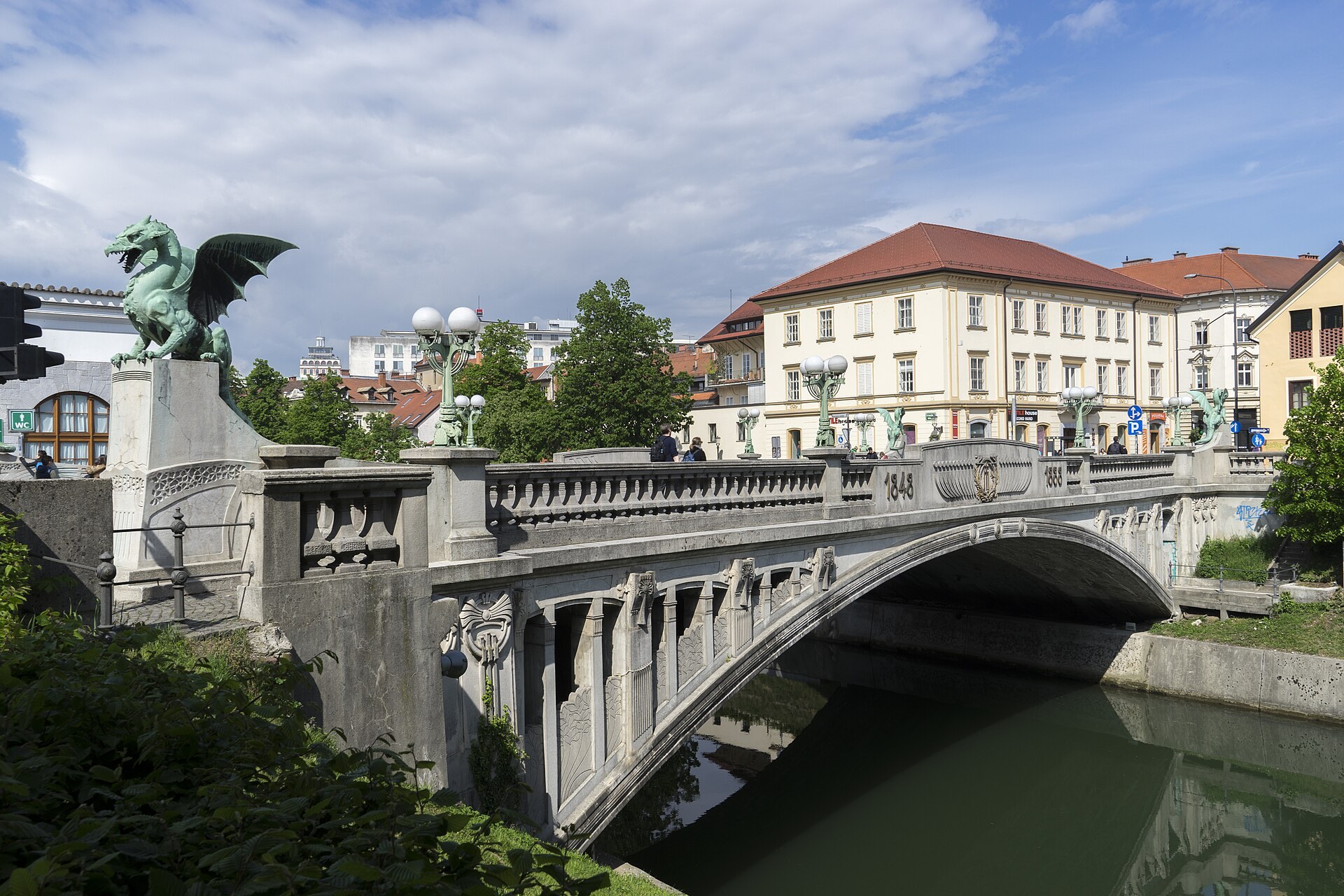
Ljubljana’s riverfront, Triple Bridge, market and other spaces show how Jože Plečnik reshaped the city for everyday public life. Selected works form a UNESCO World Heritage property. The Dragon Bridge belongs to a different architectural project and should not be credited to Plečnik. At Lake Bled, the island church and clifftop castle are separate landmarks, while Piran’s streets and Tartini Square reveal the coastal town’s Venetian connections.
- Which architect reshaped Ljubljana’s public spaces?
- Jože Plečnik. Selected works form the UNESCO property The works of Jože Plečnik in Ljubljana – Human Centred Urban Design.
- Are Lake Bled and Postojna Cave UNESCO World Heritage properties?
- Neither is itself an inscribed World Heritage property. The Škocjan Caves are listed.
- Why is Idrija a World Heritage place?
- Its mercury-mining heritage is part of the property shared with Almadén in Spain.
More about Slovenia: landmarks
Ljubljana’s riverfront, Triple Bridge, market and other spaces show how Jože Plečnik reshaped the city for everyday public life. Selected works form a UNESCO World Heritage property. The Dragon Bridge belongs to a different architectural project and should not be credited to Plečnik. At Lake Bled, the island church and clifftop castle are separate landmarks, while Piran’s streets and Tartini Square reveal the coastal town’s Venetian connections.
Predjama Castle stands against a cave mouth near Postojna. Idrija’s former mercury mine belongs to the World Heritage property shared with Almadén in Spain. Škocjan is listed for its natural cave landscape, whereas Postojna Cave and Lake Bled are not themselves inscribed World Heritage properties. Ptuj, Celje Castle, the Soča valley and the archaeological pile-dwelling sites on the Ljubljana Marshes broaden the story beyond the best-known postcard views.
Regional communities and a worldwide sporting presence
The EU country profile reports 2,135,107 residents using Eurostat’s 2026 figures. Ljubljana is the largest city, followed by Maribor. Slovenian identity coexists with regional ties, Italian and Hungarian national communities, Roma communities and people with family origins elsewhere in former Yugoslavia and beyond. Ethnicity, citizenship, religion and home language describe different things, and an old census share should not be presented as a current population estimate.
- How many people live in Slovenia?
- The EU country profile reports 2,135,107 residents using Eurostat’s 2026 figures.
- Which city is Slovenia’s largest?
- Ljubljana, the capital. Maribor is the second-largest city.
- Which minority languages have local official status?
- Italian and Hungarian have official status alongside Slovenian in the respective bilingual areas.
More about Slovenia: people & society
The EU country profile reports 2,135,107 residents using Eurostat’s 2026 figures. Ljubljana is the largest city, followed by Maribor. Slovenian identity coexists with regional ties, Italian and Hungarian national communities, Roma communities and people with family origins elsewhere in former Yugoslavia and beyond. Ethnicity, citizenship, religion and home language describe different things, and an old census share should not be presented as a current population estimate.
Roman Catholicism has an important historical presence, alongside other religious and nonreligious communities. Slovenian-speaking communities also live in neighbouring countries and in the wider diaspora. Cultural figures include writer Ivan Cankar, poet France Prešeren and architect Jože Plečnik. Cycling champions Tadej Pogačar and Primož Roglič, basketball player Luka Dončić and winter-sport athletes have brought international attention to a country with a strong tradition of outdoor recreation.