Facts about Sudan
Discover Sudan through the Nile’s great bend, Kushite pyramids, Nubian towns, Darfur’s highlands and the Red Sea coast. Explore sixteen heritage and landscape sights, ten illustrated topics and the many histories, languages and food traditions that connect Sudanese communities at home and abroad.
- Capital
- Khartoum
- Currency
- Sudanese pound (SDG)
- States
- 18
- Coast
- Red Sea
- Independence
- 1 January 1956
- UNESCO World Heritage
- 3 properties
Sudan · 0 of 20 rounds passed
Two timed rounds per topic, 20 seconds a question
Sudan lies in northeastern Africa, with Egypt to the north, the Red Sea to the northeast and South Sudan to the south. Libya, Chad, the Central African Republic, Ethiopia and Eritrea complete its neighbours. Khartoum stands where the Blue Nile and White Nile meet. Downstream, the river turns through desert landscapes before continuing into Egypt; away from it are rain-fed farming areas, grazing lands, mountains and a coral coast.
Ancient Kerma, the kingdoms of Kush and medieval Nubian cities belong to different chapters of this history. So do the sultanates of Sennar and Darfur, the Mahdist state and the struggle for independence. The war that began in April 2023 has devastated communities and cultural institutions. These pages support learning about places and people; older photographs and heritage descriptions do not establish present conditions or visitor access.
Geography of Sudan
Two Niles meet at Khartoum, with desert, savanna and a Red Sea coast beyond.
- Which rivers meet at Khartoum?
- The Blue Nile and White Nile. The combined Nile flows north towards Egypt.
- How many states does Sudan have?
- Eighteen. Disputed Abyei is not a nineteenth state in this exercise.
- Does Sudan have a coastline?
- Yes, on the Red Sea. Port Sudan and Suakin lie on this eastern coast.
History of Sudan
Kerma, Kush and medieval Nubian kingdoms precede sultanates and the modern state.
- Were Kush and ancient Egypt the same kingdom?
- No. They had distinct histories, although they interacted closely and Kushite rulers governed Egypt during its Twenty-fifth Dynasty.
- When did Sudan become independent?
- On 1 January 1956, following the Anglo-Egyptian condominium.
- When did South Sudan become a separate country?
- On 9 July 2011. It should not be included in maps or population totals for present-day Sudan.
Arabic and Sudan’s other languages
Sudanese Arabic connects many communities alongside Nubian, Beja, Fur and other languages.
- Does the linked Arabic course teach Sudanese Arabic?
- It introduces Modern Standard Arabic. Everyday Sudanese speech differs from the formal standard.
- Are Nuba and Nubian interchangeable terms?
- No. Nuba refers to diverse peoples and languages of the Nuba Mountains; Nubian languages are associated especially with the Nile valley.
- Which languages besides Arabic belong to Sudan?
- Examples include Nubian varieties, Beja, Fur and many languages of the Nuba Mountains and Blue Nile region. This is not an exhaustive list.
Culture of Sudan
Poetry, music, dress and hospitality take different forms across communities.
- What is a toub?
- A length of cloth wrapped as a garment, associated with many Sudanese women. Styles and occasions vary.
- What is the tambour?
- A lyre used in musical traditions of Sudan and neighbouring regions. It is different from the oud, a short-necked lute.
- Does one cultural tradition represent everyone in Sudan?
- No. Music, dress, religious practices and celebrations vary across communities and change over time.
Economy of Sudan
Farming, livestock, gum arabic, gold and port trade depend on people and infrastructure.
- What is Sudan’s currency?
- The Sudanese pound, abbreviated SDG. It is different from South Sudan’s pound, SSP.
- What is gum arabic?
- A gum collected from acacia trees, traded for uses including food production. It connects woodland management, rural livelihoods and exports.
- Why is Port Sudan economically important?
- Its Red Sea port connects Sudan with international shipping. Conflict and infrastructure conditions affect those links.
Politics of Sudan
The 2019 uprising, the 2021 coup and the war since 2023 are distinct turning points.
- What happened to the transition begun in 2019?
- The military coup of October 2021 disrupted the civilian–military transitional arrangement.
- When did the present war begin?
- In April 2023, with fighting between the Sudanese Armed Forces and the Rapid Support Forces.
- Does the states map show current military control?
- No. It shows administrative reference areas. It does not draw front lines or establish safe movement.
Nature & Wildlife of Sudan
Desert river corridors, seasonal wetlands, volcanic uplands and coral reefs.
- What habitats are associated with Dinder?
- Seasonal wetlands, river pools, grassland and woodland near the Ethiopian border.
- Why does Dungonab Bay matter to dugongs?
- Its seagrass habitats provide feeding areas. The bay is part of Sudan’s marine World Heritage property.
- Is the Sudd in present-day Sudan?
- No. The Sudd wetland is in South Sudan, which became independent in 2011.
Food & Cuisine of Sudan
Kisra, asida, bean dishes and stews connect grains with regional cooking traditions.
- What is kisra?
- A thin bread made from fermented batter, commonly using sorghum. It is often eaten with stews or sauces.
- What are the main ingredients in ful?
- Cooked fava beans, with oil, seasoning and other additions varying between recipes.
- What is karkade made from?
- Hibiscus. It can be prepared as a hot or cold drink.
Landmarks of Sudan
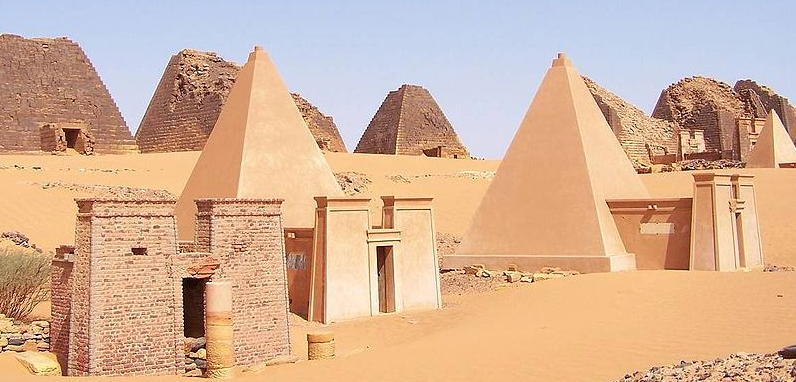
Three World Heritage properties encompass pyramid fields, temples and marine habitats.
- How many World Heritage properties does Sudan have?
- Three: the Island of Meroe sites, Gebel Barkal and the Napatan sites, and the combined Sanganeb–Dungonab Bay–Mukkawar Island marine property.
- Are Naqa and Musawwarat separate World Heritage inscriptions?
- No. They belong to the Archaeological Sites of the Island of Meroe, together with Meroë.
- Is Suakin an inscribed World Heritage property?
- No. It is on Sudan’s Tentative List. Tentative status is different from inscription on the World Heritage List.
People & Society of Sudan
Many overlapping identities and a diaspora shaped by study, work and displacement.
- Does speaking Arabic establish a Sudanese person’s ancestry?
- No. Language, community identity and ancestry overlap in different ways.
- Where do displaced Sudanese communities live?
- Both within Sudan and across borders, including neighbouring countries. Displacement is different from all migration or diaspora experience.
- Why avoid exact ethnic percentages?
- Community identities are complex, and large-scale displacement makes older estimates a poor substitute for a current census.