Facts about Serbia
Explore Serbia from Belgrade’s river confluence and Vojvodina’s plains to medieval monasteries, the Danube gorge and the forests of Tara. Learn twenty-four districts and Belgrade, place twenty-four cities, follow five rivers, discover sixteen sights, read ten illustrated topics and begin Serbian.
- Population · 2022 census, excluding Kosovo
- 6,647,003
- Capital
- Belgrade
- Currency
- Serbian dinar (RSD)
- Official language
- Serbian
- Scripts in everyday use
- Cyrillic & Latin
- Major rivers
- Danube, Sava & Morava
Serbia · 0 of 20 rounds passed
Two timed rounds per topic, 20 seconds a question
Belgrade is the capital and largest city, Novi Sad anchors Vojvodina’s northern plains, and Niš is a major centre in the south. Between them lie the Danube corridor, Šumadija’s hills, the Morava valleys and mountain country towards the west and east.
Explore the districts and Belgrade, place twenty-four selected cities and follow five rivers. Locate sixteen sights and connect them through ten topics and thirty answered questions. Continue with the existing facts quizzes and Serbian language lessons. Kosovo has its own guide and map entry on Worldly.
Plains, river corridors and mountain country
The Sava joins the Danube in Belgrade, linking Vojvodina’s northern plains with the Morava valleys and mountain country farther south. Follow the Danube east to the Iron Gates and the Drina along the western border.
- Where do the Sava and Danube meet?
- In Belgrade, below Belgrade Fortress.
- What is Vojvodina?
- An autonomous province in northern Serbia, largely in the Pannonian Plain; Novi Sad is its administrative centre.
- Does Serbia have a coast?
- No. It is landlocked; its major rivers connect to the Black Sea through the Danube.
More about Serbia: geography
Serbia is landlocked in southeastern Europe. North of the Sava and Danube, Vojvodina occupies the southern Pannonian Plain, with broad farmland and the low hills of Fruška Gora. Belgrade stands where the Sava joins the Danube. Farther south, Šumadija’s rolling country gives way to the Morava valleys and mountain ranges. Novi Sad, Kragujevac and Niš provide useful reference points for these different landscapes.
The Danube continues east through the Iron Gates, or Đerdap, along the Romanian border. The Drina forms much of the western boundary with Bosnia and Herzegovina. Serbia’s main river systems drain towards the Black Sea. This guide follows Worldly’s separate Serbia and Kosovo map entries: its city and sight pins exclude Kosovo. Kosovo declared independence in 2008; Serbia does not recognise it. The map is a learning reference, not a statement that the status dispute is settled.
From Roman cities to a modern republic
Roman cities, Nemanjić monasteries and Ottoman and Habsburg legacies overlap across Serbia. Nineteenth-century uprisings led towards autonomy and recognised independence in 1878, before the Yugoslav periods and the separate republic of today.
- When was Serbia’s independence recognised in the nineteenth century?
- At the Congress of Berlin in 1878.
- What happened to the union with Montenegro?
- Montenegro voted to leave in 2006; Serbia continued as the successor state to the union.
- Why is Studenica important?
- Founded by Stefan Nemanja in the late twelfth century, it preserves major medieval architecture and frescoes.
More about Serbia: history
Roman settlements such as Sirmium and Naissus stood on routes across the region long before the medieval Serbian state. The Nemanjić dynasty supported monasteries including Studenica, and Stefan Dušan was crowned emperor in 1346. Ottoman conquest unfolded over generations; the fall of Smederevo in 1459 ended the medieval Serbian Despotate. North of the Sava and Danube, Habsburg rule left a different political and architectural legacy.
Uprisings beginning in 1804 and 1815 led towards autonomy, followed by internationally recognised independence at the Congress of Berlin in 1878. Serbia became part of the new South Slav kingdom in 1918 and later a republic in socialist Yugoslavia. The federation’s breakup in the 1990s brought wars, displacement and grave atrocities across the region. NATO’s 1999 campaign against the Federal Republic of Yugoslavia occurred during the Kosovo conflict. The state union with Montenegro ended in 2006, leaving Serbia as a separate republic.
One language, two familiar scripts
Serbian is a South Slavic language written in both Cyrillic and Latin. Begin with dobar dan for good day and hvala for thank you, then explore a country where many community languages are also spoken.
- Which scripts does Serbian use?
- Cyrillic and Latin. Serbian and Cyrillic have constitutional official status, while Latin is widely used.
- How do you say thank you in Serbian?
- Hvala, written хвала in Cyrillic.
- Who was Vuk Karadžić?
- A nineteenth-century language reformer and collector of oral literature who helped shape modern literary Serbian.
More about Serbia: language
Serbian is a South Slavic language written in Cyrillic and Latin scripts. The constitution specifies Serbian and Cyrillic for official use, while Latin is widespread in publishing, signs and digital communication. Vuk Stefanović Karadžić helped reform literary Serbian and its Cyrillic alphabet in the nineteenth century. Standard Serbian Cyrillic has thirty letters; learning the correspondence with Latin makes many everyday signs easier to read.
Dobar dan (добар дан) means good day, hvala (хвала) means thank you and molim (молим) can mean please or you are welcome, depending on context. Serbian, Bosnian, Croatian and Montenegrin have extensive mutual intelligibility, while retaining distinct standard forms and names. Hungarian, Bosnian, Albanian, Slovak, Romanian, Romani and other languages also belong to Serbia’s communities. Worldly links to Serbian lessons for greetings, meals and getting around.
Family celebrations, dance and contemporary art
A family’s slava celebrates its patron saint, while kolo brings linked dancers together at weddings and community gatherings. Theatre, film, galleries and music add contemporary voices to these living traditions.
- What is slava?
- A family patron saint’s day celebration in Serbian Orthodox tradition.
- What is kolo?
- A collective folk dance, commonly performed by linked dancers moving in a chain or circle.
- When was Novi Sad a European Capital of Culture?
- In 2022; the title year was moved from the original 2021 schedule.
More about Serbia: culture
Slava is the celebration of a family’s patron saint in Serbian Orthodox tradition. Kolo brings linked dancers together in a chain or circle at weddings and community gatherings. UNESCO recognises both as living cultural practices; this differs from listing a monument as World Heritage. Singing to the accompaniment of the gusle, a bowed string instrument, is another recognised practice, carried by performers and oral traditions.
Culture also lives in theatres, galleries, film, literature and contemporary music. Novi Sad held the European Capital of Culture title in 2022, and Petrovaradin Fortress is one of its best-known cultural settings. Belgrade’s museums and performance spaces reflect several artistic generations. Orthodox, Catholic, Muslim, Jewish and other communities have shaped the country, with particularly visible linguistic and religious diversity in Vojvodina and the southwest.
Farms, factories and a growing services sector
Northern farms, fruit-growing districts, vehicle factories and software businesses all contribute to Serbia’s economy. Kragujevac is associated with car manufacturing and Bor with copper, while the Serbian dinar remains the national currency.
- What currency does Serbia use?
- The Serbian dinar, abbreviated RSD.
- Which city is associated with vehicle manufacturing?
- Kragujevac, in the Šumadija region.
- What is Bor known for?
- Copper mining and processing in eastern Serbia.
More about Serbia: economy
Services, manufacturing and agriculture all contribute to Serbia’s economy. Northern plains support crops such as maize, wheat and sunflower, while fruit-growing areas produce raspberries, plums and apples. Vehicle manufacturing around Kragujevac, food processing, machinery and electrical equipment connect factories with export markets. Belgrade and Novi Sad are important centres for software and other business services.
Copper mining and processing around Bor are major activities in the east. Energy production includes lignite-fired power stations and hydropower, including the Danube’s Iron Gates system shared with Romania. Serbia uses the Serbian dinar, with the currency code RSD. Trade, investment, infrastructure and environmental protection bring opportunities and competing priorities. EU accession negotiations are a political and legal process; they do not mean that Serbia already belongs to the EU or uses the euro.
Parliamentary institutions and an accession process
Serbia’s prime minister leads the government, the president is head of state and 250 deputies sit in a single parliamentary chamber. EU candidate status dates from 2012; accession negotiations opened in 2014.
- How many deputies sit in Serbia’s National Assembly?
- 250, in a single chamber.
- Who leads the government?
- The prime minister. The president is head of state.
- When did EU accession negotiations begin?
- In January 2014, after candidate status was granted in March 2012.
More about Serbia: politics
Serbia is a parliamentary republic. Its unicameral National Assembly has 250 deputies. The prime minister leads the government, while the president is head of state. Belgrade is the capital. Vojvodina has provincial institutions in Novi Sad, alongside the country’s local government system. These constitutional roles provide a more durable introduction than a list of current office-holders.
Serbia received EU candidate status in 2012 and accession negotiations opened in 2014. Normalisation of relations with Kosovo is part of that process. Kosovo’s declaration of independence is recognised by many countries and rejected by Serbia and others; avoid treating a changing recognition count as a settled fact. Worldly offers Kosovo separately, so these learning maps exclude it. City pins and the three learning groups do not depict Serbia’s administrative districts or constitutional territorial claims.
Forest refuges, wetlands and limestone gorges
Tara’s forests shelter Serbian spruce, the Uvac reserve is associated with griffon vultures, and northern wetlands support waterbirds. Mountains, grasslands and river gorges explain much of the country’s ecological variety.
- Which tree is associated with Tara?
- Serbian spruce, Picea omorika, native to a small part of the western Balkans.
- Which large bird is associated with Uvac?
- The griffon vulture, a scavenging bird of prey.
- What is Fruška Gora?
- A low mountain area and national park in northern Serbia, known for forests and monasteries.
More about Serbia: nature & wildlife
Tara’s forests above the Drina protect habitats associated with Serbian spruce, Picea omorika, a tree native to a small part of the western Balkans. Brown bears and other woodland wildlife also use the mountain landscape. Farther east, Đerdap combines wooded slopes and cliffs along the Danube, while Fruška Gora forms an island of wooded hills above the northern plain.
The Uvac reserve is known for winding river and reservoir scenery and griffon vultures. Wetlands along the Danube and Sava support waterbirds, while grasslands shelter species such as the European ground squirrel. Kopaonik and Stara Planina add higher mountain habitats. Protected landscapes have different boundaries and visitor rules; a representative map pin does not mark a walking route or guarantee access. Stay on designated routes and follow park guidance.
Pastries, peppers and regional tables
Try cheese-filled gibanica, pepper-based ajvar, bean dishes and grilled ćevapi. Regional kitchens reflect both the northern plains and the southern valleys, with fasting traditions, family recipes and shared Balkan influences.
- What is gibanica?
- A pastry commonly made with thin dough, white cheese and eggs.
- What is ajvar made from?
- Primarily peppers, often roasted; some recipes include aubergine.
- What is šljivovica?
- A plum spirit, belonging to the wider family of fruit spirits called rakija.
More about Serbia: food & cuisine
Gibanica is a pastry commonly made with thin dough, white cheese and eggs. Ćevapi and pljeskavica are familiar grilled minced-meat dishes, often served with bread and onions. Kajmak is a rich dairy food, while ajvar is a pepper-based preparation whose recipes may also include aubergine. Pasulj is a bean dish that can be prepared with meat or in a meat-free version.
Northern cooking reflects the plains and Central European connections, while southern towns such as Leskovac are associated with grilling. Orthodox fasting traditions include meals without meat, dairy or eggs, although practices and recipes vary. Plums are used for šljivovica, a type of fruit spirit, and Prokupac is a red wine grape associated with Serbia. Food traditions cross modern borders and differ between families; pork and alcohol are not universal parts of the table.
Fortresses, frescoes and Roman remains
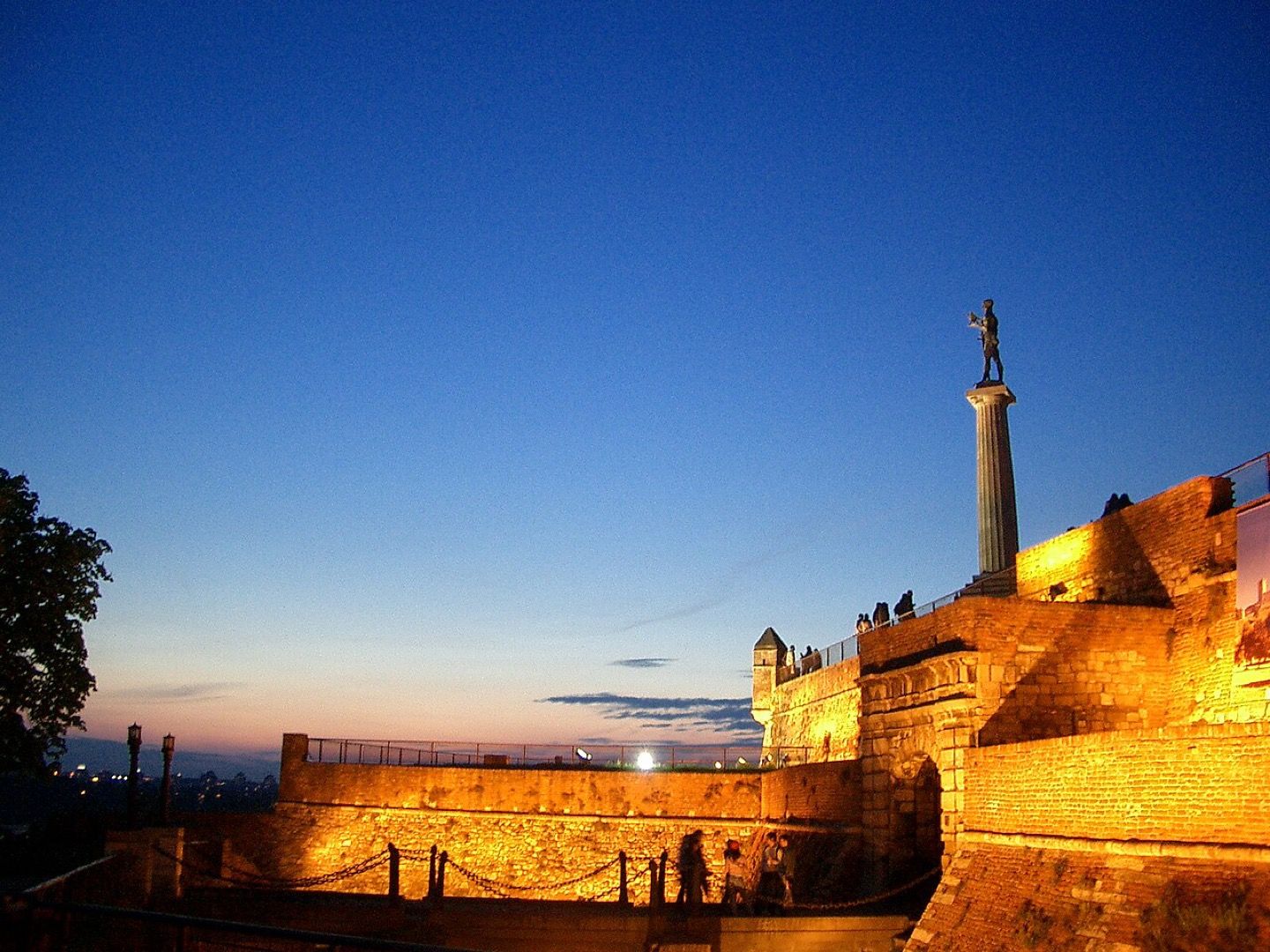
Belgrade and Petrovaradin fortresses overlook great river crossings; Studenica and Sopoćani preserve medieval frescoes. Gamzigrad-Romuliana reveals a Roman imperial complex, while Lepenski Vir reaches much further into the Danube’s prehistoric past.
- What does Belgrade Fortress overlook?
- The confluence of the Sava and Danube rivers.
- Which emperor commissioned Gamzigrad-Romuliana?
- Galerius, in the late third and early fourth centuries.
- What is Lepenski Vir?
- An archaeological site on the Danube known for prehistoric settlement remains and distinctive stone sculptures.
More about Serbia: landmarks
Belgrade Fortress overlooks the meeting of the Sava and Danube. Petrovaradin Fortress faces Novi Sad, and Golubac guards a dramatic Danube setting near the entrance to the Iron Gates. Smederevo preserves the fortified capital of the fifteenth-century Serbian Despotate. These sites tell different stories rather than representing one uniform period of Serbian history.
Studenica and Sopoćani preserve major medieval frescoes. Gamzigrad-Romuliana, commissioned by the Roman emperor Galerius, combines a fortified palace with a memorial complex. Lepenski Vir introduces a much earlier Danube settlement and carved stone figures. UNESCO’s property names and boundaries should be distinguished from individual buildings: Sopoćani belongs to the Stari Ras and Sopoćani property. Active monasteries remain places of worship, and visits should respect local rules.
Communities, migration and lives across borders
The final 2022 census counted 6,647,003 residents, excluding Kosovo. Many ethnic and linguistic communities belong to Serbia, and lives such as those of Tesla and Pupin connect local histories with places beyond modern borders.
- How many residents did the 2022 census count?
- 6,647,003. The census did not cover Kosovo; this is a dated census total rather than today’s estimate.
- Was Nikola Tesla born in present-day Serbia?
- No. He was born in Smiljan, now in Croatia, to a Serbian family, and later worked in the United States.
- Does Serbian citizenship imply one ethnic identity?
- No. Serbia has several ethnic, linguistic and religious communities.
More about Serbia: people & society
The final 2022 census counted 6,647,003 residents in its covered territory; the census was not conducted in Kosovo. This dated count is different from a current population estimate. Serbs form the majority, alongside Hungarian, Bosniak, Roma, Albanian, Slovak, Romanian, Croat, Vlach and other communities. Citizenship, ethnic identity, language and religion describe different aspects of a person’s life.
Nikola Tesla was an ethnic Serb born in Smiljan, then in the Austrian Empire and now in Croatia, who later worked in the United States. Mihajlo Pupin came from Idvor in present-day Serbia and contributed to long-distance telephony. Writer Desanka Maksimović, scientist Milutin Milanković and tennis player Novak Đoković offer other starting points for exploration. Migration and diaspora networks connect many families with life abroad, while population ageing and uneven regional development shape everyday choices.