Facts about Romania
Romania brings together the Carpathians, Transylvanian towns, the Danube Delta and the Black Sea. Explore its counties, cities, waters and sights, then connect the map with history, culture and everyday Romanian.
- Population, 2026
- About 19.0 million
- Area
- 238,398 km²
- Capital
- Bucharest
- Currency
- Leu (RON)
- Official language
- Romanian
- Highest point
- Moldoveanu, 2,544 m
Romania · 0 of 20 rounds passed
Two timed rounds per topic, 20 seconds a question
The Carpathian arc surrounds Transylvania, with Moldavia to the east, Wallachia to the south and Banat to the west. Bucharest stands on the southern plain; Constanța faces the Black Sea and Tulcea opens towards the delta. Historical regions and modern counties describe different ways of reading the country.
Learn forty-one counties and separate Bucharest, place twenty-four cities, follow five rivers and find the Black Sea. Sixteen sights, ten illustrated reading topics, thirty answered questions and ten Romanian lessons connect the map with the people and places behind it.
Geography of Romania
The Carpathian arc links Transylvania with the Danube plain and the Black Sea.
- How many counties does Romania have?
- Forty-one counties, or județe, plus the municipality of Bucharest with county-level status. Bucharest is separate from Ilfov.
- Where is Transylvania?
- In the interior of the Carpathian arc, in central and northwestern Romania. It is a historical region spanning several counties.
- What is Romania’s highest mountain?
- Moldoveanu in the Făgăraș range of the Southern Carpathians, at 2,544 metres.
More about Romania: geography
Romania lies in southeastern Europe, bordering Hungary, Serbia, Bulgaria, Moldova and Ukraine. The Carpathians curve through the country around the Transylvanian interior. The Southern Carpathians include the Făgăraș Mountains and Moldoveanu, the highest peak at 2,544 metres. Lower land spreads towards the western plain, the southern Wallachian plain and the eastern plateaus.
The Danube enters through the Iron Gates, follows much of the Bulgarian border and reaches the Black Sea through a branching delta. The Prut marks the Moldovan border; the Mureș crosses Transylvania towards Hungary. Transylvania, Wallachia, Moldavia, Banat and Dobrogea are historical or geographical regions, rather than today’s counties. The county map has 41 counties and separate Bucharest; the capital is enclosed by Ilfov but is not part of it.
History of Romania
Dacian and Roman sites, principalities and the events of 1989 mark different chapters.
- What happened in 1859?
- Moldavia and Wallachia elected the same ruler, Alexandru Ioan Cuza, beginning their political union.
- Why is Alba Iulia associated with 1918?
- An assembly there on 1 December 1918 declared the union of Transylvania with Romania. The date is Romania’s National Day.
- When did communist rule end?
- In December 1989, during the revolution that overthrew Nicolae Ceaușescu. Protests began in Timișoara and spread to Bucharest and other cities.
More about Romania: history
Trajan’s campaigns culminated in the Roman conquest of the Dacian kingdom in AD 106. Roman Dacia covered part of present-day Romania, rather than all of it. Medieval Wallachia and Moldavia developed as distinct principalities, often under Ottoman suzerainty, while Transylvania followed a different history within the Hungarian kingdom and later Habsburg rule. Vlad III, associated loosely with later Dracula stories, ruled Wallachia.
Moldavia and Wallachia chose Alexandru Ioan Cuza as their common ruler in 1859. Independence from the Ottoman Empire was internationally recognised in 1878, and Romania became a kingdom in 1881. Transylvania’s union assembly took place at Alba Iulia in 1918; the Treaty of Trianon followed in 1920. The Holocaust and wartime persecution devastated Jewish and Roma communities. Communist rule followed the Second World War; the monarchy ended in 1947. The December 1989 revolution overthrew Nicolae Ceaușescu, opening the way to multiparty politics.
Language of Romania
A Romance language with Latin spelling, distinctive diacritics and everyday phrases.
- Is Romanian a Slavic language?
- It is a Romance language descended from Latin. Contact with Slavic languages contributed vocabulary and other influences.
- What does mulțumesc mean?
- Thank you. Bună ziua is a polite daytime hello, and vă rog means please when addressing someone formally.
- What script does Romanian use?
- The Latin alphabet, including ă, â, î, ș and ț. Modern spelling differs from older Cyrillic writing traditions.
More about Romania: language
Romanian, or limba română, is a Romance language descended from Latin, related to Italian, French, Spanish and Portuguese. Contact with Slavic languages, Greek, Turkish, Hungarian and other languages has also shaped its vocabulary. It is the official language of Romania and Moldova. Romanian and Romani are different languages; Romani belongs to the Indo-Aryan branch of the Indo-European family.
Modern Romanian uses the Latin alphabet with the letters ă, â, î, ș and ț. Many definite articles attach to the end of nouns, and grammatical case distinctions survive in a reduced form. Bună ziua is a polite daytime greeting, mulțumesc means thank you, and la revedere means goodbye. Hungarian, Romani, German, Ukrainian and other languages are also spoken in Romania. The ten linked lessons introduce everyday Romanian, from greetings and numbers to ordering food and asking for help.
Culture of Romania
Spring tokens, embroidered blouses, music and film connect regional traditions.
- What is mărțișor?
- A spring custom associated with 1 March, using red-and-white threads and small gifts. Related practices are shared across the region.
- What is doina?
- An expressive, often improvised solo musical tradition recognised by UNESCO as intangible cultural heritage.
- Are the painted monasteries and wooden churches the same tradition?
- They are different. Bucovina’s monasteries are known for exterior religious paintings; Maramureș churches are known for timber construction and tall towers.
More about Romania: culture
On 1 March, mărțișor customs mark the arrival of spring with red-and-white threads and small tokens. UNESCO recognises related March practices shared by several countries. The art of making the blouse with shoulder embroidery, called altiță, is a separate intangible heritage inscription shared by Romania and Moldova. These listings recognise living practices and skills. Doina is a flexible, expressive solo musical tradition, while colinde are Christmas carols.
George Enescu combined work as a composer, violinist and conductor; the international festival bearing his name has its main home in Bucharest. Cluj-Napoca hosts the Transilvania International Film Festival, and Sibiu has a strong theatre tradition. Transylvanian Saxon fortified churches, Hungarian cultural institutions and Roma musical traditions add different histories to Romania’s cultural landscape. The painted monasteries of Bucovina and wooden churches of Maramureș represent distinct architectural traditions.
Economy of Romania
Services, vehicle manufacturing, farming and a Black Sea port connect the economy.
- Does Romania use the euro?
- It uses the Romanian leu, RON. EU membership and euro-area membership are separate.
- Where is Dacia’s Romanian production base?
- Mioveni, near Pitești in Argeș County. The brand belongs to Renault Group.
- Why is Constanța important?
- It is a major Black Sea port linked to inland transport routes, including the Danube–Black Sea Canal.
More about Romania: economy
Romania uses the leu, with currency code RON; the plural is lei. EU membership since 2007 gives it a place in the European single market, but it has not adopted the euro. Services, manufacturing and agriculture all contribute to the economy. Bucharest is a business centre, while Cluj-Napoca, Iași and Timișoara are among the cities associated with software and engineering.
Dacia’s vehicle production is associated with Mioveni near Pitești, and the automobile industry connects Romanian factories with wider European supply chains. Oil, natural gas and hydroelectricity belong to the energy mix. Agricultural landscapes include wheat, maize, sunflower and vineyards. Constanța links maritime trade with the Danube corridor. Migration has built large Romanian communities abroad, connecting households and businesses with other European countries.
Government of Romania
A semi-presidential republic with two parliamentary chambers and separate executive roles.
- What kind of republic is Romania?
- A unitary semi-presidential republic, with a president as head of state and a prime minister as head of government.
- What are the two houses of parliament?
- The Chamber of Deputies and the Senate.
- When were Schengen internal land-border checks lifted?
- On 1 January 2025. Air and sea internal-border checks had been lifted on 31 March 2024.
More about Romania: politics
Romania is a unitary semi-presidential republic. The president is head of state and the prime minister heads the government; the two offices share executive responsibilities under the constitution. Parliament has two chambers, the Chamber of Deputies and the Senate. County councils, municipalities and other local authorities handle different levels of local administration.
Romania joined NATO on 29 March 2004 and the European Union on 1 January 2007. Schengen participation began with air and sea borders on 31 March 2024; checks on persons at internal land borders were lifted on 1 January 2025. These are separate stages of accession. Bucharest is both the capital and its own county-level municipality, while Ilfov remains a separate surrounding county.
Nature of Romania
Reed beds, Carpathian forests, alpine lakes and limestone gorges support varied habitats.
- Is the whole Danube Delta inside Romania?
- The wider delta is shared with Ukraine. The UNESCO World Heritage property is in Romania; the transboundary biosphere reserve has a wider scope.
- How did Red Lake form?
- A landslide blocked a valley in 1837. Nearby Bicaz Gorge was cut through limestone by the river.
- What is Retezat known for?
- A national park established in 1935, with alpine scenery, glacial lakes and mountain forests in the Southern Carpathians.
More about Romania: nature & wildlife
The Danube Delta is a wetland mosaic of channels, lakes, reed beds and seasonally flooded land. Great white and Dalmatian pelicans are among its characteristic birds. The delta crosses the Romanian-Ukrainian border; the UNESCO World Heritage property lies in Romania, while the wider biosphere reserve is transboundary. Tulcea is a gateway city rather than a point representing the whole delta.
The Carpathians hold forests, alpine meadows and glacial lakes. Retezat became Romania’s first national park in 1935. Brown bears, wolves and lynx belong to the mountain ecosystems, but population estimates change and wildlife viewing requires care. In the Eastern Carpathians, the Bicaz River cut a limestone gorge, while nearby Red Lake formed when a landslide dammed a valley in 1837. Dobrogea’s steppe and coastal habitats differ from both the delta and high mountains.
Food of Romania
Cabbage rolls, cornmeal, sour soups and sweet holiday breads vary by region and household.
- What are sarmale?
- Stuffed cabbage or vine leaves, often filled with minced meat and rice. Recipes and meat-free versions vary.
- What is mămăligă made from?
- Cornmeal cooked with water and salt, served soft or firm with different accompaniments.
- Are mici sausages in a casing?
- They are grilled rolls of seasoned minced meat without a casing, often eaten with mustard and bread.
More about Romania: food & cuisine
Sarmale are stuffed cabbage or vine leaves, commonly filled with minced meat and rice; meat-free versions also appear. They are often served with mămăligă, a cornmeal preparation, and sour cream. Mici, also called mititei, are small grilled rolls of seasoned minced meat without a casing. Ciorbă describes a family of sour soups, including vegetable, meat and tripe versions.
Cozonac is a sweet enriched bread associated with Easter and Christmas, often filled with walnut, cocoa or other ingredients. Papanași are cheese-based dumplings, often served with sour cream and jam. Țuică is traditionally a plum spirit; pălincă can be made from several fruits, and strength varies by producer. Wine regions include Dealu Mare, Cotnari and Târnave. Romanian cooking reflects regional exchange with neighbouring Balkan, Central European and Black Sea traditions.
Landmarks of Romania
Royal residences, fortified towns, painted churches and archaeological landscapes span the country.
- Is Bran Castle securely documented as Vlad III’s home?
- Its Dracula association is largely a tourism and literary connection. Vlad III ruled Wallachia, and Bran was not his principal residence.
- What is special about Sighișoara?
- Its inhabited historic centre preserves a fortified medieval town associated with Transylvanian Saxon settlement.
- Are the two Sarmizegetusa sites the same place?
- No. Sarmizegetusa Regia was a Dacian centre in the mountains; Ulpia Traiana Sarmizegetusa was a later Roman city at a different location.
More about Romania: landmarks
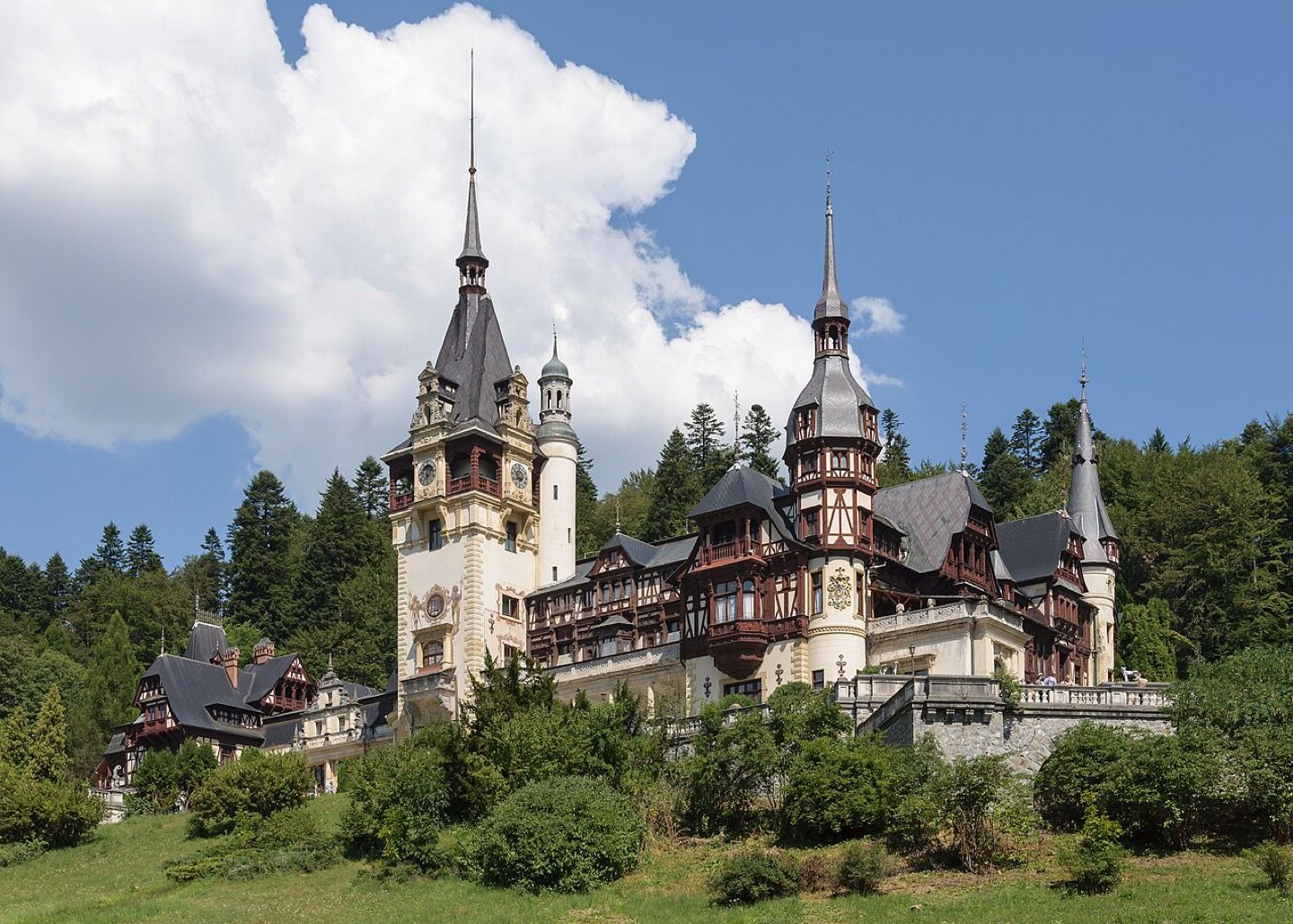
Bucharest’s Palace of the Parliament reflects the scale and disruption of Ceaușescu’s redevelopment of the capital. The Romanian Athenaeum belongs to a different era of concert life. Peleș Castle at Sinaia was built as a royal residence in the nineteenth century. Bran Castle stands southwest of Brașov; its Dracula marketing connects loosely with fiction and should not be taken as evidence that it was Vlad III’s principal residence.
Sighișoara’s historic centre and the fortified churches of Transylvania preserve aspects of Saxon urban and village history. Biertan is one of the listed fortified-church villages. Voroneț represents the painted Churches of Moldavia, and Budești is one of the UNESCO-listed wooden churches of Maramureș. Sarmizegetusa Regia was a Dacian centre, distinct from the later Roman Ulpia Traiana Sarmizegetusa. The sights game also includes Corvin Castle, Turda Salt Mine, the Iron Gates and Brâncuși’s Endless Column.
People of Romania
Sculptors, composers, writers and athletes connect Romania with a wider world.
- Where can you see Brâncuși’s Endless Column?
- In Târgu Jiu, in Gorj County. It is part of a wider monumental ensemble commemorating those who died in the First World War.
- What did Nadia Comăneci achieve in 1976?
- The first perfect 10 awarded to a gymnast at an Olympic Games, in Montreal. She received seven perfect scores during those Games.
- Did all these artists work only in Romanian?
- No. Ionesco wrote major plays in French, and Brâncuși built much of his career in Paris. Their work connects several cultural settings.
More about Romania: people & society
Constantin Brâncuși, born in Hobița, developed much of his sculptural career in Paris. His ensemble at Târgu Jiu includes the Endless Column, Gate of the Kiss and Table of Silence; it entered the UNESCO World Heritage List in 2024. George Enescu was a composer, violinist and conductor. Mihai Eminescu is a central figure in Romanian poetry, while Eugène Ionesco, born Eugen Ionescu, became a major French-language playwright associated with the Theatre of the Absurd.
At the Montreal Olympics in 1976, Nadia Comăneci became the first gymnast awarded a perfect 10 at an Olympic Games. Romania’s communities include a Romanian majority and Hungarian, Roma, German, Ukrainian, Turkish, Tatar and other minorities. Religious life includes Orthodox, Catholic, Protestant, Jewish and Muslim traditions alongside people with no religious affiliation. Migration has connected families with large communities abroad; a dated population figure is more useful than treating any estimate as permanent.