Facts about Poland
Capital Warsaw · Europe
10 topics · 20 lessons · about 20 minutes
Poland sits on the North European Plain between Germany and the eastern Slavic world, a position that has made it both a major regional power and, for 123 years, a country erased from the map entirely. Since 1989 it has gone from a collapsing planned economy to one of the fastest-growing in Europe, and it is the largest of the states that joined the European Union in 2004.
Most of the country is low and flat, sloping gently north toward a Baltic coast of dunes and sandbars, with lake districts in Masuria and Pomerania left behind by retreating ice sheets. The land rises only in the south, where the Sudetes and then the Carpathians mark the borders with Czechia and Slovakia, culminating in the sharp granite peaks of the Tatras around Zakopane. The Vistula runs the length of the country from the mountains through Kraków and Warsaw to the sea at Gdańsk.
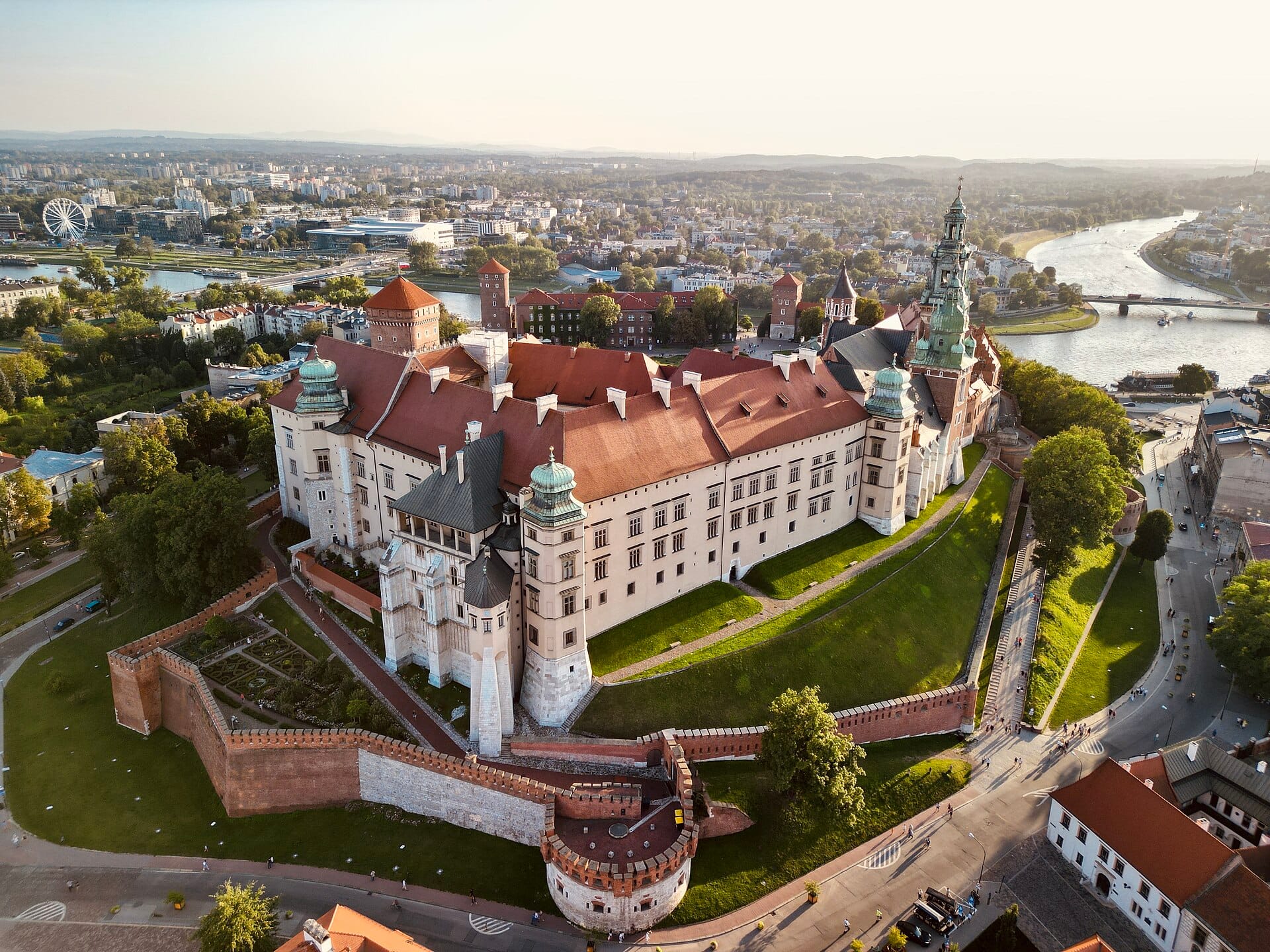
Warsaw is the capital and financial center, rebuilt almost from rubble after 1945. Kraków, which escaped that destruction, holds the royal castle and the largest medieval market square in Europe and draws the most visitors. Gdańsk on the Baltic is the historic port and the birthplace of Solidarity, Wrocław and Poznań anchor the west, and Łódź was the textile city. Auschwitz-Birkenau near Oświęcim and the Wieliczka salt mine are among the most visited sites in the country.
- Population
- 36.6 million
- Area
- 312,696 km²
- Capital
- Warsaw
- Currency
- Polish złoty (PLN)
- Official language
- Polish
- Highest point
- Rysy, 2,499 m
The Poland course
Geography of Poland2 lessons
Flat almost everywhere, with the only real mountains crowded along the southern border.
History of Poland2 lessons
A great power, then partitioned out of existence for 123 years, then rebuilt twice.
Language of Poland2 lessons
Seven cases, a famously dense consonant stack, and stress on the second-to-last syllable almost always.
Culture of Poland2 lessons
Chopin, a deeply Catholic public life, and a Polish pope who helped end communism.
Economy of Poland2 lessons
The only European economy that did not shrink in 2009, and still growing fast.
Politics of Poland2 lessons
A parliamentary republic where the president holds a veto that shapes every coalition.
Nature & Wildlife of Poland2 lessons
Europe’s last primeval lowland forest, and the bison brought back from 54 captive animals.
Food & Cuisine of Poland2 lessons
Dumplings in a dozen fillings, sour rye soup, and a hunter’s stew improved by reheating.
Landmarks of Poland2 lessons
A royal hill in Kraków, a chapel carved out of salt, and a capital rebuilt from photographs.
People & Society of Poland2 lessons
One of Europe’s most homogeneous countries, reshaped again by a million Ukrainians.
Geography of Poland
Poland covers 312,696 square kilometers between the Baltic Sea and the Carpathians, bordering Germany, Czechia, Slovakia, Ukraine, Belarus, Lithuania and the Russian exclave of Kaliningrad. Most of the territory is plain, and the average elevation is under 200 meters, which is why the country has so often been crossed by armies moving east or west.
The Vistula and the Oder are the two great rivers, both draining north to the Baltic. Glaciation left thousands of lakes across Masuria and Pomerania, and the coast is fringed by sand spits including the Hel Peninsula and the shifting dunes of Słowiński National Park. Rysy in the High Tatras, on the Slovak border, is the highest point at 2,499 meters.

History of Poland
The Polish state dates its founding to the baptism of Mieszko I in 966. Union with Lithuania created the Polish-Lithuanian Commonwealth, which by the seventeenth century was among the largest states in Europe, with an elective monarchy and a parliament whose liberum veto let a single deputy dissolve proceedings. Prussia, Russia and Austria partitioned it away entirely between 1772 and 1795.
Poland reappeared in 1918, was invaded by Germany and then the Soviet Union in 1939, and lost roughly a sixth of its population in the war, including nearly all of a Jewish community that had been the largest in Europe. Its borders were shifted west afterwards. Four decades of communist rule ended after the Solidarity movement, born in the Gdańsk shipyard in 1980, forced the partly free elections of 1989.

Language of Poland
Polish is a West Slavic language written in the Latin alphabet with diacritics including ą, ę, ł, ń, ó, ś, ź and ż. Nouns and adjectives inflect through seven cases and three genders in the singular, and verbs carry aspect, so learners meet paired forms for finished and unfinished actions rather than a simple tense system.
Clusters such as szcz and the digraph pairs cz, sz and rz give the written language its reputation for difficulty, though the spelling is fairly regular once the pairs are learned and stress falls on the penultimate syllable in almost every word. Poland is unusually uniform linguistically today, with Kashubian on the Baltic coast the main regional language and Silesian a contested case.

Culture of Poland
Catholicism is woven through the national story, and the election of Karol Wojtyła as Pope John Paul II in 1978 gave the opposition a decisive moral lift in the decade that followed. Church attendance has fallen sharply among younger Poles, and questions of religion in public life are now among the sharpest political divides.
Frédéric Chopin turned the mazurka and the polonaise into concert music and remains the central cultural figure, with a piano competition in Warsaw held every five years. Marie Skłodowska-Curie, Nicolaus Copernicus and the writers Wisława Szymborska and Olga Tokarczuk are the other names most often claimed. Name days are often celebrated more than birthdays, and Christmas Eve supper, Wigilia, is the year’s central meal.

Economy of Poland
Poland moved from central planning to a market economy through the rapid liberalisation of the early 1990s and has grown almost without interruption since, the only European Union member to avoid recession during the 2009 financial crisis. Manufacturing, especially vehicles, appliances and furniture, plus food processing, IT services and a very large logistics sector, drive output.
The country retains its own currency, the złoty, rather than adopting the euro, and remains a major recipient of European Union structural funds that have rebuilt much of its road and rail network. Coal still supplies a large share of electricity, making decarbonisation the central economic argument of the coming decade, and the labour market has shifted from exporting workers to hosting more than a million Ukrainians.

Politics of Poland
Poland is a parliamentary republic with a 460-seat Sejm and a 100-seat Senate. The president is directly elected for five years and, while mostly ceremonial, holds a veto that parliament can only override with a three-fifths majority, which regularly makes the office decisive when president and government come from opposing camps.
The country joined NATO in 1999 and the European Union in 2004. A long dispute with Brussels over judicial independence during the Law and Justice government led to funds being withheld, and the change of government in late 2023 reopened that question. Poland has become one of the largest military spenders in NATO relative to its economy and a central supply route for aid to Ukraine.
Nature & Wildlife of Poland
Białowieża Forest on the Belarusian border is the best-preserved remnant of the lowland forest that once covered the European plain, and its old growth core is a World Heritage Site. It holds the largest free-living population of European bison, a species that went extinct in the wild in the 1920s and was rebuilt from 54 animals surviving in zoos.
Wolves, lynx and brown bears live in the Carpathians, and the Biebrza marshes are among the most important wetland bird sites in Europe. Poland hosts roughly a quarter of the world’s white storks, which nest on village rooftops and utility poles, and the Masurian lakes draw sailing traffic through the summer.

Food & Cuisine of Poland
Pierogi, half-moon dumplings filled with potato and curd cheese, meat, cabbage and mushroom, or fruit in summer, are the dish most associated with the country. Bigos, a hunter’s stew of sauerkraut, fresh cabbage and assorted meats, is cooked slowly and traditionally improves each time it is reheated.
Soups matter: żurek made from soured rye flour and served with sausage and egg, barszcz of fermented beetroot drunk clear at Christmas, and cold summer chłodnik. Pork cutlet fried in breadcrumbs, kielbasa in many regional forms, cheesecake and the poppy seed roll makowiec round out the table, and vodka is distilled from both rye and potato.

Landmarks of Poland
Wawel Castle and cathedral on a limestone rise above the Vistula in Kraków were the seat and burial place of Polish kings, and the surrounding old town with its vast Main Market Square survived the war largely intact. The Wieliczka salt mine nearby has been worked since the thirteenth century and contains chapels, chandeliers and sculpture carved entirely from rock salt.
Warsaw’s Old Town is a meticulous postwar reconstruction of a district the Germans demolished after the 1944 uprising, rebuilt partly from eighteenth-century paintings and listed by UNESCO for exactly that reason. Malbork on the Nogat is the largest brick castle in the world, built by the Teutonic Knights, and the Auschwitz-Birkenau memorial is preserved as evidence of the camp system.

People & Society of Poland
Poland has around 36.6 million residents and is, by the standards of western Europe, strikingly homogeneous, a result of the border changes and population transfers that followed 1945 rather than any long-standing condition; the prewar state was multi-ethnic and multi-faith. A large diaspora lives in the United States, Germany and the United Kingdom.
That picture changed quickly after February 2022, when around a million Ukrainians settled in the country, the largest single demographic shift in decades. Birth rates are among the lowest in Europe and the population is falling, which makes pensions, healthcare staffing and migration policy the recurring domestic arguments.

Reading is one thing, recall is another. Play the Poland challenge to test what stuck. The lessons on all ten topics are open too, and a free account is what keeps your progress across them.