Facts about Oman
Explore Oman from Muscat’s harbour and the Hajar Mountains to the frankincense landscapes of Dhofar. Connect forts, oasis towns and Indian Ocean ports with the languages, food and communities that give each region its character.
- Capital
- Muscat
- Currency
- Omani rial (OMR)
- Official language
- Arabic
- Governorates
- 11
- Currency division
- 1 rial = 1,000 baisa
- UNESCO World Heritage
- 5 properties (2026)
Oman · 0 of 20 rounds passed
Two timed rounds per topic, 20 seconds a question
Oman occupies the southeastern Arabian Peninsula, sharing land borders with the United Arab Emirates, Saudi Arabia and Yemen. Its main territory stretches from the Gulf of Oman to the Arabian Sea. In the far north, Musandam overlooks the Strait of Hormuz, separated from the rest of the country by the UAE. Mountain roads lead inland from the capital to Nizwa and the high terraces of Jabal Akhdar; farther south, long distances separate the central coast from Salalah.
The country’s maritime history reaches across the Indian Ocean, while inland settlements tell stories of irrigation, farming and regional power. Bahla’s earthen fort, Bronze Age tombs and working aflaj water channels reward attention alongside the best-known landscapes. Dhofar’s summer khareef brings mist and seasonal greenery to coastal hills, a different rhythm from the dry north. Learn the regions first, then use the sights to connect places with their histories.
Geography of Oman
Northern mountains, a desert interior and monsoon-influenced Dhofar face the Indian Ocean.
- Why is Musandam separated from the rest of Oman?
- The UAE lies between Oman’s main territory and its northern Musandam exclave, which overlooks the Strait of Hormuz.
- Does the khareef affect all of Oman?
- No. Summer monsoon moisture brings cloud, drizzle and seasonal greenery to parts of Dhofar, especially its coastal hills.
- Is a wadi a permanent river?
- Not necessarily. Wadi describes a valley or watercourse, and flow can be seasonal or sudden after rain.
More about Oman: geography
The Hajar Mountains rise behind Oman’s northern coastal plain. Inland, towns and cultivated oases occupy valleys and basins before the land opens towards the Rub al Khali, or Empty Quarter. The Gulf of Oman lies off the northeast coast, and the Arabian Sea stretches along the east and south. Wadis are valleys and watercourses whose flow varies; a dry channel can carry a sudden flood after rain.
Musandam forms the country’s northern exclave at the Strait of Hormuz. Its governorate also includes Madha, a smaller Omani exclave surrounded by the UAE, with the UAE enclave of Nahwa inside it. Dhofar, at the opposite end of the country, receives summer monsoon moisture known as the khareef. This brings low cloud, drizzle and seasonal greenery to parts of the coastal hills, rather than turning every part of Oman green.
History of Oman
Copper, frankincense and ocean trade connect Bronze Age settlements with later maritime power.
- What was Magan?
- A region mentioned in Mesopotamian texts, commonly associated with copper-producing areas of present-day Oman and the UAE.
- When were Portuguese forces expelled from Muscat?
- In 1650, after taking the port in 1507.
- How does Zanzibar connect with Omani history?
- Omani maritime power extended to East Africa through commerce and rule, including Zanzibar. That history also involved the slave trade.
More about Oman: history
Bronze Age settlements, towers and tombs at Bat, Al-Khutm and Al-Ayn show that the interior participated in long-distance exchange thousands of years ago. Ancient Mesopotamian references to Magan are commonly associated with the copper-producing region of Oman and the present-day UAE. In Dhofar, frankincense linked growing areas with caravan stations and ports. These histories belong to a wider region whose boundaries differed from those of the modern state.
Portuguese forces took Muscat in 1507 and were expelled in 1650. Omani maritime power later extended to East Africa, including Zanzibar, through commerce, political rule and the slave trade. Inland imamate traditions and coastal sultans were also part of a complex political history. Sultan Qaboos ruled from 1970 to 2020, a period of major infrastructure and public-service expansion that also included the final years of the Dhofar war. Haitham bin Tarik succeeded him in 2020.
Arabic and the languages of Oman
Arabic shares a multilingual landscape with Modern South Arabian and Indian Ocean languages.
- What Arabic do the linked lessons teach?
- Modern Standard Arabic, rather than a dedicated Omani dialect course.
- Are Mehri and Jibbali dialects of Arabic?
- No. They are distinct Modern South Arabian languages within the Semitic family.
- Is Kumzari a Semitic language?
- No. Kumzari, associated with Musandam, belongs to the Iranian language family.
More about Oman: language
Arabic is Oman’s official language. Modern Standard Arabic appears in education, formal writing and news, while everyday spoken varieties differ across the country. English is widely used in business and visitor settings without being a second official language. The linked Arabic lessons introduce Modern Standard Arabic; they do not form a dedicated course in Omani dialects.
Mehri and Jibbali, also called Shehri or Shahri, are Modern South Arabian languages spoken in and around Dhofar. They are distinct Semitic languages, not dialects of Arabic. Kumzari, associated with Musandam, belongs to the Iranian language family. Balochi and Swahili reflect older maritime and family connections, while Malayalam, Urdu, Bengali and other languages are used by residents with South Asian ties. A shared nationality does not imply a single home language.
Culture of Oman
Coffee, poetry, silverwork and boatbuilding carry living skills between generations.
- What is a khanjar?
- A curved dagger associated with formal dress and special occasions. UNESCO recognises its craft skills and social practices.
- What is Al-Razfa?
- A performing tradition involving group movement and chanted poetry, shared by Oman and the UAE.
- Was Sindbad a documented resident of Sohar?
- Sindbad is a literary sailor. Associations with Sohar belong to storytelling and cultural tradition, rather than a verified biography.
More about Oman: culture
Welcoming guests with coffee and dates is a familiar expression of hospitality, though customs vary between families and occasions. The khanjar is a curved dagger associated with formal dress and special events; its making involves metalwork, leatherwork and other craft skills. UNESCO recognises these skills and social practices as intangible heritage. Men’s dress can include a dishdasha, an embroidered kumma cap or a wrapped headcloth called a mussar.
Al-Razfa combines group performance, chanted poetry and movement in traditions shared with the UAE. Other musical and poetic practices have their own regional settings. Sur’s wooden boatbuilding connects craft knowledge with Oman’s seafaring past, while pottery and silverwork connect inland towns with local markets. Sindbad belongs to storytelling traditions: associations with particular ports should be understood as cultural claims rather than a verified biography.
Economy of Oman
Oil and gas support an economy also shaped by ports, fisheries, industry and tourism.
- How many baisa make one Omani rial?
- 1,000 baisa. Prices may therefore use three decimal places.
- Which ports connect Oman with international trade?
- Sohar, Duqm and Salalah are major port and industrial centres.
- What does Oman Vision 2040 aim to change?
- It seeks a more diversified and sustainable economy, alongside educational and social development. It is a plan, not a statement that oil dependence has ended.
More about Oman: economy
Oil and natural gas remain important to Oman’s exports and public finances. Ports at Sohar, Duqm and Salalah support trade and industrial activity, while fisheries, agriculture, manufacturing and tourism provide other livelihoods. The currency is the Omani rial, abbreviated OMR, divided into 1,000 baisa. This subdivision explains why prices can be written with three decimal places.
Oman Vision 2040 sets goals for a more diversified economy, education and sustainable development. These are policy aims rather than proof that dependence on hydrocarbons has ended. Training and employment policies seek greater participation by Omani citizens, while migrant workers remain part of many sectors. Water availability, marine-resource management and the demands of development connect economic choices with the country’s environment.
Politics of Oman
A hereditary sultanate combines an elected Shura Council with an appointed State Council.
- Are both chambers of the Council of Oman elected?
- No. The Shura Council is elected, while the State Council is appointed.
- How many governorates are there?
- Eleven, including separate North and South Al Batinah and North and South Ash Sharqiyah.
- What is the Basic Statute of the State?
- Oman’s constitutional framework. The current statute was issued in 2021.
More about Oman: politics
Oman is a hereditary monarchy in which the sultan holds extensive executive authority. The Basic Statute of the State provides its constitutional framework; the current statute was issued in 2021. The Council of Oman has two chambers: the elected Shura Council and the appointed State Council. Their functions include considering legislation, development plans and the state budget within the powers defined by law.
The country has eleven governorates, divided into wilayats. North and South Al Batinah and North and South Ash Sharqiyah are separate governorates, following the 2011 divisions of the older regions. Oman helped found the Gulf Cooperation Council in 1981. Its diplomacy has often emphasised dialogue and mediation, including contacts between states with difficult relationships. This describes a diplomatic approach rather than a guarantee of neutrality in every dispute.
Nature & Wildlife of Oman
Turtle beaches, mountain wadis and Dhofar’s mist-fed habitats contrast with the desert interior.
- Which turtles nest at Ras al Jinz?
- Green sea turtles. Visitors must follow reserve guidance to avoid disturbing nesting animals.
- Is frankincense found only in Oman?
- No. Frankincense-producing trees occur elsewhere too. Boswellia sacra is strongly associated with southern Arabia.
- Is the Arabian Oryx Sanctuary still on the World Heritage List?
- No. UNESCO removed it in 2007 after a major reduction in the protected area.
More about Oman: nature & wildlife
Oman’s coast supports nesting sea turtles, seabirds and marine mammals, while mountain and desert habitats sustain species adapted to heat and scarce water. Ras al Jinz is known for green turtle nesting. Visits need to follow reserve guidance, including controls on light and disturbance. Dhofar’s monsoon-influenced hills support vegetation very different from the central desert; frankincense trees also grow in drier parts of the region.
Frankincense comes from tree resin, with Boswellia sacra strongly associated with southern Arabia; it is not a species found only in Oman. Conservation stories include the Arabian oryx, whose former sanctuary was removed from UNESCO’s World Heritage List in 2007 after a major reduction in its protected area. Wadis and mountain routes require attention to weather and local access. Clear skies overhead do not rule out flooding from rain farther upstream.
Food & Cuisine of Oman
Slow-cooked shuwa, spiced rice, seafood and halwa reflect home cooking and ocean connections.
- What is shuwa?
- Seasoned meat slow-cooked, traditionally in an underground oven, for celebrations such as Eid.
- What is Omani halwa?
- A dense sweet often flavoured with cardamom, saffron, rosewater and nuts, commonly served with coffee.
- What are makbous and harees?
- Makbous is a spiced rice dish with meat or fish; harees combines wheat and meat in a soft preparation.
More about Oman: food & cuisine
Shuwa is associated with celebrations, especially Eid: seasoned meat is wrapped and slow-cooked, traditionally in an underground oven. The preparation can involve a household or a wider group sharing the work. Rice dishes such as makbous or majboos combine spices with meat or fish. Harees brings wheat and meat together in a soft dish also familiar elsewhere in the Gulf. Recipes and names vary between regions and families.
Fish is important in coastal cooking, while dates connect meals with oasis agriculture. Omani halwa is a dense sweet commonly flavoured with ingredients such as cardamom, saffron, rosewater and nuts. It is often served with Arabic coffee, whose preparation also varies. Trade with East Africa, Iran and South Asia helped circulate ingredients and techniques; those connections add to local food traditions rather than replacing them.
Landmarks of Oman
Five World Heritage properties span earthen forts, Bronze Age tombs, irrigation and ocean trade.
- How many World Heritage properties does Oman have?
- Five as of 2026. The former Arabian Oryx Sanctuary inscription was removed in 2007.
- What is the difference between falaj and aflaj?
- Falaj is singular and aflaj is plural. These systems distribute water to farms and settlements.
- Does the aflaj inscription cover every irrigation system?
- No. UNESCO’s property contains five representative systems among many in Oman.
More about Oman: landmarks
Oman has five inscribed World Heritage properties as of 2026: Bahla Fort; the archaeological sites of Bat, Al-Khutm and Al-Ayn; the Land of Frankincense; the Aflaj Irrigation Systems of Oman; and the Ancient City of Qalhat. Some are serial properties made up of separated places. The five aflaj in the UNESCO inscription are representative systems, rather than the total number of irrigation channels in the country.
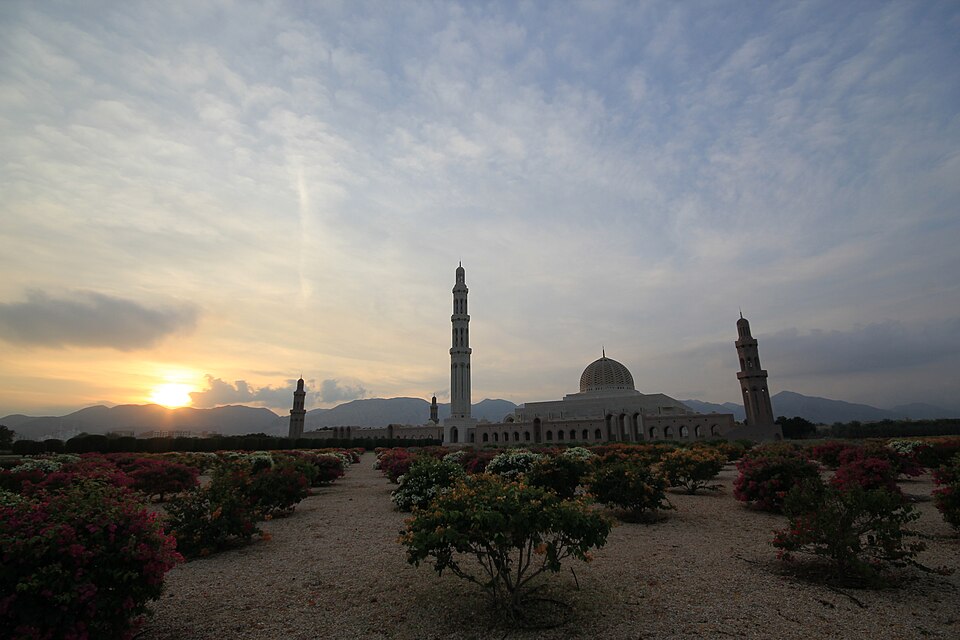
A falaj distributes water to farms and settlements; aflaj is the plural. Their channels and allocation practices make water management part of a living cultural landscape. Qalhat preserves evidence of medieval Indian Ocean trade, while the Land of Frankincense links Wadi Dawkah, Shisr, Khor Rori and Al-Baleed. Nizwa Fort and Muscat’s Sultan Qaboos Grand Mosque are significant landmarks without being separate World Heritage inscriptions. The mosque opened in 2001.
People & Society of Oman
Regional identities, migration and family links across the Indian Ocean shape modern society.
- Does one religious tradition describe every Omani?
- No. Ibadi, Sunni and Shia traditions are present, and the country also has residents of other religions.
- Are all foreign residents migrant workers?
- No. Resident population includes different groups, including family members. Citizenship and employment status are separate measures.
- Which overseas connections shaped coastal communities?
- Longstanding links with East Africa and South Asia, including Balochi and Swahili-speaking communities, alongside later migration.
More about Oman: people & society
Oman’s population includes citizens and residents from many other countries. Coastal, mountain, oasis and pastoral histories contribute to overlapping regional identities. Balochi and East African connections have long been part of the country’s social history, alongside more recent migration for work. Resident population, citizenship and employment status count different things; a foreign resident is not necessarily a worker, and an ethnic background does not determine nationality.
Islam is the state religion. Ibadi traditions have a prominent place in Omani history, alongside Sunni and Shia communities; residents also practise other religions. Reliable religious shares require clear sources and definitions, so one school should not be used as a description of every Omani. Women participate in education, business, public service and the arts, with opportunities and constraints that vary by setting. No single greeting, dress style or profession represents everyone.