Facts about Norway
Capital Oslo · Europe
10 topics · 20 lessons · about 20 minutes
Norway is a long, narrow kingdom along the western edge of Scandinavia, shaped by fjords cut into a coastline that runs past the Arctic Circle to Europe’s northern tip. Oil and gas found in the North Sea in 1969 turned a modest fishing and shipping economy into one of the wealthiest in the world, and the proceeds sit in a sovereign wealth fund that is the largest of its kind anywhere.
The country stretches roughly 1,750 kilometers from the Skagerrak in the south to the Barents Sea in the north, yet at Narvik it narrows to a strip only a few kilometers wide. Glaciers carved the western coast into fjords, the deepest of which, the Sognefjord, runs 205 kilometers inland and more than 1,300 meters down. The Scandinavian Mountains run the length of the country along the Swedish border, and the Gulf Stream keeps the coast ice free in winter at latitudes where Siberia and northern Canada are frozen solid.
Oslo at the head of its fjord is the capital and by far the largest city. Bergen is the historic Hanseatic port and the gateway to the western fjords, Trondheim holds the medieval cathedral where kings were crowned, and Tromsø, well inside the Arctic Circle, is the base for northern lights and midnight sun trips. Visitors come for the fjord country between Bergen and Ålesund, for Lofoten in the north, and for hiking routes such as Preikestolen and Trolltunga.
- Population
- 5.6 million
- Area
- 385,207 km²
- Capital
- Oslo
- Currency
- Norwegian krone (NOK)
- Official languages
- Norwegian, Sámi
- Highest point
- Galdhøpiggen, 2,469 m
The Norway course
Geography of Norway2 lessons
A coastline so folded that its true length outruns the distance around the Earth.
History of Norway2 lessons
Viking raiders, four centuries under Denmark, and full independence only in 1905.
Language of Norway2 lessons
Two official written standards for one spoken language, and no official spoken norm at all.
Culture of Norway2 lessons
Friluftsliv, janteloven and a national day in which the parade is made of schoolchildren.
Economy of Norway2 lessons
A sovereign wealth fund holding well over a percent of every listed company on Earth.
Politics of Norway2 lessons
A constitutional monarchy inside the single market but outside the European Union.
Nature & Wildlife of Norway2 lessons
Wild reindeer on the Hardangervidda, polar bears on Svalbard, and lemming years.
Food & Cuisine of Norway2 lessons
Salmon and cod in every preserved form, plus a brown cheese that tastes of caramel.
Landmarks of Norway2 lessons
A UNESCO fjord, a rock ledge 604 meters above the water, and a wooden church built without nails.
People & Society of Norway2 lessons
Five and a half million people spread thinly, with most of them near the southern coast.
Geography of Norway
Norway occupies the western side of the Scandinavian Peninsula, sharing long land borders with Sweden and shorter ones with Finland and Russia in the far north. Roughly a third of the country lies above the Arctic Circle, and Galdhøpiggen in the Jotunheimen range is the highest point in northern Europe at 2,469 meters.
Glacial erosion left a coast of fjords and tens of thousands of islands, and counting every inlet gives a shoreline far longer than the circumference of the Earth. The Sognefjord is the longest and deepest in the country. The Arctic archipelago of Svalbard and the sub-Antarctic Bouvet Island are also Norwegian, and mainland weather is unusually mild for the latitude because the North Atlantic Current carries warm water up the coast.

History of Norway
Norse seafarers raided and settled across the North Atlantic from the late eighth century, reaching Iceland, Greenland and briefly Newfoundland. Harald Fairhair is traditionally credited with unifying the kingdom around 872, and Christianity arrived over the following two centuries. Plague in the fourteenth century and dynastic union led to more than four hundred years of Danish rule.
The 1814 constitution, signed at Eidsvoll on 17 May and still celebrated as the national day, declared independence, but Norway was handed to Sweden the same year and stayed in that union until it dissolved peacefully in 1905. Germany occupied the country from 1940 to 1945. Oil was struck at Ekofisk in 1969, and Norwegians have twice voted against joining the European Union, in 1972 and 1994.

Language of Norway
Norwegian is a North Germanic language, mutually intelligible with Danish and Swedish, but it is written in two official standards. Bokmål grew out of written Danish and is used by the large majority, while Nynorsk was assembled in the nineteenth century by Ivar Aasen from rural dialects. Municipalities choose which form to use, and schools teach both.
There is no official spoken standard, and speaking your local dialect in any setting, including national broadcasting and parliament, is entirely normal. Sámi is an official language alongside Norwegian in several northern municipalities, with Northern Sámi the most widely spoken of its varieties, and Kven has recognized minority status.

Culture of Norway
Outdoor life, friluftsliv, is close to a civic value: skiing, hiking and cabin weekends are ordinary rather than specialist, and the right to roam, allemannsretten, lets anyone walk and camp on uncultivated land. Janteloven, a satirical set of rules coined by the writer Aksel Sandemose, is the usual shorthand for a social norm that frowns on showing off.
Edvard Grieg, Henrik Ibsen and Edvard Munch are the country’s best-known cultural exports, and the Nobel Peace Prize is awarded in Oslo rather than Stockholm, a division that dates to Alfred Nobel’s will. The 17 May constitution day is marked by children’s parades instead of a military one, and many take part in the national costume, the bunad.

Economy of Norway
Petroleum from the Norwegian continental shelf dominates exports, alongside seafood, metals and shipping. Norway is the largest producer of farmed Atlantic salmon in the world and, after the loss of Russian pipeline supply, became the leading gas supplier to the European Union.
Oil revenue is paid into the Government Pension Fund Global, commonly called the oil fund, which holds well over a trillion dollars and owns on average more than one percent of every listed company in the world. A fiscal rule limits what the state may spend from it each year to roughly the expected real return. Almost all electricity comes from hydropower, and the share of new cars sold that are fully electric is the highest anywhere.

Politics of Norway
Norway is a constitutional monarchy with a unicameral parliament, the Storting, whose 169 members are elected by proportional representation for fixed four-year terms with no provision for early elections. The monarch’s role is ceremonial, and governments are frequently minority coalitions that legislate through negotiation.
The country is not in the European Union but takes part in its single market through the European Economic Area, which means adopting most internal market rules without a vote on them. It is a founding member of NATO, shares a short Arctic border with Russia, and the Sámi Parliament in Karasjok holds consultative authority over questions affecting Sámi language, culture and land.
Nature & Wildlife of Norway
The Hardangervidda is the largest mountain plateau in northern Europe and holds one of the last herds of genuinely wild mountain reindeer on the continent. Moose are widespread in forested areas, and the four large carnivores, brown bear, wolf, lynx and wolverine, survive in small and closely managed numbers that remain politically contested.
Svalbard has more polar bears than permanent residents, and anyone leaving the settlements is required to carry a firearm for protection. Seabird cliffs along the coast host puffins, kittiwakes and guillemots in vast colonies, and lemming populations boom and crash on a rough three to five year cycle that ripples through the predators depending on them.

Food & Cuisine of Norway
Fish underpins the cooking. Cod is dried unsalted into stockfish on wooden racks in Lofoten, an export that has gone to southern Europe since the Middle Ages, or salted into klippfisk; lutefisk, dried fish rehydrated in lye, is a Christmas dish more discussed than eaten. Farmed salmon is now the everyday version, raw as gravlaks or cured.
Brunost, a brown whey cheese boiled until its milk sugars caramelise, is a breakfast staple that tastes closer to fudge than to cheese. Lamb and cabbage stewed together as fårikål was voted the national dish, and the open sandwich, waffles served with sour cream and jam, and cinnamon buns fill the everyday and coffee-break end of the table.
Landmarks of Norway
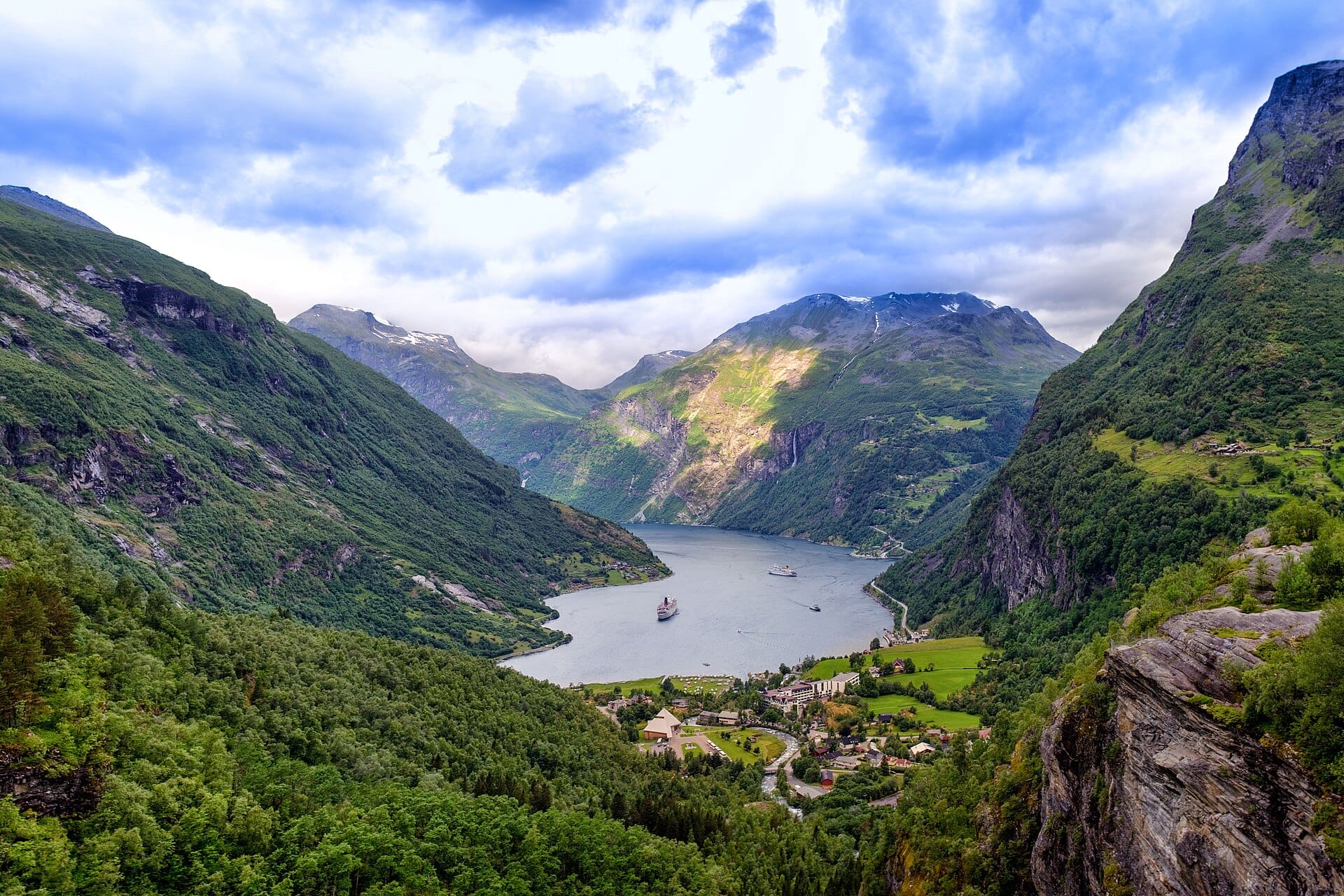
The Geirangerfjord and Nærøyfjord are jointly listed by UNESCO as the clearest example of the classic fjord landscape, with waterfalls dropping directly into water hundreds of meters deep. Preikestolen, a flat cliff platform 604 meters above the Lysefjord, and the overhanging slab of Trolltunga are the most photographed hikes in the country.
Around 28 medieval stave churches survive, built of vertical timber staves with elaborately carved portals, of which Urnes in Sogn is the oldest and a World Heritage Site. Bergen’s Bryggen wharf preserves the wooden gabled buildings of the Hanseatic trading post, and the Nidaros Cathedral in Trondheim marks the burial place of Saint Olaf.

People & Society of Norway
Norway has about 5.6 million residents in an area larger than Germany, making it one of the most thinly populated countries in Europe, and most people live in the south and southeast around the Oslo fjord. Around one in five residents is an immigrant or has two immigrant parents, with Poland, Lithuania, Ukraine and Somalia among the largest origins.
The Sámi are the indigenous people of the north, with their own parliament, language rights and reindeer herding traditions, after a long assimilation policy that was formally repudiated. Life expectancy, income and reported wellbeing are all near the top of international rankings, and parental leave is shared between parents with a portion reserved for each.

Reading is one thing, recall is another. Play the Norway challenge to test what stuck. The lessons on all ten topics are open too, and a free account is what keeps your progress across them.