Facts about Malaysia
Explore Malaysia across the Malay Peninsula and northern Borneo: the trading cities of Melaka and George Town, Kuala Lumpur’s skyline, Sarawak’s river country and Sabah’s mountains. Learn the states, federal territories, cities and waters, then discover the languages, food and histories that connect them.
- Capital
- Kuala Lumpur
- Administrative centre
- Putrajaya
- National language
- Malay
- Currency
- Malaysian ringgit (MYR)
- Administrative areas
- 13 states + 3 federal territories
- Highest mountain
- Mount Kinabalu, 4,095 m
Malaysia · 0 of 20 rounds passed
Two timed rounds per topic, 20 seconds a question
Peninsular Malaysia borders Thailand and faces Sumatra across the Strait of Malacca. Across the South China Sea, Sabah and Sarawak share Borneo with Indonesia and Brunei. Singapore is a separate country just south of Johor. Malaysia has thirteen states and three federal territories: Kuala Lumpur, Putrajaya and Labuan. The map keeps all sixteen areas separate, including the two small territories within the peninsula.
Kuala Lumpur is the national capital and the seat of Parliament; Putrajaya is the federal administrative centre. George Town and Melaka grew around maritime trade, while Johor Bahru faces Singapore. Kuching, Sibu and Miri connect different parts of Sarawak; Kota Kinabalu, Sandakan and Tawau anchor Sabah. Rainforests, limestone caves, mountain habitats and coral islands make the country much more varied than its capital’s skyline.
Geography of Malaysia
Two regions across the South China Sea, with sixteen distinct states and federal territories.
- Why does Malaysia appear in two main regions on a map?
- The South China Sea separates Peninsular Malaysia from Sabah and Sarawak on Borneo. Labuan is a federal territory off Borneo.
- How many states and federal territories does Malaysia have?
- Thirteen states and three federal territories: Kuala Lumpur, Putrajaya and Labuan. The territories are not additional states.
- Is Brunei completely surrounded by land?
- No. Its two land sections adjoin Sarawak, but it also has a South China Sea coastline.
More about Malaysia: geography
The South China Sea separates Peninsular Malaysia from East Malaysia on Borneo. The peninsula’s Titiwangsa Mountains divide many west-coast river basins from the east-facing lowlands. The Pahang River reaches the South China Sea, while the Strait of Malacca carries shipping between the peninsula and Sumatra. Penang includes an island and a mainland section; Langkawi belongs to Kedah rather than forming a separate state.
Sabah and Sarawak are Malaysia’s two Bornean states. Sarawak is the largest state by area, with the Rajang and Baram river systems; Sabah includes Mount Kinabalu and coasts facing the South China, Sulu and Celebes seas. Labuan is a separate federal territory off Borneo. Brunei has a coastline and two land sections adjoining Sarawak, so it is not a landlocked enclave. Malaysia also shares land boundaries with Thailand and Indonesia, and bridge connections with independent Singapore.
History of Malaysia
Maritime trading worlds, colonial rule, Malayan independence and Malaysia’s formation in 1963.
- How do Merdeka Day and Malaysia Day differ?
- Merdeka Day, 31 August, marks Malaya’s independence in 1957. Malaysia Day, 16 September, marks the formation of Malaysia in 1963.
- Which territories formed Malaysia in 1963?
- Malaya, Sabah, Sarawak and Singapore. Singapore became a separate independent country on 9 August 1965.
- Why was Melaka historically important?
- Its fifteenth-century sultanate developed a major maritime trading port and spread Malay political and Islamic influence. Portuguese and Dutch rule followed.
More about Malaysia: history
The peninsula and Borneo had trading networks and settled communities long before modern Malaysia. The Melaka Sultanate became a major fifteenth-century port and a centre of Malay political and Islamic influence. Portugal captured Melaka in 1511; Dutch forces, allied with Johor, took it in 1641. British control developed through different settlements and protectorates rather than one simultaneous conquest. Sabah and Sarawak followed distinct colonial histories. Japanese occupation during the Second World War brought severe hardship across the region.
The Federation of Malaya gained independence on 31 August 1957. Malaysia was formed on 16 September 1963 by Malaya, Sabah, Sarawak and Singapore; Singapore separated on 9 August 1965. Merdeka Day and Malaysia Day therefore mark different events. Tunku Abdul Rahman was the first prime minister. The communist insurgency, disputes over the federation’s formation, the 1969 communal violence and later economic and political changes also shaped the country. Independence was proclaimed at Stadium Merdeka; Dataran Merdeka is associated with the flag ceremony.
Malay and Malaysia’s other languages
Malay in Rumi and Jawi, alongside English, Chinese varieties, Tamil and Indigenous languages.
- What is Malaysia’s national language?
- Malay, commonly called Bahasa Melayu or Bahasa Malaysia, an Austronesian language. The linked lessons introduce everyday Malay.
- What are Rumi and Jawi?
- Rumi is the Latin-based writing system used for Malay. Jawi is an adapted Arabic script that retains cultural and religious uses.
- Does everyone in Malaysia speak only Malay?
- No. English, Chinese varieties, Tamil, Iban, Kadazandusun languages and many other community languages are also spoken.
More about Malaysia: language
Malay is the national language, commonly called Bahasa Melayu or Bahasa Malaysia. It belongs to the Austronesian family. Rumi uses the Latin alphabet; Jawi is an adapted Arabic script with continuing cultural and religious uses. Malay and Indonesian share a standardised Malay foundation but differ in vocabulary, pronunciation and usage. The linked Malay lessons begin with everyday phrases such as terima kasih, meaning thank you, rather than treating every regional variety as identical.
English is widely used in business, education and everyday conversation. Mandarin, Cantonese, Hokkien, Hakka and other Chinese varieties are spoken, and Tamil is an important Malaysian Indian language alongside others. Iban, Bidayuh languages, Kadazandusun languages and many other Indigenous languages form part of Borneo’s linguistic landscape. Orang Asli communities on the peninsula also speak distinct languages. A person’s ethnicity does not determine all the languages they speak, and the language of one city or household need not represent the whole country.
Culture of Malaysia
Batik, songket, open houses and festivals with different community and regional roots.
- What does Hari Raya Aidilfitri celebrate?
- The end of Ramadan. Open houses are one way families and communities welcome guests during celebrations.
- How do batik and songket differ?
- Batik uses wax-resist dyeing. Songket is woven cloth with supplementary metallic threads.
- Where are Gawai and Kaamatan celebrated?
- Gawai is associated with harvest traditions in Sarawak, and Kaamatan with those in Sabah. Their community histories and practices differ.
More about Malaysia: culture
Hari Raya Aidilfitri marks the end of Ramadan. Chinese New Year, Deepavali and Christmas also shape the public calendar, while Gawai in Sarawak and Kaamatan in Sabah celebrate harvest traditions with distinct community histories. Open houses welcome guests during many celebrations. Islam is the religion of the federation, and Buddhist, Christian, Hindu, Sikh and other communities also have important places in Malaysian life. Customs vary, so respectful dress and local guidance matter at places of worship.
Batik uses wax-resist dyeing; songket is woven cloth with supplementary metallic threads. Wau bulan kites are associated especially with the east coast, and different forms of silat combine movement, performance and martial traditions. Sarawak’s sape is a plucked string instrument associated with several Orang Ulu communities. Longhouses are homes and community spaces, not simply tourist attractions. These traditions change through artists, families and contemporary urban life rather than belonging only to an unchanging rural past.
Economy of Malaysia
Electronics, ports, services, plantations and energy link different regional economies.
- What is Malaysia’s currency?
- The Malaysian ringgit, abbreviated MYR or RM. Its exchange rate changes over time.
- Why is Penang important to manufacturing?
- Its island and mainland industrial areas form an important electronics centre. Penang is a state; George Town is its capital.
- Is Malaysia’s economy based only on plantations and oil?
- No. Manufacturing, services, finance, ports and tourism are also important, alongside agriculture and energy.
More about Malaysia: economy
Tin and rubber were central to the colonial export economy. Manufacturing and services now connect Malaysia with international supply chains: Penang’s island and mainland industrial areas are important for electronics, while the Klang Valley concentrates finance, business and logistics. Port Klang and the Port of Tanjung Pelepas handle maritime trade. Penang is a state, and George Town is its capital; calling Penang a single city obscures the mainland factories and port.
Palm oil, petroleum, natural gas and tourism are also important. Energy production and processing involve Sarawak, Sabah, Terengganu and offshore areas rather than one permanent leading state. Plantation expansion, forest conservation, working conditions and flood resilience raise linked economic and environmental questions. The currency is the Malaysian ringgit, abbreviated MYR or RM. Islamic finance is an established sector alongside conventional banking; exchange rates, industry rankings and annual output shares change over time.
Politics of Malaysia
A federal parliamentary monarchy, an elected king and distinct state and territorial arrangements.
- How is the Yang di-Pertuan Agong chosen?
- The Conference of Rulers elects the king from among nine hereditary state rulers for a five-year term under constitutional procedures.
- What are the two chambers of Parliament?
- The Dewan Rakyat, or House of Representatives, and the Dewan Negara, or Senate.
- How do Kuala Lumpur and Putrajaya differ?
- Kuala Lumpur is the national capital and seat of Parliament. Putrajaya is the federal administrative centre. Both are federal territories.
More about Malaysia: politics
Malaysia is a federal constitutional monarchy with parliamentary government. The Yang di-Pertuan Agong is head of state, elected by the Conference of Rulers from among nine hereditary state rulers for a five-year term under constitutional procedures. The prime minister heads the government. Parliament has two chambers: the Dewan Rakyat, or House of Representatives, and the Dewan Negara, or Senate. The federal Constitution defines these institutions; it does not make every state a sultanate.
Thirteen states have their own governments, while Kuala Lumpur, Putrajaya and Labuan are federal territories. Sabah and Sarawak have distinctive constitutional and administrative arrangements, including immigration controls. The Alliance coalition governed at independence; its successor Barisan Nasional was formed in 1973 and lost federal power in 2018. Civil courts and state Islamic-law institutions have different jurisdictions. Constitutional monarchy, electoral competition and debates about rights, representation and federal relations all form part of political life.
Nature & Wildlife of Malaysia
Peninsular rainforests, Bornean wildlife, limestone caves and habitats rising to Mount Kinabalu.
- Where is Mount Kinabalu?
- In Sabah on Borneo. At about 4,095 metres it is Malaysia’s highest mountain.
- Do wild orangutans live in Peninsular Malaysia?
- No. Bornean orangutans live on Borneo. The Malayan tiger is associated with the peninsula.
- What kind of forest does Taman Negara protect?
- Tropical rainforest across parts of Pahang, Kelantan and Terengganu, rather than deciduous woodland.
More about Malaysia: nature & wildlife
Malaysia’s equatorial climate supports tropical rainforests, mangroves and coral reefs, with mountain habitats changing as elevation increases. Taman Negara spans parts of Pahang, Kelantan and Terengganu and protects tropical rainforest, not deciduous woodland. Mount Kinabalu in Sabah rises to about 4,095 metres. Gunung Mulu National Park in Sarawak protects limestone karst, caves and forest; Sarawak Chamber is a vast cave chamber, distinct from the park’s other caves and passages.
Bornean orangutans and proboscis monkeys belong to Borneo’s fauna; wild orangutans do not live in Peninsular Malaysia. The critically endangered Malayan tiger survives on the peninsula. Rafflesia plants are parasitic and produce large individual flowers, while pitcher plants use a different strategy, trapping small animals for nutrients. Habitat loss, poaching, pollution and changing climate threaten ecosystems. Wildlife centres, protected forests and marine parks have different conservation roles; viewing animals should follow local conservation rules.
Food & Cuisine of Malaysia
Nasi lemak, regional laksa, roti canai and the food traditions of the peninsula and Borneo.
- What is nasi lemak?
- Coconut rice with sambal and accompaniments often including anchovies, peanuts, cucumber and egg. Recipes and additions vary.
- Are all Malaysian laksa dishes the same?
- No. Penang assam laksa has a sour fish broth; Sarawak laksa has a different spice base and accompaniments.
- What is teh tarik?
- Pulled milk tea. Pouring it between vessels mixes the drink and creates its frothy top.
More about Malaysia: food & cuisine
Nasi lemak pairs coconut rice with sambal and accompaniments that often include anchovies, peanuts, cucumber and egg. Roti canai is a layered flatbread commonly served with dal or curry; nasi kandar is associated with Indian Muslim food traditions in Penang. Satay combines grilled skewers with sauces and sides. Hawker centres, kopitiam coffee shops and mamak restaurants have different histories, and recipes and dietary practices vary by household and community.
Laksa names a family of dishes: Penang assam laksa has a sour fish broth, while Sarawak laksa uses its own spice base and accompaniments. Kelantan’s nasi kerabu, Johor’s noodle traditions and Sarawak’s manok pansoh, chicken cooked in bamboo, broaden the picture. Teh tarik is pulled milk tea, and cendol combines green jelly strands with coconut milk and palm sugar, often with shaved ice. Shared dishes connect Malaysia with neighbours without making their recipes or cultural histories identical.
Landmarks of Malaysia
Six World Heritage properties, from trading cities and archaeology to forests and caves.
- How many World Heritage properties does Malaysia have?
- Six as of October 2026, including Niah’s caves complex, inscribed in 2024, and FRIM Selangor Forest Park, inscribed in 2025.
- Are Melaka and George Town separate World Heritage properties?
- No. The two cities form one serial property, Melaka and George Town, Historic Cities of the Straits of Malacca, inscribed in 2008.
- Is Batu Caves inside Kuala Lumpur’s federal territory?
- No. It is in neighbouring Selangor. The nearby capital and the state are separate administrative areas.
More about Malaysia: landmarks
Malaysia has six World Heritage properties as of October 2026. Kinabalu Park and Gunung Mulu National Park were inscribed in 2000; Melaka and George Town form one shared historic-cities property, inscribed in 2008. The Archaeological Heritage of the Lenggong Valley followed in 2012, the Niah National Park caves complex in 2024, and FRIM Selangor Forest Park in 2025. The last is a cultural property demonstrating forest restoration and research, rather than an untouched ancient forest.
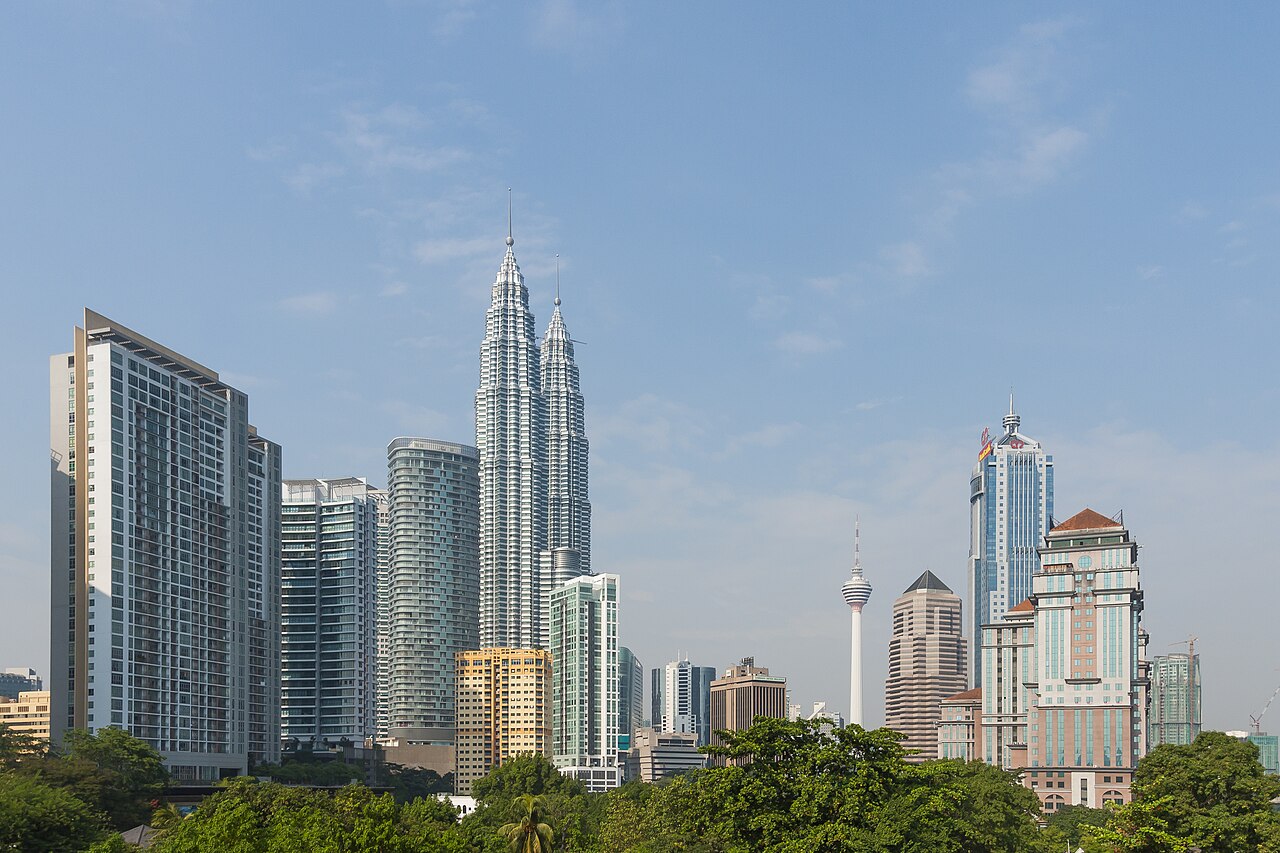
The Petronas Twin Towers and KL Tower mark modern Kuala Lumpur. Batu Caves is in neighbouring Selangor, not within Kuala Lumpur’s federal territory. Putrajaya’s civic buildings and lake introduce the administrative centre. George Town’s streets, Melaka’s riverfront, Kuching’s waterfront and Sabah’s mountain landscapes show different regional settings. The sights map distinguishes heritage properties from other landmarks and uses learning locations rather than confirmed entrances, trailheads or permission to enter protected sites.
People & Society of Malaysia
Malaysian citizenship spans many identities, languages and histories across both regions.
- Do Malaysian and Malay mean the same thing?
- No. Malaysian refers to nationality; Malay is an ethnic identity. Malaysians belong to many communities.
- Does Orang Asli name every Indigenous community in Malaysia?
- No. It refers to Indigenous peoples of Peninsular Malaysia. Sabah and Sarawak have many other distinct Indigenous peoples.
- What is Michelle Yeoh known for?
- The Ipoh-born actor won the Academy Award for Best Actress in 2023. Her international career is one example of Malaysian cultural achievement.
More about Malaysia: people & society
Malaysian nationality and Malay ethnicity are different concepts. Malay, Chinese and Indian communities are part of a wider society that includes Orang Asli peoples on the peninsula and many Indigenous peoples in Sabah and Sarawak. Iban, Bidayuh, Melanau, Kadazan-Dusun, Bajau and numerous other communities have distinct identities. Bumiputera is an administrative and political category encompassing Malays and Indigenous peoples; it does not name a single ethnic group or language.
Migration has long connected ports, plantations, mining towns and cities with the wider region and the world. Peranakan communities reflect particular local histories rather than one uniform identity. Cultural figures include filmmaker and musician P. Ramlee, Ipoh-born Academy Award winner Michelle Yeoh and badminton player Lee Chong Wei. Their careers offer different routes into Malaysian life alongside the histories of workers, families and communities whose experiences vary across regions and generations.