Facts about Mauritania
Explore Mauritania from the Atlantic ports and Senegal River valley to the Adrar plateaus, ancient caravan towns and Saharan interior. Ten illustrated topics connect landscapes with history, languages, food and everyday life.
- Capital
- Nouakchott
- Area
- About 1.03 million km²
- Currency
- Mauritanian ouguiya (MRU)
- Official language
- Arabic
- National languages
- Arabic, Pulaar, Soninke and Wolof
- Independence
- 28 November 1960
Mauritania · 0 of 20 rounds passed
Two timed rounds per topic, 20 seconds a question
Nouakchott is the coastal capital; Nouadhibou connects fishing and iron ore exports in the north. Atar, Chinguetti and Ouadane orient the Adrar, while Zouérat anchors the mining country farther north and Akjoujt lies on the road toward the capital.
Tidjikja introduces the Tagant plateau. Rosso and Kaédi connect the Senegal River valley, while Kiffa and Néma lead across the southern interior. The four historic ksour, Banc d’Arguin and the Richat Structure add heritage and landscape context to twelve settlement pins.
Geography of Mauritania
Atlantic shores, Saharan plateaus and a river valley at the edge of the Sahel.
- Which ocean borders Mauritania?
- The Atlantic Ocean, to the west.
- Which river connects Mauritania with Senegal?
- The Senegal River forms much of their shared border and supports farming and wetlands.
- Is the Richat Structure an impact crater?
- No. Its rings expose an eroded geological dome; it is not a confirmed meteorite impact crater.
More about Mauritania: geography
Mauritania lies in northwestern Africa between the Atlantic Ocean and the Sahara. It covers about 1.03 million square kilometres, bordering Western Sahara, Algeria, Mali and Senegal. The Senegal River follows much of the southern frontier. Nouakchott, the capital, is near the Atlantic coast; Nouadhibou is a northern port on the peninsula of Ras Nouadhibou, also called Cap Blanc.
Most of the country is arid, but its landscapes are not all sand dunes. The Adrar and Tagant contain rocky plateaus, escarpments and oases, while the southern Sahel receives more seasonal rain. Farming and grazing depend on this rainfall, river water and groundwater. The Richat Structure near Ouadane is a broad, eroded geological dome, not a confirmed meteorite crater. Its concentric rings stand out especially clearly from space.
History of Mauritania
Caravan towns and Islamic scholarship before colonial rule and independence in 1960.
- When did Mauritania become independent?
- On 28 November 1960, from France.
- Why were the historic ksour important?
- They connected trans-Saharan commerce with Islamic scholarship and manuscript traditions.
- Is Koumbi Saleh’s identification as Ghana’s capital certain?
- No. The archaeological site is commonly associated with the capital of medieval Ghana, but scholars debate that identification.
More about Mauritania: history
The land now called Mauritania connected Saharan pastoral communities with the Senegal River valley and wider West African trading networks. The medieval Ghana or Wagadu empire influenced the southeast; the ruins of Koumbi Saleh are commonly associated with its capital, though the identification remains debated. Sanhaja Amazigh groups were central to the eleventh-century Almoravid movement. Later Arab migrations and changing political alliances helped shape Hassaniya-speaking societies.
Caravan towns such as Chinguetti, Ouadane, Tichitt and Oualata became centres of commerce and Islamic learning. French colonial expansion brought the territory into French West Africa. Mauritania became independent on 28 November 1960, with Moktar Ould Daddah as its first president. Military coups, the Western Sahara war and withdrawal from that conflict in 1979 shaped the following decades. Slavery, the violence and expulsions around the 1989 Senegal border crisis, and struggles over equal citizenship remain part of the country’s modern history.
Mauritania’s languages
Arabic is official; Pulaar, Soninke and Wolof also have national-language status.
- What is Mauritania’s official language?
- Arabic. The constitution also names Pulaar, Soninke and Wolof as national languages.
- How does Hassaniya relate to Arabic?
- It is a spoken variety of Arabic used widely in Mauritania and neighbouring Saharan areas.
- Does the linked Arabic course teach Hassaniya specifically?
- No. It introduces general Arabic; the guide explains the distinction from everyday Hassaniya.
More about Mauritania: language
Article 6 of Mauritania’s constitution names Arabic, Pulaar, Soninke and Wolof as national languages and Arabic as the official language. Hassaniya, a variety of Arabic with Amazigh and other regional influences, is widely spoken in daily life. The formal Arabic of education, public texts and religious scholarship differs from ordinary conversation. French remains important in parts of administration, education and business without being a constitutional official language.
Pulaar-speaking communities, Soninke speakers and Wolof speakers connect the country with the wider Senegal River region. Zenaga is an endangered Amazigh language of southwestern Mauritania. Language, ethnicity and social status do not map neatly onto one another, and choices in schooling and public life have been politically contested. The linked Arabic, Wolof and French lessons introduce those languages generally: the Arabic course is not a dedicated Hassaniya course, and Pulaar and Soninke courses are not currently offered.
Culture of Mauritania
Poetry, manuscript learning, music and hospitality across several cultural traditions.
- What is the mahadra tradition?
- A system of community-based teaching and transmission of Islamic knowledge.
- What are the tidinit and ardin?
- A lute and a harp associated with Moorish musical traditions.
- Is poetry confined to one form of Arabic?
- No. Both classical Arabic and Hassaniya have important poetic traditions.
More about Mauritania: culture
Poetry has a prominent place in both classical Arabic and Hassaniya traditions. Manuscript libraries in historic towns preserve works on religion, law, grammar and other subjects, while mahadra learning communities transmit Islamic knowledge through teaching and memorisation. UNESCO recognised the mahadra system in 2023. These traditions continue in contemporary society, alongside schools, universities, publishing and digital media.
Moorish musical traditions include the tidinit lute and the ardin harp, associated with iggawin musician families. Artists such as Dimi Mint Abba and Malouma brought these sounds to wider audiences. Pulaar, Soninke and Wolof communities contribute their own musical and oral traditions. The flowing men’s daraa or boubou and women’s melahfa are familiar forms of dress, but clothing and customs vary. Making and sharing tea creates time for conversation and hospitality.
Economy of Mauritania
Iron ore trains and fishing ports connect export industries with everyday livelihoods.
- Where does the iron ore railway lead?
- From the Zouérat mining area across northern Mauritania to the export port near Nouadhibou.
- What is Mauritania’s currency?
- The Mauritanian ouguiya (MRU).
- Does farming occur only beside the Senegal River?
- No. The river valley is important, but rain-fed cultivation in the south and date growing in oases also matter.
More about Mauritania: economy
Iron ore mining around Zouérat and the railway to Nouadhibou are central to Mauritania’s industrial geography. Gold and copper mining are also important. Atlantic fisheries support exports, boat crews, markets and processing work. These industries can generate income while exposing the economy to changing commodity prices, pressure on marine ecosystems and unequal access to jobs.
Livestock keeping, irrigated farming along the Senegal River, rain-fed cultivation in the south and oasis date growing sustain other livelihoods. Shops, transport and services employ many urban residents, including in informal work. Water scarcity, drought and long distances raise costs. Offshore natural gas development, including the shared Greater Tortue Ahmeyim project with Senegal, adds another export sector; its benefits depend on public management and how income is distributed. The currency is the Mauritanian ouguiya, code MRU.
Politics of Mauritania
A republic whose institutions and citizenship debates carry the legacies of military rule and slavery.
- What replaced the two-chamber parliament after 2017?
- A unicameral parliament consisting of the National Assembly; the Senate was abolished.
- Did the abolition of slavery in 1981 end all exploitation?
- No. Later criminal laws and continuing activism reflect persistent descent-based exploitation and discrimination.
- What is the country’s full name?
- The Islamic Republic of Mauritania.
More about Mauritania: politics
The Islamic Republic of Mauritania has a president, a government headed by a prime minister and an elected National Assembly. Constitutional changes in 2017 abolished the Senate, leaving a unicameral national parliament. Islam has a constitutional role, and the legal system combines Islamic and civil-law influences. Since independence, military coups and periods of military government have alternated with electoral politics; formal institutions alone do not describe the balance of power.
Questions of representation, language, access to identity documents and unequal treatment between communities are important to public life. Slavery was formally abolished in 1981, criminalised in 2007 and addressed through stronger legislation in 2015. Descent-based exploitation and discrimination nevertheless persist, and activists continue to seek effective enforcement. These dates describe legal changes rather than the disappearance of slavery. For current political events and security conditions, consult recent reporting and official advice.
Nature & Wildlife of Mauritania
Tidal flats, seabirds and desert habitats meet on the Atlantic coast.
- Why is Banc d’Arguin important to migratory birds?
- Its tidal flats and shallow waters provide major feeding and wintering habitat.
- Where is Diawling National Park?
- In the lower Senegal River delta in southwestern Mauritania.
- Why does coastal conservation involve fishing communities?
- Local livelihoods depend on the same productive waters and habitats that conservation seeks to protect.
More about Mauritania: nature & wildlife
Banc d’Arguin National Park protects Atlantic shallows, islands, tidal flats and desert coastline. It is a UNESCO World Heritage property and a major wintering and feeding area for migratory waterbirds, as well as a breeding habitat for resident birds. These are different seasonal roles: not all the birds arriving from northern breeding grounds breed here. Seagrass beds and productive coastal waters support fish and other marine life.
Imraguen fishing communities have longstanding relationships with the Banc d’Arguin coast. Conservation involves livelihoods as well as habitat protection. In the south, Diawling National Park protects and restores wetlands in the Senegal River delta, where water management affects plants, fish and birds. Inland, sparse vegetation and unpredictable rainfall shape desert and Sahelian habitats. Drought, land degradation and fishing pressure require different responses; dryland restoration includes managing pasture, soil and water, rather than simply planting a continuous wall of trees.
Food & Cuisine of Mauritania
Fish and rice, pastoral dairy and shared glasses of tea.
- Is couscous a cereal crop?
- No. It is a prepared grain food, commonly made from semolina or other cereals.
- What is zrig?
- A milk-based drink, often diluted with water and sometimes sweetened.
- What does the food photograph show?
- Fish sellers in Nouakchott, rather than a prepared meal.
More about Mauritania: food & cuisine
Mauritanian food connects Atlantic fishing, Senegal River agriculture, oasis produce and pastoral livelihoods. Fish with rice and vegetables is familiar on the coast and shares a regional history with Senegalese ceebu jën. Couscous dishes, rice, millet and sorghum appear in different settings. Couscous is a prepared food made from grain, not a separate cereal crop. Dates connect meals and hospitality with oasis cultivation.
Camel, cattle, sheep and goat products contribute meat and dairy, with choices depending on region, household resources and the occasion. Zrig is a milk-based drink, often diluted and sometimes sweetened. Tea preparation is a social activity: small glasses may be served in successive rounds, with time for conversation. Recipes and rituals vary between families. The photograph shows fish being sold in Nouakchott, an ingredient and livelihood scene rather than a finished dish.
Landmarks of Mauritania
Four historic ksour, a coastal World Heritage park and the rings of the Richat.
- Are the four ksour four separate UNESCO properties?
- No. Ouadane, Chinguetti, Tichitt and Oualata are components of one World Heritage property.
- What distinguishes Oualata’s old townscape?
- Its decorated houses and its history as a Saharan trading and learning centre.
- What is Terjit?
- An oasis with palms and springs in a gorge south of Atar in the Adrar region.
More about Mauritania: landmarks
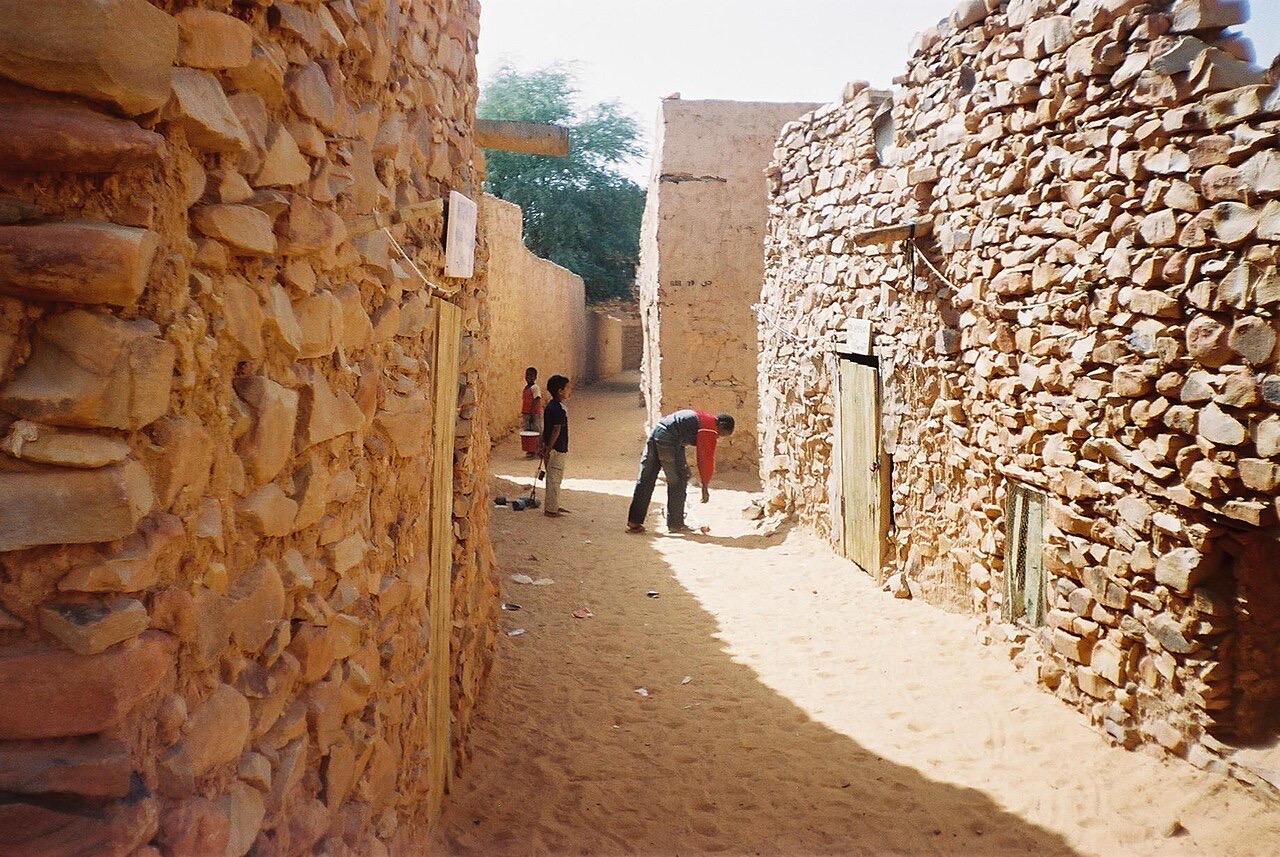
Ouadane, Chinguetti, Tichitt and Oualata together form one UNESCO World Heritage property: the Ancient Ksour. A ksar is a historic settlement; ksour is the plural. These towns developed around caravan trade, religious life and scholarship. Chinguetti is known for its mosque and manuscript libraries, Ouadane for its old hillside townscape, Tichitt for stone architecture and Oualata for decorated houses. They are inhabited places and cultural landscapes, not just ruins.
Other learning locations reveal different histories and environments. The Richat Structure exposes rings of rock northeast of Ouadane, while Terjit is an oasis among the Adrar escarpments. Koumbi Saleh links archaeology with debates about medieval Ghana. Banc d’Arguin and Diawling represent coastal and delta conservation. Nouakchott’s Port de Pêche connects the modern capital with artisanal fishing. The map marks approximate locations, not boundaries, entrances or travel routes; access and local arrangements require separate checks.
People & Society of Mauritania
A diverse society linked by cities, river communities, pastoral histories and migration.
- Why did Nouakchott grow rapidly after the 1960s?
- Urban opportunities and rural pressures, including severe droughts, encouraged migration into the capital.
- Do language and social identity form simple fixed categories?
- No. Language, family history, status and self-identification overlap in complex ways.
- Which neighbouring country is the origin of many refugees in southeastern Mauritania?
- Mali.
More about Mauritania: people & society
Mauritanian society includes Hassaniya-speaking Bidhane and Haratine communities as well as Pulaar, Soninke and Wolof-speaking peoples and others. These names describe complex and changing identities, not fixed biological categories. Haratine identities are closely connected with histories of enslavement and struggles for equality, but individuals’ experiences cannot be reduced to a single status. Language, occupation, family history and self-identification overlap in different ways.
Droughts in the 1970s and 1980s accelerated movement from pastoral and rural livelihoods into towns. Nouakchott grew rapidly, bringing new opportunities alongside pressure on housing, water and services. Families maintain ties between cities, oases, river communities and neighbouring countries. Mauritania also hosts refugees from Mali, including in the southeast. Islam shapes much public and family life, while education, music, activism, work and migration connect younger generations with wider regional and global worlds.