Facts about Madagascar
Madagascar is an Indian Ocean island whose highlands, rainforests, dry forests and spiny thickets support an extraordinary variety of life. Its communities connect African and Southeast Asian histories through a shared but diverse Malagasy language. Antananarivo is the highland capital; coastal towns face the Mozambique Channel and the wider Indian Ocean.
- Capital
- Antananarivo
- Population
- About 25.7 million (2018 census)
- Area
- 587,041 km²
- Official languages
- Malagasy and French
- Currency
- Malagasy ariary (MGA)
- Regions
- 24
Madagascar · 0 of 20 rounds passed
Two timed rounds per topic, 20 seconds a question
The island lies east of Mozambique, separated from mainland Africa by the Mozambique Channel. The central highlands descend steeply towards the wet east and more gradually towards the seasonally dry west. The far southwest is especially arid. Offshore islands include Nosy Be in the northwest and Nosy Boraha, also called Sainte-Marie, off the east coast.
Madagascar has 24 regions. Vatovavy and Fitovinany separated in 2021; Ambatosoa was created by a 2023 law from Maroantsetra and Mananara Avaratra districts and inaugurated in 2025. The six traditional provinces are a different framework. The water map follows complete available river courses and retains full marine areas, including the Indian Ocean well beyond Madagascar.
Geography of Madagascar
An island of highlands, wet eastern slopes and a drier western coast.
- Which ocean surrounds Madagascar?
- Madagascar lies in the southwestern Indian Ocean, east of mainland Africa.
- Where does Madagascar rank among the world’s islands by area?
- Greenland, New Guinea and Borneo are larger; Madagascar ranks fourth.
- What natural vegetation is associated with Madagascar’s wetter eastern slope?
- Moist trade winds help sustain rainforest along the eastern escarpment.
More about Madagascar: geography
Madagascar is the world’s fourth-largest island by area, after Greenland, New Guinea and Borneo. It lies in the southwestern Indian Ocean, across the Mozambique Channel from Africa. Its long geological isolation followed separation from Africa and, about 88 million years ago, from the Indian landmass. The central highlands contain plateaus, rice-growing valleys and mountain massifs. Maromokotro in the northern Tsaratanana massif is the highest summit, about 2,876 metres above sea level.
Moist trade winds feed the eastern rainforests. The west is more seasonal, while the southwest contains dry spiny vegetation. Cyclones can bring damaging winds and floods, especially along the east. The Betsiboka reaches Bombetoka Bay near Mahajanga; the Tsiribihina, Mangoky and Onilahy drain towards the west. Lake Alaotra drains through the Maningory towards the eastern coast. These waterways form connected landscapes rather than isolated map segments.
History of Madagascar
Indian Ocean settlement, expanding kingdoms and independence in 1960.
- Which two broad regions contributed to the ancestry and settlement of Madagascar?
- Malagasy settlement and ancestry reflect Indian Ocean links with Southeast Asia and East Africa; the earliest settlement dates remain debated.
- Which highland kingdom expanded over much of Madagascar in the nineteenth century?
- The Merina monarchy expanded from the central highlands, without ever controlling every part of the island equally.
- In which year did Madagascar become independent from France?
- Independence was proclaimed on 26 June 1960.
More about Madagascar: history
Madagascar’s settlement brought together people and knowledge from Southeast Asia and East Africa through Indian Ocean voyaging and exchange. Archaeology, language and genetics provide different kinds of evidence; the precise timing and sequence of early settlement remain debated. Coastal and highland societies developed distinct political traditions. Andrianampoinimerina consolidated Imerina in the late eighteenth and early nineteenth centuries; his son Radama I expanded Merina power much farther across the island.
Ranavalona I resisted foreign influence and Christian missions during her reign from 1828 to 1861, while imposing coercive labour and punishing opponents. French troops took Antananarivo in 1895, followed by annexation in 1896 and the monarchy’s abolition in 1897. The 1947 anti-colonial uprising met violent repression. Independence came on 26 June 1960. Didier Ratsiraka’s socialist Second Republic began in 1975; later decades brought constitutional change and repeated political crises.
Language of Madagascar
An Austronesian language in Africa, with regional varieties and French alongside it.
- What is Madagascar’s national language?
- Malagasy is the national language and one of the country’s two official languages.
- To which language family does Malagasy belong?
- Malagasy belongs to the Austronesian family; being spoken in Africa does not exclude that linguistic ancestry.
- The written standard of Malagasy is largely based on which variety?
- The written standard developed largely from the Merina variety of the central highlands.
More about Madagascar: language
Malagasy is the national language and, with French, an official language. It belongs to the Austronesian family, with close relationships to Southeast Barito languages of Borneo, including Ma’anyan. This ancestry does not make Malagasy any less an African language in its present geography and social life. Contact with Bantu languages, Arabic, French and other languages has also left traces in vocabulary and usage.
The written standard is based largely on the Merina variety, but Malagasy has many regional forms. Its Latin-based alphabet has 21 letters, omitting C, Q, U, W and X. Manao ahoana is a common greeting, misaotra means thank you, and azafady can mean please or excuse me. Kabary is formal public oratory, using proverbs and imagery. The guide links the existing Malagasy lessons, which introduce everyday expressions rather than every regional variety.
Culture of Madagascar
Kabary, woven lamba, zebu cattle and music with many local traditions.
- In some highland communities, what does famadihana involve?
- Famadihana may involve removing ancestors’ remains from a family tomb and rewrapping them. It is not practised by every Malagasy community.
- What are fady in Malagasy cultural life?
- Fady are prohibitions that vary among places, families and communities; ask locally rather than assuming one universal set.
- What is a lamba?
- Lamba is a broad term for cloth worn as a wrap; particular textiles are also used in funerary practices.
More about Madagascar: culture
Family, ancestry and relations with place matter across many Malagasy communities, though practices vary widely. Fady are prohibitions associated with particular families, communities or places. Famadihana, practised in some highland communities, involves rewrapping ancestral remains and renewing family connections. It is not a ceremony shared by everyone on the island. Tomb forms also differ, including painted tombs and carved memorial posts in some southern traditions.
Lamba are cloth wraps with everyday, ceremonial and funerary uses. Zebu cattle can represent wealth, support farming and take part in ceremonies. Musical instruments include the bamboo tube zither called valiha, the marovany box zither and the small kabosy guitar. Salegy is energetic dance music associated especially with the north and coast. Fanorona is a strategy board game whose pieces capture by approach and withdrawal, rather than a mancala seed-sowing game.
Economy of Madagascar
Rice landscapes, vanilla exports, fragrant oils and major mineral projects.
- Which orchid-derived spice is a major Malagasy export?
- Madagascar is a major producer of natural vanilla, especially in the northeast. Market shares vary by year.
- Which grain is central to Malagasy agriculture and meals?
- Rice is central to cultivation, landscapes and food culture, although many households grow and eat other staples too.
- Which gemstones drew miners to Ilakaka in the late 1990s?
- Sapphire discoveries transformed Ilakaka and drew miners and traders from Madagascar and abroad.
More about Madagascar: economy
Rice is central to agriculture and food security, grown on irrigated terraces, valley floors and other landscapes. Vanilla production is especially associated with the northeastern Sava region; Madagascar is a major supplier of natural vanilla, but prices and global shares fluctuate. Ylang-ylang flowers, notably around Nosy Be, provide fragrant oil for perfumery. Cloves, fisheries, textiles and tourism also contribute to livelihoods and trade.
The Ambatovy project produces nickel and cobalt, linking a mine near Moramanga to processing near Toamasina. Sapphire discoveries transformed Ilakaka in the late 1990s. The national currency is the ariary, code MGA. Rural livelihoods face cyclones, drought, limited infrastructure and uneven access to services. Tavy refers to clearing and burning vegetation for cultivation; its environmental effects depend on location, land pressure and the time allowed for vegetation to recover.
Politics of Madagascar
Constitutional institutions, 24 regions and a history of political transitions.
- Which city is Madagascar’s capital?
- Antananarivo lies in the central highlands and is the national capital.
- How did the 2010 Constitution organise the national executive?
- The constitutional framework provided for a president and prime minister. This dated description must be distinguished from the military-led transition following October 2025.
- Which districts form the region of Ambatosoa under the 2023 law?
- Ambatosoa was created from the northern part of Analanjirofo and inaugurated in 2025.
More about Madagascar: politics
The 2010 Constitution provided a semi-presidential framework with a president and prime minister, and a Parliament composed of the National Assembly and Senate. Constitutional design should be distinguished from who exercises power during a transition. The 2009 removal of Marc Ravalomanana brought Andry Rajoelina to transitional power and led to an African Union suspension, lifted in 2014. A further military takeover in October 2025 prompted another AU suspension and calls for a return to constitutional order.
Madagascar’s 24 regions differ from the six traditional provinces. The 2021 division of Vatovavy-Fitovinany created separate Vatovavy and Fitovinany regions. The 2023 Ambatosoa law separated Maroantsetra and Mananara Avaratra from Analanjirofo; inauguration followed in 2025. Antananarivo is the capital. This guide dates political events and institutional descriptions rather than treating a past constitutional arrangement or officeholder as an undated current fact.
Nature & Wildlife of Madagascar
Lemurs, chameleons, baobabs and habitats found nowhere else.
- What does endemic mean when describing a Malagasy species?
- An endemic species occurs naturally only within a particular geographic area; percentages differ among groups of organisms.
- Which primates are characteristic of Madagascar’s native wildlife?
- Lemurs evolved into many species in Madagascar. Some introduced lemur populations also live in the Comoros, so absolute claims about all wild populations are misleading.
- Which process threatens many Malagasy forest species?
- Forest clearance, fragmentation, hunting and other pressures threaten Madagascar’s biodiversity.
More about Madagascar: nature & wildlife
Long isolation helped Madagascar develop exceptional biological diversity and endemism. Endemic means occurring naturally only within a particular area; the proportion differs among groups of organisms. Lemurs diversified into many species, from mouse lemurs to the indri. Some lemurs were introduced to the Comoros, so saying that every wild lemur lives only in Madagascar would be misleading. The fossa is the island’s largest native mammalian predator and belongs to the Malagasy carnivore family Eupleridae.
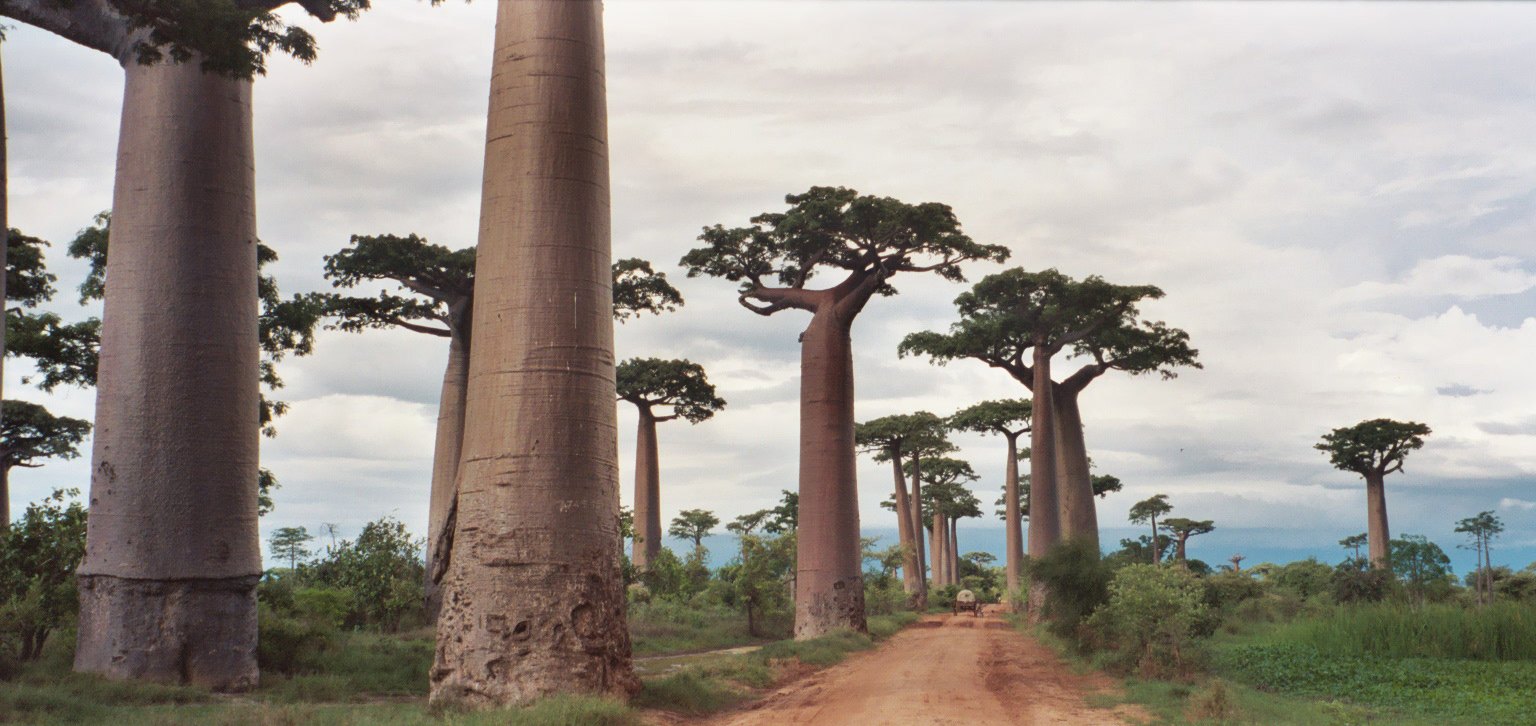
Chameleons include tiny Brookesia species and larger Furcifer species. Six baobab species are endemic to Madagascar, including the tall Grandidier’s baobabs of the west. The eastern rainforests, western dry forests and southern spiny thickets support different communities of organisms. Habitat loss, fragmentation, hunting and illegal logging threaten many species. The extinct elephant birds were enormous flightless birds; their taxonomy and size estimates continue to be researched.
Food & Cuisine of Madagascar
Rice with laoka, leafy stews, chilli condiments and small breakfast cakes.
- Which staple usually forms the centre of a Malagasy meal?
- Rice commonly anchors a meal, with accompaniments called laoka. Meals vary by household and region.
- Which stew combines meat with leafy greens and sometimes ginger?
- Romazava combines leafy greens with meat; ingredients and preparation vary.
- What kind of condiment is sakay?
- Sakay is a hot chilli condiment; recipes may include ginger, garlic or other ingredients.
More about Madagascar: food & cuisine
Rice commonly forms the centre of a Malagasy meal, with accompaniments broadly called laoka. Romazava combines leafy greens with meat, sometimes with ginger and other seasonings. Ravitoto uses pounded cassava leaves, often cooked with pork, though recipes differ. Coastal meals may feature fish, coconut and seafood, while ingredients and eating habits vary with region, season and household resources.
Ranovola, also called ranon’ampango, is made by adding water to the browned rice crust remaining in a pot. Sakay is a hot chilli condiment. Koba includes several sweets; koba akondro commonly combines banana, peanuts and rice flour wrapped in leaves and steamed. Mofo gasy are small sweet rice-flour cakes cooked in a moulded pan. Baguettes and other bakery foods show French influence alongside local breakfast traditions.
Landmarks of Madagascar
Royal hills, limestone tsingy, sandstone canyons and a baobab avenue.
- Which western town is closest to the Avenue of the Baobabs?
- The famous baobab avenue lies northeast of Morondava in Menabe.
- What defines the landscape of Tsingy de Bemaraha?
- The tsingy are heavily eroded limestone formations with sharp ridges, crevices and caves.
- What is the Royal Hill of Ambohimanga?
- Ambohimanga preserves a royal town, burial places and sacred associations in the highlands near Antananarivo.
More about Madagascar: landmarks
The Royal Hill of Ambohimanga preserves a royal town, burial places and sacred associations near Antananarivo. The Rova palace complex in the capital was badly damaged by fire in 1995 and subsequently underwent reconstruction. Far to the west, the Avenue of the Baobabs lies northeast of Morondava. Tsingy de Bemaraha is known for sharp limestone ridges, crevices and caves, protected within a UNESCO World Heritage property.
Isalo National Park contains sandstone massifs, grasslands and deep canyons. Ranomafana and Andasibe-Mantadia protect contrasting eastern forest landscapes. Nosy Be is a major northwestern island destination; Nosy Boraha off the east is associated with Indian Ocean piracy and seasonal whale sightings. Fianarantsoa is a highland educational and cultural centre near wine-growing areas. Pins identify learning locations, including representative points in large parks, rather than entrances or travel routes.
People & Society of Madagascar
Shared language, overlapping identities and connections across the Indian Ocean.
- How should the often-cited eighteen Malagasy ethnic groups be understood?
- The familiar list of eighteen is a broad convention. Identities overlap and do not define fixed biological or linguistic divisions.
- Which community is associated with the highlands around Antananarivo?
- Merina history is strongly associated with Imerina in the central highlands; no region is inhabited exclusively by one group.
- For what is Gisèle Rabesahala remembered?
- Gisèle Rabesahala was a political organiser, independence advocate and defender of human rights, later serving as a minister.
More about Madagascar: people & society
The 2018 census counted about 25.7 million residents. This dated count differs from later estimates. Malagasy identities reflect varied histories, places and social connections. The often-cited list of eighteen ethnic groups is a broad convention, not a complete inventory of identities or a set of biological boundaries. Merina communities are associated with the central highlands, Betsimisaraka communities with the east, and Sakalava communities with parts of the west and northwest.
Vezo identity in the southwest has strong ties to fishing and seafaring; individual livelihoods are more varied than any single label. Christianity has a major presence, alongside Islam and diverse ancestral practices that may overlap with religious affiliation. Razana refers to ancestors. Historical figures include Ranavalona III, the last reigning monarch, and Gisèle Rabesahala, a political organiser and advocate for independence and human rights. Contemporary Malagasy life includes both rural communities and growing towns connected by migration and family networks.