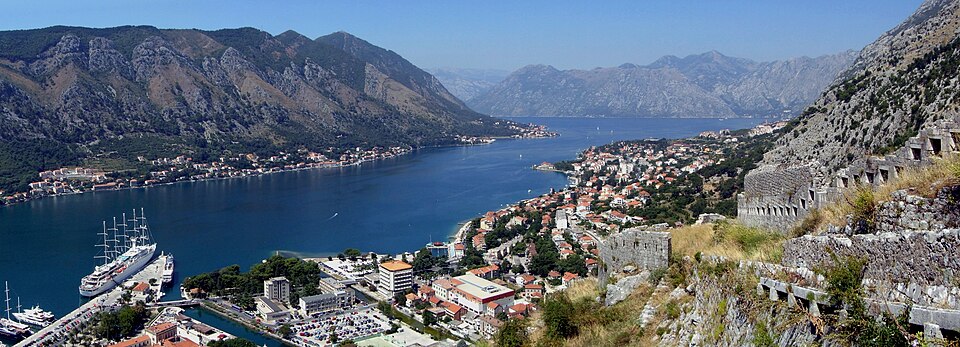
Facts about Montenegro
Explore Montenegro from the Bay of Kotor and the Adriatic coast to Cetinje, Lake Skadar and the high country of Durmitor. Learn its local authorities, place sixteen cities and towns, explore the lake, river and coast, discover sixteen sights, read ten illustrated topics and begin Serbian or Albanian.
- Population, 2023 census
- 623,633
- Area
- 13,812 km²
- Capital
- Podgorica
- Old Royal Capital
- Cetinje
- Currency
- Euro (€)
- Official language
- Montenegrin
Montenegro · 0 of 20 rounds passed
Two timed rounds per topic, 20 seconds a question
A compact western Balkan country, Montenegro brings together a Mediterranean coast, limestone mountains, river canyons and a lake shared with Albania. Podgorica is the capital; Cetinje is the Old Royal Capital. Kotor, Budva, Bar and Ulcinj anchor different stretches of coast, while Nikšić, Kolašin, Žabljak and Pljevlja open routes into the interior.
The city map teaches settlement locations rather than municipal boundaries. Thirty answered questions connect geography with history, institutions, culture and daily life. The language section offers Serbian and Albanian lessons; Serbian is a closely related standard, not a dedicated Montenegrin course.
From the Adriatic to the Dinaric mountains
Montenegro lies in southeastern Europe on the Adriatic Sea. It borders Croatia, Bosnia and Herzegovina, Serbia, Kosovo and Albania. Mountains rise sharply behind the coast, while the Zeta plain around Podgorica forms a lower corridor between the interior and Lake Skadar. The lake is shared with Albania; the Bojana, also called Buna, carries its water towards the Adriatic.
- Is the Bay of Kotor a fjord?
- Its steep sides resemble one, but it is a drowned river-valley landscape rather than a glacier-carved fjord.
- Which lake does Montenegro share with Albania?
- Lake Skadar, also known as Lake Shkodër. Its outlet is the Bojana/Buna.
- Which sea borders Montenegro?
- The Adriatic Sea, part of the Mediterranean.
More about Montenegro: geography
Montenegro lies in southeastern Europe on the Adriatic Sea. It borders Croatia, Bosnia and Herzegovina, Serbia, Kosovo and Albania. Mountains rise sharply behind the coast, while the Zeta plain around Podgorica forms a lower corridor between the interior and Lake Skadar. The lake is shared with Albania; the Bojana, also called Buna, carries its water towards the Adriatic.
The Bay of Kotor is a drowned river-valley landscape rather than a glacier-carved fjord. Inland, limestone karst, high pastures and deep canyons shape travel and settlement. The Tara and Piva meet to form the Drina, part of the Danube–Black Sea drainage, while the Morača flows into Lake Skadar. The country therefore spans two major drainage directions within a small area.
Zeta, a royal capital and restored independence
The medieval lands of Duklja and Zeta form part of Montenegro’s historical background. Later, the Petrović-Njegoš dynasty governed a mountain state centred on Cetinje, first through prince-bishops and then secular rulers. The Congress of Berlin recognised Montenegro’s independence in 1878. Prince Nikola proclaimed a kingdom in 1910; coastal towns such as Kotor had different histories, including Venetian and Habsburg rule.
- When did Montenegro restore independence?
- Parliament declared independence on 3 June 2006, following the referendum of 21 May.
- Which city was the royal capital?
- Cetinje, whose royal and diplomatic buildings preserve that history.
- When was independence internationally recognised in the nineteenth century?
- At the Congress of Berlin in 1878.
More about Montenegro: history
The medieval lands of Duklja and Zeta form part of Montenegro’s historical background. Later, the Petrović-Njegoš dynasty governed a mountain state centred on Cetinje, first through prince-bishops and then secular rulers. The Congress of Berlin recognised Montenegro’s independence in 1878. Prince Nikola proclaimed a kingdom in 1910; coastal towns such as Kotor had different histories, including Venetian and Habsburg rule.
After the First World War, Montenegro was incorporated into the new South Slav state in 1918. It became a republic of socialist Yugoslavia after the Second World War, then remained with Serbia after the federation’s breakup. A referendum on 21 May 2006 supported ending the state union with Serbia, and parliament declared independence on 3 June. The referendum date and declaration date mark different steps.
Montenegrin and its closely related neighbours
Montenegrin is the official language under the constitution. Serbian, Bosnian, Albanian and Croatian are also in official use, and Latin and Cyrillic have equal standing. Montenegrin, Serbian, Bosnian and Croatian are closely related South Slavic standards with extensive mutual intelligibility. Their names and standard forms also express cultural and national identities; mutual understanding does not erase those distinctions.
- What is Montenegro’s official language?
- Montenegrin. Serbian, Bosnian, Albanian and Croatian are also in official use under the constitution.
- Which scripts are used?
- Latin and Cyrillic; the constitution gives them equal standing.
- Do the linked Serbian lessons teach a separate Montenegrin course?
- No. They teach a closely related standard with extensive mutual intelligibility, while Montenegrin retains its own name and standard.
More about Montenegro: language
Montenegrin is the official language under the constitution. Serbian, Bosnian, Albanian and Croatian are also in official use, and Latin and Cyrillic have equal standing. Montenegrin, Serbian, Bosnian and Croatian are closely related South Slavic standards with extensive mutual intelligibility. Their names and standard forms also express cultural and national identities; mutual understanding does not erase those distinctions.
Dobar dan means good day and hvala means thank you. You will encounter both scripts in public life, alongside Albanian and other community languages in relevant areas. Worldly’s linked course teaches Serbian, a useful related standard, rather than a dedicated Montenegrin curriculum. Albanian lessons offer another route into the country’s multilingual setting.
Coastal traditions and mountain storytelling
Cetinje’s museums, former embassies and monastery tell a story different from the maritime towns of the Bay of Kotor. Orthodox, Catholic and Muslim heritage coexist across the country. The Bokeljska mornarica, or Boka Navy, preserves a community tradition associated with Kotor’s seafaring past; its ceremonial gatherings connect families, music, dress and civic memory.
- What is the Boka Navy?
- A community organisation preserving Kotor’s maritime traditions and ceremonies, rather than the modern state’s naval service.
- What is a gusle?
- A bowed string instrument used to accompany epic singing in the region.
- Why visit Cetinje for culture?
- Its museums, monastery and former royal and diplomatic buildings explain the country’s political and artistic history.
More about Montenegro: culture
Cetinje’s museums, former embassies and monastery tell a story different from the maritime towns of the Bay of Kotor. Orthodox, Catholic and Muslim heritage coexist across the country. The Bokeljska mornarica, or Boka Navy, preserves a community tradition associated with Kotor’s seafaring past; its ceremonial gatherings connect families, music, dress and civic memory.
Gusle-accompanied epic poetry and the oro dance belong to traditions associated with the mountain interior. Petar II Petrović-Njegoš combined political and religious leadership with poetry, and his writing remains influential. Contemporary cultural life includes theatre, film, visual art and music festivals. These living forms sit alongside inherited customs rather than reducing Montenegro to a single costume or song.
Tourism, energy and an adopted currency
Tourism and other services play a major role in Montenegro’s economy. The coastal season supports accommodation, restaurants, transport and construction, while mountain tourism draws visitors to the north. The port of Bar connects maritime trade with the inland railway. Agriculture includes vineyards, olives and livestock, with production varying between Mediterranean coastal areas and upland communities.
- What currency does Montenegro use?
- The euro.
- Does euro use mean membership of the euro area?
- No. Montenegro adopted the euro without a formal EU monetary agreement; currency use and membership are different.
- Which port is a major trade gateway?
- Bar, linked to the interior by road and railway.
More about Montenegro: economy
Tourism and other services play a major role in Montenegro’s economy. The coastal season supports accommodation, restaurants, transport and construction, while mountain tourism draws visitors to the north. The port of Bar connects maritime trade with the inland railway. Agriculture includes vineyards, olives and livestock, with production varying between Mediterranean coastal areas and upland communities.
Montenegro uses the euro without a formal monetary agreement with the European Union. Currency use does not itself confer EU or euro-area membership. Hydropower is important, while the Pljevlja area has a history of coal mining and thermal generation. Seasonal work, regional disparities and the balance between development and landscape protection shape economic choices.
A parliamentary republic with two capital roles
Montenegro is a parliamentary republic. The elected parliament legislates, the prime minister leads the government, and the president is head of state. Podgorica is the capital and main administrative centre. Cetinje has the distinct constitutional status of Old Royal Capital; the two names do not describe interchangeable administrative roles.
- What is the capital?
- Podgorica. Cetinje has the separate status of Old Royal Capital.
- Who leads the government?
- The prime minister; the president is head of state.
- When did Montenegro join NATO?
- In 2017. NATO membership is separate from the EU accession process.
More about Montenegro: politics
Montenegro is a parliamentary republic. The elected parliament legislates, the prime minister leads the government, and the president is head of state. Podgorica is the capital and main administrative centre. Cetinje has the distinct constitutional status of Old Royal Capital; the two names do not describe interchangeable administrative roles.
The 2007 constitution established the framework of the restored independent state. Montenegro joined NATO in 2017 and opened EU accession negotiations in 2012. These are separate institutions and separate processes. Local government operates through municipalities, including the capital and Old Royal Capital. This guide’s city pins mark settlements, not municipal boundaries.
Glacial lakes, canyons and wetland birds
Durmitor’s limestone massif contains glacial lakes, alpine grasslands and forests above the Tara river canyon. Black Lake, or Crno jezero, near Žabljak is one of its best-known landscapes. UNESCO’s Durmitor property recognises the mountain and canyon environment; a national park boundary and a World Heritage boundary need not be identical.
- Which mountain park is World Heritage-listed?
- Durmitor National Park, recognised for its mountain, lake and canyon landscape.
- Which large bird is associated with Lake Skadar?
- The Dalmatian pelican, among many waterbirds using the wetlands.
- Where is Biogradska Gora?
- In the mountainous interior near Kolašin and Mojkovac, protecting forest and a glacial lake.
More about Montenegro: nature & wildlife
Durmitor’s limestone massif contains glacial lakes, alpine grasslands and forests above the Tara river canyon. Black Lake, or Crno jezero, near Žabljak is one of its best-known landscapes. UNESCO’s Durmitor property recognises the mountain and canyon environment; a national park boundary and a World Heritage boundary need not be identical.
Lake Skadar’s wetlands support waterbirds, including Dalmatian pelicans, while Biogradska Gora protects old forest around a mountain lake. Lovćen rises behind the coast, and the Prokletije mountains extend towards Albania and Kosovo. Mountain weather, snow and steep terrain make distance alone a poor measure of a journey. Park rules and seasonal conditions matter when planning visits.
Seafood on the coast, dairy in the mountains
Coastal kitchens often use fish, shellfish, olive oil and leafy vegetables. Around Lake Skadar, carp and other freshwater fish connect meals with the lake economy. In the mountains, potatoes, maize, cheese and cultured dairy underpin substantial dishes. Kačamak combines ingredients such as potatoes, maize meal and cheese, with recipes varying by household and region.
- What is Njeguški pršut?
- Dry-cured ham associated with the Njeguši area.
- What is kačamak?
- A filling dish using ingredients such as potatoes, maize meal and cheese; local recipes vary.
- What is Vranac?
- A red grape variety associated with wine-making in Montenegro and neighbouring countries.
More about Montenegro: food & cuisine
Coastal kitchens often use fish, shellfish, olive oil and leafy vegetables. Around Lake Skadar, carp and other freshwater fish connect meals with the lake economy. In the mountains, potatoes, maize, cheese and cultured dairy underpin substantial dishes. Kačamak combines ingredients such as potatoes, maize meal and cheese, with recipes varying by household and region.
Njeguški pršut is dry-cured ham associated with Njeguši, the village area between Cetinje and the Bay of Kotor. Cheese and smoked meats accompany bread and vegetables, while wine-making has an important centre around the Podgorica basin. Vranac is a well-known red grape variety. Muslim communities and individual preferences mean that pork and alcohol are not universal parts of the table.
Stone towns, cliff monasteries and royal buildings
Kotor’s fortified old town stands inside a wider UNESCO-listed natural and cultural landscape. St Tryphon’s Cathedral and the town walls help explain the port’s history. Perast and its island churches belong to the bay’s maritime setting. Farther south, Budva and Stari Bar preserve different urban layers, while Ulcinj’s old town reflects the southern coast’s multicultural past.
- Is only Kotor’s old town UNESCO-listed?
- The listed property is wider: the Natural and Culturo-Historical Region of Kotor, including its surrounding landscape.
- Which monastery is set into a cliff?
- Ostrog Monastery, above the Zeta valley.
- Where is Njegoš’s mausoleum?
- On Jezerski vrh in Lovćen National Park, above the Cetinje area.
More about Montenegro: landmarks
Kotor’s fortified old town stands inside a wider UNESCO-listed natural and cultural landscape. St Tryphon’s Cathedral and the town walls help explain the port’s history. Perast and its island churches belong to the bay’s maritime setting. Farther south, Budva and Stari Bar preserve different urban layers, while Ulcinj’s old town reflects the southern coast’s multicultural past.
Ostrog Monastery is built against a pale cliff above the Zeta valley and remains an active place of pilgrimage. Cetinje’s royal museum and Lovćen’s Njegoš mausoleum connect the dynasty with its cultural legacy. The Đurđevića Tara Bridge spans the Tara canyon. Sight pins are learning reference points: they do not establish opening hours, trail access or the entrance to a protected landscape.
A small country with several identities
The final 2023 census counted 623,633 usual residents. This is a dated census count, not a current population estimate. Montenegrin, Serb, Bosniak, Albanian, Muslim, Roma, Croat and other identities belong to the country’s social landscape. Ethnic identity, language, religion and citizenship are different questions and should not be treated as interchangeable.
- How many residents did the 2023 census count?
- 623,633 usual residents in the final results; this is a census count for 2023.
- Are ethnicity and citizenship the same?
- No. A citizen can identify with any of several ethnic, linguistic or religious communities.
- Which city is the largest urban centre?
- Podgorica, also the capital and principal administrative centre.
More about Montenegro: people & society
The final 2023 census counted 623,633 usual residents. This is a dated census count, not a current population estimate. Montenegrin, Serb, Bosniak, Albanian, Muslim, Roma, Croat and other identities belong to the country’s social landscape. Ethnic identity, language, religion and citizenship are different questions and should not be treated as interchangeable.
Podgorica is the largest urban centre, while coastal towns experience strong seasonal changes and many northern settlements have different employment and migration patterns. Orthodox Christianity, Islam and Catholicism are prominent religious traditions. Family networks, diaspora connections, sport and local associations shape everyday life alongside education and work. A coastal resort cannot stand for the experience of the whole country.