Facts about Moldova
Explore Moldova from Chișinău and the Codri hills to Dniester fortresses, Gagauzia and the Lower Prut wetlands. Connect its districts, cities, rivers and sights with history, culture and everyday Romanian.
- 2024 census, covered areas
- About 2.409 million
- Area, whole territory
- About 33,800 km²
- Capital
- Chișinău
- Currency
- Moldovan leu (MDL)
- Official language
- Romanian
- Highest point
- Bălănești Hill, about 430 m
Moldova · 0 of 20 rounds passed
Two timed rounds per topic, 20 seconds a question
Between Romania and Ukraine, Moldova is a country of rolling hills, river valleys, vineyards and multilingual communities. Chișinău is the capital; Bălți anchors the north and Comrat is the centre of autonomous Gagauzia. The Prut follows Romania’s border, while a short Danube frontage at Giurgiulești links this landlocked country with shipping.
Learn 37 administrative areas with different statuses, place twenty cities and sixteen sights, follow three selected rivers and explore ten illustrated topics. Thirty answered questions, eighty reviewed quiz questions and ten Romanian lessons connect the map with its people and places. Reference boundaries do not show effective control in Transnistria.
Geography of Moldova
Rolling hills between the Prut and Dniester reach a short Danube frontage.
- Which countries border Moldova?
- Romania to the west and Ukraine to the north, east and south. Moldova has no border with Russia.
- Does Moldova have a sea coast?
- No, but its short Danube frontage at Giurgiulești gives it access to river and maritime shipping.
- Are all 37 map areas districts?
- No. There are 32 districts, three separate municipalities, autonomous Gagauzia and the left-bank territorial units, with different statuses.
More about Moldova: geography
Moldova is a landlocked country in eastern Europe between Romania and Ukraine. The Prut follows the western border with Romania; the Dniester, called Nistru in Romanian, passes through the north and east before reaching the Black Sea through Ukraine. The country has no sea coast, but a short Danube frontage at Giurgiulești supports a port connected with river and maritime shipping.
Rolling hills, farmland and vineyards dominate the landscape. The wooded central uplands are often called the Codri, and Bălănești Hill rises to about 430 metres. The regions game distinguishes 32 districts, three separate municipalities, autonomous Gagauzia and the left-bank territorial units. These 37 areas have different legal statuses. They are an administrative reference depiction rather than a map of effective control, which differs around Transnistria and Bender.
History of Moldova
Historic Moldavia, Bessarabia, Soviet rule and independence describe different periods.
- Is historical Moldavia the same as today’s Moldova?
- No. The medieval principality included territory in present-day Romania, Moldova and Ukraine; their boundaries differ.
- What happened in 1812?
- The Russian Empire annexed the eastern part of the Principality of Moldavia, between the Prut and Dniester, known as Bessarabia.
- When did Moldova declare independence?
- On 27 August 1991, as the Soviet Union was breaking up. The date is celebrated as Independence Day.
More about Moldova: history
The medieval Principality of Moldavia emerged in the fourteenth century and included land on both sides of today’s Romanian–Moldovan border. Ștefan cel Mare, or Stephen the Great, ruled from 1457 to 1504. Moldavia later came under Ottoman suzerainty. In 1812 the Russian Empire annexed its eastern territory between the Prut and Dniester, which became known as Bessarabia. The modern republic and the historical principality cover different territories.
Bessarabia united with Romania in 1918. Soviet annexation in 1940 led to the creation of the Moldavian Soviet Socialist Republic from much of Bessarabia and a strip east of the Dniester. The Holocaust, wartime violence, Soviet deportations and repression left deep losses. Moldova declared independence on 27 August 1991. Fighting in 1992 left a continuing division with Transnistrian de facto authorities; a ceasefire did not resolve the region’s political status.
Languages of Moldova
Romanian is the official language in a multilingual society.
- What is Moldova’s official language?
- Romanian. The Constitutional Court affirmed this designation in 2013; legislation updated the wording in 2023.
- Is Gagauz a variety of Romanian?
- No. Gagauz is a Turkic language, while Romanian is a Romance language.
- How do you say thank you?
- Mulțumesc. Bună ziua is a polite daytime greeting, and la revedere means goodbye.
More about Moldova: language
Romanian is Moldova’s official language. It is a Romance language descended from Latin, related to Italian, French, Spanish and Portuguese. Moldovan has been used as a historical and political name for the same standard language. The Constitutional Court affirmed the Romanian designation in 2013, and legislation in 2023 replaced references to Moldovan in the official wording. Language labels and personal identity do not always follow the same pattern.
Modern standard Romanian uses the Latin alphabet with ă, â, î, ș and ț. Bună ziua is a polite daytime hello; mulțumesc means thank you. Russian, Ukrainian, Gagauz, Bulgarian, Romani and other languages also belong to Moldova. Gagauz is a Turkic language, distinct from Romanian. Transnistrian de facto authorities use Russian, Ukrainian and a Cyrillic-written form labelled Moldovan. The ten linked lessons introduce everyday Romanian.
Culture of Moldova
Spring threads, woven carpets and music connect households with shared traditions.
- What do mărțișor threads look like?
- They combine red and white and are associated with spring customs on 1 March.
- What is a hora?
- A communal circle dance found in Moldova and neighbouring cultural traditions.
- Are carpets and embroidered blouses the same UNESCO inscription?
- No. Traditional wall-carpet craftsmanship and blouse embroidery with altiță are separate shared inscriptions with Romania.
More about Moldova: culture
Mărțișor customs mark the arrival of spring on 1 March with red-and-white threads, often worn or given with small tokens. UNESCO recognises related March practices shared by Moldova, Romania, Bulgaria and North Macedonia. Wall-carpet craftsmanship and the art of the embroidered blouse with altiță are separate intangible heritage inscriptions shared with Romania. These recognise living skills and customs, rather than a list of monuments.
The hora circle dance, village celebrations, choral singing and instrumental ensembles are familiar parts of cultural life. The National Opera and Ballet Theatre in Chișinău bears the name of soprano Maria Bieșu. Gagauz, Bulgarian, Ukrainian, Jewish, Roma and other communities contribute different histories and traditions. Wine-making links family gatherings with rural work, and contemporary festivals, theatre and popular music sit alongside inherited practices.
Economy of Moldova
Wine, food production, services and migration connect Moldova with wider markets.
- Does Moldova use Romania’s currency?
- No. Moldova uses the Moldovan leu, MDL; Romania uses the Romanian leu, RON.
- Which grapes are associated with Moldovan wine?
- Examples include Fetească Albă, Fetească Neagră and Rară Neagră, alongside international varieties.
- Why do remittances matter?
- Money sent by people working abroad supports many households. Any percentage of GDP needs a date and a source.
More about Moldova: economy
Moldova uses the Moldovan leu, currency code MDL, introduced in 1993. It is separate from Romania’s leu, RON. Agriculture, food processing, wine production and services all contribute to the economy. Vineyards grow local and international grape varieties; Fetească Albă, Fetească Neagră and Rară Neagră are among the regional varieties highlighted by the national wine sector.
Chișinău is a centre for business, education and information technology. The EU Association Agreement signed in 2014 includes a Deep and Comprehensive Free Trade Area, linking Moldovan businesses with European markets. Migration and remittances connect households with communities abroad, although their share of the economy changes over time. Energy imports, drought and the war in neighbouring Ukraine create economic pressures that cannot be reduced to one permanent dependence or ranking.
Government of Moldova
A parliamentary republic with autonomous Gagauzia and an unresolved territorial conflict.
- How many members does Moldova’s parliament have?
- 101, in a single chamber. The prime minister heads the government and the president is head of state.
- Is Gagauzia the same as Transnistria?
- No. Gagauzia has autonomous status within Moldova; Transnistria has a separate unresolved conflict and de facto authorities.
- When did EU membership negotiations begin?
- The first accession conference on 25 June 2024 formally opened negotiations. Moldova received candidate status in 2022.
More about Moldova: politics
Moldova is a parliamentary republic. Its parliament has 101 members; the president is head of state and the prime minister heads the government. The constitution declares permanent neutrality. Gagauzia has an autonomous territorial status within Moldova, with Comrat as its centre. It is distinct from the unresolved Transnistrian conflict and should not be described as another breakaway state.
Transnistria is internationally recognised as part of Moldova, but de facto authorities based in Tiraspol control much of the east and Bender on the west bank of the Dniester. The river alone therefore does not trace control. The OSCE supports a settlement based on Moldova’s sovereignty and territorial integrity with a special status for the region. Moldova received EU candidate status in 2022, and formal membership negotiations opened on 25 June 2024. Candidacy and negotiations are stages towards membership.
Nature of Moldova
Oak woods, limestone valleys and Lower Prut wetlands shape the natural landscape.
- What is the Codri landscape?
- Wooded central hills, with deciduous forest interspersed with villages and farmland.
- Where is Lake Beleu?
- In southern Moldova near the lower Prut, within the wetland landscape of the Lower Prut Biosphere Reserve.
- Is the Lower Prut designation a World Heritage inscription?
- It is a UNESCO biosphere reserve designation, granted in 2018. Biosphere reserves and World Heritage properties are different programmes.
More about Moldova: nature & wildlife
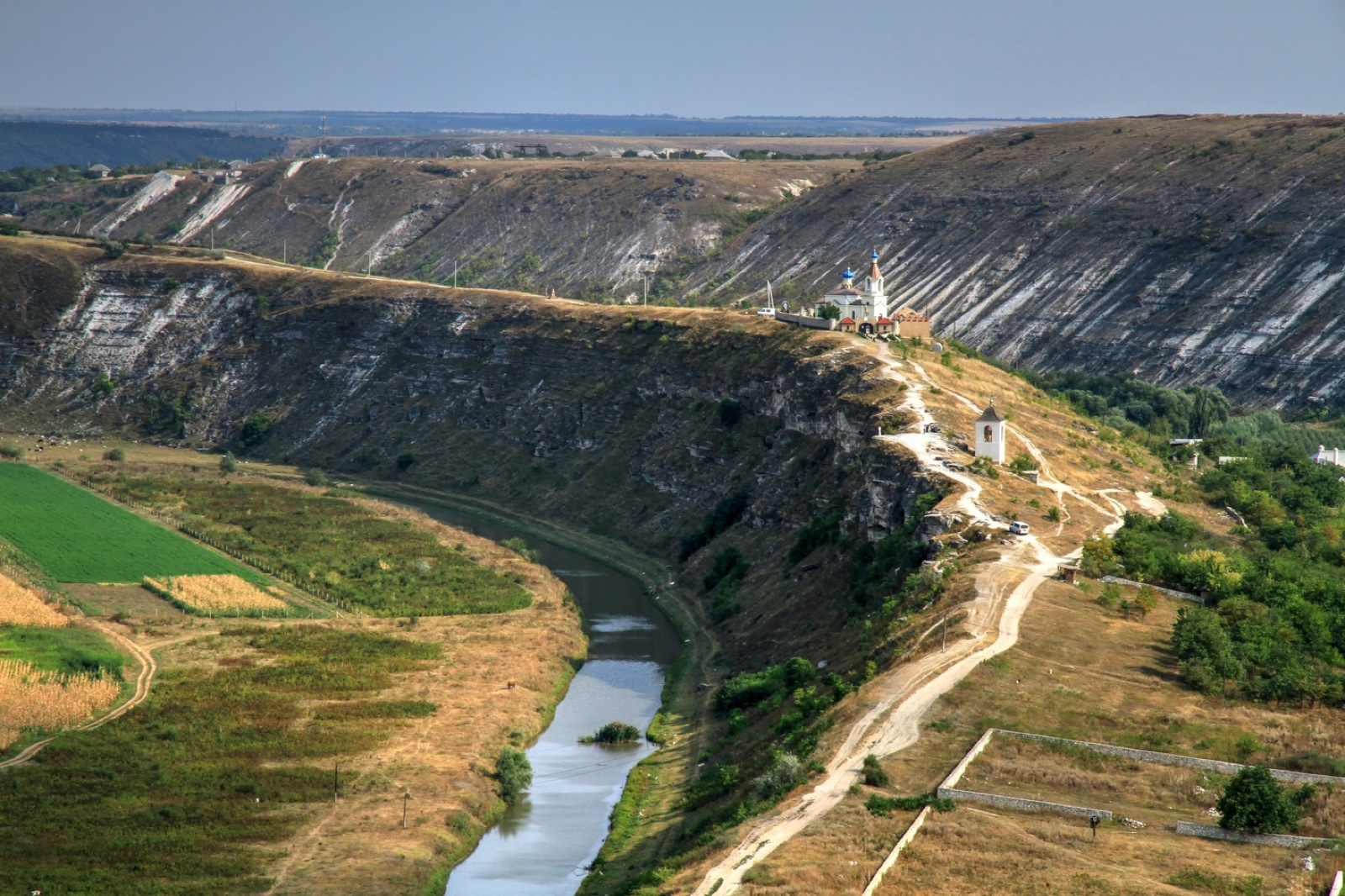
The Codri hills preserve patches of deciduous woodland among farmland and villages. Codru Reserve, established in 1971, protects forest habitats in central Moldova. The wooded Tigheci hills farther south form a different landscape, shown in this topic’s photograph. Along the Dniester and its tributaries, limestone slopes and river bends frame sites such as Orheiul Vechi, Saharna and Țipova.
The Lower Prut Biosphere Reserve, designated by UNESCO in 2018, encompasses floodplain lakes, wet meadows, reed beds and river forest in southern Moldova. Lake Beleu is an important part of this wetland system and supports migrating and nesting birds. Its water levels and access conditions vary. Soil erosion, drought, water pollution and habitat loss affect the wider countryside; a learning map cannot establish current paths, water levels or suitable visitor access.
Food of Moldova
Cornmeal, filled pastries, cabbage rolls and sour chicken soup anchor many meals.
- What is mămăligă made from?
- Cornmeal cooked with water, usually with salt, served with a variety of accompaniments.
- Are plăcinte always sweet?
- No. Fillings can be savoury, such as cheese or cabbage, or sweet, such as pumpkin or fruit.
- What is zeamă?
- A traditional sour chicken soup, commonly prepared with noodles, herbs and fermented bran liquid.
More about Moldova: food & cuisine
Mămăligă is made from cooked cornmeal and can accompany cheese, sour cream, meat or stews. Sarmale are cabbage or vine leaves wrapped around fillings such as rice and minced meat, with meat-free variations as well. Plăcinte are filled pastries, made with ingredients including cheese, potato, cabbage, pumpkin or fruit. A filling can be sweet or savoury, and recipes differ between households.
Zeamă is commonly a chicken soup with noodles and a souring ingredient such as fermented bran liquid, often scented with lovage. It belongs to everyday cooking as well as gatherings. Seasonal vegetables, preserves, bread and fruit are familiar on the table. Gagauz, Bulgarian, Ukrainian and other community cuisines add their own dishes. Moldova makes still and sparkling wines; divin is a wine brandy, rather than a grape variety.
Landmarks of Moldova
Cave monasteries, river fortresses, underground cellars and a survey point tell different stories.
- Is Orheiul Vechi in the centre of modern Orhei?
- No. The archaeological and cave-monastery landscape lies near Butuceni and Trebujeni, southeast of modern Orhei.
- What does the Rudi geodetic point commemorate?
- A station in the Struve Geodetic Arc, the multinational nineteenth-century survey chain used to measure the Earth.
- Are Cricova and Mileștii Mici medieval castles?
- No. They are wineries with underground galleries adapted from limestone workings.
More about Moldova: landmarks
Orheiul Vechi is a cultural and natural landscape around the Răut near Butuceni and Trebujeni, with archaeological remains and a cave monastery. It is separate from modern Orhei. Soroca’s circular stone fortress stands beside the Dniester, while Căpriana, Saharna and Țipova illustrate different monastic settings. Chișinău’s Nativity Cathedral and Triumphal Arch stand close together in the capital’s centre.
Cricova and Mileștii Mici occupy underground galleries adapted from limestone workings. Mimi Castle at Bulboaca and Purcari connect architecture with wine-making. Rudi’s modest geodetic marker belongs to the UNESCO-listed Struve Geodetic Arc, a survey chain across ten countries that helped measure the Earth. The sights game distinguishes an individual monument pin from a wider landscape. Bender Fortress is included for historical learning in an area covered by advice against travel to Transnistria.
People of Moldova
A multilingual population, artists and a large diaspora connect many communities.
- What does the 2024 census population figure cover?
- About 2.409 million usual residents in the census-covered territory. It excludes localities outside the constitutional authorities’ effective control and is not a count of the diaspora.
- Who was Maria Bieșu?
- A Moldovan opera soprano. The National Opera and Ballet Theatre in Chișinău bears her name.
- What was Eugen Doga known for?
- Composing music, including film scores. His work is an important part of Moldova’s musical heritage.
More about Moldova: people & society
Moldova includes people identifying as Moldovan or Romanian, alongside Ukrainian, Gagauz, Russian, Bulgarian, Roma, Jewish and other communities. Identity, citizenship and the language a person speaks are different questions. Orthodox Christianity is the largest religious tradition, alongside other faiths and people with no religious affiliation. Migration connects families with communities in Romania, Italy and many other countries.
The final 2024 census results estimated about 2.409 million usual residents in the territory covered; it could not enumerate localities outside the constitutional authorities’ effective control, including Bender and most left-bank localities. That figure is not a total for the whole internationally recognised territory or the diaspora. Cultural figures include opera singer Maria Bieșu, composer Eugen Doga and poet Grigore Vieru. Their work offers routes into music, literature and the everyday use of Romanian.