Facts about Monaco
Monaco rises from Mediterranean harbours to steep residential streets on the French Riviera. The Rock, Monte Carlo, Fontvieille and Larvotto reveal different sides of one small sovereign state. Explore eight district locations, discover sixteen sights, read ten illustrated topics and begin French.
- Capital
- Monaco
- Residents, 31 December 2024
- 38,423
- Land added at Mareterra, 2024
- 6 hectares
- State
- Sovereign principality
- Official language
- French
- Currency
- Euro (€)
- National Council
- 24 elected members
Monaco · 0 of 20 rounds passed
Two timed rounds per topic, 20 seconds a question
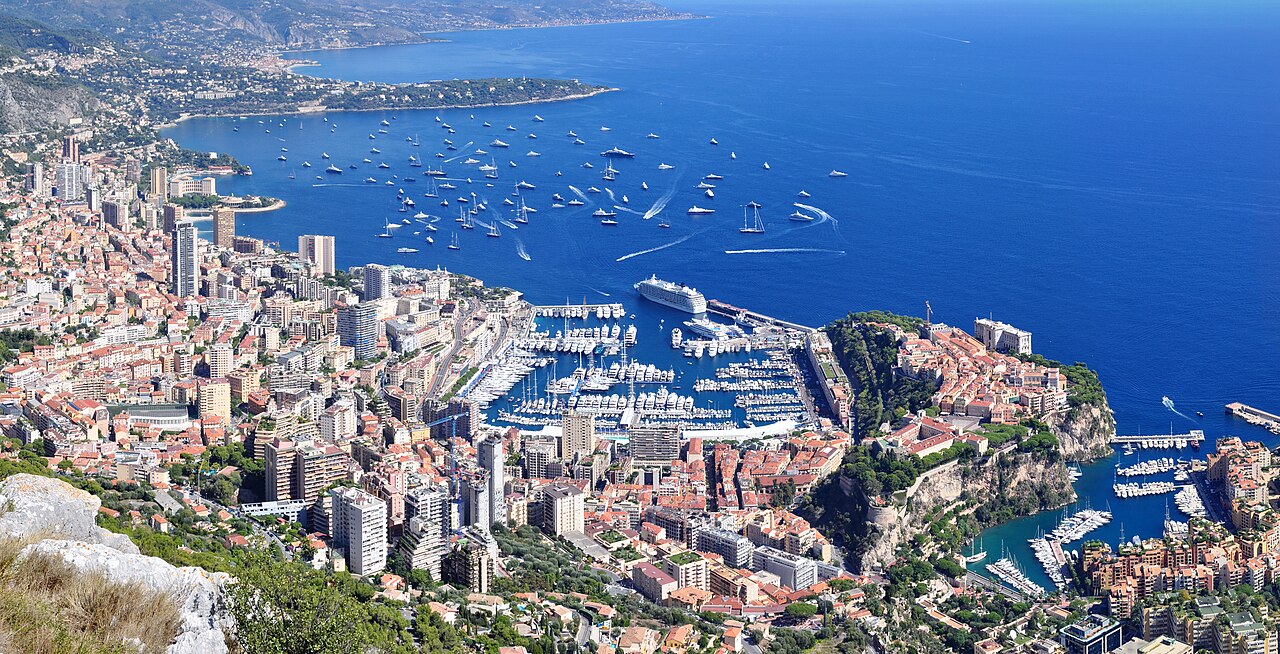
Monaco-Ville occupies the Rock above the sea, with the Prince’s Palace, cathedral and Oceanographic Museum. La Condamine wraps around Port Hercule below it. Monte Carlo climbs around the casino farther northeast, while Larvotto follows the eastern waterfront. Fontvieille, southwest of the Rock, was largely built on reclaimed land. Higher streets in Les Moneghetti, Jardin Exotique and La Rousse show how a dense city works on a steep slope.
France is Monaco’s only land neighbour; Italy is nearby but shares no border with the principality. Monaco is one municipality, and Monte Carlo is a district within it. The six-hectare Mareterra extension opened in December 2024. The map’s dated 2017 reference outline predates that project; district pins identify representative locations rather than administrative boundaries. Stairs, public lifts and buses connect places that look close together on a flat map.
Geography of Monaco
A coastal city-state whose districts climb from the sea towards France.
- Is Monte Carlo a country?
- No. It is a district within the sovereign Principality of Monaco.
- Does Monaco border Italy?
- No. France is its only land neighbour. Italy is nearby along the Riviera.
- What changed at Mareterra in 2024?
- A six-hectare extension built into the sea opened in December 2024. The map’s 2017 reference coastline predates it.
More about Monaco: geography
Monaco occupies a small stretch of Mediterranean coast between French communities including Cap-d’Ail, Beausoleil and Roquebrune-Cap-Martin. Only Vatican City is smaller among sovereign states. The Alps rise behind this part of the Riviera, leaving little level ground. Monaco-Ville stands on a rocky promontory; La Condamine surrounds Port Hercule, and Monte Carlo lies farther northeast. These are parts of the same country, rather than separate cities or states.
Land reclamation has repeatedly changed Monaco’s coast. Fontvieille grew on a major twentieth-century extension, and Mareterra added six hectares in 2024. A historical outline therefore cannot describe every present shoreline. The guide’s eight district-location pins teach relative positions without claiming to show legal district boundaries. Monaco’s railway station is underground, and public lifts and stairs are important connections between the waterfront and higher neighbourhoods.
History of Monaco
A Genoese fortress, the Grimaldis and treaties that reshaped the principality.
- What happened in 1297?
- François Grimaldi captured the fortress. Control later changed hands, so this is not a claim of uninterrupted rule from that year.
- Who protected Monaco after 1815?
- The Kingdom of Sardinia. France’s military safeguard followed the settlement of 1861.
- What did the 1861 treaty settle?
- France recognised Monaco’s sovereignty, and the transfer of Menton and Roquebrune to France was settled.
More about Monaco: history
Genoese settlers established a fortress on the Rock in 1215. François Grimaldi’s capture of it in 1297 became a founding episode in the dynasty’s story, traditionally associated with his disguise as a friar. Control changed hands afterwards, so the date does not mean uninterrupted rule from that moment. Honoré II adopted the title of prince in the seventeenth century. France annexed Monaco during the Revolutionary period, before the principality was restored in 1814.
From 1815 Monaco came under the protection of the Kingdom of Sardinia. The 1861 treaty with France recognised Monaco’s sovereignty and settled the transfer of Menton and Roquebrune to France. Casino development, the railway and Riviera tourism transformed the remaining territory. Rainier III married Grace Kelly in 1956; Albert II succeeded him in 2005. Monaco joined the United Nations in 1993 and the Council of Europe in 2004.
Language of Monaco
French is official; Monégasque preserves a distinct Ligurian heritage.
- Which language is official?
- French. Monégasque is a traditional local Ligurian variety with a separate cultural role.
- Why do some old-town street signs show two languages?
- French and Monégasque appear together on some signs, reflecting official usage and local heritage.
- Do the linked lessons teach Monégasque?
- They teach French. Bonjour and merci are French phrases, not a Monégasque course.
More about Monaco: language
French is Monaco’s official language under the constitution. Monégasque, locally written munegascu, is a traditional Ligurian variety related to speech across the nearby Italian border. It is distinct from French and from standard Italian. Preservation includes school teaching, writing and cultural associations. In Monaco-Ville, some street signs display both French and Monégasque, while official-language status belongs to French.
Italian and English are also commonly heard in an international community with many commuters and visitors. Language, nationality and residence describe different things: a French-speaking resident need not be a French citizen, and a Monégasque citizen need not use the heritage language every day. The linked lessons introduce French. Bonjour means hello, merci means thank you and au revoir means goodbye; these are French phrases rather than lessons in Monégasque.
Culture of Monaco
Saint Dévote, opera, ballet and motor racing in a small urban setting.
- Where does the Grand Prix run?
- On a temporary street circuit through Monte Carlo and La Condamine, beside Port Hercule.
- When is National Day?
- 19 November, a date retained under Albert II rather than his actual birthday.
- Is the Monaco Yacht Show a sailing race?
- It is a yacht exhibition. Monaco Classic Week is a separate maritime event.
More about Monaco: culture
Saint Dévote, Monaco’s patron saint, is honoured in January, including a ceremonial boat burning near the chapel at the head of the harbour. National Day is celebrated on 19 November. That date has been retained under Albert II and does not match his actual birthday. The Opéra de Monte-Carlo, Les Ballets de Monte-Carlo and the Monte-Carlo Philharmonic Orchestra sustain performing traditions alongside international exhibitions and festivals.
The first Monaco Grand Prix took place in 1929. Its temporary street circuit uses both Monte Carlo and La Condamine, with Port Hercule forming a familiar backdrop. It is not a permanent racetrack outside the city. The International Circus Festival of Monte-Carlo began in 1974. The Monaco Yacht Show is a yacht exhibition, while Monaco Classic Week is a separate maritime gathering; the events should not be treated as interchangeable sailing races.
Economy of Monaco
Business services, tourism and scarce land, supported by cross-border workers.
- Does Monaco use the euro because it belongs to the EU?
- No. It uses the euro through a monetary agreement with the EU and is not an EU member.
- Is gambling the whole economy?
- No. Finance, business services, property, construction, retail and tourism all contribute.
- Why distinguish residents from workers?
- Many employees commute from France and Italy, contributing to output without being counted as Monaco residents.
More about Monaco: economy
Finance, business services, construction, property, retail and tourism all contribute to Monaco’s economy. The casino shaped its international reputation, but gambling does not explain the whole economy. Fontvieille combines housing, businesses, a harbour and sports facilities on largely reclaimed ground. The shortage of land influences development, property prices and the need for infrastructure that connects densely built neighbourhoods.
Monaco uses the euro under a monetary agreement with the European Union, while remaining outside the EU. Its customs relationship with France is a separate arrangement. Many workers live in France or Italy and commute to Monaco. This makes resident population and workforce different measures, and complicates comparisons of GDP per resident. Tax treatment also depends on nationality and circumstances, including special rules for many French residents; “nobody pays tax” is misleading.
Politics of Monaco
A sovereign prince, a government and an elected twenty-four-seat council.
- How many members sit in the National Council?
- Twenty-four, elected for five-year terms. It is separate from the municipal Communal Council.
- Is Monaco only an observer at the Council of Europe?
- No. It became a full member on 5 October 2004. The Council of Europe is distinct from the EU.
- Which constitution governs Monaco?
- The constitution of 1962, revised in 2002. Monaco is a constitutional monarchy headed by a sovereign prince.
More about Monaco: politics
Monaco is a constitutional monarchy. Its constitution dates from 1962 and was revised in 2002. The sovereign prince is head of state, and a minister of state heads the government. Legislative authority is exercised jointly by the prince and the National Council, whose twenty-four members are elected for five-year terms. The Communal Council handles municipal affairs; it is a different institution from the national legislature.
Close treaties with France coexist with Monaco’s separate sovereignty. Monaco is a United Nations member and has been a full member of the Council of Europe since 5 October 2004. The Council of Europe is distinct from the European Union, which Monaco has not joined. Euro use and the open land border with France do not make Monaco an EU member or a signatory to the Schengen agreements.
Nature & Wildlife of Monaco
Marine habitats and planted gardens in a densely built coastal territory.
- What is Monaco’s carbon-neutrality target year?
- 2050. The emissions-reduction milestone for 2030 is a separate objective.
- What grows in the Jardin Exotique?
- Its collection is associated with succulents and cacti from dry regions.
- Who established the Oceanographic Museum?
- Prince Albert I. The museum was inaugurated in 1910.
More about Monaco: nature & wildlife
Monaco’s environment is primarily coastal and urban. Mediterranean summers are generally hot and dry, with more rain in the cooler part of the year. The Japanese Garden near Larvotto is a designed landscape of water, stone and planting. The Jardin Exotique is associated with succulents and cacti, rather than a tropical rainforest. Gardens provide green space within the city, while the surrounding sea supports habitats beyond the small land territory.
The Larvotto marine protected area and the nearby Pelagos Sanctuary connect Monaco with wider Mediterranean conservation. The Oceanographic Museum, inaugurated in 1910 under Albert I, presents marine science and the principality’s oceanographic history. Monaco’s legislated climate objectives include carbon neutrality in 2050; a 2030 emissions-reduction goal is a different milestone. Land reclamation also changes marine environments, so a new waterfront should not be confused with untouched natural coastline.
Food & Cuisine of Monaco
Chard-filled pastries, stockfish and flavours shared across the Riviera.
- What are barbagiuan?
- Fried pastry parcels commonly filled with chard and ricotta; recipes vary.
- What is stocafi?
- A stockfish dish cooked with ingredients such as tomatoes and olives.
- What is socca made from?
- Chickpea flour. It is shared with the food traditions of the surrounding Riviera.
More about Monaco: food & cuisine
Barbagiuan are fried pastry parcels associated with Monaco, commonly filled with chard, ricotta and other ingredients that vary by recipe. Stocafi is a stockfish dish cooked with ingredients such as tomatoes and olives. Monégasque fougasse is a festive sweet bread, distinct from the savoury versions found elsewhere. Together these foods connect local identity with the wider traditions of Provence and Liguria.
Socca is a chickpea-flour pancake familiar across the nearby Riviera, including Nice. Pissaladière, vegetables, olive oil, pasta and fish also belong to this shared food landscape. The market and food hall in La Condamine offer an everyday counterpoint to Monte Carlo’s luxury restaurants. Le Louis XV is associated with chef Alain Ducasse, but Monaco’s food culture extends well beyond its fine-dining addresses.
Landmarks of Monaco
The palace on the Rock, the casino and two very different harbours.
- Where is the Prince’s Palace?
- On the Rock in Monaco-Ville, rather than in Monte Carlo.
- Did Charles Garnier design the whole casino?
- He designed the adjoining opera hall inaugurated in 1879. The casino complex developed in several phases.
- Are Port Hercule and Fontvieille Harbour the same?
- No. Port Hercule is northeast of the Rock; Fontvieille Harbour is on its southwestern side.
More about Monaco: landmarks
The Prince’s Palace occupies the Rock in Monaco-Ville, close to the cathedral and Oceanographic Museum. The cathedral contains the tombs of Rainier III and Princess Grace; it is separate from Sainte-Dévote Chapel below the Rock. The Casino de Monte-Carlo stands northeast of Port Hercule. Charles Garnier designed the adjoining opera hall, inaugurated in 1879, rather than every part of the casino complex.
Port Hercule lies between the Rock and Monte Carlo, while Fontvieille’s smaller harbour is on the Rock’s southwestern side. The Grimaldi Forum is an exhibition and congress centre near Larvotto, not the national parliament. The Japanese Garden and Nouveau Musée National’s Villa Sauber add other nearby stops. Pins in the sights map identify learning locations; opening times and access should be checked with the relevant venue.
People & Society of Monaco
Citizens, international residents and commuters form different communities.
- How many residents were counted in 2024?
- 38,423 on 31 December 2024, according to IMSEE. The figure excludes commuters living abroad.
- Does residence automatically confer nationality?
- No. Citizenship and residence are separate legal statuses.
- Which Monaco-born driver won the 2024 home Grand Prix?
- Charles Leclerc. Louis Chiron is another notable Monégasque driver from an earlier era.
More about Monaco: people & society
IMSEE recorded 38,423 residents on 31 December 2024, including 9,262 Monégasque nationals living in Monaco. These are dated resident figures, not a count of everyone who works in the principality or all citizens living abroad. French and Italian communities are prominent among its many nationalities. Citizenship, permission to reside and employment are separate statuses; moving to Monaco does not automatically confer nationality.
Monaco-born racing driver Charles Leclerc won his home Formula One Grand Prix in 2024. Louis Chiron belongs to an earlier generation of Monégasque motor racing. Grace Kelly was an American actor before becoming Princess Grace through her marriage to Rainier III; her Academy Award was for The Country Girl. Writer Louis Notari helped establish written Monégasque literature, offering a different perspective on the principality’s cultural life.