Facts about Luxembourg
Luxembourg fits fortress valleys, steel towns, vineyards and wooded hills between Belgium, France and Germany. Its capital is a European institutional centre, while Luxembourgish, French and German shape everyday life across the grand duchy. Explore twelve cantons, sixteen cities and towns, four rivers and sixteen sights, then begin the country’s languages.
- Population, 1 January 2026
- About 691,000
- Area, national portal
- 2,586 km²
- Capital
- Luxembourg City
- National language
- Luxembourgish
- Currency
- Euro (€)
- Highest point
- Kneiff, about 560 m
Luxembourg · 0 of 20 rounds passed
Two timed rounds per topic, 20 seconds a question
Luxembourg City stands above the Alzette and Pétrusse valleys in the south-central part of the country. The Minett in the southwest grew around iron ore and steel; Esch-sur-Alzette and Belval now combine industrial heritage with university life. In the east, the Moselle marks the German frontier beside vineyards and towns such as Remich and Grevenmacher. Echternach and the Mullerthal introduce sandstone gorges and abbey history.
The northern Éislek, also called the Oesling, belongs to the Ardennes. Clervaux, Wiltz, Vianden and Esch-sur-Sûre sit among wooded ridges and winding rivers. Luxembourg is a sovereign state, separate from the Belgian province of Luxembourg. Domestic public buses, trams and second-class trains have been free since 29 February 2020; first-class rail and travel beyond the border have separate fare rules.
Geography of Luxembourg
Ardennes hills, southern plateaus and three neighbouring countries.
- Which countries border Luxembourg?
- Belgium, France and Germany. The grand duchy is landlocked and is separate from Belgium’s province of Luxembourg.
- What is Luxembourg’s highest point?
- Kneiff, near Huldange in the far north, at about 560 metres. Nearby Buurgplaatz is slightly lower.
- What are the Éislek and Gutland?
- Two broad landscape regions. The Éislek, or Oesling, is the northern Ardennes area; the Gutland covers the gentler south and centre.
More about Luxembourg: geography
Luxembourg is landlocked between Belgium to the west and north, Germany to the east and France to the south. The national portal gives an area of 2,586 square kilometres. The northern Éislek is the Luxembourg part of the Ardennes, with wooded hills and deeply cut valleys. The more gently rolling Gutland occupies the south and centre. Kneiff, near Huldange in the far north, is the highest point at about 560 metres; nearby Buurgplaatz is slightly lower.
The Our, Sûre and Moselle form sections of the eastern frontier with Germany. Water from most of the country reaches the Rhine through the Moselle system. Luxembourg City occupies plateaus above the Alzette and Pétrusse, making bridges and changes in level part of daily travel. The sandstone Mullerthal lies in the east, while iron-rich rocks shaped the Minett in the southwest. These landscape regions differ from the country’s twelve cantons and from the city game’s two learning groups.
History of Luxembourg
A castle in 963, two London treaties and a separate dynasty in 1890.
- What happened in 963?
- Count Siegfried acquired the fortified site associated with Luxembourg’s origins. The modern sovereign state did not already exist in its present form.
- How do the London treaties of 1839 and 1867 differ?
- The 1839 treaty partitioned Luxembourg and established its modern territorial form. The 1867 treaty declared neutrality, ended the Prussian garrison and required the fortress to be dismantled.
- When did Luxembourg stop sharing a monarch with the Netherlands?
- In 1890. The personal union ended when the two countries followed different succession rules.
More about Luxembourg: history
Luxembourg traces its origins to Count Siegfried’s acquisition of a fortified site in 963. The settlement grew into a county and later a duchy, and the House of Luxembourg produced Holy Roman emperors including Charles IV. Burgundy, the Habsburgs and France later controlled the fortress at different times. The Congress of Vienna created the grand duchy in 1815, linked to the Netherlands by a shared monarch. The 1839 Treaty of London partitioned it, establishing the distinction between today’s grand duchy and the Belgian province of Luxembourg.
The 1867 Treaty of London declared Luxembourg neutral, required the Prussian garrison to leave and led to the dismantling of much of the fortress. The personal union with the Netherlands ended in 1890. Germany occupied Luxembourg in both world wars. During the Second World War, Nazi rule brought persecution, deportation and forced conscription; fighting returned during the Battle of the Bulge in 1944–1945. After the war Luxembourg abandoned neutrality, helped found NATO in 1949 and joined the founding European communities in the 1950s.
Language of Luxembourg
Lëtzebuergesch is the national language in a multilingual society.
- Is Luxembourgish the same as German?
- No. Luxembourgish is the national language and has its own standard. It is a West Germanic language closely related to Moselle Franconian varieties.
- How do you greet someone in Luxembourgish?
- Moien means hello. Äddi means goodbye, and Merci is an everyday thank you. Merci villmools means thank you very much.
- Do Luxembourgish, French and German have identical legal roles?
- No. The 1984 law names Luxembourgish as the national language, permits all three in administrative and judicial matters, and assigns French to legislation.
More about Luxembourg: language
The 1984 language law names Luxembourgish, Lëtzebuergesch, as the national language. Luxembourgish, French and German may be used in administrative and judicial matters, while legislation is drafted in French. Their roles overlap: French is prominent in shops and workplaces, German in parts of the press, and Luxembourgish in conversation and public life. English and Portuguese are also widely heard. Luxembourgish belongs to the West Germanic family and is closely related to Moselle Franconian varieties across the border.
Moien means hello, Äddi means goodbye and Merci is an everyday thank you; Merci villmools means thank you very much. Language use varies with the speaker, institution and setting rather than following a simple regional border. Schooling is multilingual, with different languages used at different stages and in different programmes. The linked lessons offer an introduction to Luxembourgish, French and German. Learning one of them does not replace the other two or represent every resident’s home language.
Culture of Luxembourg
A hopping procession, a centuries-old fair and a modern arts scene.
- What happens at Echternach’s hopping procession?
- Participants move in rows to music on Whit Tuesday in honour of St Willibrord. UNESCO inscribed the tradition as intangible heritage in 2010.
- Was Luxembourg City first European Capital of Culture in 1988?
- No. It held the title in 1995 and again in 2007 with the Greater Region. Esch-sur-Alzette and its partner area followed in 2022.
- Does National Day always fall on the grand duke’s actual birthday?
- No. The sovereign’s official birthday is celebrated on 23 June, independently of the actual birthday of the reigning grand duke.
More about Luxembourg: culture
Echternach’s hopping procession takes place on Whit Tuesday in honour of St Willibrord. Participants move in rows to music in a living tradition inscribed by UNESCO in 2010. The Schueberfouer fair in Luxembourg City dates to a charter of 1340. National Day on 23 June marks the sovereign’s official birthday; the date is ceremonial and need not match the reigning grand duke’s actual birthday. Buergbrennen bonfires and spring festivities add other seasonal traditions.
Luxembourg City was European Capital of Culture in 1995 and again in 2007, the second time with the wider Greater Region. Esch-sur-Alzette and its partner area held the title in 2022. Mudam, designed by I. M. Pei, presents contemporary art near Fort Thüngen, and the Philharmonie on Kirchberg hosts an international concert programme. Luxembourg-born photographer Edward Steichen curated The Family of Man, first shown at New York’s Museum of Modern Art in 1955 and now permanently displayed at Clervaux Castle.
Economy of Luxembourg
Steelmaking roots, investment funds and a workforce crossing borders.
- Why is GDP per resident unusually high?
- A large cross-border workforce contributes to output while living outside the resident population used in the ratio. GDP per resident is not every resident’s income.
- Is all train travel free?
- Domestic second-class trains, public buses and trams have been fare-free since 29 February 2020. First-class rail and the parts of journeys outside Luxembourg follow separate fare rules.
- What does Belval show about economic change?
- Former steelmaking land now combines preserved blast furnaces with the University of Luxembourg, research, housing and other activities.
More about Luxembourg: economy
Iron ore and steel transformed southern Luxembourg during the nineteenth and twentieth centuries. The Minett’s mines, mills and railway settlements attracted workers from abroad. Finance later became a major part of the economy, including banking, insurance and investment fund administration. Satellite communications, logistics, research and digital services also contribute. Belval’s former industrial land now hosts the University of Luxembourg alongside preserved blast furnaces, showing how the southern economy has changed.
Many employees commute from France, Belgium and Germany. Their work contributes to Luxembourg’s economic output, while they are not counted in its resident population. This helps explain why GDP per resident is exceptionally high; it is not the same as the income received by every resident. Luxembourg adopted the euro for accounting in 1999 and euro cash in 2002. Domestic public buses, trams and second-class trains became fare-free on 29 February 2020, while first-class rail and cross-border fares require separate attention.
Politics of Luxembourg
A parliamentary grand duchy and a founding participant in European integration.
- How many members sit in the Chamber of Deputies?
- Sixty, elected for five-year terms. The Council of State is advisory, not a second elected parliamentary chamber.
- Was the Schengen Agreement signed in Luxembourg City?
- No. It was signed in 1985 aboard the Princesse Marie-Astrid on the Moselle near the village of Schengen.
- Are the European courts in Luxembourg and Strasbourg the same?
- No. Luxembourg hosts the Court of Justice of the European Union. The European Court of Human Rights, a Council of Europe institution, is in Strasbourg.
More about Luxembourg: politics
Luxembourg is a parliamentary constitutional monarchy whose head of state bears the title Grand Duke. The prime minister leads the government, which is accountable to the elected Chamber of Deputies. The Chamber has sixty members elected for five-year terms. The Council of State is an advisory institution rather than a second elected parliamentary chamber. Local administration is organised through communes; the twelve cantons should not be confused with the four parliamentary constituencies.
Luxembourg was a founding member of NATO, the European Coal and Steel Community and the European Economic Community. Luxembourg City hosts the Court of Justice of the European Union, the European Court of Auditors and the European Investment Bank, among other European bodies. The 1985 Schengen Agreement takes its name from the Moselle village where representatives signed aboard the ship Princesse Marie-Astrid. Signing the agreement in 1985 and implementing passport-free travel in 1995 were separate events.
Nature & Wildlife of Luxembourg
Sandstone gorges, reservoir waters and former mining land reclaimed by nature.
- Is Upper Sûre Lake natural?
- It is a reservoir formed by damming the Sûre. It has important drinking-water and recreational functions.
- Why is Mullerthal called Little Switzerland?
- Its sandstone cliffs, wooded gorges and rock passages inspired the nickname. It is not an alpine mountain region.
- Is the Minett a UNESCO World Heritage property?
- It is a UNESCO Biosphere area. That designation differs from the World Heritage listing for Luxembourg City’s old quarters and fortifications.
More about Luxembourg: nature & wildlife
The Éislek’s forests and valleys form the setting for the Our and Upper Sûre nature parks. Upper Sûre Lake is a reservoir, created by damming the river, and is important for drinking-water supply as well as recreation. The eastern Mullerthal landscape is known for sandstone walls, narrow passages and waterfalls such as Schiessentümpel. Its nickname, Little Switzerland, describes a rocky landscape rather than alpine elevation.
In the southwest, former iron-ore sites now support distinctive grasslands, woodland and industrial habitats within the Minett UNESCO Biosphere area. Orchids, bats and woodland birds are among the organisms associated with Luxembourg’s varied habitats. Vineyards line sunny slopes beside the Moselle, while river corridors connect the small country with neighbouring ecosystems. Nature parks, biosphere recognition and World Heritage are different designations, each with its own purpose.
Food & Cuisine of Luxembourg
Smoked pork and broad beans, potato fritters and Moselle wines.
- What is Judd mat Gaardebounen?
- Smoked pork collar served with broad beans, one of Luxembourg’s familiar traditional dishes.
- What are Gromperekichelcher and Kniddelen?
- Gromperekichelcher are potato fritters. Kniddelen are dumplings made from flour and eggs, often served with bacon or sauce.
- Is Crémant de Luxembourg Champagne?
- No. It uses the traditional bottle-fermentation method, but Champagne is a protected name for wines from the Champagne region of France.
More about Luxembourg: food & cuisine
Judd mat Gaardebounen combines smoked pork collar with broad beans and is one of Luxembourg’s best-known dishes. Gromperekichelcher are crisp potato fritters often sold at fairs and markets. Kniddelen are flour-and-egg dumplings, commonly served with bacon or sauce. Rieslingspaschtéit is a meat pie with wine-flavoured jelly. These dishes sit within a food culture shaped by neighbouring French, German and Belgian traditions and by migration.
Quetschentaart is a plum tart associated with the late-summer harvest. Along the Moselle, producers make white wines including Riesling and Pinot Gris, as well as Crémant de Luxembourg. Crémant is sparkling wine made by the traditional method, with a second fermentation in the bottle; it is not Champagne, which is a protected regional name. Beer brewing also has a long history, and Portuguese and other international food traditions are part of contemporary daily life.
Landmarks of Luxembourg
Fortifications, restored castles and a university among old steelworks.
- Where is The Family of Man displayed?
- At Clervaux Castle. The Benedictine abbey above Clervaux is a different building.
- Which valley does the Adolphe Bridge cross?
- The Pétrusse valley in Luxembourg City. The Moselle runs along the country’s eastern border.
- Are Esch-sur-Sûre and Esch-sur-Alzette the same town?
- No. Esch-sur-Sûre is a northern village on a river bend. Esch-sur-Alzette is the country’s second-largest city in the southern former mining region.
More about Luxembourg: landmarks
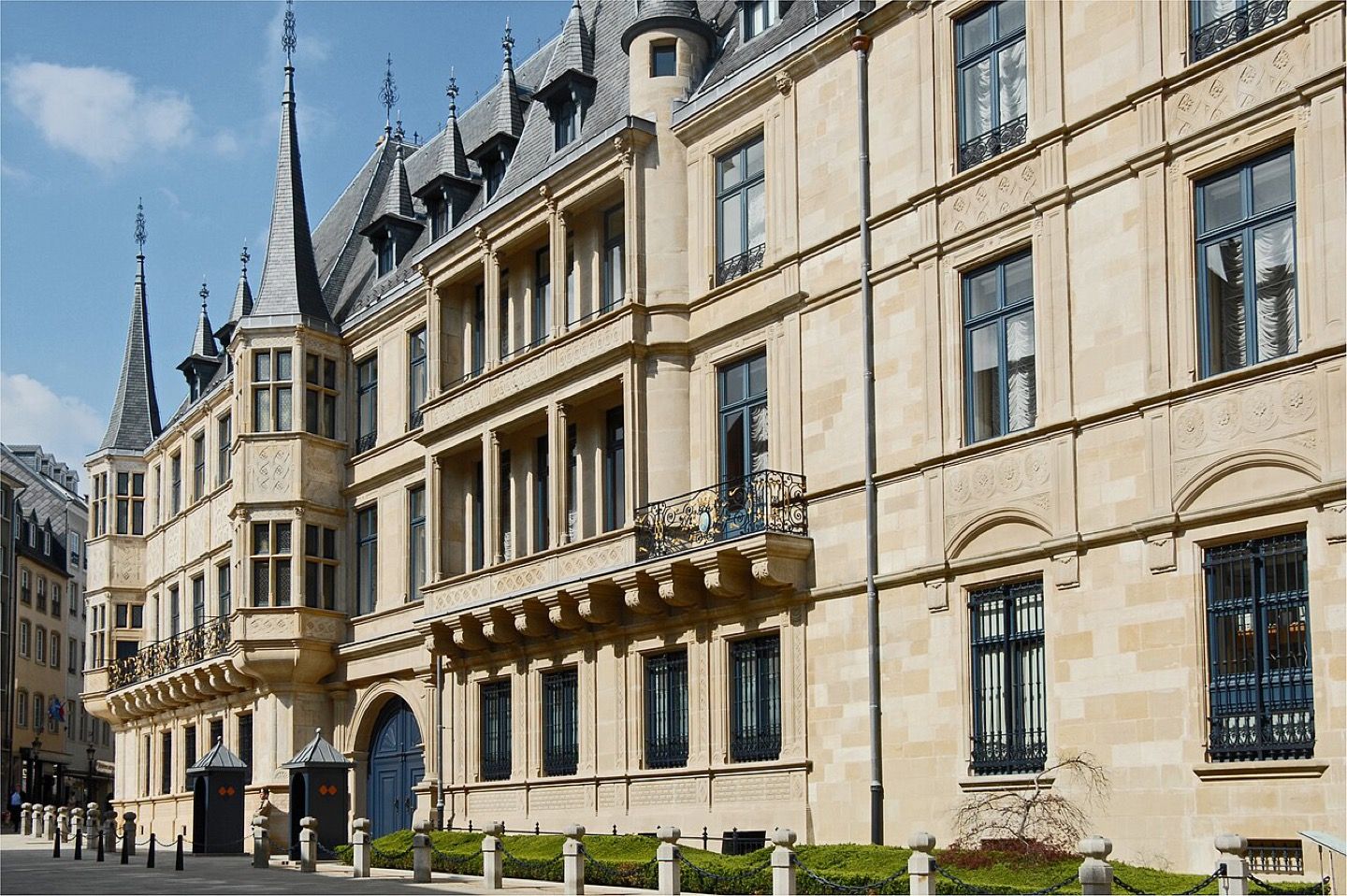
Luxembourg City’s old quarters and fortifications form the country’s UNESCO World Heritage property. The Bock Casemates, surviving walls and valley viewpoints reveal why the fortress once had such strategic importance. The Grand Ducal Palace and Chamber of Deputies stand close together in the upper town; Notre-Dame Cathedral and the Adolphe Bridge connect other chapters of the capital’s history. The bridge crosses the Pétrusse valley, not the Moselle.
Vianden Castle overlooks the Our valley, while Bourscheid and Beaufort preserve different forms of castle architecture. Echternach’s basilica and former abbey recall its religious history. Clervaux Castle, distinct from the abbey above the town, houses The Family of Man. Farther south, Belval’s blast furnaces and Rumelange’s National Mining Museum introduce industrial heritage. Schengen’s European museum connects a small riverside village with the history of European borders.
People & Society of Luxembourg
An international population shaped by emigration, industry and commuting.
- How many people live in Luxembourg?
- About 691,000 on 1 January 2026, according to the national portal. Workers commuting from neighbouring countries are not included as residents.
- What does the foreign-national share measure?
- Citizenship. The national portal gives 46.6 percent on 1 January 2026; that is different from the share of people with a migration background or a particular home language.
- Which Luxembourg-born photographer curated The Family of Man?
- Edward Steichen. He grew up in the United States and curated the exhibition for New York’s Museum of Modern Art in 1955.
More about Luxembourg: people & society
The national portal reports about 691,000 residents on 1 January 2026, with 46.6 percent holding a foreign nationality. This is a measure of citizenship, not a count of languages, ancestry or cultural identity. Portuguese, French, Italian, Belgian and German communities have helped shape contemporary Luxembourg. Cross-border workers form a separate population of people who work in Luxembourg while living in a neighbouring state.
Luxembourg was once a country of emigration before industrialisation attracted workers and their families. Edward Steichen was born in Bivange and moved to the United States as a child. Gabriel Lippmann, born in Luxembourg, received the 1908 Nobel Prize in Physics for his interference-based colour photography method. Robert Schuman was born in Luxembourg but became a French statesman. Cyclist Charly Gaul won the 1958 Tour de France, adding a different strand to the country’s international story.