Facts about Lithuania
Explore Lithuania from Vilnius’s baroque streets and Kaunas’s modernist avenues to the Curonian dunes, northern pilgrimage sites and eastern lakes. Learn ten counties, place sixteen cities and towns, explore rivers and coastal waters, discover sixteen sights, read ten illustrated topics and begin Lithuanian.
- Capital
- Vilnius
- Population, 2021 census
- 2,810,761
- Official language
- Lithuanian
- Currency
- Euro (€)
- Counties / municipalities
- 10 / 60
- EU and NATO member since
- 2004
Lithuania · 0 of 20 rounds passed
Two timed rounds per topic, 20 seconds a question
Lithuania’s short Baltic coast opens into the Curonian Lagoon, while the Nemunas and Neris connect inland cities with forested valleys. Travel east towards Aukštaitija’s lakes, west through Samogitia or south into Dzūkija to encounter distinct regional landscapes.
Learn sixteen settlement locations and sixteen heritage and landscape sights, then connect the map with history, food, institutions and daily life. The learning groups organise places rather than teaching county boundaries.
Baltic shores, glacial lakes and the Nemunas
Lithuania lies on the southeastern shore of the Baltic Sea. Latvia borders it to the north, Belarus to the east and south, Poland to the southwest and Russia’s Kaliningrad exclave to the southwest. Vilnius stands inland near the Neris and Vilnia rivers. Kaunas lies at the meeting of the Neris and Nemunas, while Klaipėda is the main seaport.
- Is Vilnius a coastal city?
- No. Vilnius is inland; Klaipėda is the principal seaport.
- Which countries border Lithuania?
- Latvia, Belarus, Poland and Russia through its Kaliningrad exclave.
- Is the entire Curonian Spit Lithuanian?
- No. Its northern part is in Lithuania and its southern part is in Russia’s Kaliningrad region.
More about Lithuania: geography
Lithuania lies on the southeastern shore of the Baltic Sea. Latvia borders it to the north, Belarus to the east and south, Poland to the southwest and Russia’s Kaliningrad exclave to the southwest. Vilnius stands inland near the Neris and Vilnia rivers. Kaunas lies at the meeting of the Neris and Nemunas, while Klaipėda is the main seaport.
Glaciers shaped the lowlands, rolling uplands and lake districts. Aukštaitija in the east has many lakes; Žemaitija, or Samogitia, occupies much of the west. The Curonian Spit separates the Curonian Lagoon from the Baltic and is shared with Russia. Lithuania has ten counties and sixty municipalities; the city map’s two learning groups do not represent administrative boundaries.
A grand duchy and two independence anniversaries
Mindaugas was crowned king in 1253. The Grand Duchy of Lithuania later expanded far beyond the borders of today’s country and included many Ruthenian lands. The 1386 union through Jogaila’s marriage linked its dynasty with Poland; the Union of Lublin in 1569 created the Polish–Lithuanian Commonwealth. Most Lithuanian lands entered the Russian Empire after the Commonwealth’s final partition in 1795.
- Why are both 16 February and 11 March commemorated?
- 16 February marks the 1918 independence declaration; 11 March marks the 1990 re-establishment of independence.
- What happened in 1569?
- The Union of Lublin established the Polish–Lithuanian Commonwealth.
- What was the Baltic Way?
- A peaceful human chain through Lithuania, Latvia and Estonia on 23 August 1989, marking fifty years since the Molotov–Ribbentrop Pact.
More about Lithuania: history
Mindaugas was crowned king in 1253. The Grand Duchy of Lithuania later expanded far beyond the borders of today’s country and included many Ruthenian lands. The 1386 union through Jogaila’s marriage linked its dynasty with Poland; the Union of Lublin in 1569 created the Polish–Lithuanian Commonwealth. Most Lithuanian lands entered the Russian Empire after the Commonwealth’s final partition in 1795.
The Council of Lithuania declared the restoration of an independent state on 16 February 1918. Soviet occupation and annexation in 1940 were followed by Nazi German occupation in 1941 and renewed Soviet rule in 1944. The Holocaust destroyed most of Lithuania’s Jewish community. Soviet deportations and repression also left deep scars. Lithuania proclaimed the re-establishment of independence on 11 March 1990; Soviet forces killed civilians in Vilnius in January 1991, before broad international recognition later that year.
A living Baltic language
Lithuanian is the official language and belongs to the Baltic branch of the Indo-European family. Latvian is its closest surviving relative. Estonian belongs to a different family, Uralic. Lithuanian preserves grammatical features valuable to historical linguists, but it is a modern language that continues to change, rather than an unchanged ancient tongue.
- Is Lithuanian Slavic?
- No. It is an Indo-European Baltic language, related most closely to Latvian.
- How do you say thank you?
- Ačiū means thank you; labas is a familiar greeting.
- Is Estonian closely related to Lithuanian?
- No. Estonian is Uralic and Finnic; Lithuanian is Indo-European and Baltic.
More about Lithuania: language
Lithuanian is the official language and belongs to the Baltic branch of the Indo-European family. Latvian is its closest surviving relative. Estonian belongs to a different family, Uralic. Lithuanian preserves grammatical features valuable to historical linguists, but it is a modern language that continues to change, rather than an unchanged ancient tongue.
The Latin-based alphabet includes ą, č, ę, ė, į, š, ų, ū and ž. Labas means hello and ačiū means thank you. Nouns change form through grammatical cases, and stress and vowel length matter in pronunciation. Aukštaitian and Samogitian are major dialect groupings. Polish, Russian and other languages are spoken in Lithuania too; the linked lessons introduce standard Lithuanian.
Song celebrations, midsummer and basketball
Lithuania’s song celebration tradition began with a national festival in Kaunas in 1924. Large choirs, dance groups and instrumental ensembles gather for performances that connect local societies with national cultural life. UNESCO recognises the Baltic song and dance celebrations jointly across Lithuania, Latvia and Estonia. Sutartinės, a Lithuanian multipart singing tradition, have separate UNESCO recognition.
- What are sutartinės?
- A Lithuanian multipart singing tradition recognised by UNESCO.
- What does Joninės celebrate?
- Midsummer, with traditions including wreaths, bonfires and gatherings.
- Which sport is especially prominent?
- Basketball has a particularly strong following and international history.
More about Lithuania: culture
Lithuania’s song celebration tradition began with a national festival in Kaunas in 1924. Large choirs, dance groups and instrumental ensembles gather for performances that connect local societies with national cultural life. UNESCO recognises the Baltic song and dance celebrations jointly across Lithuania, Latvia and Estonia. Sutartinės, a Lithuanian multipart singing tradition, have separate UNESCO recognition.
Joninės, also called Rasos, marks midsummer with gatherings, wreaths and bonfires. Cross-crafting combines wooden crosses, craftsmanship and devotional traditions. Basketball has a prominent place in public life, from neighbourhood courts to international competitions. Literature, theatre, cinema and the painting and music of Mikalojus Konstantinas Čiurlionis offer other ways into a culture that varies by region and generation.
Ports, manufacturing and city services
Lithuania’s economy combines services, manufacturing, transport and agriculture. Vilnius is a centre for finance, information technology and business services; Kaunas combines industry, education and logistics. Klaipėda’s ice-free port connects maritime trade with inland transport. Food processing, furniture, engineering and laser technology are among the country’s industries, while grain and dairy production link rural areas with export markets.
- When did Lithuania adopt the euro?
- On 1 January 2015, replacing the litas.
- Which city is the main seaport?
- Klaipėda, on the Baltic coast at the entrance to the Curonian Lagoon.
- What does Lithuania produce besides amber crafts?
- Its industries include food processing, furniture, engineering and laser technology, alongside a substantial services sector.
More about Lithuania: economy
Lithuania’s economy combines services, manufacturing, transport and agriculture. Vilnius is a centre for finance, information technology and business services; Kaunas combines industry, education and logistics. Klaipėda’s ice-free port connects maritime trade with inland transport. Food processing, furniture, engineering and laser technology are among the country’s industries, while grain and dairy production link rural areas with export markets.
Lithuania joined the European Union in 2004 and adopted the euro on 1 January 2015, replacing the litas. These were separate steps in integration with European markets. Amber has a long history as a Baltic craft and trade material, although it represents only a small part of the modern economy. Emigration, returning residents and demand for skilled workers influence labour markets; city growth and rural opportunities differ.
The Seimas, presidency and European memberships
Lithuania is a republic governed under the constitution adopted in 1992. The Seimas is its 141-member unicameral parliament. The president is directly elected and serves as head of state, with an important role in foreign and security policy. The prime minister leads the government, whose formation requires the constitutional involvement of the president and Seimas.
- What is Lithuania’s parliament called?
- The Seimas, a unicameral parliament with 141 members.
- Is the president directly elected?
- Yes. The president is head of state; the prime minister leads the government.
- Did EU membership and euro adoption happen together?
- No. Lithuania joined the EU in 2004 and adopted the euro in 2015.
More about Lithuania: politics
Lithuania is a republic governed under the constitution adopted in 1992. The Seimas is its 141-member unicameral parliament. The president is directly elected and serves as head of state, with an important role in foreign and security policy. The prime minister leads the government, whose formation requires the constitutional involvement of the president and Seimas.
Lithuania joined NATO on 29 March 2004 and the European Union on 1 May 2004. Euro adoption followed in 2015. Municipal councils and mayors deal with local government, while counties are a different territorial level. The national flag has horizontal yellow, green and red bands; the Vytis, an armoured horseman, appears on the coat of arms. This country guide introduces institutions rather than providing a naturalisation exam preparation course.
Dunes, wetlands and forest lakes
Aukštaitija National Park protects a landscape of lakes, forests and villages in the east. Dzūkija in the south has sandy soils, pine forests and river valleys, with longstanding mushroom and berry gathering traditions. Žemaitija National Park surrounds Lake Plateliai in the west. These landscapes reflect both ecological processes and centuries of settlement and land use.
- Where are the eastern forest lakes?
- Aukštaitija National Park is one of Lithuania’s best-known lake and forest landscapes.
- Why is the Nemunas Delta important for birds?
- Its wetlands and flood meadows offer feeding and resting habitats along migration routes.
- Can visitors walk anywhere on the Curonian dunes?
- No. Use designated paths and follow protected-area rules to avoid damaging fragile dune habitats.
More about Lithuania: nature & wildlife
Aukštaitija National Park protects a landscape of lakes, forests and villages in the east. Dzūkija in the south has sandy soils, pine forests and river valleys, with longstanding mushroom and berry gathering traditions. Žemaitija National Park surrounds Lake Plateliai in the west. These landscapes reflect both ecological processes and centuries of settlement and land use.
The Curonian Spit’s dunes and pinewoods form a narrow coastal landscape shaped by wind, sand and human efforts to stabilise it. The Nemunas Delta has wetlands and flood meadows important to migrating birds, with Ventė Cape known for bird ringing. Žuvintas is a biosphere reserve with lake, marsh and meadow habitats. Stay on designated dune paths and protected-area routes: a landscape pin identifies a place, not a trailhead or a permitted route.
Rye bread, cepelinai and pink beet soup
Dark rye bread is a familiar staple. Potatoes, dairy products, pork, grains, mushrooms and berries feature in many traditional dishes. Cepelinai are large potato dumplings commonly filled with meat or curd. Šaltibarščiai is a cold pink beetroot soup usually made with cultured dairy, cucumber and herbs and served with hot potatoes. Recipes and everyday diets vary between households.
- What are cepelinai?
- Large potato dumplings, often filled with meat or curd.
- What gives šaltibarščiai its pink colour?
- Beetroot, mixed with cultured dairy and other ingredients.
- What are kibinai associated with?
- The Karaim community, especially in Trakai; they are filled pastries with a distinct local history.
More about Lithuania: food & cuisine
Dark rye bread is a familiar staple. Potatoes, dairy products, pork, grains, mushrooms and berries feature in many traditional dishes. Cepelinai are large potato dumplings commonly filled with meat or curd. Šaltibarščiai is a cold pink beetroot soup usually made with cultured dairy, cucumber and herbs and served with hot potatoes. Recipes and everyday diets vary between households.
Kugelis is a baked potato pudding, while šakotis is a branching spit cake associated with celebrations. In Trakai, kibinai pastries connect local food with the country’s Karaim community; they should not be treated as evidence that every Lithuanian household shares the same tradition. Farmers’ markets, contemporary restaurants and vegetarian cooking add to a food culture shaped by Baltic, neighbouring and minority influences.
Baroque Vilnius, modernist Kaunas and Trakai
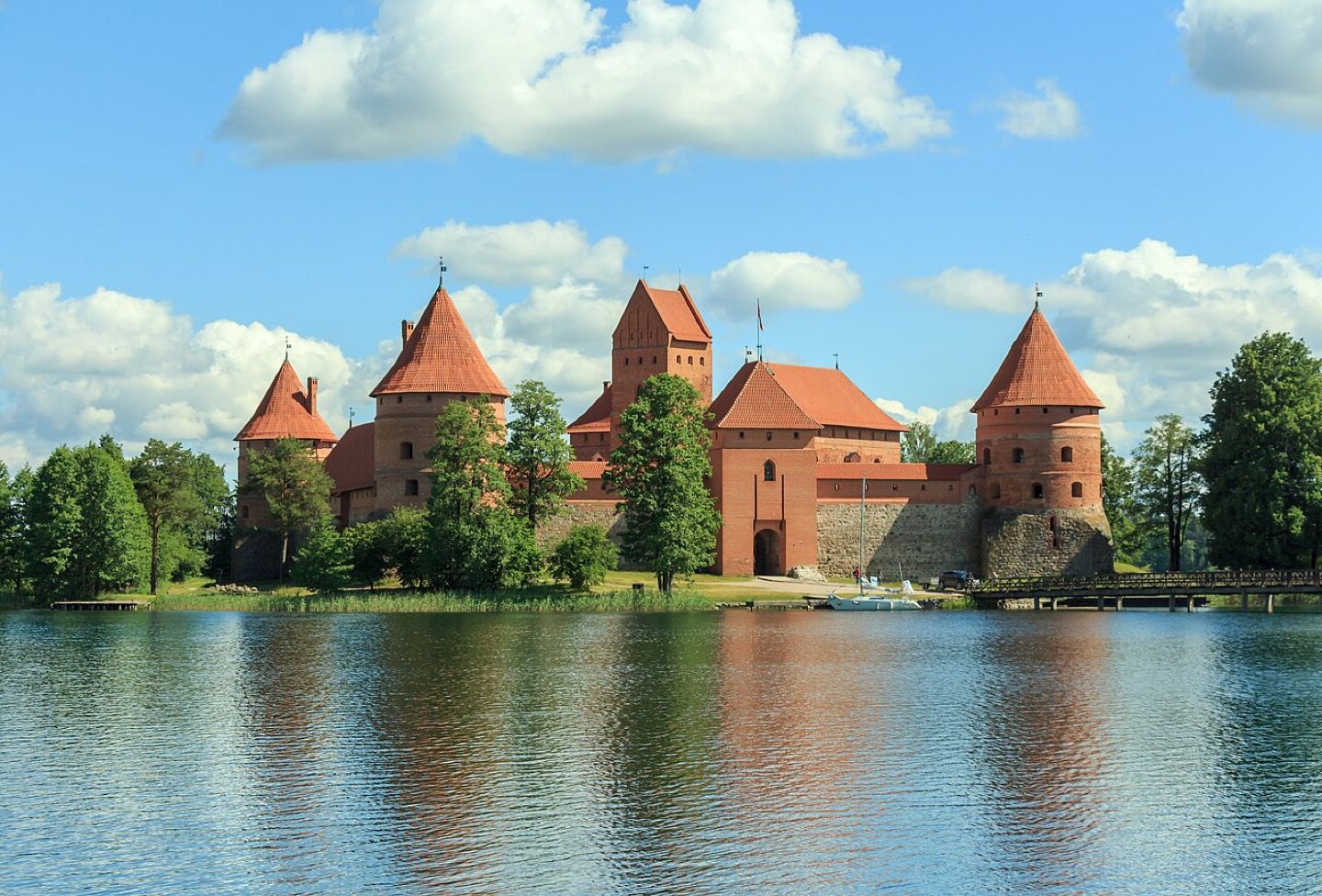
Vilnius’s UNESCO-listed historic centre brings together winding streets, churches and the historic university. Its baroque architecture sits within a city shaped by Lithuanian, Polish, Jewish and other communities. Trakai Island Castle stands on an island in Lake Galvė west of Vilnius. The reconstructed castle evokes the grand-ducal past, while the nearby town preserves Karaim heritage.
- Which city has UNESCO-listed interwar modernism?
- Kaunas, whose listed modernist architecture dates to 1919–1939.
- Where is Trakai Island Castle?
- On an island in Lake Galvė, west of Vilnius.
- What is Kernavė known for?
- Its archaeological landscape and hillforts, associated with early settlement and medieval Lithuania.
More about Lithuania: landmarks
Vilnius’s UNESCO-listed historic centre brings together winding streets, churches and the historic university. Its baroque architecture sits within a city shaped by Lithuanian, Polish, Jewish and other communities. Trakai Island Castle stands on an island in Lake Galvė west of Vilnius. The reconstructed castle evokes the grand-ducal past, while the nearby town preserves Karaim heritage.
Kaunas served as the temporary capital during the interwar period, when Vilnius was under Polish control. Its modernist architecture from 1919–1939 is a UNESCO World Heritage property. Kernavė’s hillforts form an archaeological landscape of early settlement and medieval power. The Hill of Crosses near Šiauliai is a living pilgrimage site, and the Curonian Spit combines cultural history with dunes and fishing settlements. Heritage designations describe specific properties, not entire surrounding regions.
Regional identities and a global diaspora
Lithuania’s 2021 census counted 2,810,761 usual residents. This is a dated census count rather than a current population estimate. Vilnius is the largest city, followed by Kaunas and Klaipėda. Ethnic Lithuanians form the majority; Polish, Russian, Belarusian, Ukrainian and other communities contribute to the country’s society. Language, ethnic identity and citizenship describe different aspects of a person’s life.
- What population figure does this guide use?
- The 2021 census count of 2,810,761 usual residents, not a current estimate.
- Do historical regions match county boundaries?
- No. Cultural regions and modern administrative divisions are different ways of describing the country.
- What does Litvak refer to?
- Jewish people and traditions rooted in historical Lithuania, whose territory extended beyond today’s borders.
More about Lithuania: people & society
Lithuania’s 2021 census counted 2,810,761 usual residents. This is a dated census count rather than a current population estimate. Vilnius is the largest city, followed by Kaunas and Klaipėda. Ethnic Lithuanians form the majority; Polish, Russian, Belarusian, Ukrainian and other communities contribute to the country’s society. Language, ethnic identity and citizenship describe different aspects of a person’s life.
Historical regions include Aukštaitija, Žemaitija, Dzūkija, Suvalkija and Lithuania Minor, with cultural boundaries that do not simply match modern counties. Jewish Lithuanian, or Litvak, heritage is part of the country’s history despite the devastating losses of the Holocaust. Karaim and Tatar communities also have deep roots. Emigration and diaspora networks have connected families with North America, Britain, Ireland and many other places; return migration also shapes contemporary life.