Facts about Sri Lanka
Sri Lanka brings ancient reservoir cities, tea-growing highlands and Indian Ocean shores into a compact island. Explore Colombo and Kotte, Kandy’s sacred landscape, Jaffna’s peninsula and Galle’s fort, with Sinhala and Tamil histories woven through the journey.
- Capital
- Colombo
- Legislative capital
- Sri Jayewardenepura Kotte
- Commercial centre
- Colombo
- Currency
- Sri Lankan rupee (LKR)
- Official languages
- Sinhala and Tamil
- Administration
- 9 provinces · 25 districts
- Independence
- 4 February 1948
Sri Lanka · 0 of 20 rounds passed
Two timed rounds per topic, 20 seconds a question
The central hills rise above coastal plains and the northern dry zone. Anuradhapura and Polonnaruwa lead into the island’s ancient kingdoms; Sigiriya and Dambulla stand nearby. Nuwara Eliya and Ella connect tea country with highland railways, while Trincomalee and Batticaloa open onto the eastern coast. The monsoons affect each region differently.
Three map games teach all nine provinces, twenty cities and towns, and six selected waters. Sixteen sights locate temples, archaeological landscapes, forests and coastal landmarks. Ten illustrated topics share their reading with the facts course and answer thirty common questions. Sinhala lessons introduce one of the country’s two official languages; Tamil is equally part of its linguistic life.
An island of monsoons, highlands and coastal plains
Nine provinces connect a dry northern plain, a wetter southwest and the central highlands.
- Does Sri Lanka share a land border with India?
- No. The Palk Strait and Gulf of Mannar separate the island from India. Adam’s Bridge is a chain of shoals, not an open land crossing.
- What is Sri Lanka’s capital?
- Sri Jayewardenepura Kotte is the legislative capital and seat of Parliament. Colombo remains the principal commercial city and an important centre of government activity.
- How is Sri Lanka divided administratively?
- Into nine provinces and twenty-five districts. The provinces map teaches the first level; a province is larger than a city or district with a similar name.
More about Sri Lanka: geography
Sri Lanka lies in the Indian Ocean off southeastern India, separated from it by the Palk Strait and Gulf of Mannar. The island has no land border. Coastal plains surround a mountainous south-central interior, whose highest point is Pidurutalagala at 2,524 metres. Rivers flow out from these uplands; the Mahaweli, the longest, turns northeast towards the sea near Trincomalee. Ancient reservoirs, often called tanks, store water across the drier plains.
The country has nine provinces and twenty-five districts. Colombo is its principal commercial city; nearby Sri Jayewardenepura Kotte is the legislative capital and home of Parliament. Kandy occupies the central hills, Jaffna the far northern peninsula, and Galle the southwest coast. Southwest and northeast monsoons bring different rainfall patterns: the southwest is generally wetter, while much of the north and east forms the dry zone. A season suitable for one coast may bring rough seas or heavy rain to the other.
Ancient kingdoms, colonial Ceylon and independence
Anuradhapura and Polonnaruwa precede centuries of maritime contact and colonial rule.
- When did Sri Lanka become independent?
- On 4 February 1948, as Ceylon. It became a republic and adopted the name Sri Lanka in 1972.
- Why are Anuradhapura and Polonnaruwa important?
- They were major capitals with royal, Buddhist and irrigation landscapes. Anuradhapura’s history is earlier; Polonnaruwa became especially prominent in the medieval period.
- When did Sri Lanka’s civil war end?
- In 2009. The war is commonly dated from 1983; its end did not resolve all questions about missing people, displacement, accountability and reconciliation.
More about Sri Lanka: history
Anuradhapura developed into a major royal and Buddhist centre in the first millennium BCE. Reservoirs, monasteries and long-distance trade linked the dry-zone kingdoms with the wider Indian Ocean. Buddhism became established in the third century BCE according to the island’s chronicles. Polonnaruwa later flourished as a medieval capital. The island’s past also includes Tamil kingdoms, South Indian connections, Muslim trading communities and shifting regional centres; it cannot be reduced to a single uninterrupted kingdom.
Portuguese influence began on the coast in the early sixteenth century, followed by Dutch and then British rule. Britain took the Kandyan kingdom in 1815 and governed the whole island as Ceylon. Independence came on 4 February 1948; the republic adopted the name Sri Lanka in 1972. Language policies, discrimination and competing nationalisms contributed to a civil war between the state and the LTTE from 1983 to 2009. Its civilian losses, displacement and unresolved questions of accountability remain central to understanding the country.
Sinhala, Tamil and the role of English
Two official languages use distinct scripts; English has constitutional status as the link language.
- What are Sri Lanka’s official languages?
- Sinhala and Tamil. The Constitution also recognises English as the link language.
- Are Sinhala and Tamil closely related languages?
- They belong to different families: Sinhala is Indo-Aryan and Tamil is Dravidian. Each has its own script and literary traditions.
- Do the guide’s Sinhala lessons teach every Sri Lankan language?
- They teach Sinhala. Tamil is also official and central to many communities; English and other community languages have distinct roles.
More about Sri Lanka: language
Sinhala and Tamil are Sri Lanka’s official languages and national languages. English is the link language under the Constitution and is widely used in parts of education, business and administration. Sinhala belongs to the Indo-Aryan branch of languages, while Tamil is Dravidian. Their scripts are different too: Sinhala’s rounded letters do not form a version of the Tamil alphabet. A shared country does not mean a shared mother tongue.
Sinhala is the majority language. Tamil is especially important in the north and east and among Malaiyaha, or Hill Country, Tamil communities; many Sri Lankan Muslims also use Tamil. Place names may appear in Sinhala, Tamil and English, with different spellings and historical forms. The linked Sinhala lessons introduce everyday expressions such as ayubowan. They are a starting point in one language, while a visit to Jaffna or Batticaloa offers a different linguistic setting.
Living religious traditions and an island’s festivals
Buddhist, Hindu, Muslim and Christian traditions shape festivals, arts and public life.
- What is a Poya day?
- A full-moon public holiday associated with Buddhist observance. Different Poya days commemorate different events in Buddhist history and tradition.
- What is the Esala Perahera?
- A major annual ceremonial procession in Kandy, involving dancers, drummers and religious observances associated with the Temple of the Tooth and nearby shrines.
- Which Sri Lankan crafts and performances are UNESCO living heritage?
- Examples include Rukada Natya string-puppet drama and traditional Dumbara mat weaving. Living heritage concerns practices and knowledge, distinct from UNESCO World Heritage places.
More about Sri Lanka: culture
Theravada Buddhism has a prominent place in Sri Lanka, alongside Hinduism, Islam and Christianity. Poya full-moon days are public holidays, and Vesak marks the Buddha’s birth, enlightenment and passing with lanterns and acts of giving. Sinhala and Tamil New Year falls in April, while Thai Pongal, Deepavali, Eid and Christmas belong to other important calendars. A festival’s meaning depends on the community and place celebrating it.
Kandyan dance, low-country dance and Sabaragamuwa dance have distinct traditions. Kandy’s Esala Perahera brings drummers, dancers and ceremonial processions into the city’s streets. Rukada Natya, traditional string-puppet drama, is recognised by UNESCO as living heritage, as is Dumbara mat weaving. Cricket provides another shared cultural reference: Sri Lanka won the men’s Cricket World Cup in 1996. At working temples, shoes, clothing and photography are governed by the site’s religious customs.
Tea, garments, services and the road from crisis
Tea plantations are one part of an economy also shaped by garments, services, tourism and remittances.
- What does Sri Lanka export besides tea?
- Garments are a major goods export. Other exports and services include rubber products, spices, tourism and business services; the economy extends well beyond tea plantations.
- What happened in the 2022 economic crisis?
- Sri Lanka faced severe foreign-exchange shortages, inflation, shortages of essentials and a sovereign debt default. Debt restructuring and an IMF-supported programme followed.
- Which currency is used in Sri Lanka?
- The Sri Lankan rupee, LKR. It is a different currency from the Indian rupee, INR.
More about Sri Lanka: economy
Ceylon tea remains an internationally recognised export, grown across high-, mid- and low-elevation estates. The plantation landscape developed under British rule, with workers brought from southern India; their descendants are part of today’s Malaiyaha Tamil communities. Garment manufacturing is another important export industry. Services, ports, tourism, overseas workers’ remittances, agriculture and fishing all contribute to livelihoods. Colombo’s port connects the island to major Indian Ocean shipping routes.
A severe economic crisis in 2022 brought foreign-exchange shortages, high inflation, fuel queues and a sovereign debt default. Debt restructuring and an IMF-supported programme have shaped the subsequent recovery. Improving national indicators do not mean every household has recovered: living costs, poverty and access to employment remain important concerns. Sri Lanka’s currency is the Sri Lankan rupee, abbreviated LKR; it is separate from the Indian rupee. Avoid treating export rankings, prices or exchange rates as permanent facts.
A republic with a president and Parliament
An elected presidency, a 225-member Parliament and provincial institutions share the constitutional landscape.
- How many members sit in Sri Lanka’s Parliament?
- 225: 196 elected from electoral districts and 29 allocated through the national list.
- Where does Parliament meet?
- In Sri Jayewardenepura Kotte, east of Colombo, in a complex built on an island in Diyawanna Oya.
- What did the Thirteenth Amendment introduce?
- It provided for provincial councils and recognised Tamil as an official language. It forms an important part of debates about devolution and language rights.
More about Sri Lanka: politics
Sri Lanka is a republic governed under the Constitution adopted in 1978, as amended. The president is head of state and government, and the prime minister and Cabinet operate within a system that also depends on parliamentary confidence. Parliament has 225 members: 196 elected from electoral districts and 29 allocated through the national list. Its chamber stands on an island in Diyawanna Oya at Sri Jayewardenepura Kotte, east of Colombo.
The Thirteenth Amendment introduced provincial councils and made Tamil an official language. The Constitution gives Buddhism the foremost place while guaranteeing religious rights; constitutional wording and how rights are experienced are different questions. The 2022 Aragalaya protest movement grew from economic hardship and demands for political accountability. Learning the institutions, electoral system and history of devolution provides more durable context than memorising a current officeholder, whose term may change.
Rainforest, highland grasslands and dry-zone wildlife
Sinharaja and the Central Highlands protect very different habitats on the same small island.
- How do Sinharaja and Horton Plains differ?
- Sinharaja is lowland wet-zone rainforest. Horton Plains is a high-elevation landscape with montane forest and grassland.
- What makes up the Central Highlands World Heritage property?
- Horton Plains National Park, Peak Wilderness Protected Area and Knuckles Conservation Forest. The property contains several separate protected areas.
- Why is elephant conservation also a community issue?
- Elephants move beyond protected areas into farmland and settlements. Habitat fragmentation and crop damage bring people and elephants into conflict.
More about Sri Lanka: nature & wildlife
Sri Lanka’s habitats change sharply with elevation and rainfall. Sinharaja protects lowland wet-zone rainforest, while Horton Plains contains montane forest and grassland. The Knuckles range and Peak Wilderness belong with Horton Plains to the serial Central Highlands World Heritage property. These places support many species found nowhere else, including birds, amphibians and plants. Dry-zone parks such as Yala, Wilpattu and Minneriya offer another ecological setting.
Sri Lankan elephants move between forests, scrub and farmland, and conflict over land and crops is a serious conservation issue. Leopards occur in several habitats, while coastal lagoons, mangroves, reefs and nesting beaches support other wildlife. Whale-watching does not guarantee a sighting, and seasonal sea conditions matter. Protected-area rules, responsible viewing distances and the needs of local communities belong in any account of wildlife tourism. Habitat loss and fragmented movement routes cannot be solved simply by drawing park boundaries.
Rice and curry, hoppers and regional tables
Coconut, rice, spices and seafood connect dishes whose names and preparations vary by community.
- What is the difference between hoppers and string hoppers?
- Hoppers are bowl-shaped pancakes made from fermented batter. String hoppers are steamed nests of fine rice-flour noodles.
- What is kottu?
- A dish made by chopping flatbread on a hot griddle with vegetables and, depending on the order, egg, meat or other additions.
- What is kiribath?
- Rice cooked with coconut milk, commonly cut into pieces and served for celebrations or significant occasions.
More about Sri Lanka: food & cuisine
Rice and curry commonly means a plate of rice with several vegetable, pulse, fish or meat preparations rather than a single sauce. Coconut milk, grated coconut, curry leaves and spices give many dishes their character. Pol sambol combines coconut with chilli and other seasonings; dhal is an everyday pulse dish. Hoppers, called appa in Sinhala and appam in Tamil, are bowl-shaped pancakes, while string hoppers are fine steamed rice-flour noodles.
Kottu chops flatbread together with vegetables, egg or meat on a hot griddle. Kiribath is rice cooked with coconut milk, often served at celebrations. Jaffna’s food traditions include distinctive curries and palmyra products; coastal cooking varies with fishing communities and local ingredients. Lamprais reflects the island’s Dutch Burgher heritage, and Muslim communities contribute dishes such as watalappan. There is no single spice level or diet shared by every Sri Lankan household.
Rock fortresses, sacred cities and a coastal fort
Sigiriya, Dambulla, Kandy and Galle reveal different periods and purposes in the built landscape.
- How many UNESCO World Heritage properties does Sri Lanka have?
- Eight: six cultural and two natural properties. The natural properties are Sinharaja Forest Reserve and the Central Highlands of Sri Lanka.
- Is Sigiriya the same place as Dambulla?
- No. Sigiriya is a rock fortress and royal archaeological landscape; Dambulla is a separate cave-temple complex to its southwest.
- Why is Galle Fort historically important?
- It is part of a fortified coastal trading town whose architecture reflects South Asian traditions and successive European colonial influences, especially the Dutch period.
More about Sri Lanka: landmarks
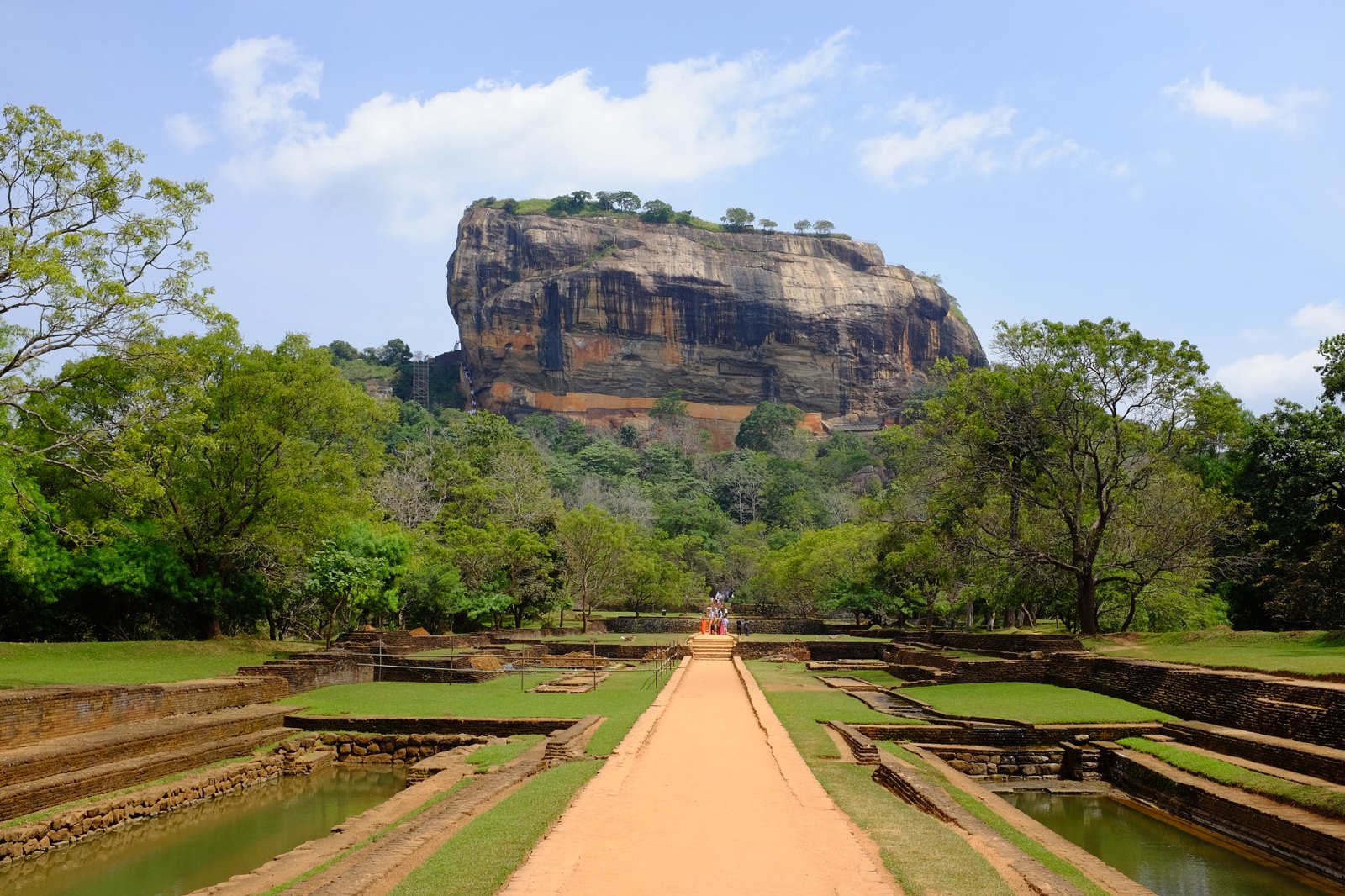
Sigiriya rises above gardens and the remains of a fifth-century royal centre associated with King Kashyapa. Nearby Dambulla is a cave-temple complex with Buddhist paintings and sculptures. Anuradhapura and Polonnaruwa preserve extensive sacred and royal landscapes; they are cities of monuments, not single buildings. Kandy’s Temple of the Tooth forms part of a living sacred city, while the Old Town of Galle and its fortifications reflect Indian Ocean trade and successive colonial periods.
Sri Lanka has eight UNESCO World Heritage properties: six cultural properties and two natural ones, Sinharaja and the Central Highlands. The guide’s sixteen sights also include Jaffna’s Nallur Kandaswamy Temple, Trincomalee’s Koneswaram Temple, the Nine Arch Bridge near Ella and the pilgrimage mountain Sri Pada. A pin marks a representative place, not a guaranteed entrance. Sacred mountains, large archaeological zones and protected forests require different kinds of access and local guidance.
Communities, migration and everyday life
Sinhalese, Tamil, Muslim, Burgher, Malay and Vedda histories intersect across the island.
- Are language, ethnicity and religion the same thing in Sri Lanka?
- No. They overlap in different ways. Many Sri Lankan Muslims speak Tamil, for example, and Christian communities include different linguistic and ethnic backgrounds.
- Who are the Malaiyaha Tamils?
- A community also called Hill Country Tamils, with many ancestors brought from southern India to work on plantations during British rule. Their history is distinct from, though connected with, other Tamil communities.
- Who are the Vedda?
- Indigenous communities of Sri Lanka with their own histories and living cultural traditions. Their contemporary lives cannot be reduced to a single traditional occupation or tourist image.
More about Sri Lanka: people & society
Sri Lanka is home to Sinhalese, Sri Lankan Tamil, Malaiyaha Tamil, Moor, Burgher, Malay, Vedda and other communities. Ethnicity, language and religion overlap without being interchangeable: many Muslims speak Tamil, for example, while Christians come from different linguistic backgrounds. Vedda communities have Indigenous histories and contemporary lives that should not be treated as a vanished past or a visitor attraction. A person’s identity cannot be read reliably from a name or a province.
The tea-growing highlands, northern peninsula, eastern coast, farming settlements and Colombo’s metropolitan region have different social histories. The civil war and overseas migration reshaped families and created substantial diasporas. Plantation workers and their descendants have faced distinct struggles over citizenship, housing, wages and recognition. Education, cricket, music and travel connect communities, while reconciliation requires attention to minority rights, missing people and the experiences of those displaced. The guide uses enduring context rather than undated population percentages.