Facts about Liechtenstein
Liechtenstein climbs from the Rhine valley to Alpine pastures between Switzerland and Austria. Vaduz brings together a castle, parliament and art museums; nearby villages connect factories, vineyards and mountain trails. Locate all eleven municipality centres, discover twelve sights, read ten illustrated topics and begin German.
- Capital
- Vaduz
- Area
- 160 km²
- Municipalities
- 11
- Official language
- German
- Currency
- Swiss franc (CHF)
- Landtag
- 25 seats
Liechtenstein · 0 of 20 rounds passed
Two timed rounds per topic, 20 seconds a question
The Rhine runs along the western frontier with Switzerland, while the eastern mountains meet Austria. Vaduz is the capital, and Schaan immediately to its north is the largest municipality by population. Balzers anchors the south. Triesenberg and Planken sit above the valley, while Eschen, Mauren, Gamprin, Ruggell and Schellenberg form the northern Unterland. The six southern municipalities make up Oberland.
Municipal territories include detached mountain parcels, so the map uses settlement-centre pins rather than municipal boundary polygons. Malbun belongs to Triesenberg and is a mountain resort, not a twelfth municipality. Switzerland and Liechtenstein share a customs area and the Swiss franc; Liechtenstein separately belongs to the European Economic Area and Schengen. These arrangements do not make it part of Switzerland or a member of the European Union.
Geography of Liechtenstein
A Rhine valley and Alpine country with eleven municipalities and two neighbours.
- Why is Liechtenstein doubly landlocked?
- Its two neighbours, Switzerland and Austria, are themselves landlocked. Uzbekistan is the other doubly landlocked country.
- Is Schaan the capital?
- No. Vaduz is the capital; Schaan is the largest municipality by population.
- Do the map pins show municipal borders?
- No. They mark the eleven main settlements. Municipalities can include detached Alpine parcels; Malbun belongs to Triesenberg.
More about Liechtenstein: geography
Liechtenstein covers about 160 square kilometres between Switzerland and Austria. Both neighbours are landlocked, making Liechtenstein doubly landlocked: reaching a coast requires crossing at least two national borders. Uzbekistan is the other country in this category. The Rhine forms much of the western frontier, and Grauspitz reaches 2,599 metres on the southern border with Switzerland. There is no coastline or international airport.
Six municipalities belong to Oberland and five to Unterland, the two electoral districts. Vaduz is the capital, whereas Schaan is the largest municipality by population. Several municipalities have detached Alpine territories, so a simple valley map cannot show every municipal parcel. The eleven pins identify the main settlements. Malbun and Steg are mountain settlements within Triesenberg, rather than additional municipalities.
History of Liechtenstein
Schellenberg and Vaduz became a principality in 1719; Swiss ties developed later.
- When was the principality created?
- In 1719, by uniting Schellenberg and Vaduz. Sovereignty followed in 1806.
- When did the Swiss customs treaty take effect?
- It was signed in 1923 and entered into force in 1924. The Swiss franc became official in 1924.
- When did women gain the national vote?
- In 1984. Liechtenstein joined the United Nations in 1990 and the EEA in 1995.
More about Liechtenstein: history
The Liechtenstein dynasty bought the lordship of Schellenberg in 1699 and the county of Vaduz in 1712. Their status as territories held directly from the emperor mattered to the family’s standing in the Holy Roman Empire. Emperor Charles VI united them as the Principality of Liechtenstein in 1719. Liechtenstein became sovereign in 1806, as the empire came to an end. It later belonged to the German Confederation until that organisation ended in 1866, and abolished its army in 1868.
After the First World War, Liechtenstein turned away from its former close economic relationship with Austria. A customs treaty with Switzerland was signed in 1923 and entered into force in 1924; the Swiss franc became the official currency in 1924. The 1921 constitution remains the basis of government, with later amendments. Women gained the national vote in 1984. Liechtenstein joined the United Nations in 1990 and the European Economic Area in 1995.
Language of Liechtenstein
Standard German in public writing, Alemannic dialects in everyday conversation.
- Which language is official?
- German. Standard German is used in education and public writing, alongside Alemannic dialects in everyday speech.
- What is distinctive about Triesenberg’s speech?
- Its Walser heritage connects it with medieval settlers from the Valais. The linked lessons teach standard German rather than this dialect.
- Where is the University of Liechtenstein?
- In Vaduz. The country also has its own international telephone code, +423.
More about Liechtenstein: language
German is the official language. Standard German is used in education, public documents and much published writing, while local Alemannic dialects are widely spoken in everyday life. Speech varies between villages. Triesenberg has a distinct Walser heritage, linked to settlers from the Valais in the Middle Ages. Alemannic describes a wider dialect family across borders, so treating it as wholly separate from Swiss German creates a misleading choice.
The University of Liechtenstein is in Vaduz, not Schaan. Liechtensteiner Vaterland is a German-language newspaper, and the country has its own international telephone code, +423. The linked lessons teach standard German rather than a local dialect: Guten Tag means good day, danke means thank you and bitte can mean please or you are welcome. Dialect greetings heard locally may differ from these classroom forms.
Culture of Liechtenstein
National Day, village associations, museums and a blue-and-red flag.
- When is National Day?
- 15 August, also the feast of the Assumption.
- What colours are on the flag?
- Blue above red, with a gold crown at the upper hoist. It is not Germany’s black, red and gold flag.
- Are the Princely Collections and Kunstmuseum the same?
- No. The Kunstmuseum is the state museum of modern and contemporary art; the Princely Collections are separate and include important holdings in Vienna.
More about Liechtenstein: culture
National Day falls on 15 August, combining a public celebration with the feast of the Assumption. Brass bands, choirs, voluntary associations and village events contribute to cultural life beyond Vaduz. Triesenberg’s Walser Museum documents settlement, dialect and mountain life. Liechtenstein’s flag has blue above red, with a gold crown in the upper hoist. It should not be confused with Germany’s black, red and gold tricolour.
The National Museum presents cultural and natural history, while the Kunstmuseum focuses on modern and contemporary art. The Princely Collections are a separate collection with important holdings in Vienna; they are not all displayed at Vaduz Castle. Postage stamps and the Postal Museum offer another route into the country’s visual history. Alpine skiing has a strong sporting tradition, alongside football and other club sports.
Economy of Liechtenstein
Export manufacturing and financial services share a small, international economy.
- Is banking the whole economy?
- No. Export manufacturing is also important, including construction technology and dental products.
- Why does Liechtenstein use the Swiss franc?
- It has close monetary and customs arrangements with Switzerland, while remaining a separate sovereign country.
- Does EEA membership mean EU membership?
- No. Liechtenstein participates in the European Economic Area and EFTA but is not an EU member.
More about Liechtenstein: economy
Precision manufacturing, construction technology, dental products and financial services all contribute to Liechtenstein’s economy. Hilti is based in Schaan, while Ivoclar also has its headquarters there. This industrial base matters alongside banking and wealth management. Vineyards, farms and tourism are visible parts of the landscape, but neither tourism nor sales of collectible stamps explain the economy as a whole.
Liechtenstein uses the Swiss franc and shares a customs area with Switzerland. Membership of EFTA and the European Economic Area connects it to the European single market, while it remains outside the EU. Many employees commute from neighbouring countries. They contribute to production without being counted as residents, which makes GDP per resident an imperfect measure of household prosperity. A shared customs area also does not mean residents are exempt from tax.
Politics of Liechtenstein
A hereditary monarchy, elected Landtag and direct-democratic votes share power.
- How many members sit in the Landtag?
- Twenty-five, elected in the Oberland and Unterland electoral districts.
- Who is prince, and who acts as regent?
- Hans-Adam II has been reigning prince since 1989. Hereditary Prince Alois has exercised sovereign functions as regent since 2004.
- Does Schengen remove every border requirement?
- No. Routine internal border checks are normally absent, but travel-document rules and possible temporary controls still apply.
More about Liechtenstein: politics
The constitution describes Liechtenstein as a constitutional hereditary monarchy on a democratic and parliamentary basis. The prince and the people both have roles in the state. The Landtag has twenty-five members, elected from Oberland and Unterland. A five-member government conducts executive business. Referendums and initiatives give voters direct influence; constitutional amendments approved in 2003 also confirmed extensive powers for the prince.
Hans-Adam II became reigning prince in 1989. Hereditary Prince Alois has exercised the sovereign’s day-to-day functions as regent since 2004; these are different roles. Liechtenstein belongs to the UN, Council of Europe, EFTA, EEA and Schengen, but not the EU. Schengen normally removes routine checks at internal borders without removing all travel-document requirements or the possibility of temporary controls. Switzerland undertakes some diplomatic and consular representation by agreement.
Nature & Wildlife of Liechtenstein
Northern wetlands and high Alpine habitats support different kinds of wildlife.
- What is Ruggeller Riet?
- A protected wetland in the north, different from the country’s high Alpine habitats.
- What is foehn?
- A warm, dry downslope wind that can affect the Rhine valley. Mountain and valley conditions can differ strongly.
- Are the mountain paths suitable in any weather?
- No. Routes such as the Fürstensteig have exposed sections and require suitable conditions, equipment and experience.
More about Liechtenstein: nature & wildlife
The Ruggeller Riet in the north preserves a lowland wetland landscape, with meadows, birds and seasonal flowers. Higher slopes support forests, Alpine grasslands and rocky habitats used by animals such as chamois and marmots. Forest composition changes with altitude and exposure: broadleaf trees grow at lower elevations, while spruce and other conifers become prominent higher up. No single tree list describes the entire country.
Elevation creates strong differences between the Rhine valley and mountain weather. Foehn winds can bring warm, dry conditions, and winter snow supports skiing around Malbun. Mountain trails such as the Fürstensteig cross exposed terrain and require suitable conditions and experience. The Rhine has been engineered for flood protection; the present river corridor is not an untouched floodplain. Reserve boundaries, protected forests and Alpine habitats are different categories and should not be combined into an unsupported national percentage.
Food & Cuisine of Liechtenstein
Cheese-covered Käsknöpfle, Ribel and vineyards connect the country with its neighbours.
- What are Käsknöpfle?
- Small flour-and-egg dumplings served with cheese and often fried onions, part of a wider Alpine cooking tradition.
- What is Ribel?
- A traditional maize-based dish commonly served with apple sauce or fruit preserves.
- Is all princely winery wine grown in Liechtenstein?
- No. Its Herawingert vineyard is in Vaduz, but the winery also operates in Austria.
More about Liechtenstein: food & cuisine
Käsknöpfle are small flour-and-egg dumplings served with cheese and often fried onions. They belong to a broader Alpine family of dishes also found in Austria and Switzerland; recipes and accompaniments vary. Ribel is a traditional maize-based dish, commonly eaten with fruit preserves or apple sauce. Dairy foods, potatoes, bread and soups connect local cooking with the surrounding Rhine valley and mountain regions.
Vineyards grow on sheltered slopes near Vaduz, where the Hofkellerei des Fürsten von Liechtenstein has its Herawingert vineyard. The princely winery also operates in Austria, so not every bottle associated with it comes from Liechtenstein. Fruit brandies and local beer add to the drinks made in the country. A restaurant menu may draw on several neighbouring cuisines rather than a fixed list of exclusively national dishes.
Landmarks of Liechtenstein
Vaduz and Gutenberg castles, small museums and mountain paths reveal different histories.
- Can visitors normally enter Vaduz Castle?
- The interiors are not generally open because it remains a princely residence. Check official visitor information for current arrangements.
- Where is Gutenberg Castle?
- On a hill in Balzers, at the southern end of the country. It is separate from Vaduz Castle.
- Is the Via Alpina an ancient route?
- It is a modern international hiking network. Calling it an ancient footpath is misleading.
More about Liechtenstein: landmarks
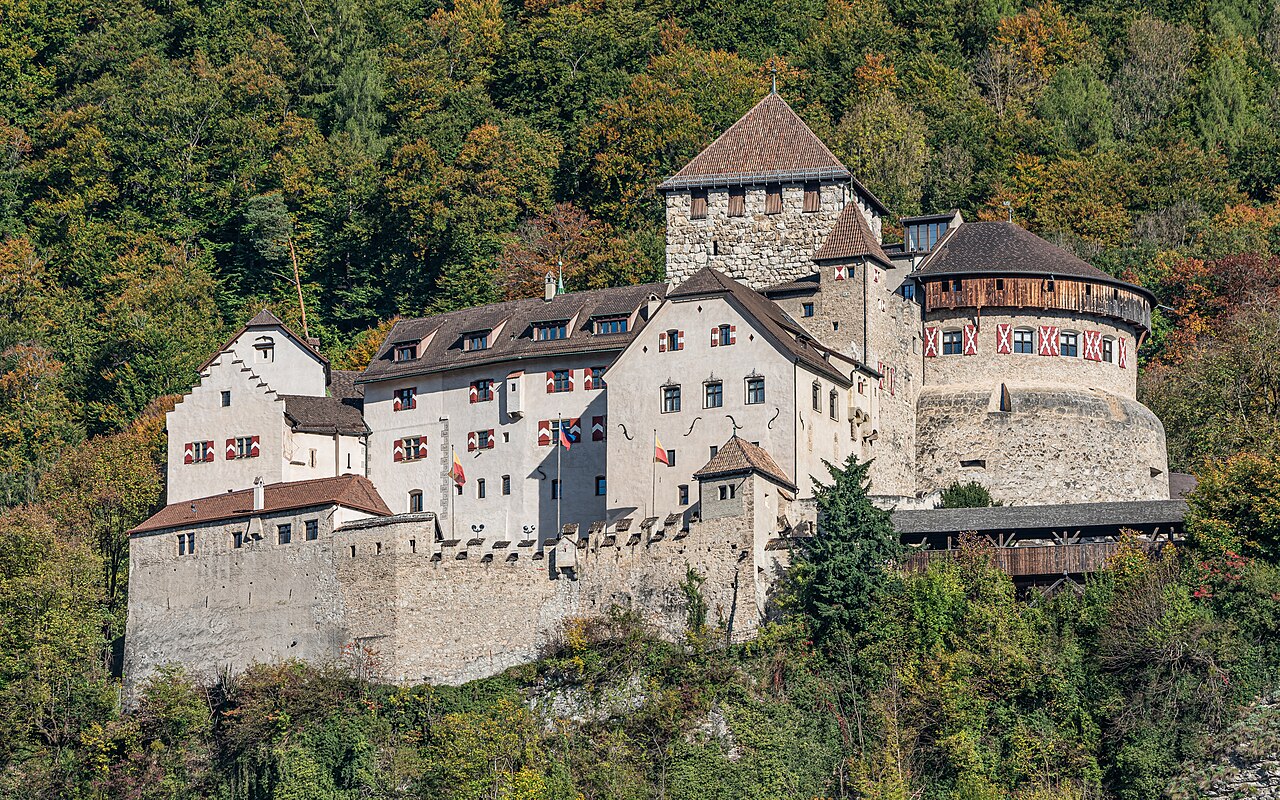
Vaduz Castle stands on the hillside above the capital and remains a princely residence; its interiors are not generally open to visitors. Gutenberg Castle occupies a separate hill in Balzers, far to the south. In central Vaduz, the cathedral, government quarter, Landtag and National Museum lie close together. The black exterior of the Kunstmuseum marks another distinct institution, dedicated to modern and contemporary art.
The wooden Old Rhine Bridge links Vaduz with Sevelen in Switzerland. Schellenberg’s castle ruins recall the northern lordship that helped form the principality. Triesenberg opens onto mountain routes towards Gaflei, Steg and Malbun. The Via Alpina is a modern international hiking network, not an ancient road. Sight pins mark learning locations, including viewpoints and large natural areas; they are not entrances or a promise of unrestricted access.
People & Society of Liechtenstein
Residents, citizens and cross-border commuters describe different communities.
- Are residents and citizens the same group?
- No. Citizenship, residence and employment are different statuses; many workers live outside Liechtenstein.
- Who was Josef Gabriel Rheinberger?
- A Vaduz-born composer and organist who worked largely in Munich, known especially for organ and choral music.
- What did Hanni Wenzel win in 1980?
- Two Alpine skiing gold medals at the Lake Placid Winter Olympics.
More about Liechtenstein: people & society
Liechtenstein has a small resident population with people of many nationalities. Residence, citizenship and a job in the country are different legal and statistical categories. Cross-border workers are central to everyday economic life, while municipal associations and local traditions remain important in a country with only eleven municipalities. Roman Catholicism has a strong historical presence, alongside other religious communities and people with no religious affiliation.
Vaduz-born composer Josef Gabriel Rheinberger spent much of his working life in Munich and is especially associated with organ and choral music. Hanni Wenzel won two Alpine skiing gold medals at the 1980 Winter Olympics; her brother Andreas and daughter Tina Weirather also became prominent skiers. The ruling family takes its name from Liechtenstein Castle in present-day Austria, rather than the Alpine territory it later acquired.