Facts about Jordan
Discover Jordan from Amman’s hillside neighbourhoods and the stone streets of As-Salt to Petra, Wadi Rum and the reefs of Aqaba. Follow the Jordan Valley, explore Roman cities and mosaic churches, and learn about the languages, food and communities that connect these places.
- Capital
- Amman
- Currency
- Jordanian dinar (JOD)
- Official language
- Arabic
- Governorates
- 12
- Sea access
- Gulf of Aqaba, Red Sea
- UNESCO World Heritage
- 8 properties (2026)
Jordan · 0 of 20 rounds passed
Two timed rounds per topic, 20 seconds a question
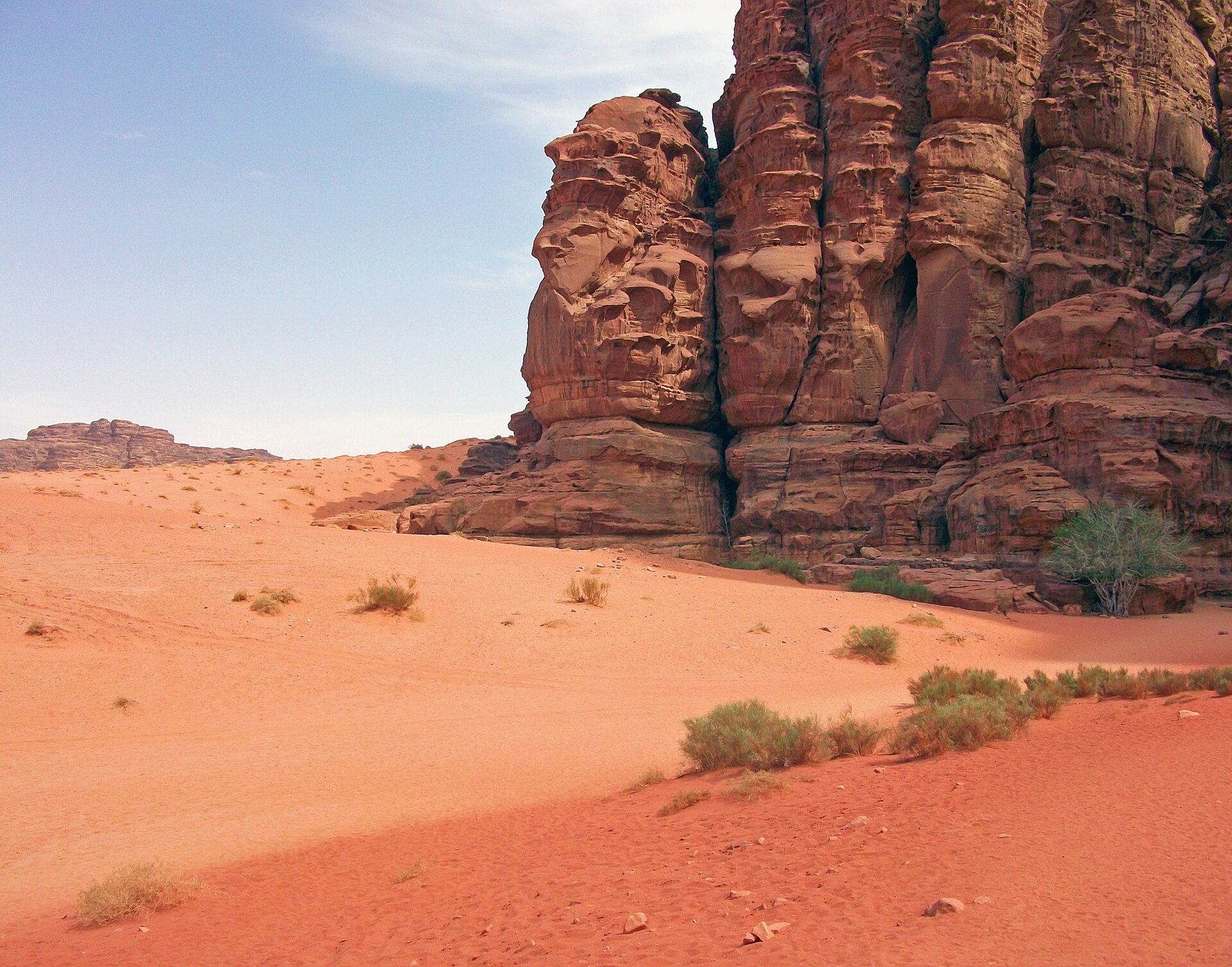
Jordan’s best-known landscapes sit along a striking change in elevation. The Jordan Valley and Dead Sea lie below sea level, while roads climb into the western highlands around Amman, Madaba, Karak and Dana. Farther south, Petra’s sandstone gorges lead towards Wadi Rum’s open desert and the short Red Sea coast at Aqaba. The much larger eastern Badia contains desert settlements, basalt landscapes and historic routes towards Syria, Iraq and Saudi Arabia.
A country guide needs room for both monuments and everyday places. Jerash preserves streets and temples from a Roman city; As-Salt tells a later story through yellow limestone houses, shops and shared public spaces. Madaba’s mosaics and the Baptism Site connect with living Christian traditions. Coffee, mansaf, markets and family gatherings give another way into the country. Check current official advice and local conditions before planning visits, especially canyon walks and desert journeys.
Geography of Jordan
A low river valley, western highlands and a vast eastern desert meet a short Red Sea coast.
- Is the Dead Sea connected to the ocean?
- No. It is a very salty inland lake with no outlet. Jordan’s sea access is through Aqaba on the Gulf of Aqaba, an arm of the Red Sea.
- Is all of Jordan desert?
- No. Desert covers much of the country, but Jordan also has western highlands, northern woodlands, a low river valley and a short marine coast.
- What makes the Dead Sea shore unusual?
- It is the lowest exposed land on Earth. Falling lake levels change its elevation and shoreline, so precise measurements need a reference date.
More about Jordan: geography
Jordan lies in Southwest Asia, bordering Syria, Iraq, Saudi Arabia, Israel and the Palestinian territory of the West Bank. The Jordan River forms part of its western boundary and flows into the Dead Sea, a very salty inland lake with no outlet to the ocean. The Dead Sea shore is the lowest exposed land on Earth. Its elevation and shoreline change as water levels fall, so a precise depth needs a date.
The western highlands contain Amman and many other major settlements. Valleys descend towards the Jordan Rift Valley, while the arid Badia extends across the east. In the south, Wadi Rum’s sandstone and granite mountains contrast with Aqaba’s coast. Aqaba opens onto the Gulf of Aqaba, an arm of the Red Sea and Jordan’s only sea access. The three waters in this guide introduce a river, an inland lake and a gulf; they are a selection rather than a complete inventory.
History of Jordan
Nabataean trade, Roman cities and early Islamic art precede the modern Hashemite kingdom.
- Who developed Petra as a major trading city?
- The Nabataeans. Its importance rested on trade routes and water engineering as well as its rock-cut architecture.
- What was the Decapolis?
- A name for a group of cities associated with Greek and Roman culture in the region. Jerash and Philadelphia, now Amman, were among them.
- When is Jordan’s independence commemorated?
- On 25 May 1946. The Emirate of Transjordan had been established in 1921 under Abdullah within the British mandate framework.
More about Jordan: history
The lands of present-day Jordan have histories that long predate the modern state. Ammon, Moab and Edom were ancient kingdoms in different parts of the region. Petra became a major Nabataean centre, combining caravan trade with sophisticated water collection and storage. Rome annexed the Nabataean kingdom in 106 CE. Jerash and ancient Philadelphia, now Amman, belonged to the group of cities known as the Decapolis; that name does not describe a modern province or a single surviving city.
Byzantine churches left important mosaics at Madaba and Um er-Rasas. Early Islamic patrons created buildings such as Quseir Amra, whose wall paintings survive in a small bath complex. Later periods brought Crusader, Ayyubid, Mamluk and Ottoman rule in different places. The Emirate of Transjordan was established in 1921 under Abdullah, within the British mandate framework. Independence is commemorated on 25 May 1946. The modern kingdom’s development has been shaped by regional wars, migration and its Hashemite monarchy.
Arabic and the languages of Jordan
Arabic has formal and everyday varieties, alongside English and community languages.
- What is Jordan’s official language?
- Arabic. Modern Standard Arabic is used formally, while everyday speech includes Jordanian, Palestinian and Bedouin varieties.
- What variety do the linked Arabic lessons teach?
- Modern Standard Arabic. They are an introduction to formal Arabic, rather than a dedicated Jordanian dialect course.
- Is English an official language?
- No. It is widely used in tourism, business and parts of education, but Arabic is the official language.
More about Jordan: language
Arabic is Jordan’s official language. Modern Standard Arabic is used in formal writing, education and news, while everyday speech includes Jordanian and Palestinian varieties within the wider Levantine Arabic continuum. Bedouin varieties also have their own histories and features. A speaker may change register with the situation, so formal Arabic and daily conversation should not be treated as identical. Arabic is written from right to left.
English is widely used in tourism, business and parts of education, but it is not an official language. Circassian, Chechen and Armenian communities maintain additional linguistic traditions, with different levels of use across generations. Place names have several accepted Latin spellings: Salt and As-Salt, Karak and Kerak, or Jerash and Jarash can refer to the same place. Worldly’s linked Arabic lessons introduce Modern Standard Arabic rather than a dedicated course in Jordanian spoken Arabic.
Culture of Jordan
Coffee, oral traditions, dabke and shared urban spaces reveal different forms of hospitality.
- What is dabke?
- A group dance associated with weddings and celebrations across the Levant, including Jordan.
- Why does coffee appear in descriptions of hospitality?
- Offering Arabic coffee, often flavoured with cardamom, is a familiar way to welcome guests. Practices differ between households and occasions.
- What cultural space does UNESCO recognise around Petra and Wadi Rum?
- The cultural space of the Bedu, including oral traditions, knowledge of the landscape and other living practices.
More about Jordan: culture
Hospitality can take many forms, from coffee offered to a visitor to a large family meal. Arabic coffee is commonly flavoured with cardamom, while tea is another familiar drink. Bedouin oral poetry, storytelling and knowledge of desert places belong to living traditions, rather than only to performances for visitors. UNESCO recognises the cultural space of the Bedu in Petra and Wadi Rum. Practices differ between communities, households and occasions.
Dabke is a group dance associated with weddings and celebrations across the Levant. Music can include the oud and other instruments, alongside contemporary popular styles. Madaba is known for mosaic making, where ancient works have helped sustain modern craft and training. As-Salt’s World Heritage inscription draws attention to hospitality and the relationships between its Muslim and Christian residents. Cities, villages and mobile pastoral histories all contribute to Jordanian cultural life.
Economy of Jordan
Aqaba’s trade, services and mineral exports operate within tight water and energy constraints.
- What is Jordan’s currency?
- The Jordanian dinar, abbreviated JOD.
- Which city is Jordan’s seaport?
- Aqaba, on the Gulf of Aqaba at the northern end of the Red Sea.
- Why is water scarcity an economic issue?
- Households, farming and industry all need reliable supplies. Scarcity, leakage and climate pressures affect services, costs and livelihoods.
More about Jordan: economy
Jordan’s economy includes services, manufacturing, mining and agriculture. Tourism connects guides, accommodation, transport and crafts with heritage sites and natural landscapes. Phosphate and potash are important mineral products, with potash processing linked to Dead Sea brines. Aqaba is the country’s seaport, handling trade through the Red Sea. The national currency is the Jordanian dinar, abbreviated JOD; exchange rates and visitor prices should be checked when needed.
Water scarcity is a central constraint on households, farming and economic development. Jordan also depends heavily on imported energy, although renewable generation has expanded. The World Bank identifies employment, investment and reliable public services as continuing development challenges. Regional conflict can disrupt trade, flights and tourism, while hosting displaced people increases demand for services. These pressures have several causes and should not be reduced to a single community or a single industry.
Politics of Jordan
A hereditary monarchy, a two-chamber parliament and twelve governorates organise the state.
- What kind of political system does Jordan have?
- A hereditary constitutional monarchy. The king is head of state and appoints the prime minister.
- Are both chambers of parliament elected?
- No. The House of Representatives is elected, while the king appoints the Senate.
- How many governorates does Jordan have?
- Twelve. A governorate can share its name with a city while covering a much larger area.
More about Jordan: politics
Jordan is a hereditary constitutional monarchy. The king is head of state and holds substantial powers, including appointing the prime minister. The National Assembly has two chambers: an elected House of Representatives and a Senate whose members are appointed by the king. The cabinet directs government administration within this constitutional framework. Understanding those powers is more useful than assuming that every constitutional monarchy operates in the same way.
The country is divided into twelve governorates, each containing smaller administrative units. Amman is both the capital city and the name of a governorate extending well beyond the urban centre. Jordan signed a peace treaty with Israel in 1994 and has long-standing diplomatic relationships across the region and beyond. Jerusalem’s holy sites and the Palestinian question remain important in Jordanian public life and diplomacy. Administrative learning maps do not settle international boundary questions or describe present travel conditions.
Nature & Wildlife of Jordan
Highland woodlands, desert wetlands and coral reefs make Jordan more than a desert landscape.
- What habitats does Aqaba Marine Reserve protect?
- Coral reefs, seagrass and other marine habitats in the Gulf of Aqaba. It became a UNESCO World Heritage property in 2026.
- Why is Azraq’s wetland under pressure?
- Groundwater depletion has greatly reduced the original oasis. Conservation work relies on managed water supplies.
- Can a canyon route be assumed open all year?
- No. Weather, flash-flood risk, season and local operating decisions affect access, including at Wadi Mujib.
More about Jordan: nature & wildlife
Jordan’s habitats range from northern woodlands and Dana’s mountain valleys to eastern desert and the Gulf of Aqaba’s coral reefs. Dana Biosphere Reserve spans a steep change in elevation and several ecological zones. Azraq is a desert wetland important for birds, but groundwater depletion has severely reduced the original oasis. Conservation work there depends on managed water supplies; a historic wetland photograph is not evidence of today’s water coverage.
The Royal Society for the Conservation of Nature manages several reserves and conservation programmes, including work with Arabian oryx at Shaumari. Aqaba Marine Reserve protects coral, seagrass and associated marine life and joined the UNESCO World Heritage List in 2026. It has a different management framework under the Aqaba Special Economic Zone Authority. Heat resilience does not make reefs immune to pollution or physical damage. Canyon access, including at Wadi Mujib, depends on weather, season and local operating decisions.
Food & Cuisine of Jordan
Mansaf and jameed sit alongside shared Levantine dishes and desert cooking traditions.
- What is mansaf?
- A festive meal of meat in a yoghurt-based sauce, served with rice or sometimes bulgur over thin bread. Its social traditions are recognised by UNESCO.
- What is jameed?
- Dried fermented yoghurt used to prepare the sauce for many versions of mansaf.
- How are maqluba and zarb different?
- Maqluba is cooked in a pot that is turned over for serving. Zarb uses an underground oven and is associated with Bedouin desert hospitality.
More about Jordan: food & cuisine
Mansaf is closely associated with Jordanian hospitality and celebration. Meat is cooked in a yoghurt-based sauce and served with rice or sometimes bulgur over thin bread. Jameed, dried fermented yoghurt, is an important ingredient in many versions. UNESCO recognises mansaf’s preparation and social meanings as intangible cultural heritage. Recipes, serving arrangements and the way people eat it vary; a ceremonial description is not a rule for every meal.
Maqluba combines rice, vegetables and often meat in a pot turned over for serving. Zarb cooks food in an underground oven and is associated with Bedouin desert hospitality. Falafel, hummus, flatbread, olive oil and za’atar connect Jordan with wider Levantine food traditions. Knafeh is a familiar syrup-soaked sweet, often made with cheese. Palestinian family traditions and other regional connections shape the food of modern Jordan, alongside the ingredients and practices of different local communities.
Landmarks of Jordan
Petra is one part of a heritage landscape that also includes mosaics, basalt towns and living cities.
- How many UNESCO World Heritage properties does Jordan have?
- Eight as of 2026, including Aqaba Marine Reserve, inscribed that year. Older lists with seven predate that addition.
- Is Petra’s Treasury an ancient bank?
- No. The Treasury is a familiar modern name for a rock-cut monument generally interpreted as a tomb.
- Is Jerash an inscribed World Heritage property?
- No. It is on Jordan’s Tentative List, which is a different status from inscription on the World Heritage List.
More about Jordan: landmarks
UNESCO lists eight World Heritage properties in Jordan in 2026: Petra, Quseir Amra, Um er-Rasas, Wadi Rum, the Baptism Site at Al-Maghtas, As-Salt, Umm al-Jimal and Aqaba Marine Reserve. The last joined the list in 2026. The list includes cultural, natural and mixed heritage. Jerash is a major archaeological site but remains on the Tentative List; that status is different from inscription on the World Heritage List.
Petra’s Treasury is a monumental rock-cut façade generally interpreted as a tomb, despite its familiar modern name. Petra was an extensive city with water systems, temples and many other buildings. Quseir Amra is known for early Islamic paintings, Um er-Rasas for church mosaics and Umm al-Jimal for basalt architecture. Mount Nebo is associated with the biblical tradition of Moses viewing the Promised Land. Religious tradition, archaeological evidence and a modern visitor name describe different kinds of connection to a place.
People & Society of Jordan
Urban neighbourhoods, village ties and histories of migration shape overlapping identities.
- Is Amman the same as Amman Governorate?
- No. Amman is the capital city, while its governorate also includes extensive territory outside the urban area.
- Does one background describe everyone in Jordan?
- No. People have overlapping national, family, regional and community identities, with East Bank, Palestinian, Circassian, Chechen, Armenian and other connections.
- Are resident population and refugee registration totals interchangeable?
- No. They count different populations, and neither is automatically the same as the number of Jordanian citizens.
More about Jordan: people & society
Most people in Jordan live in urban areas, with Amman the largest city and a major centre of work and education. Family connections also reach villages, farming districts and desert communities. East Bank and Palestinian family histories overlap with national belonging in many ways. Circassian, Chechen and Armenian communities are also part of the country’s history. An ethnic background, a language and a citizenship status are different things and should not be used interchangeably.
Most Jordanians are Muslim, while Christian communities maintain churches, schools and long local histories. Jordan has received successive groups of displaced people, including Palestinians, Iraqis and Syrians, as well as workers from other countries. Refugee registration totals, resident population and the number of citizens measure different populations. Students, artists, craftspeople and business owners contribute to changing public life, while communities abroad maintain family and professional connections with Jordan.