The Italy course
Facts about Italy, for your next trip
Explore ten topics about Italy and put what you learn into practice. Play the facts rounds on this page, then continue with another topic.
Capital Rome · Europe · 10 topics · 20 rounds · 80 questions · 20 seconds each
Italy is a long peninsula in southern Europe that has shaped Western law, religion, art and food more than almost any other country of its size. It was assembled into a single state only in 1861, which is why regional identity still runs deeper here than national identity for many Italians.
Italy is a republic of 20 regions, five of which hold special autonomy for linguistic or island reasons, and regional identity still runs deeper than national identity for many Italians in a state assembled only in 1861. The peninsula stretches about 1,200 kilometers from the Alps into the central Mediterranean, with the Apennines running its length like a spine and leaving little flat ground apart from the Po Valley in the north, which holds most of the farmland and heavy industry. Sicily and Sardinia are the two large offshore islands, and the country carries Europe’s only active mainland volcanoes.
Rome is the capital and holds the ancient city along with Vatican City inside it, while Milan is the financial and fashion center and Turin the historic car industry. Florence and Venice carry the Renaissance and the maritime republic respectively, Naples anchors the south beneath Vesuvius, and Palermo governs Sicily. Italy is among the most visited countries in the world, and most trips string together some combination of Rome, Florence and Venice, then branch out to the Amalfi coast, Tuscany or the lakes.
- Population
- 59 million
- Area
- 301,340 km²
- Currency
- Euro (€)
- Official language
- Italian
- Regions
- 20, five with special autonomy
- Highest point
- Mont Blanc, 4,806 m
Italy · Geography
Geography of Italy
The Alps close off the north, while the Apennines run down the peninsula. Between them, the broad Po Valley holds much of the northern farmland. Sicily and Sardinia extend the country far beyond the familiar outline of the boot.
Commonly asked
- What are the two main mountain ranges in Italy?
- The Alps form the northern arc. The Apennines run along the peninsula, dividing much of its eastern and western sides.
- What are the largest Italian islands?
- Sicily is the largest, just beyond the toe of the mainland. Sardinia lies farther west, immediately south of the French island of Corsica.
Italy · History
History of Italy
Ancient Rome left its language and law across Europe, but a unified Italian state came much later. Explore the city-states of the Renaissance and the movement that brought most of the peninsula together in 1861.
Commonly asked
- When did Italy become a unified country?
- The Kingdom of Italy was proclaimed in 1861. Unification continued afterward, with Rome incorporated in 1870 and becoming the capital in 1871.
- When did Italy become a republic?
- A referendum in June 1946 replaced the monarchy with a republic. The republican constitution came into force in 1948.
Italy · Language
The Italian language
Standard Italian developed from the Tuscan literary tradition. Alongside it, regional languages preserve the histories of places that spent centuries under different rulers. Learn how that background still shapes the words people use.
Commonly asked
- What language family does Italian belong to?
- Italian is a Romance language, descended from Latin. It is related to languages such as French and Spanish.
- Why is Tuscany important to the Italian language?
- Writers including Dante used the Tuscan vernacular in influential works. That literary tradition helped it become the basis of standard Italian.
Italy · Culture
Culture of Italy
A local festival can tell you as much about a town as its museum. Explore the art and music that travelled far beyond Italy, alongside the regional traditions that still give each place its own identity.
Commonly asked
- What was the Italian Renaissance?
- It was a period of renewed interest in classical learning and artistic experimentation. Cities such as Florence became important centres of painting and architecture.
- Where did opera begin?
- Opera developed in Italy around the end of the sixteenth century, with early experiments in Florence combining music and drama.
Italy · Economy
Economy of Italy
Italy makes far more than the fashion and food it exports around the world. Regional industrial districts specialise in machinery and manufactured goods, often through networks of smaller firms. Tourism connects another part of the economy to its historic cities and coast.
Commonly asked
- What currency does Italy use?
- Italy uses the euro. Euro banknotes and coins entered circulation in 2002, replacing the lira.
- What is an Italian industrial district?
- It is a local concentration of firms working in related activities. Specialised suppliers and manufacturers can share skills and support the same production chain.
Italy · Politics
How Italy is governed
Italy is a parliamentary republic with a president as head of state and a prime minister leading the government. Its twenty regions connect national politics to local decisions, with five holding special autonomous status.
Commonly asked
- What are the two houses of Italy’s Parliament?
- The Chamber of Deputies and the Senate of the Republic. The government must maintain the confidence of both houses.
- How many regions does Italy have?
- Italy has twenty regions. Five have special autonomous status, reflecting particular historical or geographical circumstances.
Italy · Nature & Wildlife
Nature and wildlife of Italy
Alpine habitats give way to Apennine forests as you move south, then to Mediterranean scrub and volcanic landscapes. Explore how this range of environments supports wildlife, from mountain ibex to wolves in the peninsula’s interior.
Commonly asked
- Where is Mount Etna?
- Etna is on the eastern side of Sicily, near Catania. It is an active volcano whose eruptions have repeatedly shaped the surrounding landscape.
- Where do Alpine ibex live?
- Alpine ibex live in the mountains of the Alps. Their strong hooves help them move across steep rocky slopes.
Italy · Food & Cuisine
Food and cooking in Italy
Italian cooking changes from one region to the next. Rice and butter are common in parts of the north, while olive oil and durum-wheat pasta are closely associated with the south. Explore the local origins behind dishes you may already know.
Commonly asked
- Which Italian city is closely associated with pizza?
- Naples is the home of the Neapolitan pizza tradition. Its style of dough and wood-fired baking became influential far beyond the city.
- Is risotto a type of pasta?
- No. Risotto is a rice dish, closely associated with northern Italy. Stock is added during cooking to create its characteristic creamy texture.
Italy · Landmarks
Landmarks of Italy
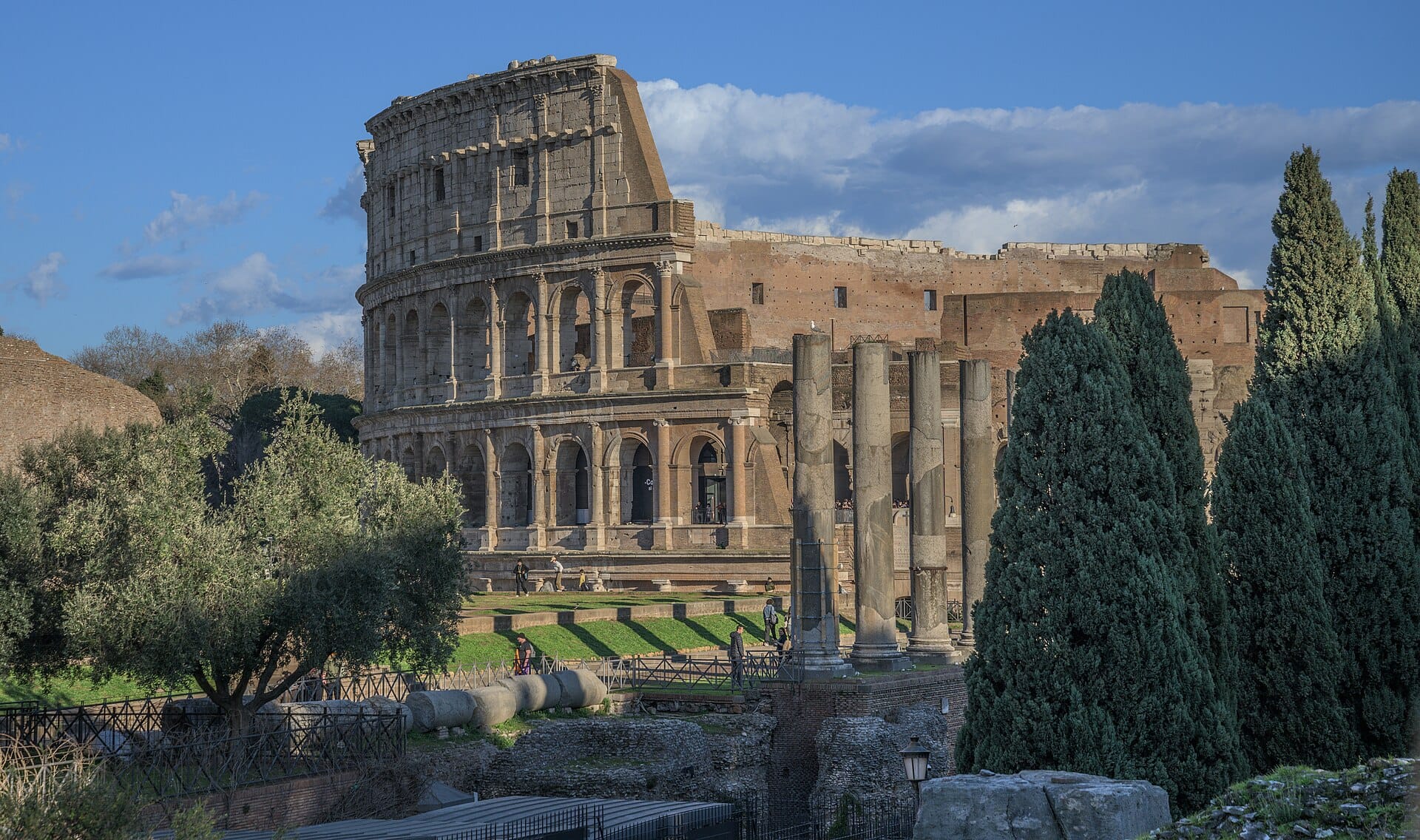
Rome’s ancient buildings and Florence’s cathedral tell different chapters of the same country’s history. Explore the places behind the familiar photographs and learn what each was built to do.
Commonly asked
- What was the Colosseum used for?
- The Colosseum was an ancient Roman amphitheatre used for public spectacles, including gladiatorial contests.
- What is the Leaning Tower of Pisa?
- It is the bell tower of Pisa Cathedral. Uneven settlement in the ground caused it to lean during construction.
Italy · People & Society
People and society in Italy
Italian identity reaches well beyond the country’s borders through generations of emigration. Within Italy, regional ties and local languages remain part of everyday life. Explore how these histories connect with the country people live in today.
Commonly asked
- Why are there large Italian communities outside Italy?
- Large waves of emigration in the nineteenth and twentieth centuries took Italians to the Americas and other parts of the world. Their descendants maintain many connections to that heritage.
- Are regional identities important in Italy?
- Yes. The country was unified relatively recently compared with the long histories of its cities and regions. Local traditions and speech continue to reflect those histories.